Book List · Coffee Table Books · Gift Guide
A coffee table book has one job: to be opened by someone who did not plan to open it. These thirty do that job, and then they teach you something.
From a jellyfish drawn in 1904 to the Earth seen from orbit, from Leonardo’s polyhedra to Tesla’s patents
Tap a cover to open the book. Scroll the shelf sideways for all thirty.
30
books, every one we would put on our own table
4
rooms: the planet, geometry, design and science heirlooms
1509
the oldest, with drawings by Leonardo da Vinci
15
of them reviewed in full on Abakcus
Most lists of the best coffee table books are lists of the biggest ones: fashion monographs, travel photography, a famous architect’s collected works. They look expensive and get opened once. The books below were picked by a different rule. Each one has to work in the three seconds a guest gives it, standing by the sofa with a cup in hand, and then keep working for the hour after they sit down.
That rule pulls the list toward science, mathematics and design, because those are the subjects where a picture is also an argument. A plate of Haeckel’s radiolarians is beautiful, but it is also a claim about how life is built. A page of Byrne’s Euclid is a Mondrian, and it is also a proof. Every book here is like that: you come for the image and you leave with the idea.
The thirty are grouped into four rooms. The first opens onto the living planet, the second onto geometry you could frame, the third onto design you can hold, and the last onto a handful of scientific classics printed as objects worth inheriting. If you are shopping for someone, use the gift finder below. If the list leaves you wanting more, the 68 best geometry books and our gift guide for nerds pick up where this one stops.
The coffee table test
Open it anywhere
Any page, picked at random, has to do something to you in three seconds.
Survive the handling
Big, sewn, heavy paper. These books will be opened by people holding coffee.
Teach while it shows
Every picture has to come with an idea. Pretty alone is a calendar.
Look good shut
The cover is the first thing a guest reads. It should start the conversation.
Gift finder · Who is it for?
Jellyfish, trees, storms and Earth from orbit.
Room I · Books 1–7
Books that turn a table into a window: the sea floor, the sky at cruising altitude, a forest drawn to scale, and the colour of a robin's egg named before photography.
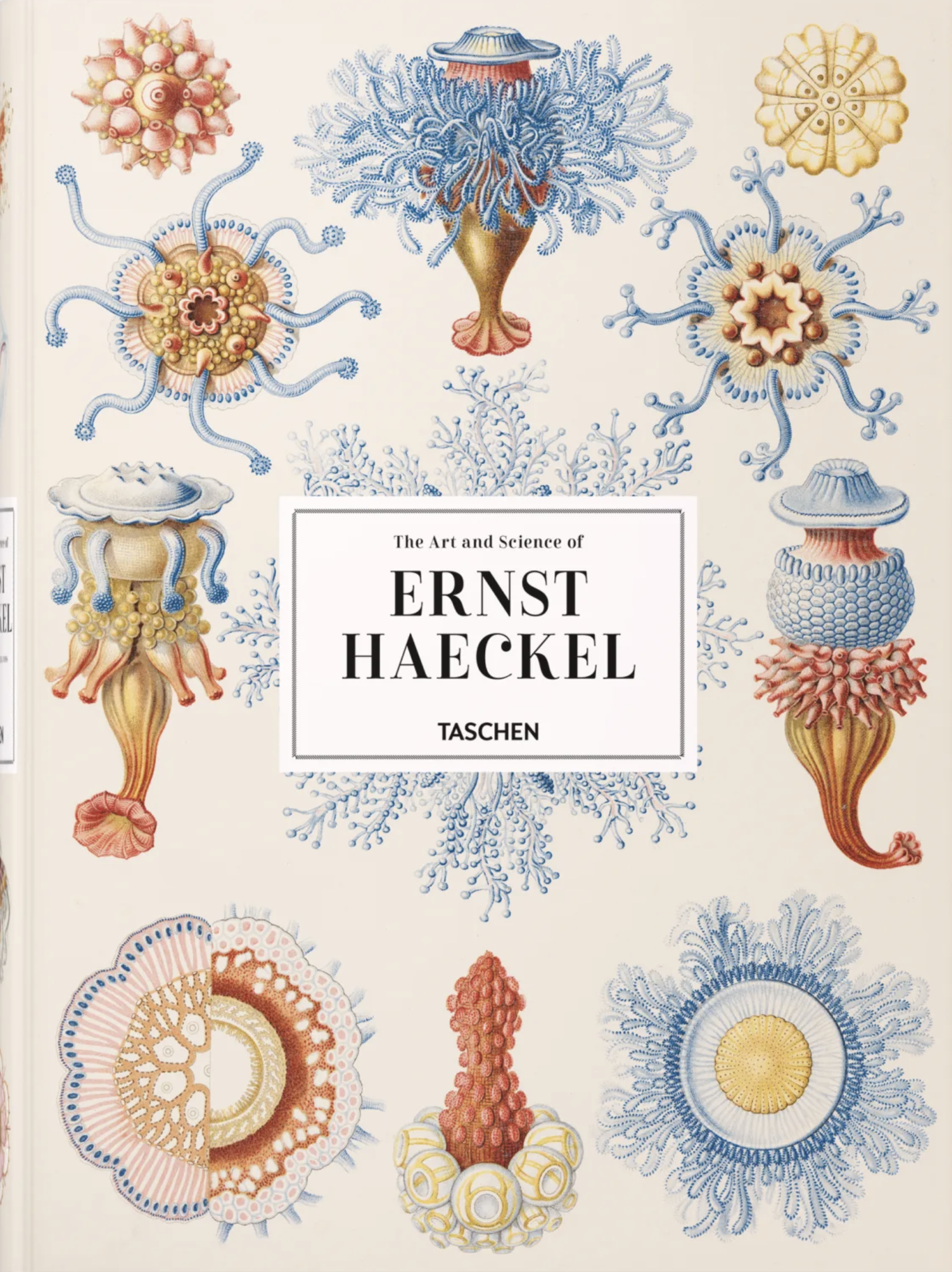
No. 01 · TASCHEN · 2017 · 704 pages
Rainer Willmann & Julia Voss
The heaviest argument ever printed that nature is a designer.
Ernst Haeckel was a zoologist who drew like an illuminator. His radiolarians, single-celled sea creatures with glass skeletons, look like chandeliers; his jellyfish look like ballgowns. When his plates were collected as Art Forms in Nature at the turn of the twentieth century, designers took them straight into Art Nouveau, and the main gate of the 1900 Paris Exposition was modelled on one of his radiolarians.
TASCHEN’s edition gathers more than 450 of his lithographs, watercolours and drawings in 704 pages, at a size that lets the plates breathe. It is the book on this list most likely to be opened by a child and a biologist at the same time, and neither will be disappointed. If you buy only one book from this page, buy this one.
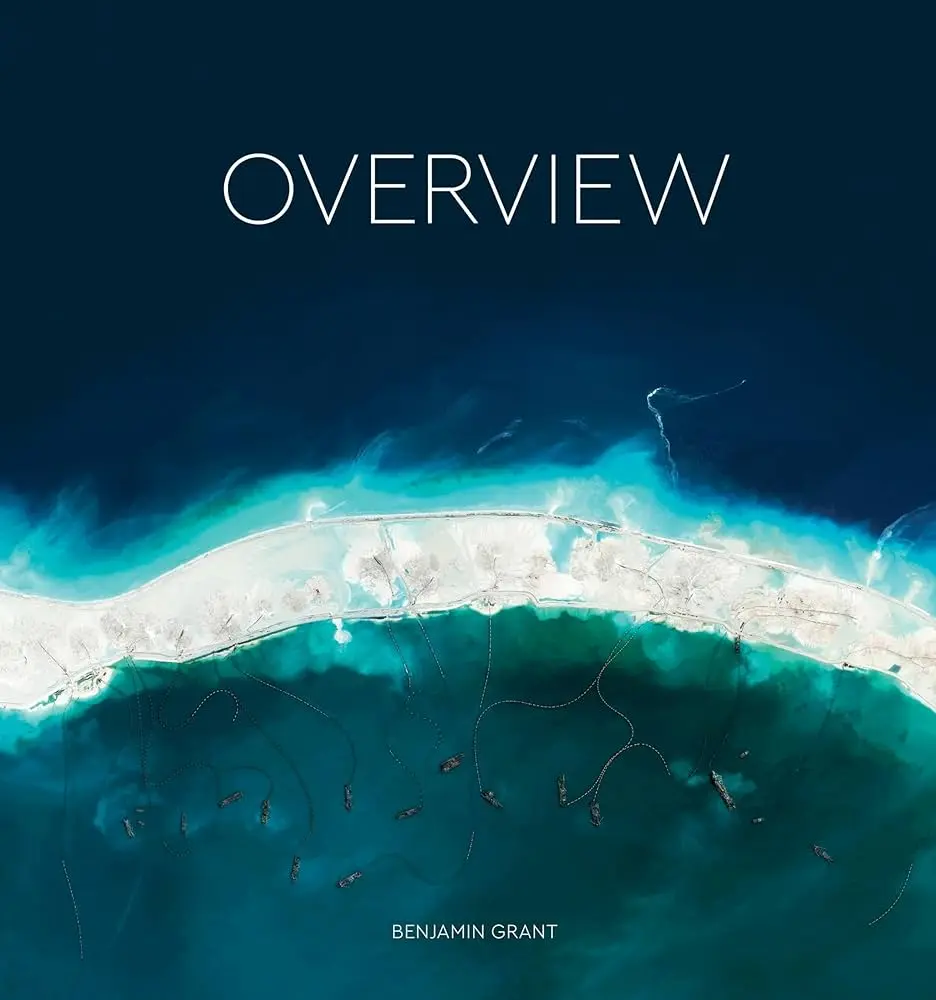
No. 02 · Ten Speed Press · 2016 · 200+ satellite images
Benjamin Grant
Beauty first, then the caption tells you what you are looking at.
Benjamin Grant started posting one satellite image a day in 2013, and the book that grew out of it holds more than 200 of them. Tulip fields in the Netherlands become stripes of pure colour, irrigation circles in the desert become polka dots, an evaporation pond becomes a Rothko. You turn the page because each one is gorgeous.
Then you read the caption. The pretty turquoise is a mine’s tailings pond; the neat grid is a suburb swallowing a desert. The title borrows from the overview effect, the shift astronauts describe after seeing the whole planet at once, and the book delivers a small dose of it to anyone who sits on your sofa. It is the most quietly political book on this list. If you like this scale of thinking, watch Powers of Ten next.
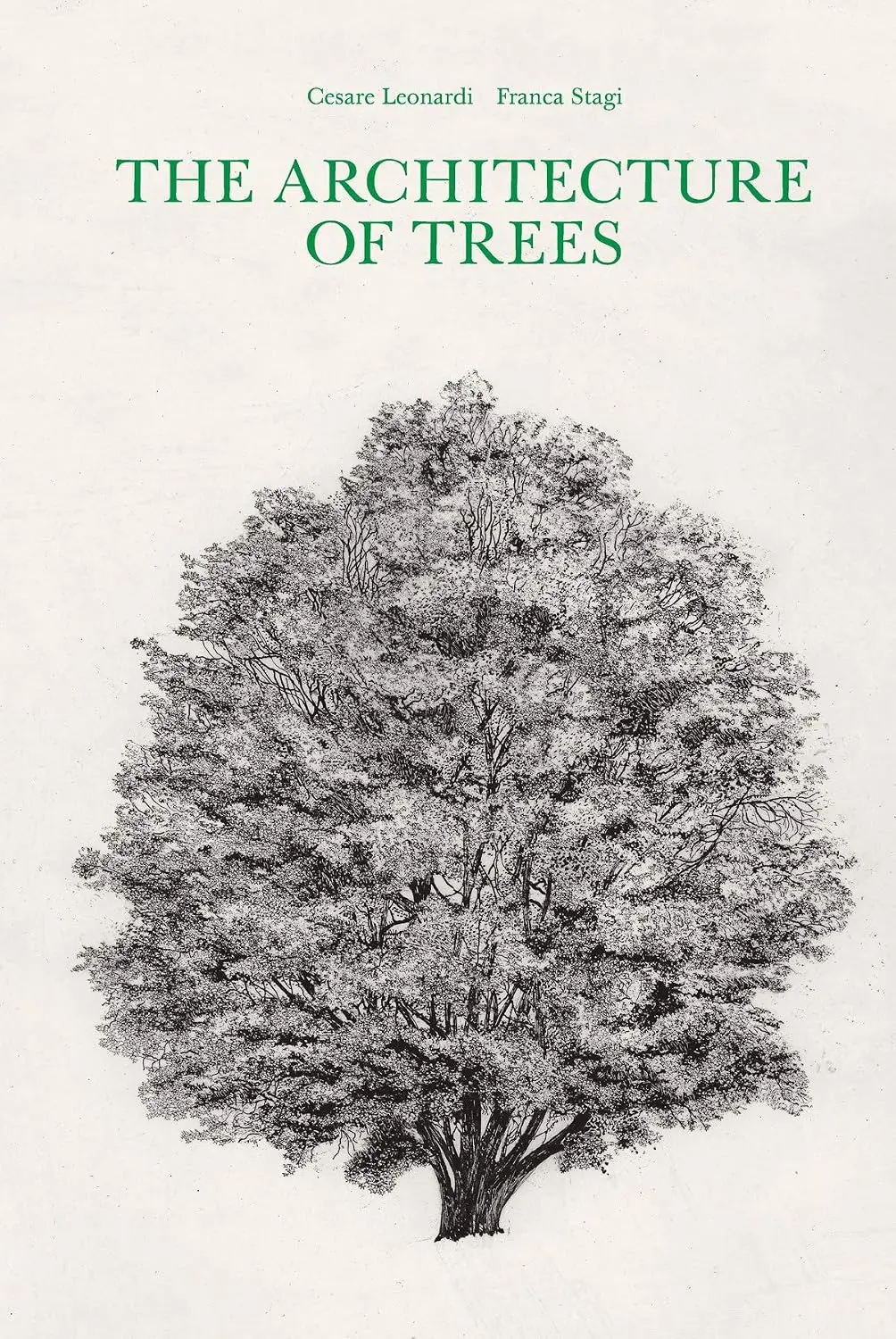
No. 03 · Princeton Architectural Press · 2019 · first published 1982
Cesare Leonardi & Franca Stagi
212 species, each drawn twice: once in leaf, once in winter.
Two Italian architects spent some twenty years photographing and measuring trees, then drew 212 species by hand at a scale of 1:100, each one twice: in full summer leaf and bare in winter. They added the shadow each tree casts. The original came out in Italy in 1982 and became a cult object among landscape architects; Princeton Architectural Press finally published it in English in 2019.
It is a field guide, an atlas and a drawing manual at once, and the ink drawings are so fine that people frame single pages. Put it next to a window and somebody will start comparing the tree outside with the plates.
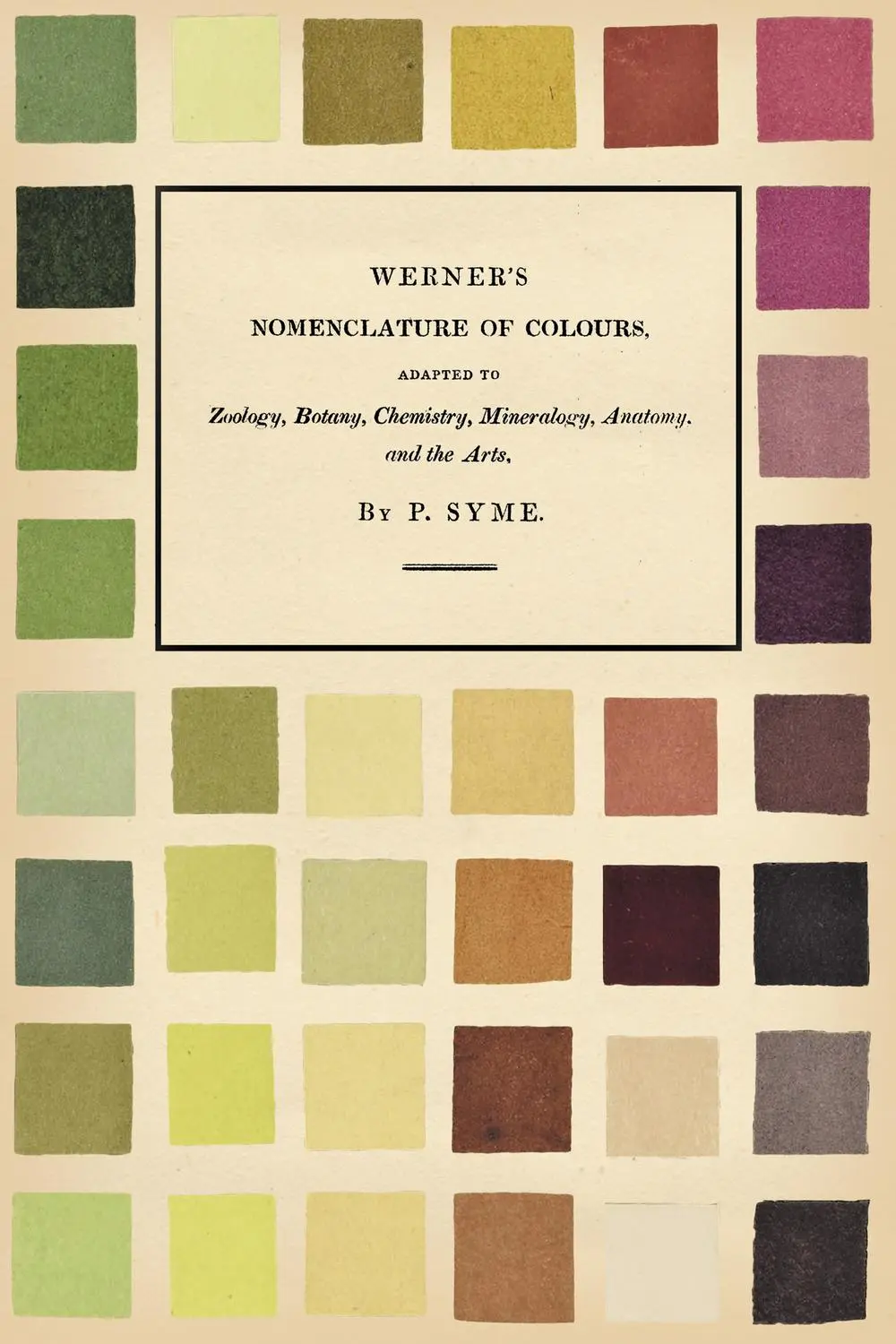
No. 04 · Smithsonian Books · 2018 · first published 1814
Patrick Syme
The colour chart naturalists carried before Pantone existed.
Before colour photography, how did a scientist tell another scientist exactly which red a feather was? In 1814 the Edinburgh painter Patrick Syme answered by expanding the German geologist Abraham Werner’s colour scheme into 108 hand-painted swatches, and next to each he wrote where in nature you could find it: in an animal, a plant and a mineral. Scarlet red is in the scarlet ibis; skimmed-milk white is in the white of a human eyeball.
Naturalists carried it into the field for decades, Darwin among them. The Smithsonian’s reprint is the smallest book on this list, closer to a pocket book than a slab, but it is the one guests keep picking up, reading the names out loud and checking them against the room. For the grand version of the same idea, see the 800-page colour book of 1692.
No. 05 · University of Chicago Press · 2016
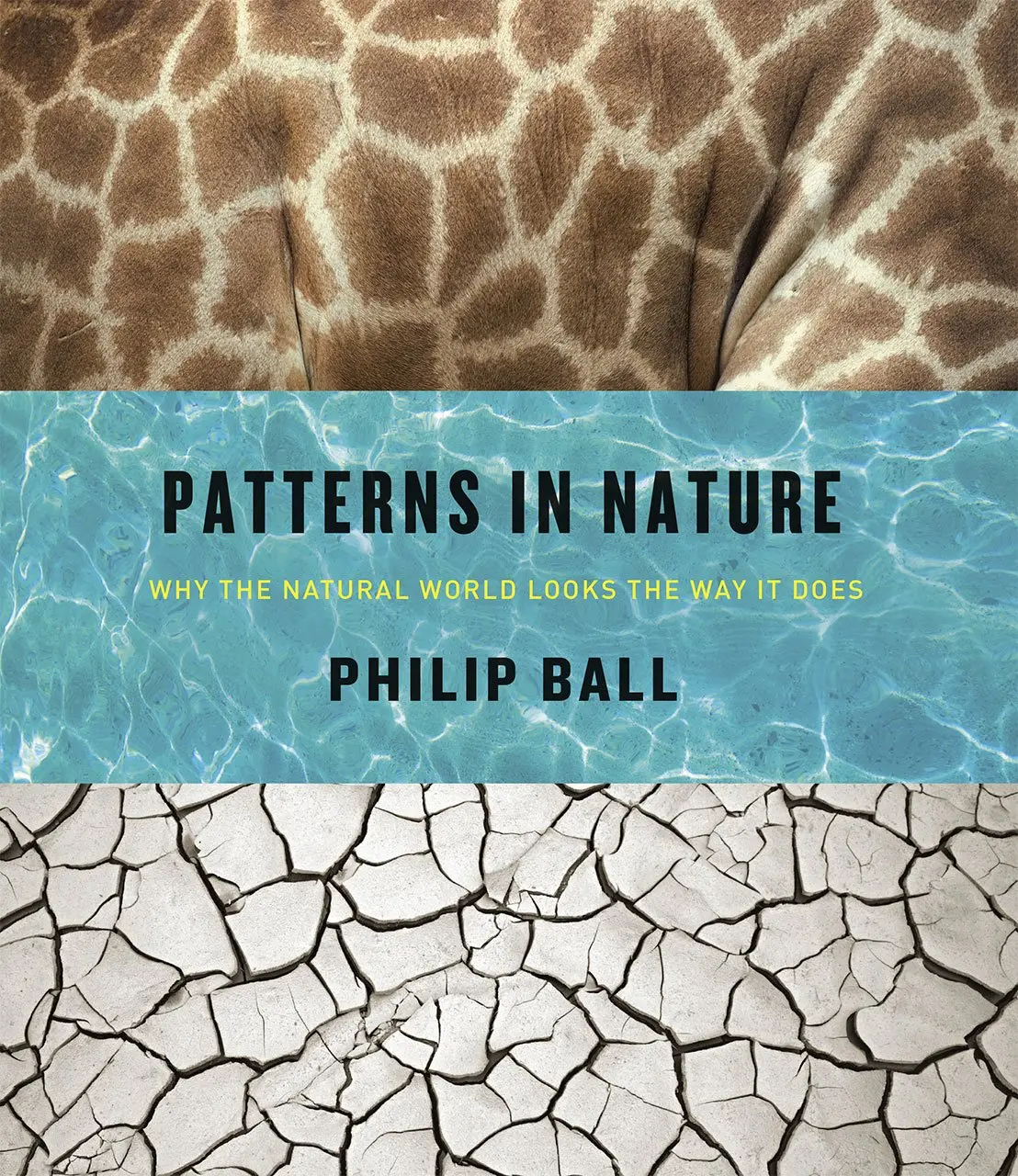
Philip Ball
Zebra stripes, dunes and soap foam, explained by the same few rules.
Why do zebras have stripes and leopards have spots? Why do sand dunes, cloud streets and the ridges on your fingertips look like the same pattern drawn at different sizes? Philip Ball, a science writer trained as a chemist, gathers the answers into one large, photograph-heavy volume: Alan Turing’s reaction-diffusion equations, soap foams, branching rivers, cracks in mud.
It is the rare book that looks like a coffee table book and works like a reference. The photographs hook you; the half page of text under each one leaves you understanding, for example, why a honeycomb is hexagonal and a pine cone spirals the way Fibonacci numbers say it should.
No. 06 · Ivy Press · 224 pages
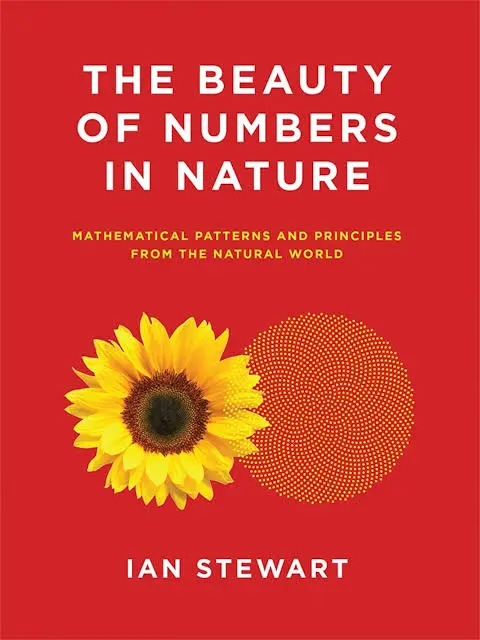
Ian Stewart
From a snowflake to a leopard's tail, with not one equation.
Ian Stewart is one of the best explainers mathematics has ever had, and here he sets himself a hard constraint: no equations. Starting from Kepler’s question about why snowflakes have six corners, he walks through symmetry, spirals, fractals and the spot-making equations Turing proposed, all the way to the rings on a leopard’s tail.
Every spread pairs a short essay with large photographs, so it reads in coffee-break chunks. It is the friendliest door into mathematics on this list, and the one I would give a teenager who thinks they do not like the subject.
No. 07 · teNeues · 2018 · 160 pages
Santiago Borja
Thunderstorms seen from the one seat built for watching them.
Santiago Borja is an airline pilot who photographs thunderstorms from the flight deck of a Boeing 767, from a seat built for watching weather. The book holds ninety of his frames: anvil clouds lit from inside by lightning, towering cumulonimbus seen side-on instead of from below, the night sky above all of it.
What makes it more than a photo book is that a meteorologist explains every cloud, so each image comes with the physics that built it. Guests who are nervous flyers tend to either love it or close it quickly.
Room II · Books 8–17
Ten books where a proof is also a picture: coloured Euclid, Leonardo's polyhedra, Escher's impossible buildings and the geometry problems Japanese mathematicians hung in temples.
No. 08 · TASCHEN facsimile · first published 1847
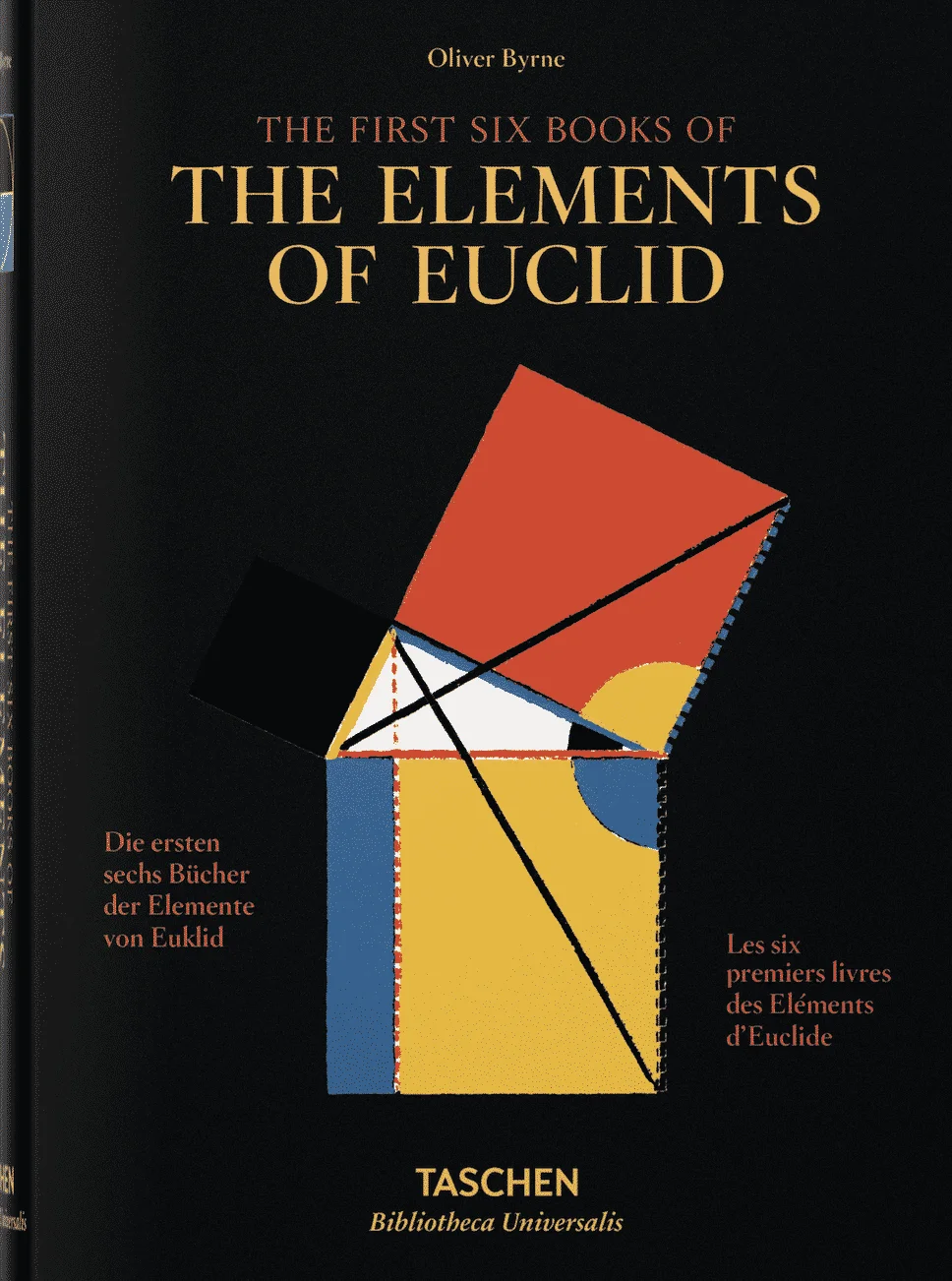
Oliver Byrne
Euclid in red, yellow and blue, seventy years before Mondrian.
In 1847 an Irish surveyor named Oliver Byrne did something no one had done to Euclid in two thousand years: he took the letters out. Instead of “the angle ABC,” his proofs show you a little red wedge, a yellow triangle, a blue line, and your eye follows the argument without ever going back and forth between text and figure. The book was a commercial failure in its day.
Today it looks like it was designed by the Bauhaus, roughly seventy years before the Bauhaus existed, and TASCHEN’s facsimile is one of the best-loved books it sells. It is the most beautiful mathematics book ever printed, and it is also an honest way to learn geometry. Read about the man behind it in Here’s Looking at Euclid.
No. 09 · Facsimile · first published Venice, 1509
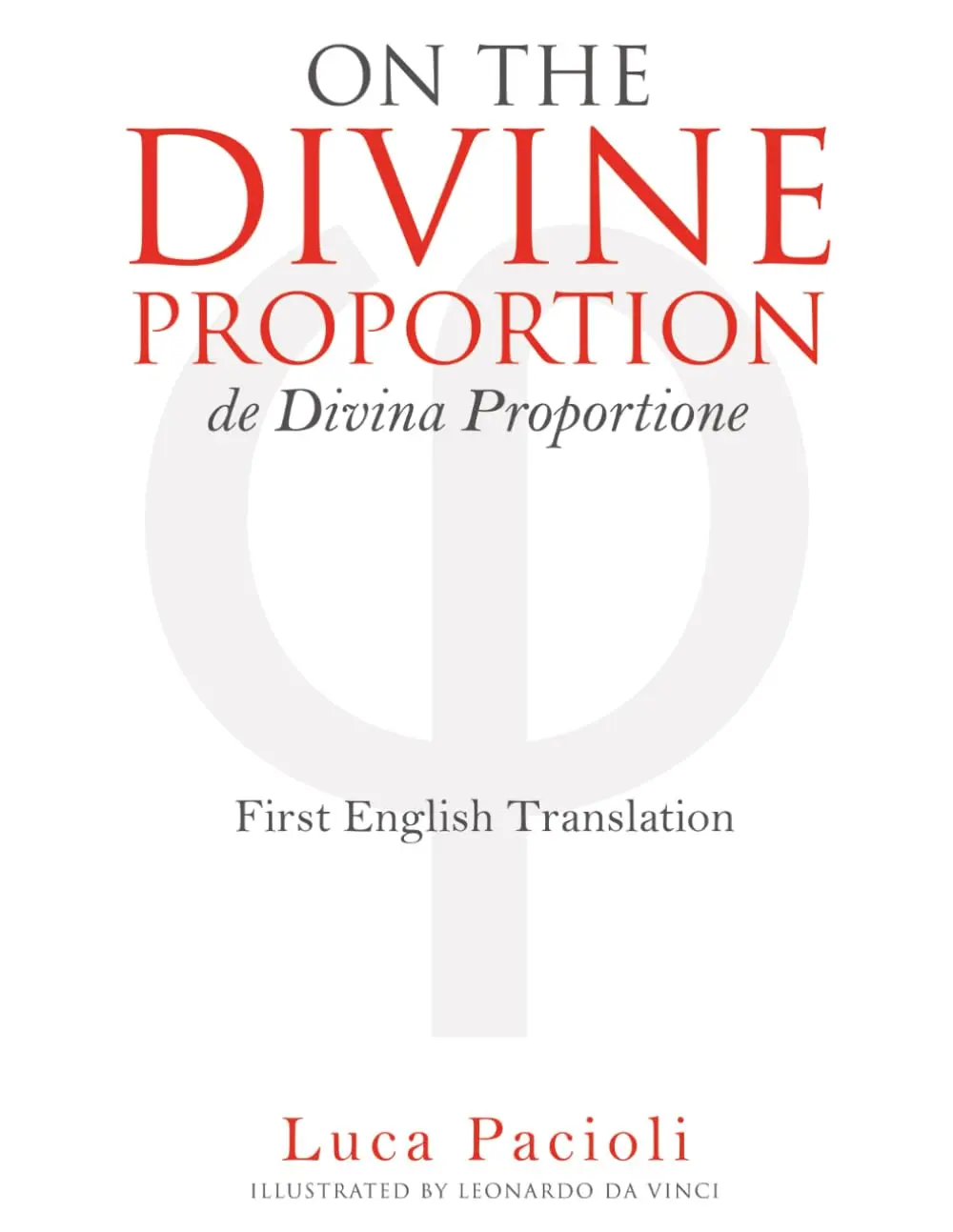
Luca Pacioli, drawings by Leonardo da Vinci
The only book Leonardo illustrated that was printed in his lifetime.
In Milan in the 1490s, the Franciscan mathematician Luca Pacioli lived at the court of Ludovico Sforza alongside Leonardo da Vinci. Pacioli wrote a treatise on the golden ratio and its place in geometry and architecture, and Leonardo drew the illustrations: around sixty polyhedra shown as skeletons, their edges solid and their faces open, so you can see straight through them.
Printed in Venice in 1509, it is the only book Leonardo illustrated that appeared in his lifetime, and we still draw solids his way. Pacioli’s mystical claims about the ratio do not hold up, but the drawings do, and a good facsimile makes a table feel like a Renaissance study. For a modern artist working in the same tradition, see Rafael Araujo.
No. 10 · TASCHEN · first published 1976
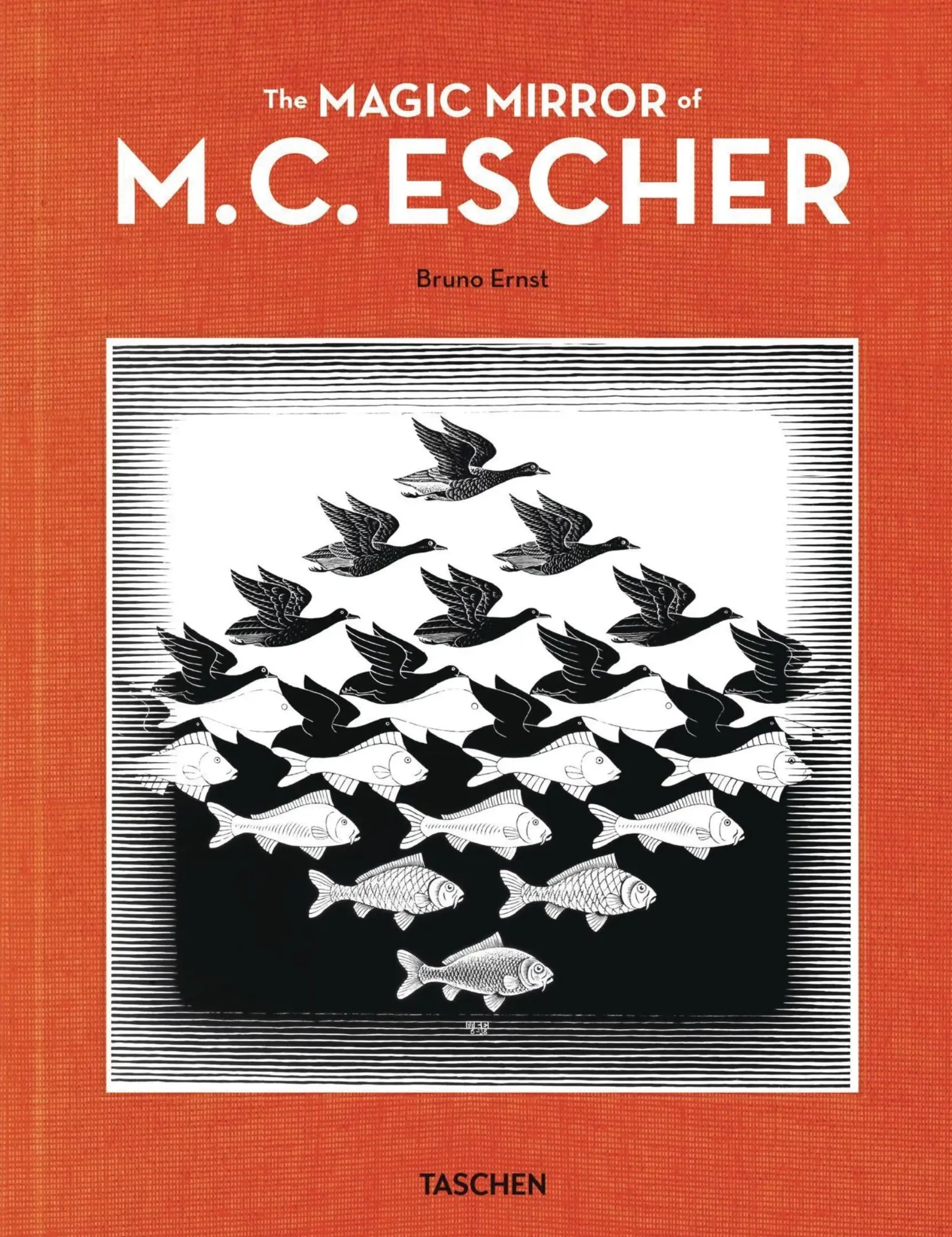
Bruno Ernst
How the impossible staircases were built, told by Escher's friend.
Bruno Ernst was the pen name of Hans de Rijk, a mathematics teacher who became Escher’s friend and wrote this book through regular meetings with the artist, who read and corrected the drafts. So it is not a critic’s monograph but a workshop journal: how the endless staircases were constructed, which rule of perspective each impossible building breaks, why the centre of Print Gallery was left blank.
The reproductions are what bring people to it; the explanations are what keep them there. Pair it with our piece on the Penrose triangle, the impossible object Escher borrowed for his Waterfall.
No. 11 · Thames & Hudson
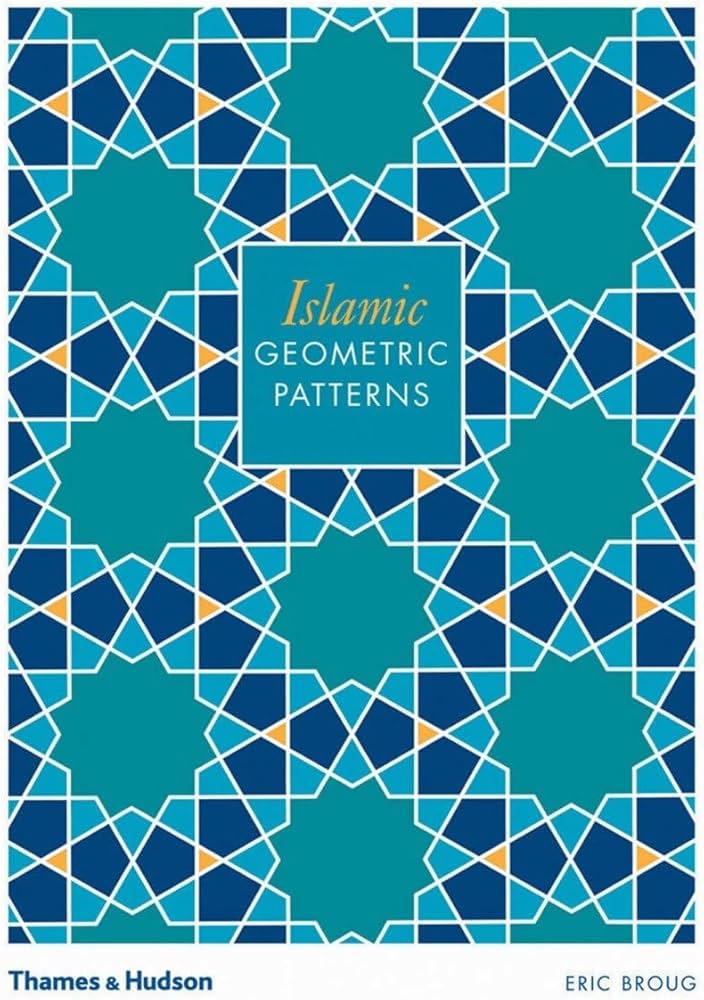
Eric Broug
A compass, a ruler and 1,400 years of patterns you can draw yourself.
The star patterns on mosques and palaces from Córdoba to Samarkand look impossibly complicated, and Eric Broug’s book shows that every one of them starts with a compass, a ruler and a circle. Step by step, with clear diagrams, he walks you through how historic patterns were actually constructed, and by the end of a chapter you have drawn one yourself.
This is the one book on the list that turns into an activity. Leave it on the table with a pencil and a compass and see who reaches for them first.
No. 12 · Princeton University Press · 2008
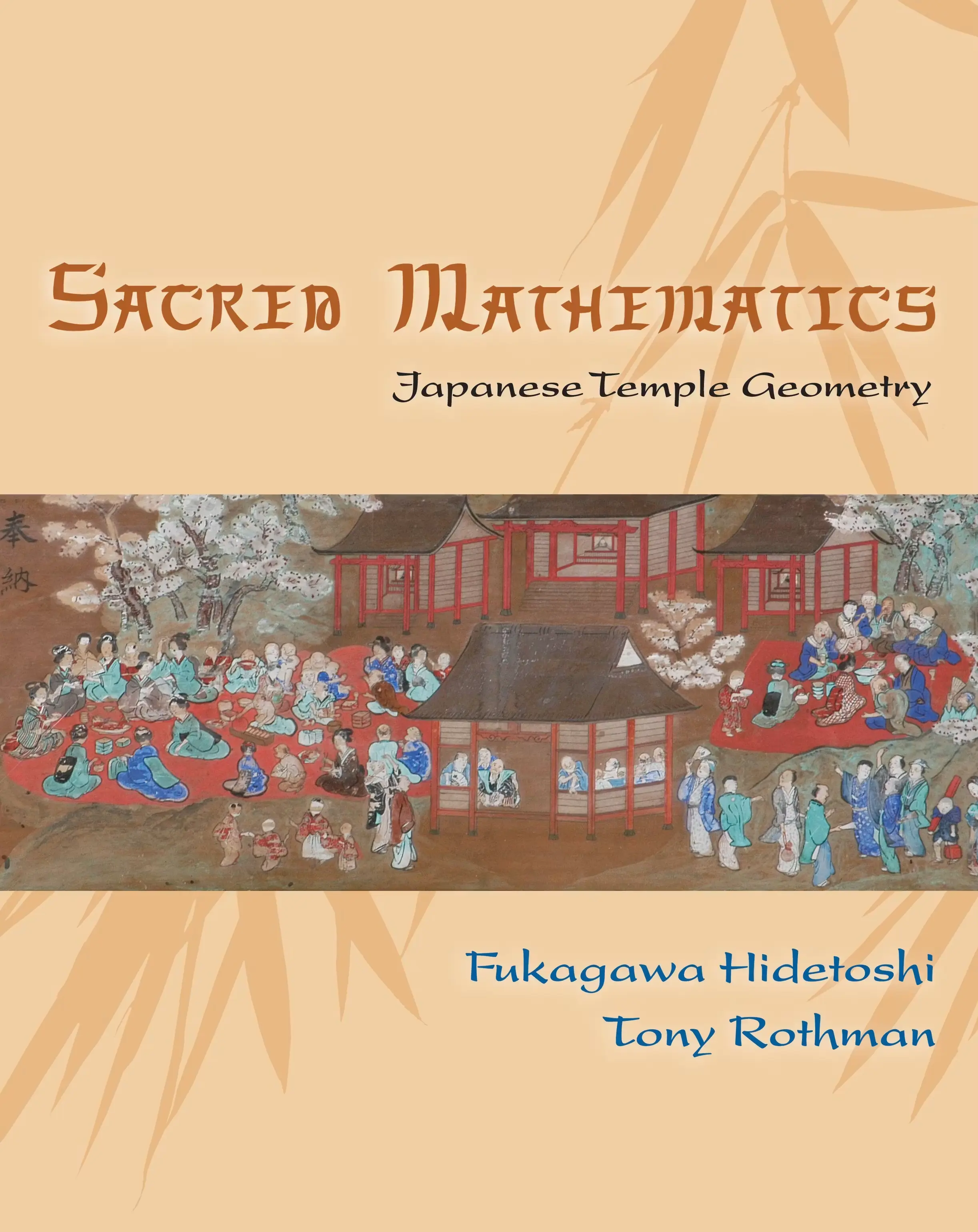
Fukagawa Hidetoshi & Tony Rothman
Geometry problems painted on wood and hung in temples as offerings.
During Japan’s two centuries of isolation, people from samurai to farmers solved geometry problems, painted them on wooden tablets called sangaku and hung them in Shinto shrines and Buddhist temples as offerings. Circles packed inside triangles, spheres inside cones, all in colour and calligraphy, many of them fiendishly hard.
Fukagawa Hidetoshi, a Japanese high school teacher who spent decades documenting the surviving tablets, and the physicist Tony Rothman reproduce them with photographs, history and solutions; the foreword is by Freeman Dyson. It is the most surprising book on this list, and every problem in it is a challenge you can hand to a guest.
No. 13 · Princeton University Press · 2014
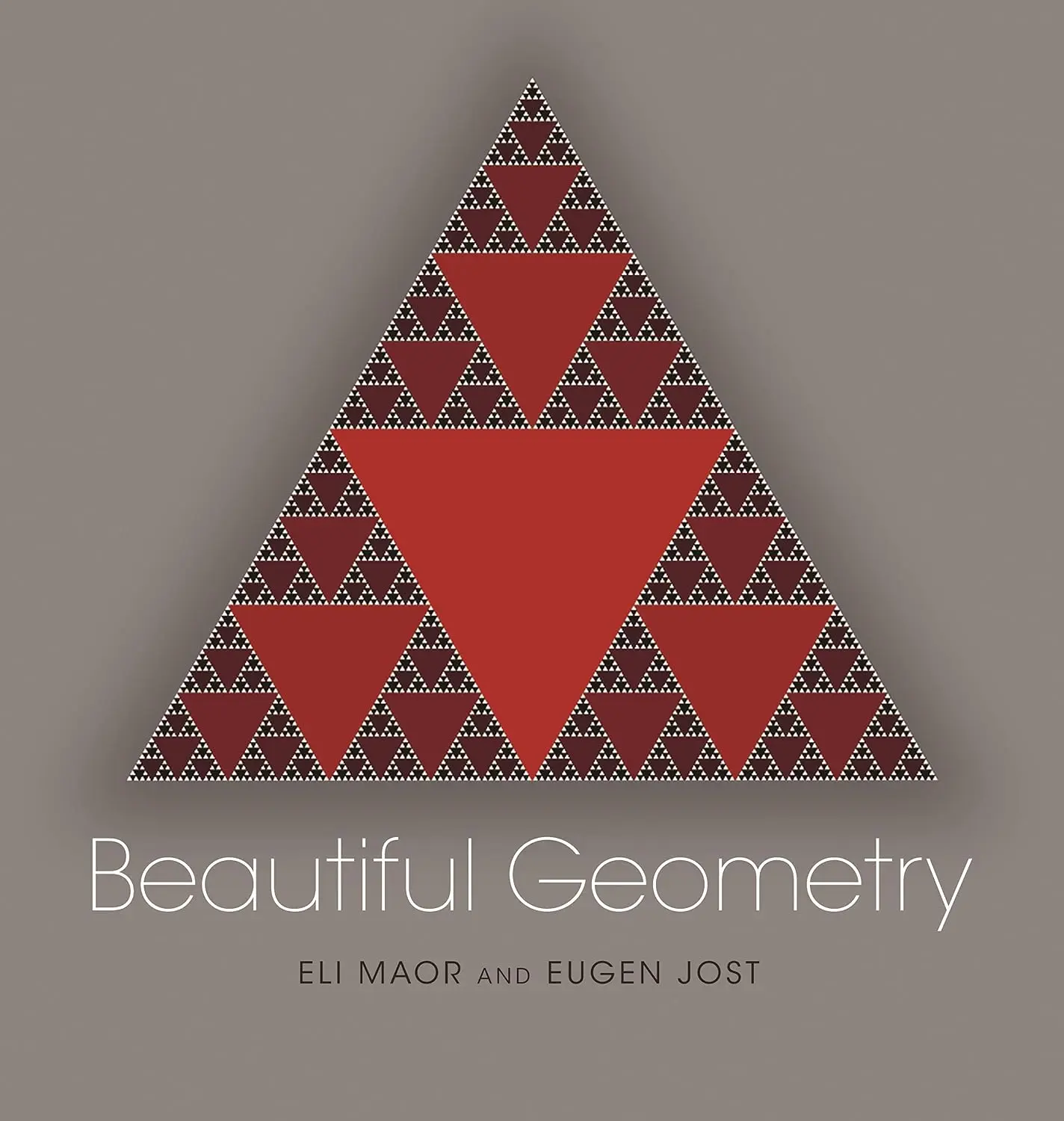
Eli Maor & Eugen Jost
Fifty-one theorems, each facing a painting made for it.
Fifty-one short chapters, each about one theorem or idea, from Thales and Pythagoras to infinity. On the left, the mathematician Eli Maor tells the history and the mathematics in a few pages; on the right, the Swiss artist Eugen Jost has painted the same idea in colour.
Real mathematics in gift-book format is rare, and this is the best example I know. Each chapter lasts about as long as a cup of coffee, which is the ideal length for a book that lives on a table.
No. 14 · W. H. Freeman · 1982
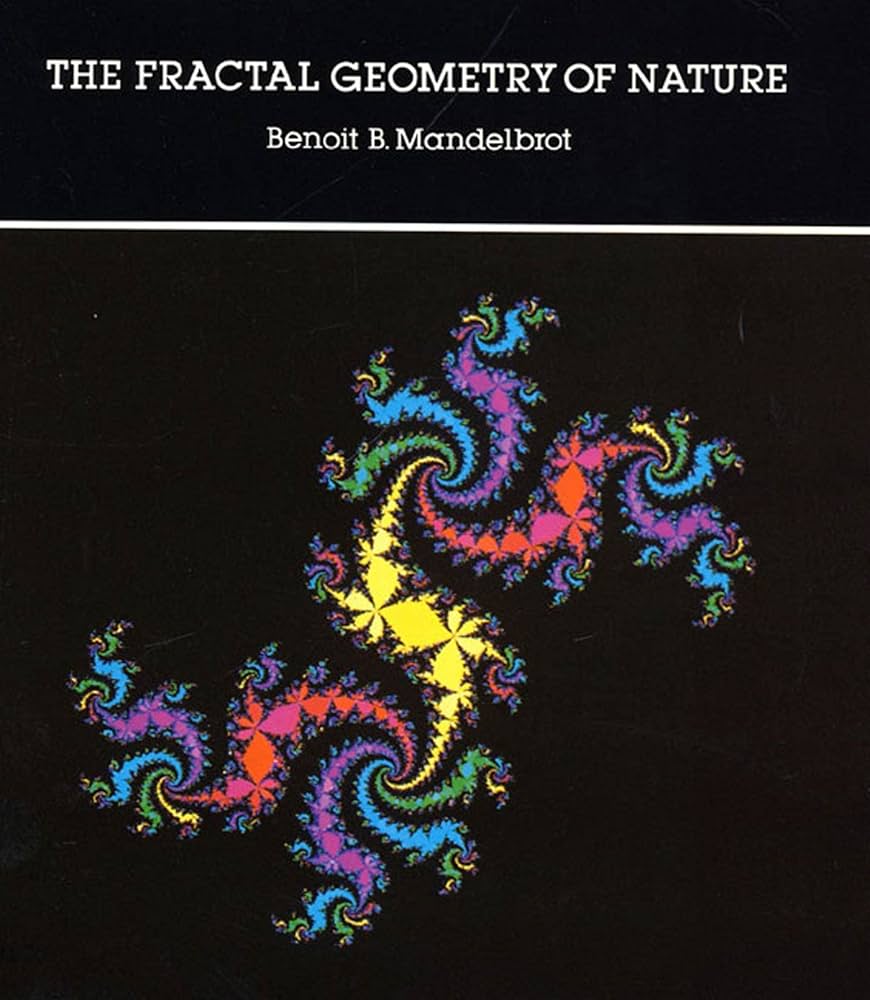
Benoît B. Mandelbrot
The book that gave coastlines, clouds and mountains a mathematics.
Benoît Mandelbrot’s point was simple and radical: mountains are not cones and coastlines are not circles, so the geometry of Euclid cannot describe them. In this book he built the new geometry that could, the geometry of shapes that look equally rough at every scale, and named it fractal.
It is not a light read; it is a manifesto with mathematics in it. But the colour plates, including some of the first computer-generated fractal landscapes and planets, made it a cult object in 1982 and still look striking. It is the book on this list that changed science the most.
No. 15 · Princeton University Press · 2016
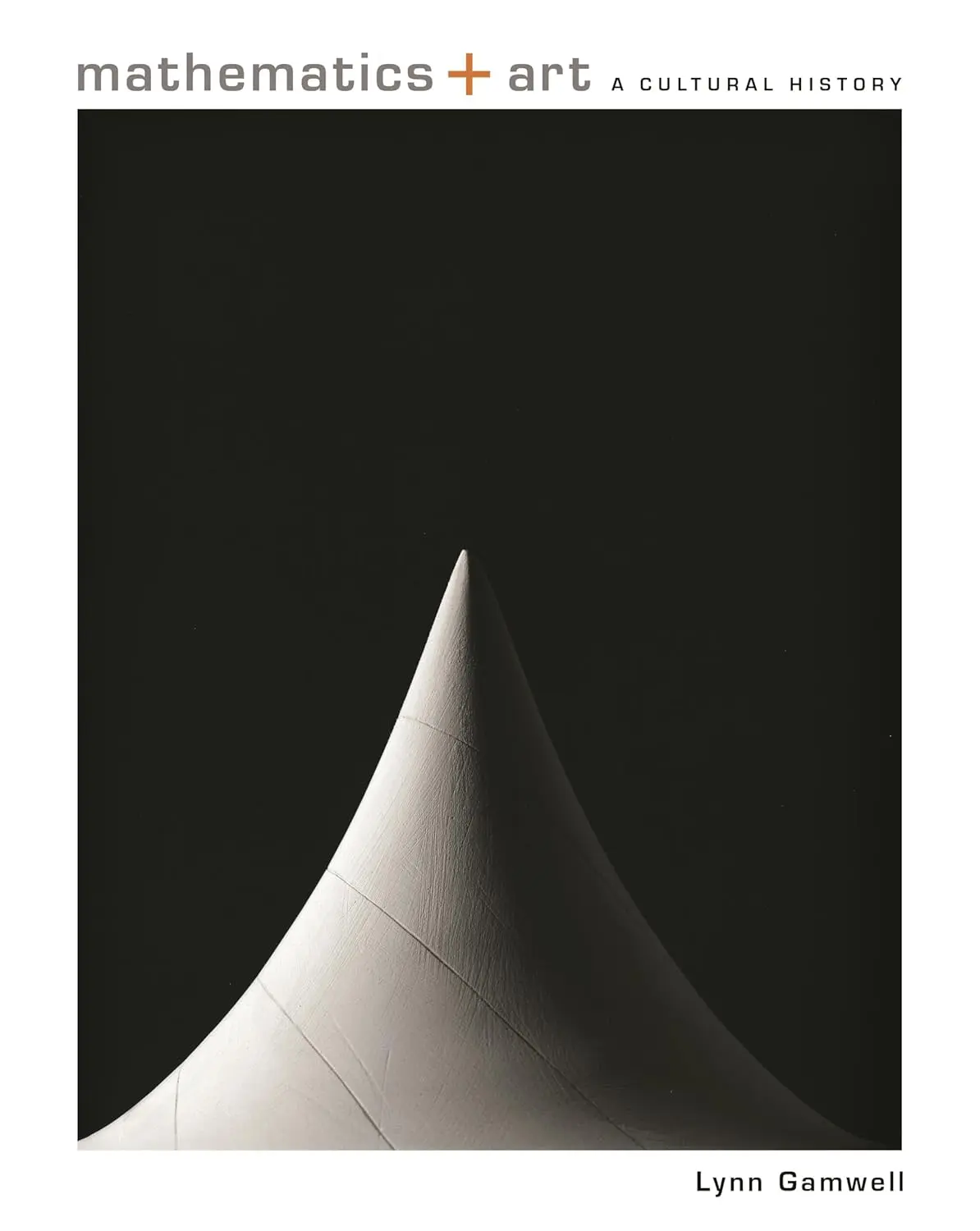
Lynn Gamwell
Four thousand years of artists and mathematicians reading each other.
Lynn Gamwell, an art historian, tells the story of how mathematical ideas shaped art, from Babylonian tablets and Greek proportion through perspective, non-Euclidean geometry and infinity to the abstract and computer art of the twentieth century. Hundreds of colour illustrations carry the argument, and the foreword is by Neil deGrasse Tyson.
It is the heaviest book in this room and the most complete. Open it anywhere and you land on a connection you had never made, a painting suddenly explained by a theorem or the reverse. Our list of math books written by artists, architects and writers is its natural companion.
No. 16 · GraphicDesign& · 2014
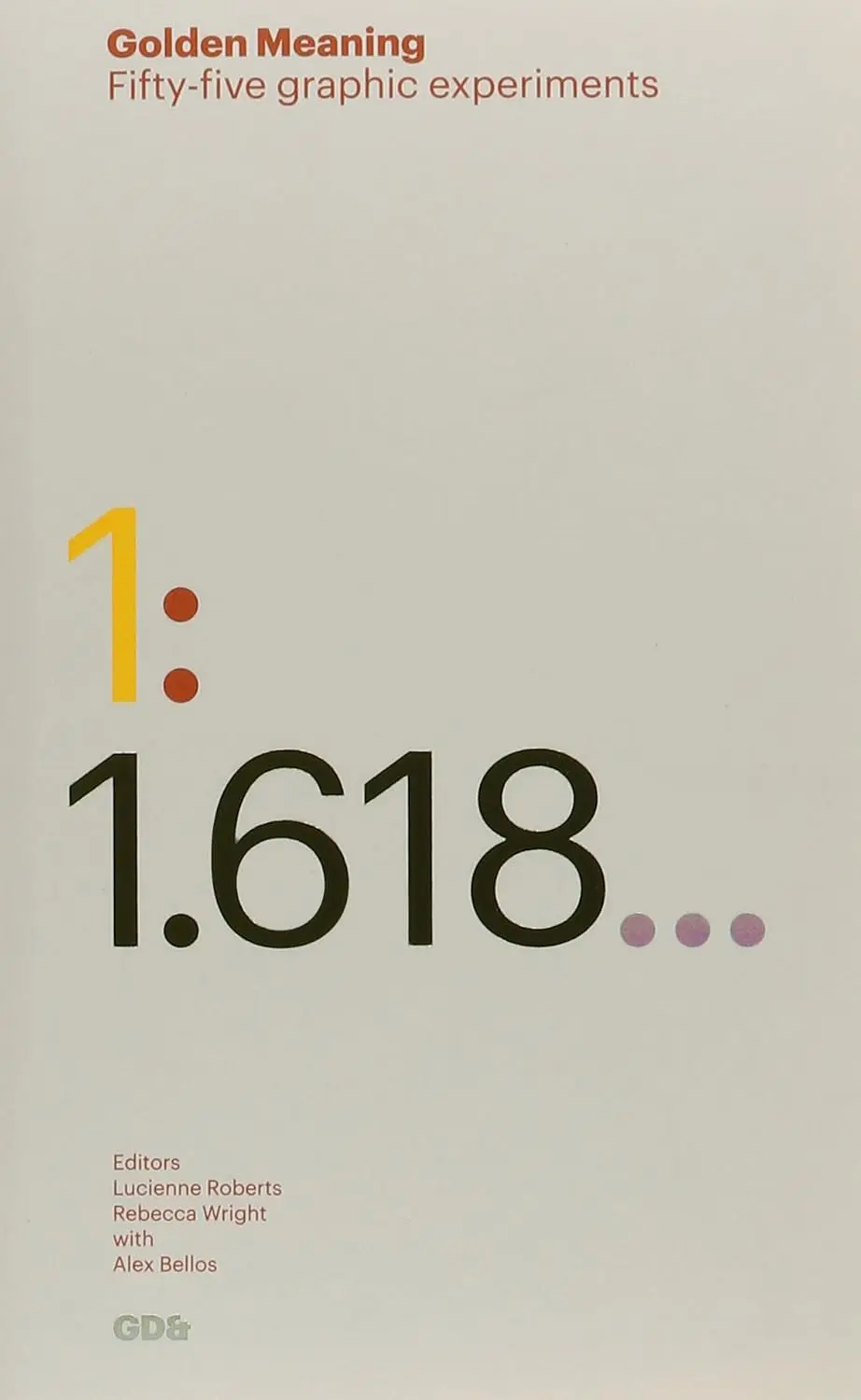
Ed. Lucienne Roberts & Rebecca Wright
Fifty-five designers, one brief: show the golden ratio.
The publisher GraphicDesign& gave fifty-five graphic designers the same brief: visualise the golden ratio. The answers range from the serious and didactic to the openly sarcastic, because many designers are tired of hearing that phi is hidden in every shell and every logo.
That is what makes the book clever. It neither worships the golden ratio nor debunks it; it shows fifty-five ways of looking at one number, and leaves you to decide. It is the funniest book on this list.
No. 17 · Johns Hopkins University Press · 2016
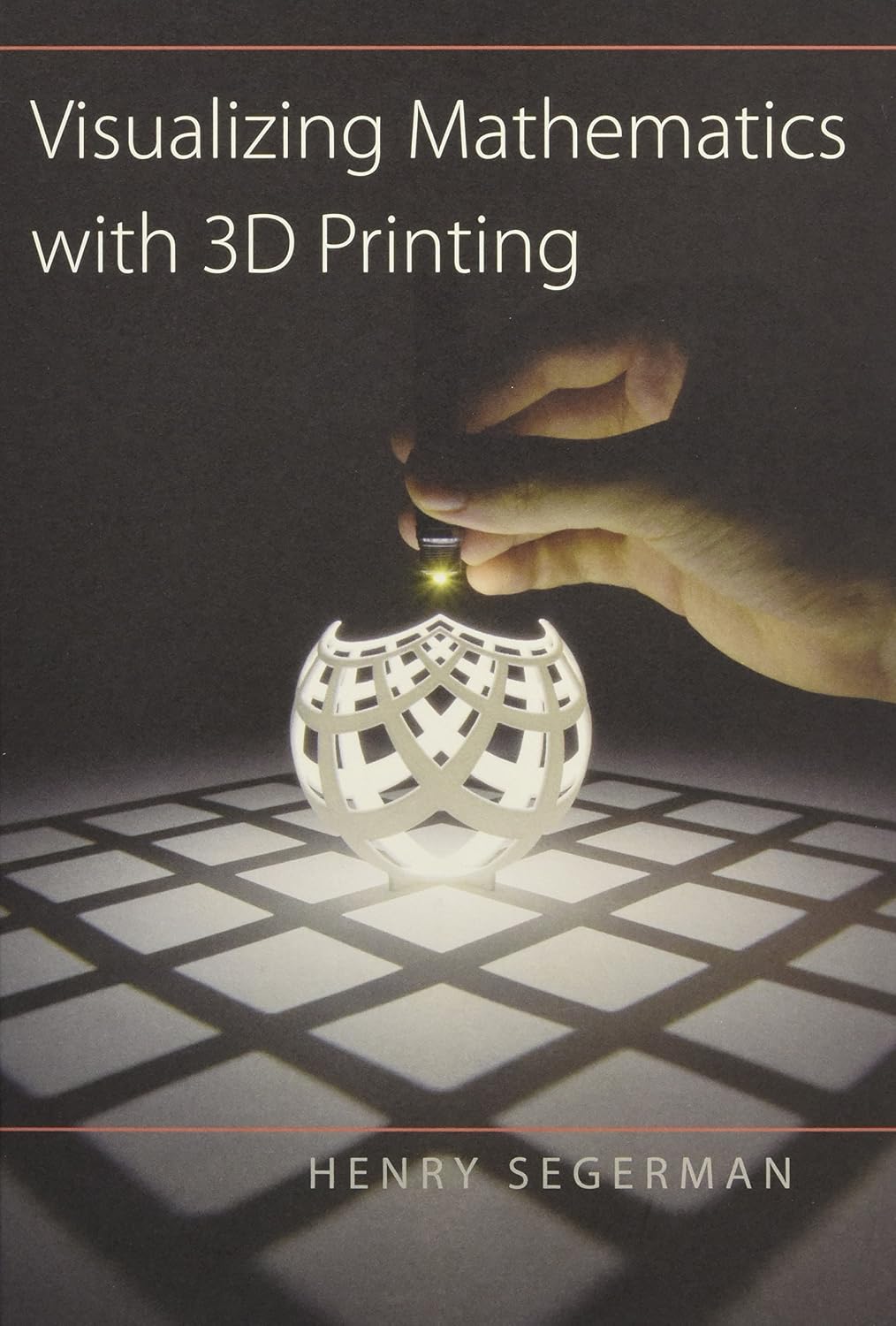
Henry Segerman
Four-dimensional shapes you can turn over in your hand.
Some mathematical objects only make sense when you turn them over in your hand, so the mathematician Henry Segerman prints them. His book walks through 3D-printed models of symmetry, knots, curved space and the shadows of four-dimensional shapes, with photographs that look like sculpture, and the files are online so you can print the objects yourself.
Leave it on the table next to one printed model and watch it travel around the room. To see what Segerman does with a single object, watch his impossible triangle.
Room III · Books 18–26
Nine books about how things are made to look the way they do: pasta, letters, chairs, tents, grids and the three shapes of the Bauhaus.
No. 18 · Thames & Hudson · 2011
George L. Legendre
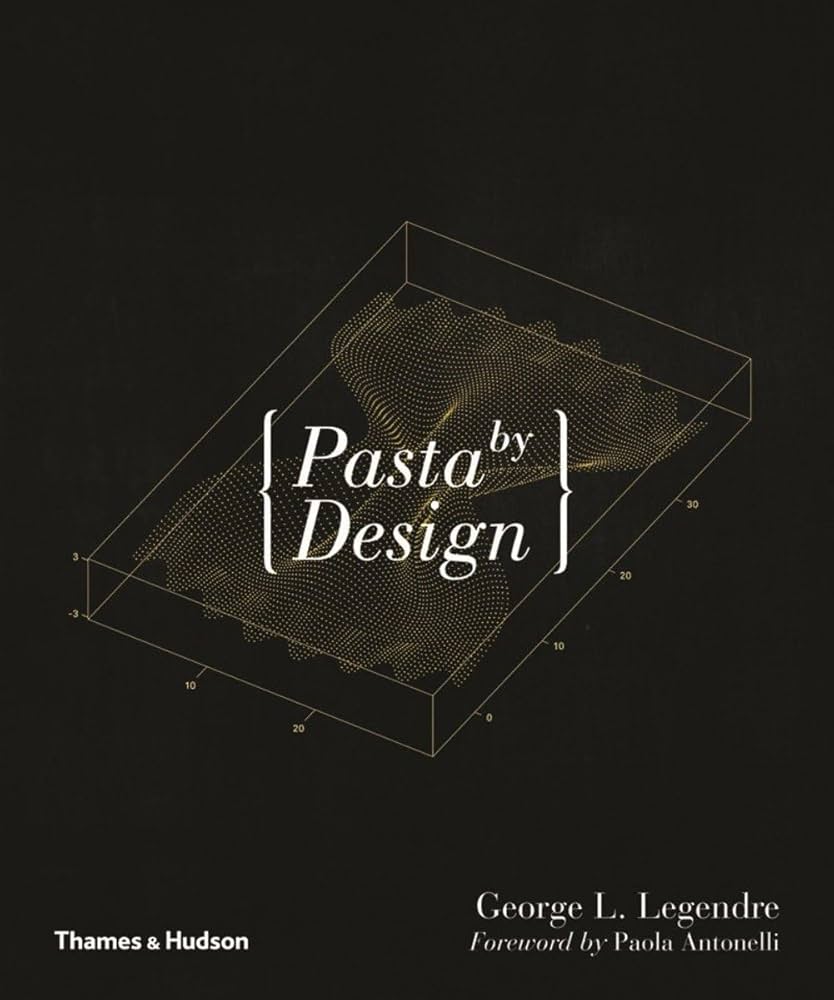
Ninety-two pasta shapes, each with its own equation.
George Legendre is an architect, and he treats pasta the way architects treat buildings: as surfaces that can be described with equations. His book catalogues ninety-two shapes, from rigatoni to farfalle, each with a sharp computer rendering and the parametric equations that generate it, plus a family tree of how the shapes relate.
There are no recipes. There is something better: the moment a guest who has eaten fusilli all their life sees its formula. It is the book on this list that converts the most people to mathematics without them noticing.
No. 19 · Boxtree · 2010
Caz Hildebrand & Jacob Kenedy
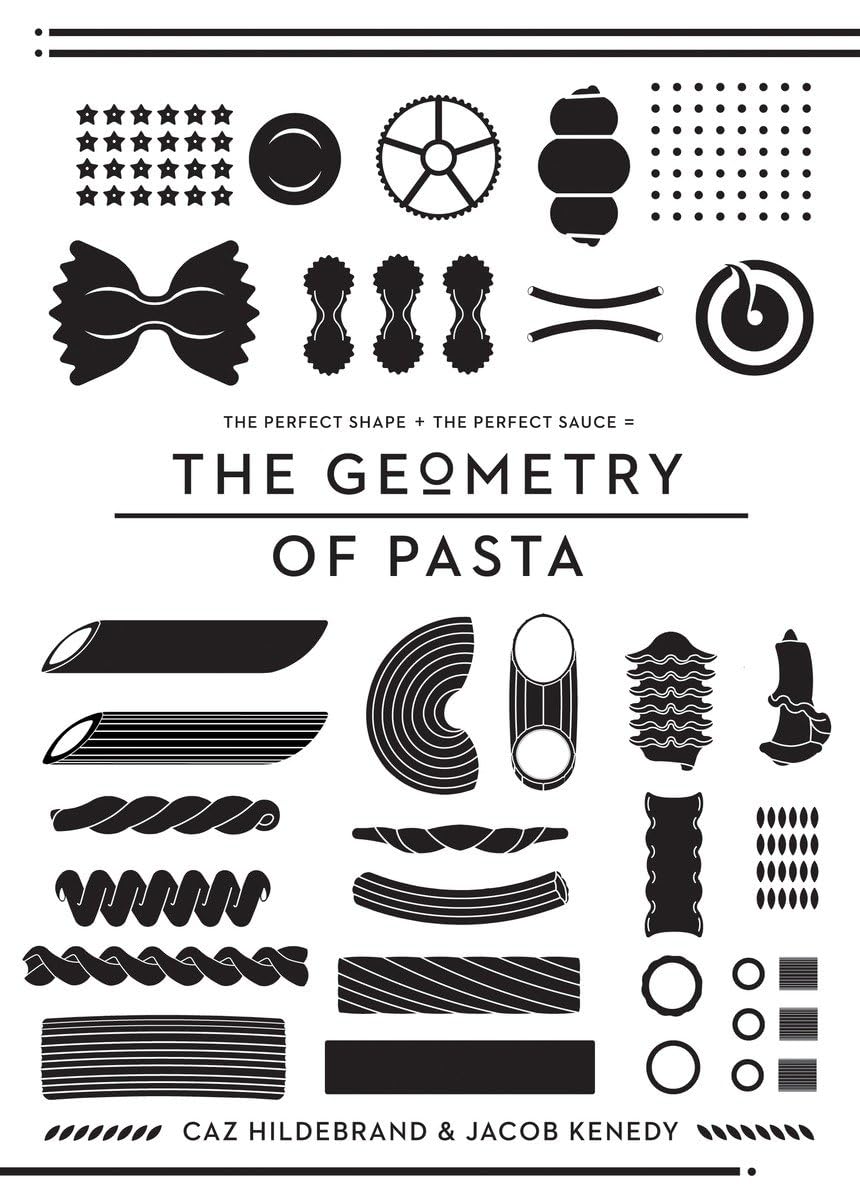
Why every shape wants its own sauce, drawn in black and white.
The designer Caz Hildebrand drew every pasta shape as a crisp black-and-white graphic, and Jacob Kenedy, the chef behind the London restaurant Bocca di Lupo, paired each shape with the sauces it was made for, with its history and recipes. The idea at the heart of it is that shape is flavour: a ridged tube holds a chunky sauce, a thin ribbon wants a silky one.
Where Pasta by Design is the engineer’s view, this is the cook’s, and the two look wonderful side by side. It is also the only book on this list that will get used in the kitchen.
No. 20 · Thames & Hudson · 2016
Stephen Coles
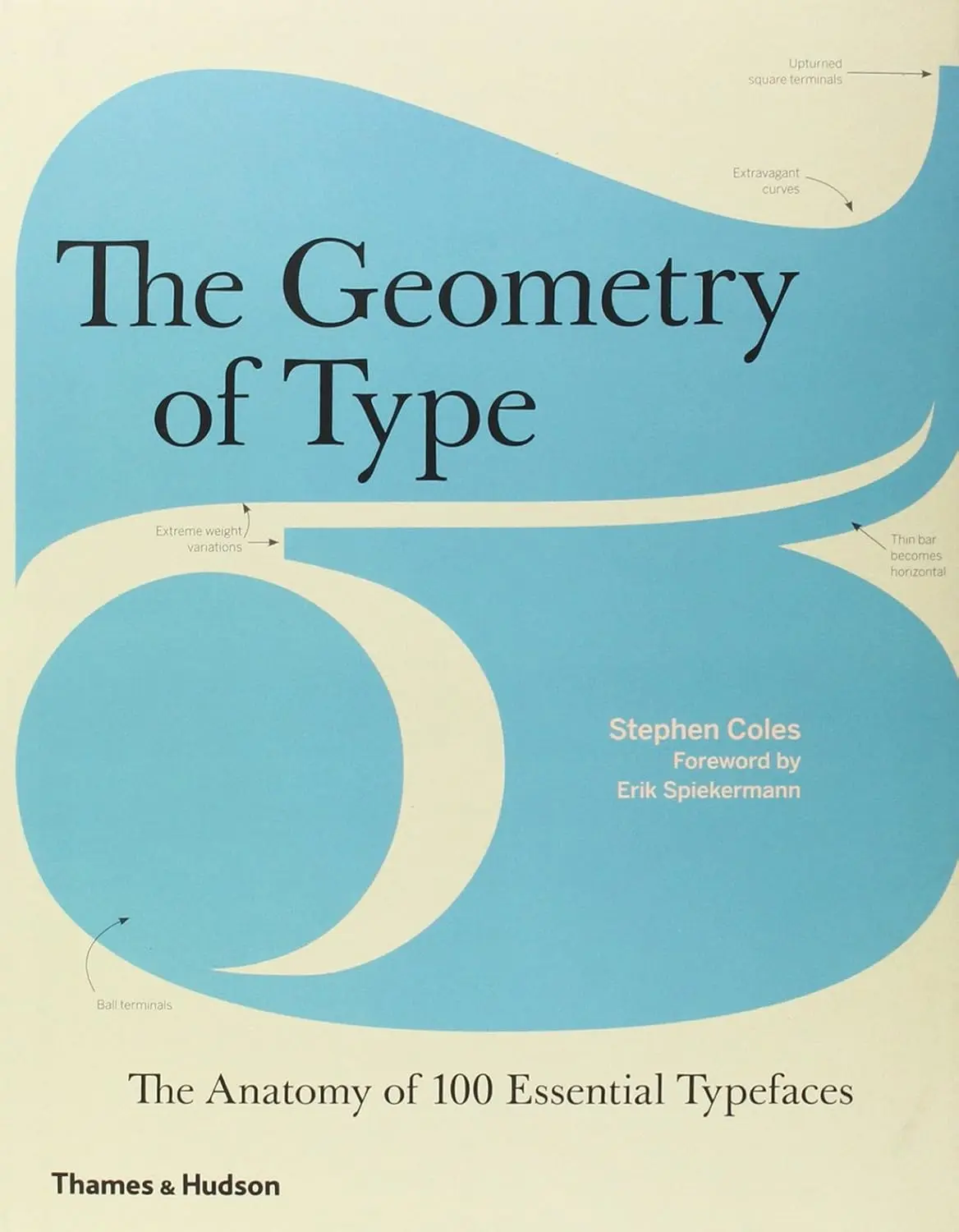
One hundred typefaces, taken apart one spread at a time.
Stephen Coles takes one hundred typefaces, from old-style serifs to grotesques, and gives each one a strict double-page spread with the letters enlarged and annotated: the shape of the bowl, the size of the counter, the angle of the stress. Read a dozen and you start seeing why one font feels friendly and another feels expensive.
It changes how you see every menu, sign and book cover afterwards, which is the most a design book can do. For the geometric roots of letters, see the Dürer who built Roman capitals with ruler and compass.
No. 21 · Les Grandes Personnes · 2016 · pop-up
Dominique Ehrhard
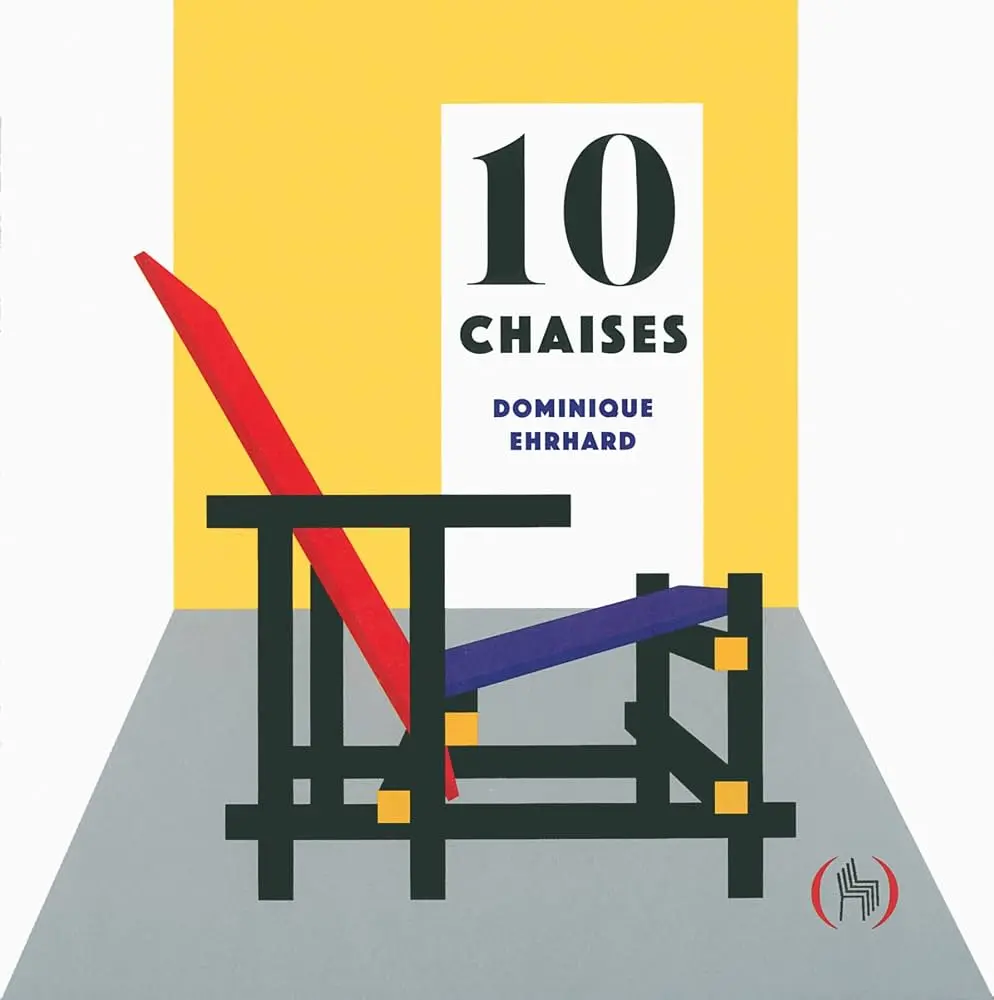
A century of chairs that stand up off the page when you open it.
Dominique Ehrhard folds ten design classics, from Thonet’s 1880 rocking chair and Rietveld’s Red and Blue chair to the Eames rocker and Mendini’s Proust armchair, into paper models that stand up when you open the spread and fold flat when you close it. Each fold is a small geometry problem, and each chair is reduced to the one line that makes it that chair.
It is the most delightful object on this list, and the one that disappears first when children visit. The text is minimal, so the French and English editions work equally well.
No. 22 · Princeton Architectural Press · 2023
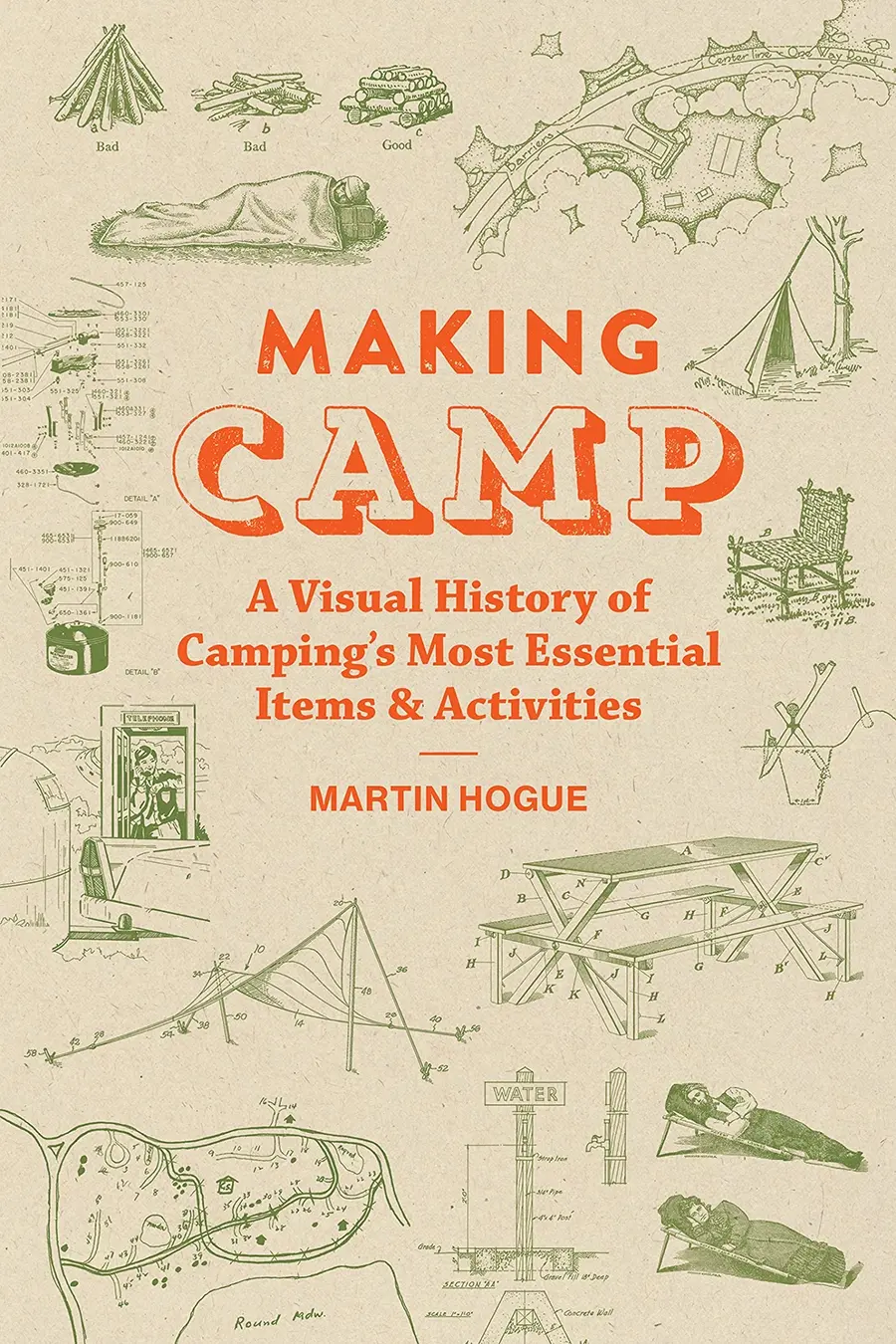
Martin Hogue
The tent, the fire pit and the picnic table, read as design history.
The campsite looks natural, but almost everything in it was designed: the fire ring, the picnic table, the numbered pitch, the tent, the sleeping bag, the campground map. Martin Hogue, an architect, traces a century of those objects, from early sacks stuffed with leaves to campsites with a power outlet on the table.
Its archival photographs and drawings make it a great book to browse, and its argument, that we design our idea of wilderness as carefully as a living room, makes it a great one to argue about.
No. 23 · Niggli · 1981 · German–English
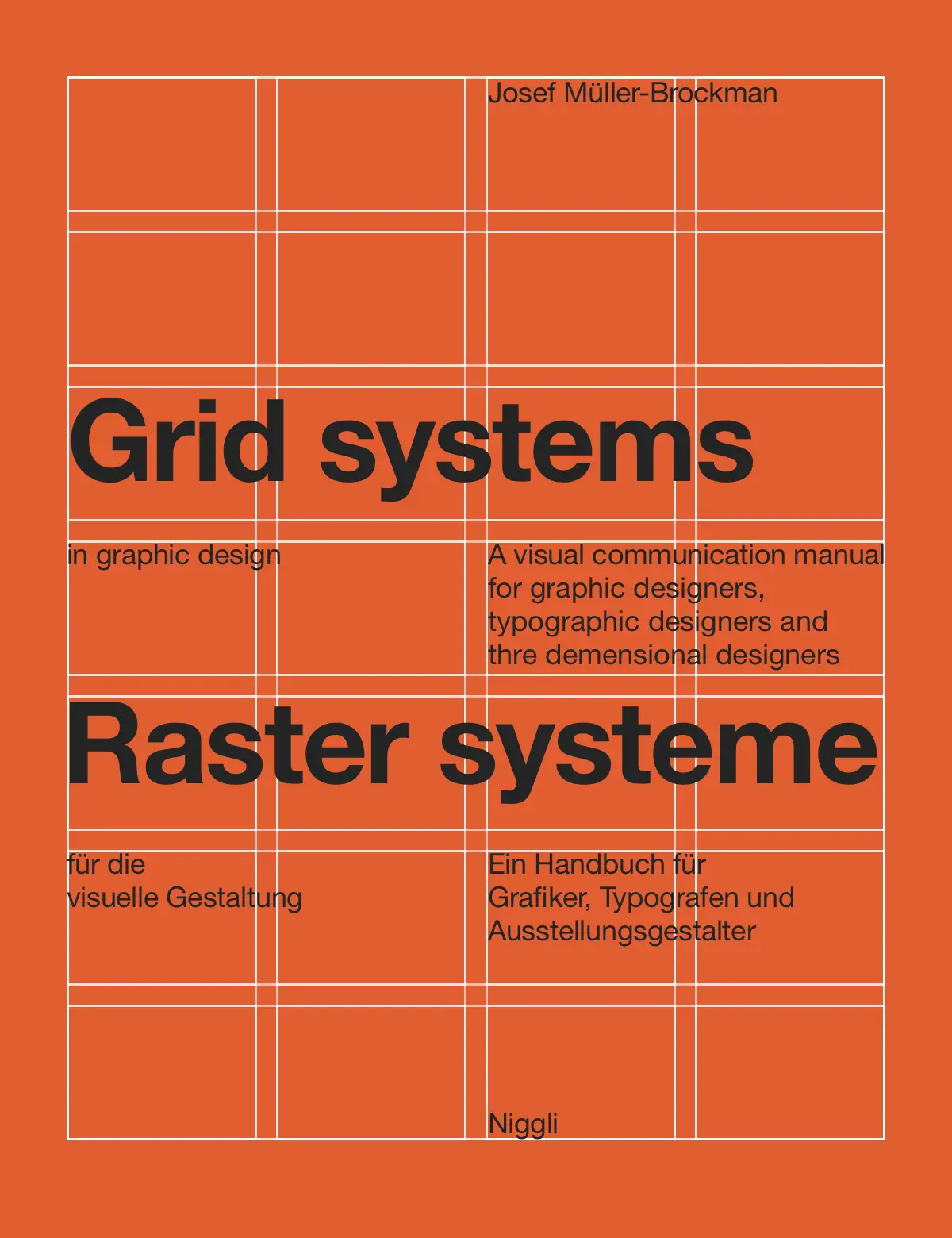
Josef Müller-Brockmann
The Swiss rulebook for the page, set in the system it teaches.
The founding text of Swiss graphic design. Josef Müller-Brockmann takes page layout out of the realm of taste and turns it into a system you can build, from the number of columns to the spacing of the lines, with a reason for every decision. The book is itself set in the grid it teaches, in German and English side by side.
For a designer it is a bible; for everyone else it is a revelation about why some pages feel calm and others feel chaotic. It is the most rigorous book in this room, and the one a mathematician will like most.
No. 24 · Princeton Architectural Press · 2015
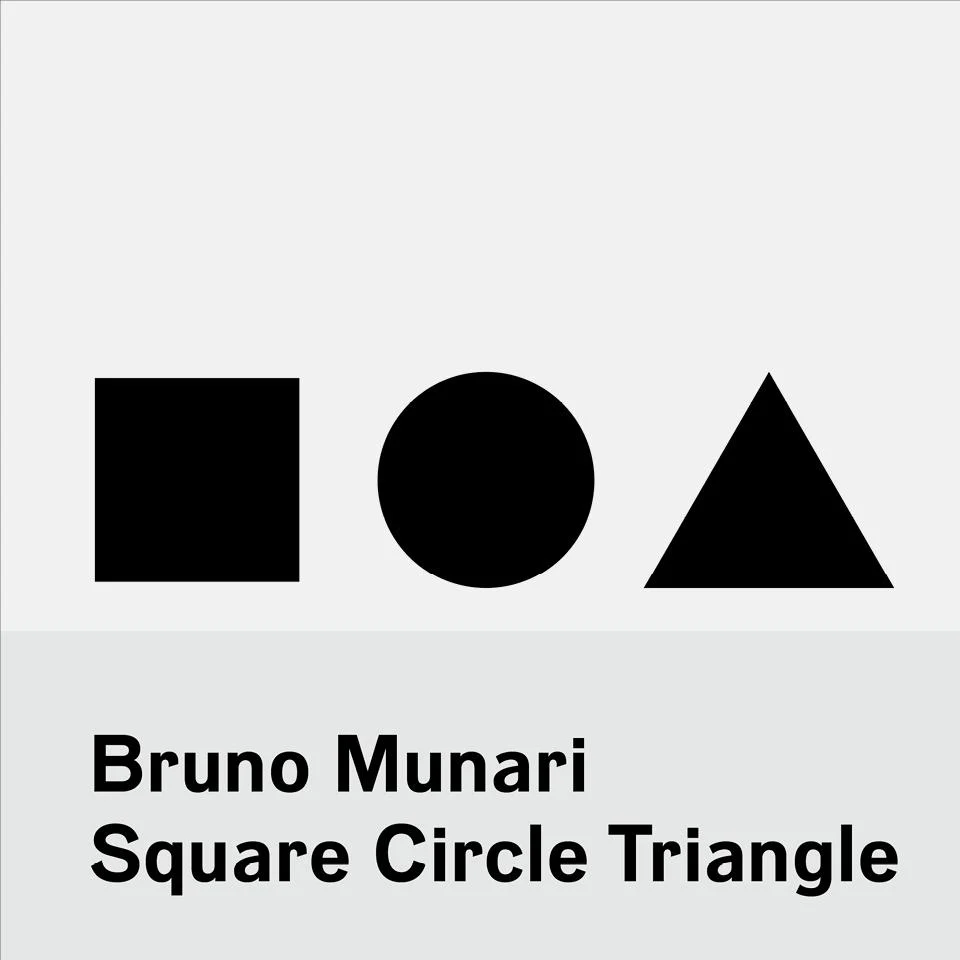
Bruno Munari
Three shapes, and everywhere people have ever put them.
The Italian designer Bruno Munari wrote three small books, one each about the square, the circle and the triangle, collecting in hundreds of little images every place people have used each shape: in buildings, alphabets, games, symbols and everyday objects. Princeton Architectural Press gathered them into one volume.
It is zero theory and pure observation, and after reading it you will notice every circle on your street. Munari is the designer who said that complicating is easy and simplifying is hard; this book proves he could do the hard thing.
No. 25 · Princeton Architectural Press · 2019 edition
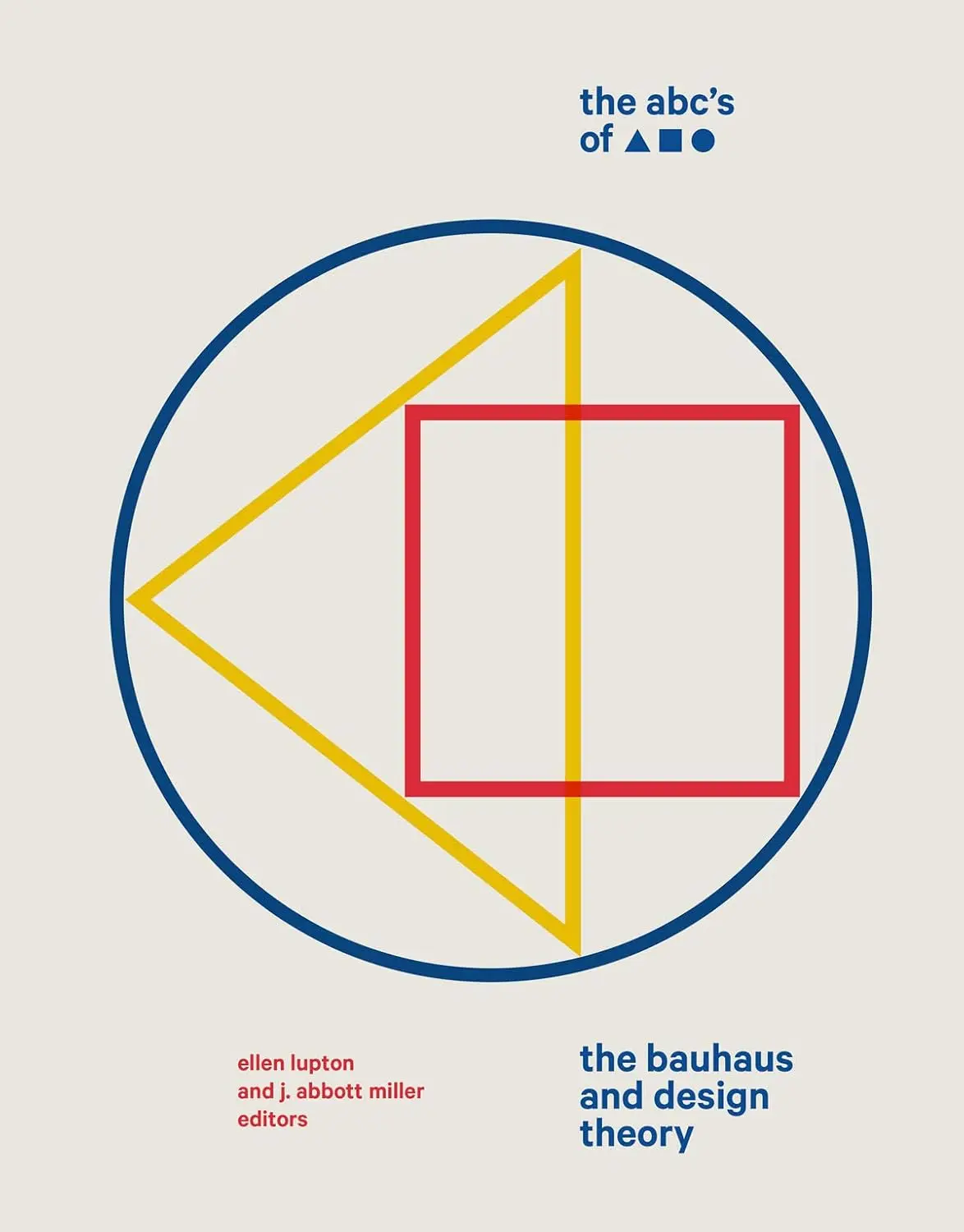
Ellen Lupton & J. Abbott Miller
The Bauhaus in three shapes and three colours.
In 1923 Wassily Kandinsky handed out a questionnaire at the Bauhaus asking people to fill a triangle, a square and a circle with yellow, red and blue. Most put yellow in the triangle, red in the square and blue in the circle, and that answer became a kind of founding myth for modern design. Ellen Lupton and J. Abbott Miller tell its story in a slim, sharply designed book.
It is short enough to read in one sitting and smart enough to reread. Put it next to Munari and Byrne’s Euclid and you have the whole history of three shapes and three colours on one table.
No. 26 · first published 1948
Le Corbusier
A ruler built from the human body and the golden ratio.
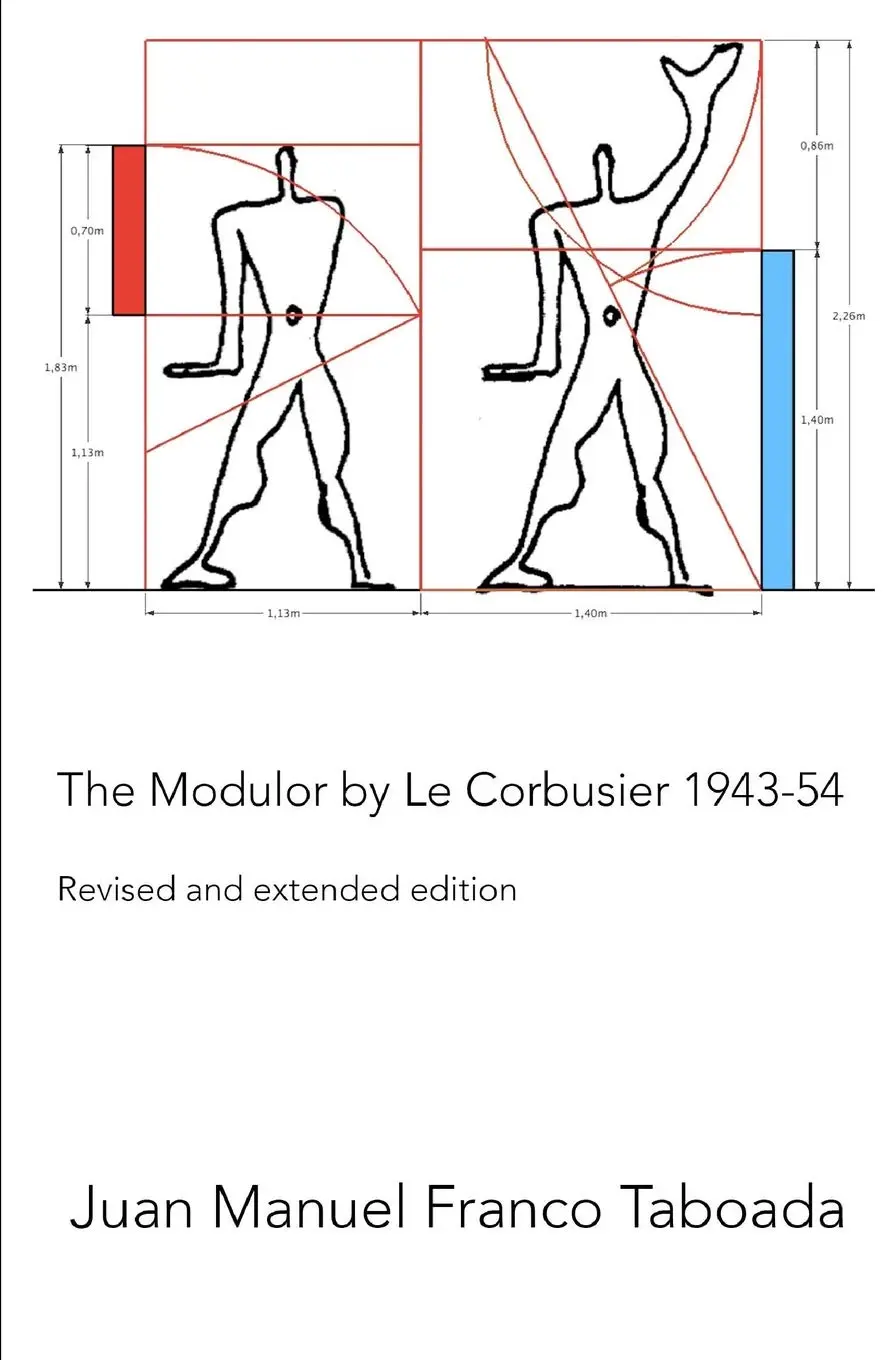
Le Corbusier wanted a ruler based on the human body rather than on the metre or the foot. He took a standard human height, divided it by the golden ratio again and again, and got two series of measurements that he believed could harmonise every building. The Modulor is his account of the system, half manifesto and half notebook, with his own doubts folded in.
The system never became universal, and its claims have been fairly criticised. But the Unité d’habitation in Marseille was built to it, so this is one of the very few proportion theories ever poured in concrete, and a beautiful thing to own.
A good table holds three to five books, biggest at the bottom. Pick yours and see what the stack says about you.
Build your stack · up to 5 books
A curious person's table: no single subject wins, which is exactly the point.
Room IV · Books 27–30
Four scientific classics printed by a small workshop in Barcelona as objects to keep for a lifetime: Newton, Tesla, Humboldt and Gauss.
No. 27 · Kronecker Wallis · Barcelona · three volumes
Isaac Newton
The most important physics book ever written, bound like an art object.
Kronecker Wallis began with a crowdfunding campaign to print Newton’s 1687 masterpiece the way it deserved. The collector’s edition splits the Principia into its three books, each bound separately with an exposed sewn spine and the Greek letters alpha, beta and gamma pressed into the covers, and houses them in one case. Petrol blue and coral orange run through the pages.
It is the most important physics book ever written, presented as an object you could put in a design museum. The print run is limited, so check our full Kronecker Wallis catalog for its current stock.
No. 28 · Kronecker Wallis · 500 pages · 20 × 27 cm
Nikola Tesla
All 112 of Tesla's U.S. patents, drawings and all.
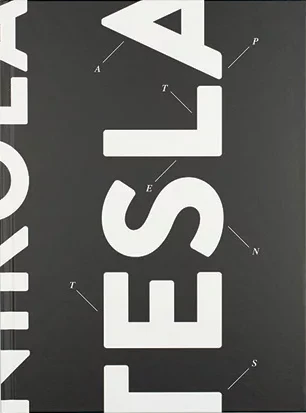
The best way into Tesla’s mind is through his patents, and the United States Patent Office has 112 of them on record. This book collects every one in chronological order across 500 pages, with the original technical drawings: cut-away motors, coils and circuit diagrams that are among the finest engineering draughtsmanship of the nineteenth century.
Behind a black cover with enormous type, it is the book on this list most likely to be picked up by an engineer and not put down again.
No. 29 · Kronecker Wallis · about 300 drawings
Alexander von Humboldt
Humboldt's drawings, bound on papers you can feel change.
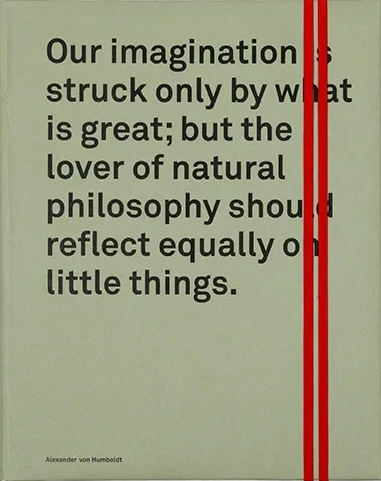
Alexander von Humboldt spent five years crossing South America from 1799 and later travelled across Siberia, and he backed his notes with a vast number of drawings. This book gathers about 300 of them, in the same spirit as Haeckel’s plates, with captions in English, German and Spanish.
Its trick is tactile: each section is printed on a different paper, with a different texture and size, so you feel the book change as you travel through it. It sells out often, which is a good reason to watch for it.
No. 30 · Kronecker Wallis · hand-sewn, numbered
Carl Friedrich Gauss
The private notebooks of the prince of mathematicians, redrawn by hand.
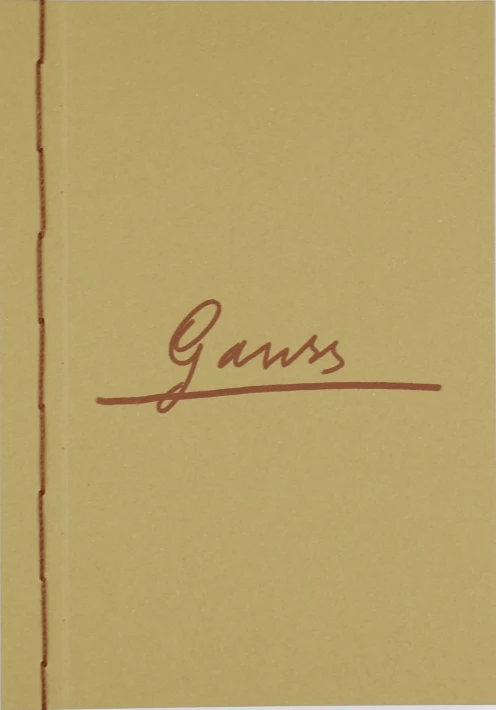
Carl Friedrich Gauss filled private notebooks with discoveries he never published. This edition gathers five of them, and every page has been redrawn by hand from the original scans, so the handwriting is his and the print is perfectly sharp. The large diagrams unfold as A4 inserts, which the unglued Japanese stab binding makes possible; each copy is hand-sewn and numbered.
Inside is the diary entry of 10 July 1796, where the nineteen-year-old Gauss wrote ΕΥΡΗΚΑ and proved that every positive whole number is a sum of three triangular numbers. It is the smallest object in this room and the most intimate. For more pages like it, see our pieces on original math papers and Dirac’s handwritten thesis.
A coffee table is the one shelf in the house that strangers read. What you put on it says what you find interesting, and it hands that interest to whoever sits down. That is why I would rather see a pasta equation or a Japanese temple problem there than another monograph nobody opens.
Start with Haeckel or Byrne if you want the safest bet, Pasta by Design if you want the biggest reaction, and the Principia if you want something to leave to your grandchildren. And if a guest walks off with one, take it as a compliment. For a reading list with a very different spirit, try the books Einstein recommended.
A good coffee table book can be opened at any page and reward you within seconds, is printed large on paper that survives handling, and teaches something alongside its pictures. The best ones also look good closed, because the cover is what starts a conversation.
The Art and Science of Ernst Haeckel, Overview by Benjamin Grant, Philip Ball's Patterns in Nature and The Architecture of Trees are the strongest picks for nature and science. For mathematics, start with Oliver Byrne's coloured Euclid, Beautiful Geometry and The Magic Mirror of M.C. Escher.
Yes, especially for someone hard to buy for. A coffee table book is a book and an object at once, so it works even for people who do not read much. Match it to their interest: Pasta by Design for a cook, Grid Systems in Graphic Design for a designer, Newton's Principia collector's edition for a history-of-science fan.
Oliver Byrne's 1847 edition of Euclid, which replaces letters in the proofs with red, yellow and blue shapes, is the usual answer, and TASCHEN's facsimile makes it affordable. De Divina Proportione, with Leonardo da Vinci's drawings of polyhedra, is the oldest contender.
Keep wandering
A few more pieces in the same spirit — math, design, and slow attention.
18 Books Einstein Recommended: From Euclid to Dostoevsky
Einstein never wrote a reading list. He left something better: the books that changed him, the ones he argued over in Bern, and the ones he wrote prefaces for.
Open
68 Best Geometry Books for Mathematicians and Designers
The beautiful, the rigorous, and the hard to find — six shelves running from Byrne's colored Euclid to the geometry of pasta, and the thesis that mathematicians and designers love the same books.
Open
15 Science Books That Print Like Design Objects: The Kronecker Wallis Catalog
A small publisher in Barcelona turns the most important texts in the history of science — Newton, Euclid, Gauss, Turing — into design objects.
Open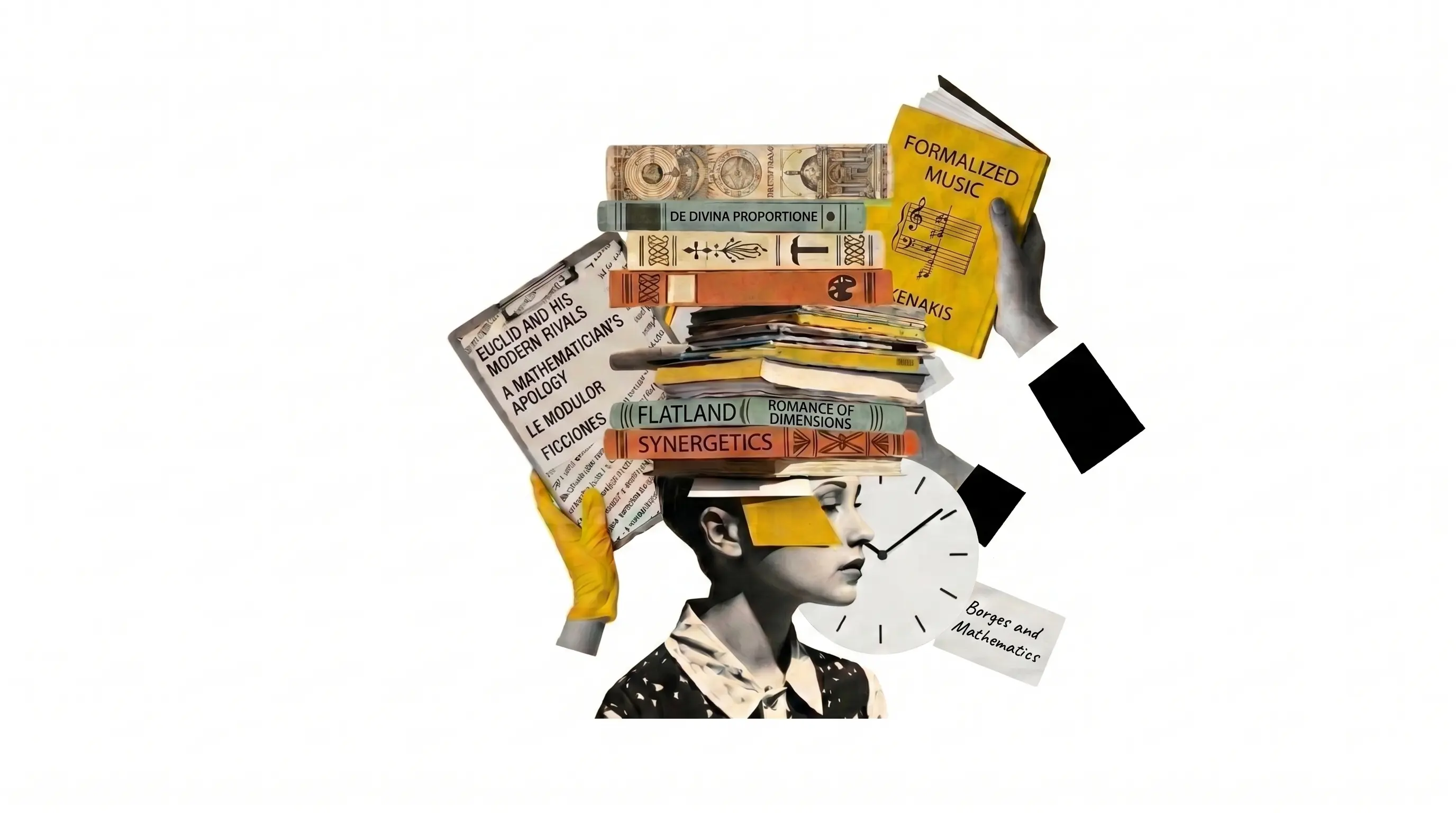
14 Mathematics Books Written by Artists, Architects, and Writers
Pacioli, Dürer, Carroll, Borges, Xenakis — fourteen books on mathematics written by painters, composers, architects, and novelists who never held a faculty position.
Open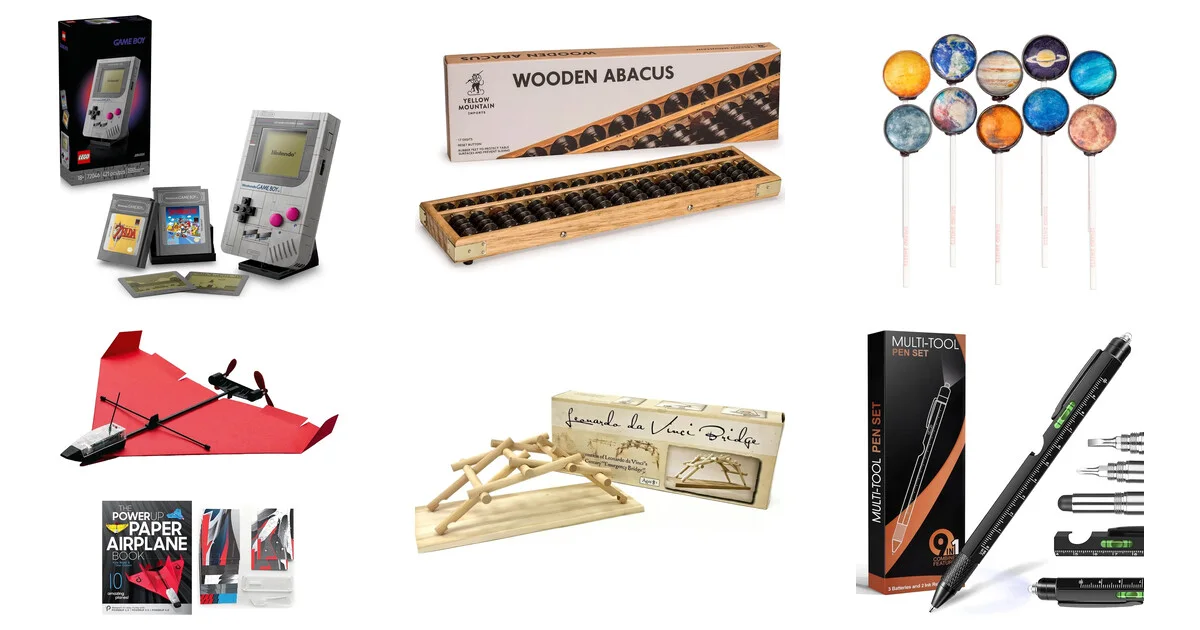
Gifts for Nerds: 18 Gadgets for Engineers and Math Lovers
A soroban, a paper plane with a motor, a Game Boy made of bricks and a lamp shaped like a tired duck: eighteen gifts for the people who take things apart to see how they work.
Open
The Best Math Movies: Lives Written on the Board
A Beautiful Mind, Good Will Hunting, Pi, Proof, The Imitation Game, Hidden Figures — twenty-three films where the mathematics is never really about the numbers, but about the people wrestling with them.
Open