n a London architecture office, late at night, two people are eating pasta. There's Chianti on the table — whether good or bad is unknown. George Legendre and his colleague Marco Guarnieri are looking at the same parametric equations they use during the day to define building facades. One of them says: “We're already doing this. For buildings. Why not for pasta?”
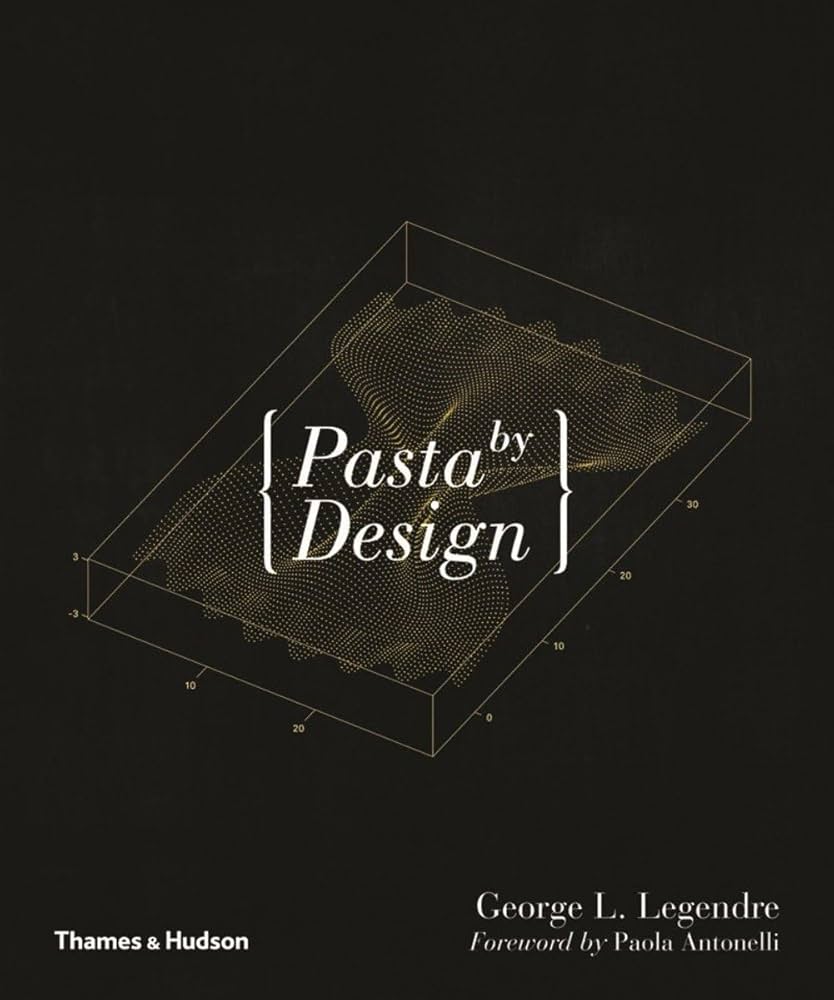
The book came out of that question. Thames & Hudson published it in 2011; it was translated into German the following year. The title is plain: Pasta by Design.
But what's inside is anything but plain.
This is not a cookbook
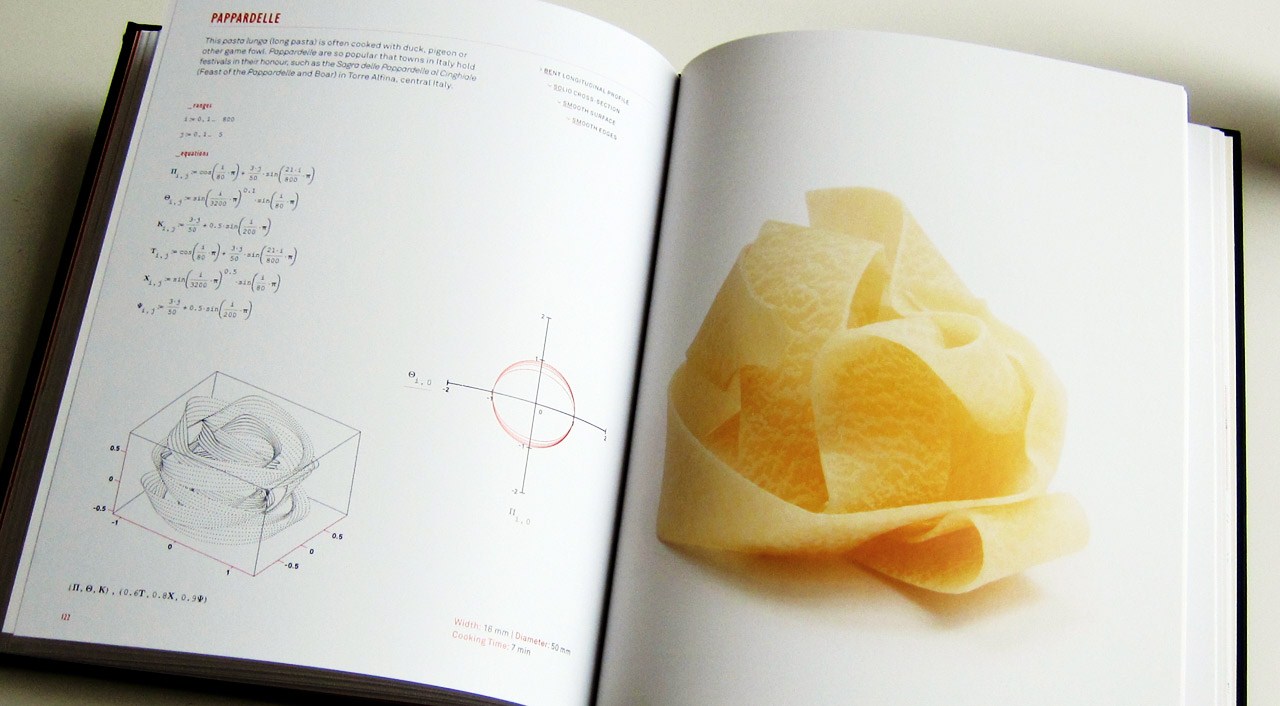
Open the book and there are no recipes. None at all. Instead: photograph, equation, wireframe drawing, brief description. The same format repeated for each pasta shape, 92 times.
Each pasta page carries: what the shape is, where it's eaten, which sauce might work — but these are supplementary. The main subject is mathematical structure. Each shape is defined by three parametric equations using only two trigonometric functions: sine and cosine.
From fusilli to cappelletti, from spaghetti to pappardelle — the same mathematical skeleton underlies them all. Legendre's claim: there is a geometric logic connecting all pasta shapes, and that logic can be written as a formula.
Pasta by Design — By the Numbers
92
Pasta shapes catalogued
3
Parametric equations defining each shape
2
Core functions used: sin and cos
208
Pages — 90 colour photos, 200+ illustrations
4.3
Amazon rating (44 reviews)
2012
Year of German translation
Phylogenetics — or treating pasta like a living specimen
Legendre borrowed a tool from biology to classify pasta shapes: phylogenetics. This is a method that maps morphological kinship relationships — similarities in form, structure, and origin — among living species. Normally used to measure the structural distance between whales and cows. Legendre used it to measure the geometric distance between rigatoni and penne.
The result: the family tree diagram at the front of the book. 92 pasta shapes arranged on a tree according to their geometric properties — edge type, surface texture, cross-section shape, folding method. It shows that two pasta shapes that look entirely different may actually belong to the same mathematical class.
Pasta Family Tree — Selected Branches
The equations — which is the whole point
Each pasta shape is defined by three equations: Π (Pi), Θ (Theta), and K, corresponding to the x, y, and z coordinates respectively. Parameters i and j take values over specific ranges; inside the equations you see only sin and cos.
Mathematically, this is parametric surface modelling. Architects use it to design building facades. Legendre applied the same system to his dinner. The geometry escapes the kitchen in other ways too — a Pringle chip is a hyperbolic paraboloid, shaped that way for the same structural reasons that keep thin-shell roofs standing.
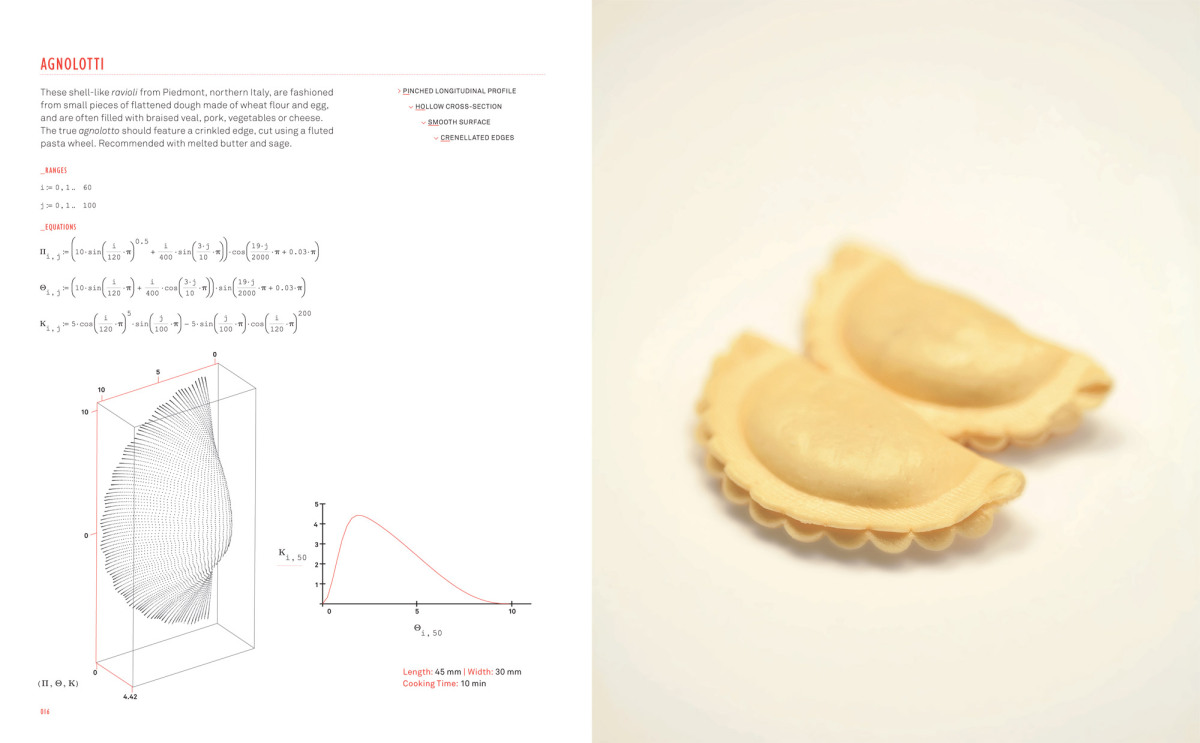
Cappelletti
A northern Italian Christmas tradition. Served in chicken broth. The name means “little hats.”
i = 0…40  j = 0…120

Π = (0.1+sin(3i/160·π))·cos(2.3j/120·π)
Θ = (0.1+sin(3i/160·π))·sin(2.3j/120·π)
K = 0.1+j/400+(0.3−0.231·i/40)·cos(i/20·π)
Cavatappi
36 mm long hollow helicoidal tubes. The name means “corkscrew.” Sauce gets inside and stays there.
i = 0…70  j = 0…150

Π = (3+2·cos(i/35·π)+0.1·cos(2i/7·π))·cos(j/30·π)
Θ = (3+2·cos(i/35·π)+0.1·cos(2i/7·π))·sin(j/30·π)
K = 3+2·sin(i/35·π)+0.1·sin(2i/7·π)+j/6
“Seeing mathematics in fusilli makes perfect sense today. Programmers talk about beautiful code, and designers use math to create organic shapes.”
— Paola Antonelli, MoMA Curator of Design & Architecture (foreword)
The book's quiet argument
There is also this: Italian nonnas who have been making pasta for centuries already knew — without calculation — all the geometry Legendre spent years computing in a London office. Knowledge that lived in their hands, he formalised into symbols.
Is that an injustice? Perhaps. But it is also one of the oldest problems in the history of mathematics: the conversion of intuitive knowledge into symbolic knowledge. Turning a point into a line, a line into an equation. In a way, Legendre paid the nonnas a compliment — he found their shapes so beautiful he wanted to make them permanent. Henry Billingsley had the same instinct in 1570 — his English Euclid came with paper fold-out solids you could hold in your hand.
MIT Media Lab · 2017 · Tangible Media Group
Flat sheets that become pasta in water
A 2017 project at MIT's Tangible Media Group took the parametric logic of Legendre's book somewhere entirely different: instead of describing pasta shapes mathematically, the team built pasta that assembles its own shape when submerged in water.
The mechanism is simple. A flat two-layer film of gelatin — top layer denser than the bottom — curls when wet, because the layers absorb water at different rates. By printing thin strips of edible cellulose onto the surface in specific patterns, the researchers could control exactly where and how much the film bent. The result: flat discs that spring into macaroni, rotini, saddle shapes, flowers — whatever the cellulose pattern dictates.
“We thought maybe in the future our shape-changing food could be packed flat and save space.”
— Wen Wang, MIT Media Lab
The practical argument: a box of conventional macaroni is 67 percent air by volume. Flat sheets stack efficiently, take less packaging, ship for less. The team called it “the pasta manufacturer's IKEA model” — pass the compression savings to the consumer.
Legendre catalogued pasta geometry. MIT's Tangible Media Group went one step further and made the geometry dynamic — shape as behaviour, not just form. The connection is more than metaphorical: both projects treat pasta as a design problem first, a food problem second.
A working taxonomy
Selected shapes from Legendre's catalogue, mapped by category, geometric profile, regional origin, and canonical sauce pairing.
| Name | Category | Shape | Region | Best with |
|---|---|---|---|---|
| Spaghetti | Lunga | Cylindrical solid | Nationwide | Clams, carbonara, aglio e olio |
| Pappardelle | Lunga | Flat wide ribbon | Tuscany | Wild boar ragù, hare |
| Linguine | Lunga | Flat elliptical strand | Liguria, Naples | Pesto genovese, seafood |
| Penne rigate | Corta | Ridged tube, angled cuts | Rome, Campania | Arrabbiata, amatriciana |
| Fusilli | Corta | Helical screw | Campania | Thick tomato, pesto |
| Rigatoni | Corta | Ridged large tube | Rome | Rich meat ragù, pajata |
| Farfalle | Corta | Ruffled edge, pinched centre | Lombardy, Emilia | Cream sauces, cold salads |
| Cavatappi | Corta | Hollow helicoidal tube | Campania | Thick tomato, baked dishes |
| Ravioli | Ripiena | Flat filled pillow | Widespread | Brown butter, sage |
| Tortellini | Ripiena | Folded toric ring | Bologna, Modena | Broth, cream |
| Cappelletti | Ripiena | Hat-shaped fold | Romagna, Marche | Broth, cream |
| Agnolotti | Ripiena | Folded half-moon | Piedmont | Roasting juices, butter |
Parametric Pasta Visualizer
Select a pasta — wireframe generated from equations
Spaghetti
Π = r·cos(t) | Θ = r·sin(t) | K = s · Cook: 8–10 min.
Who should read this book?
No one and everyone. The honest answer: if you're looking for recipes, you're at the wrong shelf. If you want to understand how pasta engineering works, why some shapes hold sauce and why others don't — the book explains those too, but as footnotes.
The real audience sits at the intersection of any of these: mathematicians, architects, designers, data visualisation practitioners, Montessori teachers, and pasta enthusiasts who don't mind being a little peculiar — the same breed that finds a shelf built on the Fibonacci sequence perfectly reasonable as furniture.
One Amazon reviewer loaded the equations into Mathematica and started spinning the 3D shapes on screen — children who saw it all said “let me try that!” That is one of the finest things a book can achieve.
George L. Legendre
Architect · Writer · Harvard GSD Professor
Founding partner of IJP Architects. Specialist in complex surfaces. Graduated from Harvard GSD in 1994, later taught at ETH Zurich, Princeton, and the AA School of Architecture. The firm's signature works include the Henderson Waves bridge in Singapore (300 metres) and the steel Equinox sculpture in Birmingham. Pasta by Design is part of a research series exploring the intersection of mathematics and design.
Book Details
- Title
- Pasta by Design
- Author
- George L. Legendre
- Publisher
- Thames & Hudson
- Year
- 2011
- Pages
- 208
- ISBN
- 978-0-500-51580-0
Reviews
- MoMA
- Foreword by Paola Antonelli
- Amazon
- 4.3 / 5 (44 reviews)
- Wallpaper*
- Editors' Pick, 2011
- German ed.
- 2012, DVA Verlag