Curves that carry load show up in stadium roofs and in the snack aisle — if you know where to look.
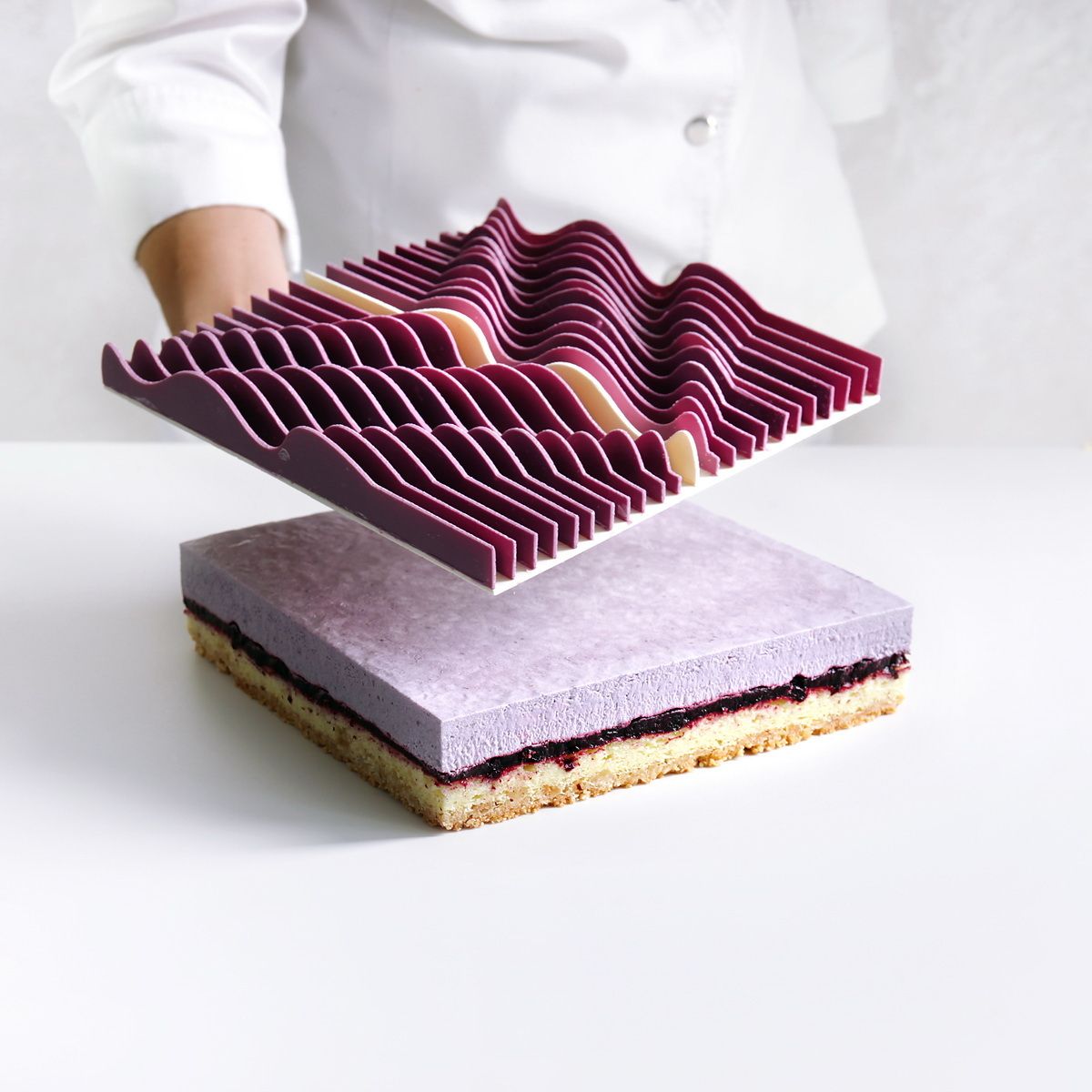
More food where the geometry is the point: Pasta by Design, which writes an equation for every pasta shape; Dinara Kasko's kinetic tarts; and a solar system in Belgian chocolate. For another surface built from nothing but straight lines, make a hyperbolic slot; for a surface that refuses to have two sides, the Möbius strip.
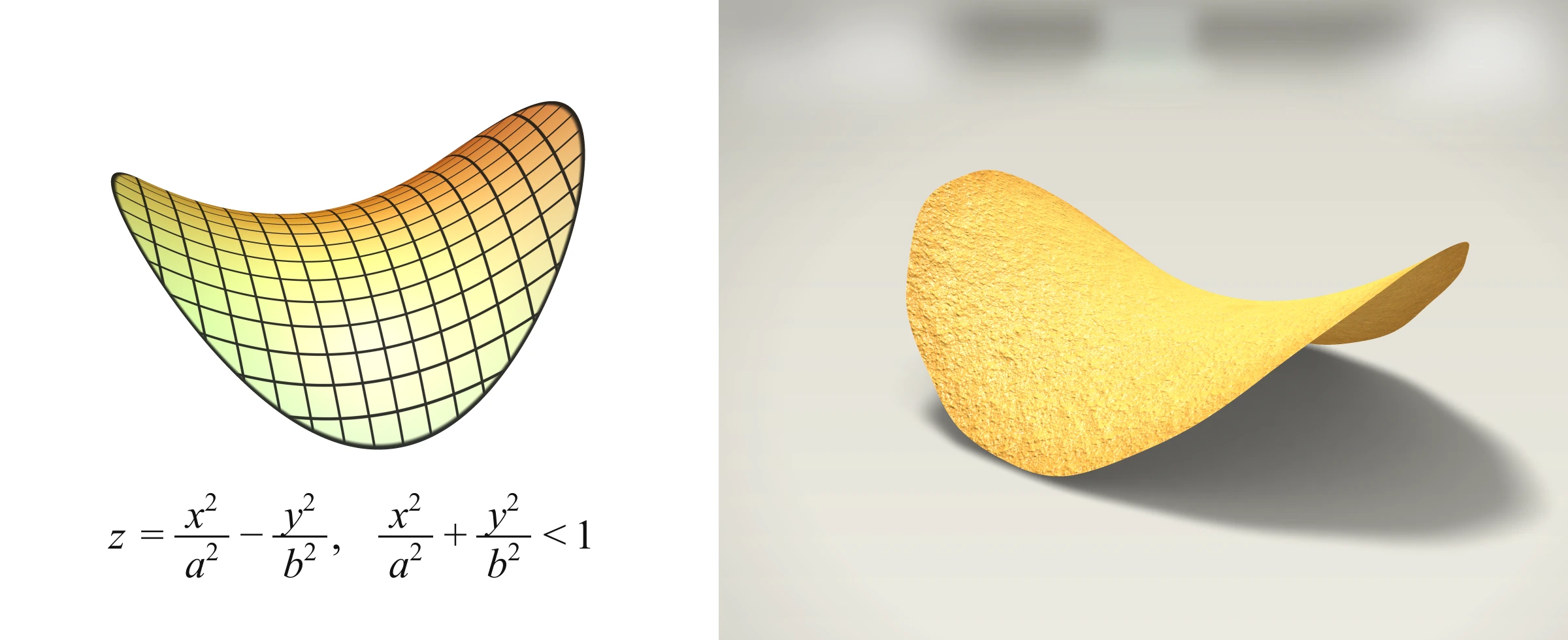
The problem Fredric Baur was actually solving
In the 1960s, Procter & Gamble chemist Fredric J. Baur was handed a brief that sounds mundane and turned out to be geometric: make a chip that doesn't arrive broken. Ordinary chips — sliced from whole potatoes, fried, tumbled into bags with a cushion of gas — reached the shelf as a mix of whole chips, halves and crumbs, with plenty of air in between.
The trouble is that every sliced chip has its own accidental shape. In a bag, chips touch each other at a handful of points, in random orientations, and every bump in the truck concentrates load on those points. No packing scheme can fix that, because no two chips are alike.
Baur's answer was not a tougher chip. It was a chip that is the same every time — pressed from dough into one precise curved shape — so that the chips could be stacked like spoons inside a rigid tube. The shape that makes this work was already well known to architects and mathematicians. It is called a hyperbolic paraboloid.

What a hyperbolic paraboloid actually is
The name sounds formidable; the shape is not. Picture a square frame of wire. Lift two opposite corners and push the other two down. A soap film or a stretched cloth spanning that frame takes a shape that rises along one diagonal and falls along the other. That is a hyperbolic paraboloid.
In coordinates it is the graph of a single equation, with one plus and one minus:
The surface, and the oval that cuts out the chip
The minus sign does all the work. Hold y fixed and z grows like +x²: a parabola opening upward. Hold x fixed and z falls like −y²: a parabola opening downward. Slice the surface vertically and you get parabolas; slice it horizontally (z = constant) and you get hyperbolas. That is where both halves of the name come from. The second inequality is the cookie cutter: the oval outline of the chip.
The point at the center is a saddle point: a minimum if you walk along x, a maximum if you walk along y. It is the same object that shows up in multivariable calculus when the second-derivative test comes back inconclusive — a critical point that is neither a peak nor a valley.

Negative curvature, and why you can't flatten a Pringle
At every point of a smooth surface there are two principal curvatures: the most the surface bends in one direction and the most it bends in the perpendicular one. Their product is the Gaussian curvature, K. On a sphere both bend the same way, so K is positive. On a cylinder one of them is zero, so K = 0. On a saddle they bend in opposite directions, so K is negative — everywhere.
For our chip the standard formula for a graph z = f(x, y) gives
Gaussian curvature of the Pringle surface
Two things to read off. The curvature is negative at every point, and it is strongest at the center, where it equals −4/(a²b²), fading toward the rim. A Pringle is not uniformly curved; it is most sharply saddled in the middle.
To put numbers on it, give the saddle a height h, so that z = h(x²/a² − y²/b²). Take a chip roughly 7 cm long and 5 cm wide (a ≈ 3.5 cm, b ≈ 2.5 cm) whose tips sit about 1 cm above its low points (h ≈ 0.5 cm). These are ruler-on-the-kitchen-table figures, not factory specs, but they give the idea:
An illustrative chip: principal radii at the center
At its center, then, the chip curves up along its length like a circle of radius about 12 cm, and down across its width about twice as sharply, like a circle of radius about 6 cm.
Now Gauss's Theorema Egregium — his “remarkable theorem” of 1827 — says that K cannot change when a surface is bent without stretching. A flat sheet has K = 0. So no amount of careful bending will turn a flat sheet of paper into a Pringle; you would have to stretch or crumple it. The wire-frame picture above works because a soap film or cloth can stretch. Paper can only approximate the shape with creases.
Why this shape is structurally strong
A flat plate under a load in the middle has only one way to resist: it bends, and bending in a thin brittle sheet ends quickly in a crack. A doubly curved shell can resist differently. Because it cannot bend without stretching, a load on it is carried mostly as membrane forces — pushes and pulls running along the surface — rather than as bending. Thin materials are far stronger in membrane action than in bending.
The opposing curvatures brace each other. The shape that looks precarious — curving two ways at once — is exactly the shape that refuses to fold.
On a hyperbolic paraboloid the two families of curves play complementary roles: along the arch-like direction the surface works in compression, along the hanging-cable direction it works in tension. Engineers exploit this at building scale for the same reason Baur exploited it at snack scale: a very thin shell can span a lot of space.
None of this makes a Pringle indestructible — anyone who has reached the bottom of a dropped can knows better. What the geometry buys is a chip that is stiff for its thickness and is loaded gently by its neighbors, which is all a stack in a tube needs.
The stackability constraint
Stacking has a simpler requirement than strength: the chips must be identical. If every chip is the same surface z = f(x, y), then the chip above is just the chip below shifted straight up by its own thickness, and the two touch along a broad area instead of at a few points.
Any repeatable shape would stack. The saddle is a good choice because it does several jobs at once: it is stiff, as above; its oval outline fits a round tube; and its curvature keeps each chip centered on the one below, so the column doesn't slide sideways. Sliced potato chips can't play this game at all — they are all different.
One refinement. Shifting a chip straight up by t keeps the vertical gap at t everywhere, but the gap measured perpendicular to the surface is t·cos θ, where θ is how steeply the chip slopes at that point. Near the center the chip is almost flat and the two gaps agree; out toward the rising tips the slope grows and the chips sit closer together, face to face. The stack is snuggest exactly where the chip is steepest.
Gap normal to the surface between two chips offset vertically by t
The can follows from the chip. A column of identical ovals is, in effect, a cylinder, and a cylinder is the cheapest rigid container to make. Chip, stack and container are three consequences of a single decision: make every chip the same saddle.
How the shape is manufactured
A slice of real potato can't be pressed into a precise saddle; its cellular structure tears and springs back. So Pringles are not potato chips in the usual sense. They are made from a dough of dried potato flakes with wheat starch, rice flour and corn flour, rolled into a thin uniform sheet and cut into ovals while still flat and pliable.
- Forming on a saddle moldEach flat oval is laid on a curved carrier shaped to the target saddle, and a matching mold closes over it. The dough takes the shape while it is still soft.
- Frying while constrainedThe chip is fried while still held in the mold. Frying drives off the water and sets the starch, freezing the saddle in place. Fried loose, the same dough would curl unpredictably.
- Stacking and canningAfter seasoning and cooling, the chips come off the line already nested and oriented the same way, and the stack is fed straight into the tube. That only works because every chip is the same shape.
The snap
Bite a Pringle and it doesn't bend first; it breaks, cleanly and loudly. Part of that is the material. A properly crisp chip is a glassy starch foam, and glassy materials fail suddenly rather than slowly. A chip pressed into a mold and fried while held there may also carry some locked-in residual stress, which would help a crack, once started, run away. Part of it, plausibly, is the shape.
A flat cracker can flex a little under your teeth before it gives way, so the crack starts gently. A doubly curved shell cannot flex without stretching, so it stores the force of the bite as stress across a wider region and then lets go all at once. That is a qualitative argument, not a measured one — but it matches what your ears tell you.
A shape that cannot bend has only one way to give up: suddenly.
It also explains the sad, quiet chip at the bottom of a can left open overnight. Water softens the starch, and the chip can now flex and tear instead of snapping. The geometry hasn't changed; the material has stopped cooperating with it.
A geometry built from straight lines
Here is the property that makes the hyperbolic paraboloid so popular with builders. Factor the equation:
A difference of squares hides two families of straight lines
Fix the first bracket at some constant, and z becomes a linear function of what is left — a straight line lying entirely on the surface. Fix the second bracket instead and you get a second family of straight lines. Through every point of the curved chip pass exactly two straight lines that stay on it. Switch the explorer above to “Straight lines” to watch them.
This is why Candela could pour curved concrete over formwork made of straight timber boards: lay straight boards between two skewed edge beams, and they automatically trace a hyperbolic paraboloid. The shell is curved; every piece of wood under it was straight.
It is also the deeper reason the same shape turns up in a Mexican church roof and an American snack. The hyperbolic paraboloid sits at a rare intersection: it is analytically simple, structurally efficient, and buildable from straight elements. Fredric Baur was solving a packaging problem, not designing a roof. But the geometry of efficient thin shells doesn't care about scale — it works the same for a concrete canopy over a restaurant in Xochimilco and for a stack of chips in a can.
Hold negative curvature in your hands
A Pringle is the edible version of a saddle. If you want one that doesn't go stale — and whose curvature never fades toward the edge — you can crochet it.
Pringles geometry: quick answers
›What shape is a Pringle?
A Pringle is a hyperbolic paraboloid — a saddle surface described by z = x²/a² − y²/b², cut to an oval outline. It curves up along its long axis and down along its short axis.
›Why are Pringles shaped like a saddle?
Because identical saddle-shaped chips nest into one another, so they can be stacked in a rigid tube instead of tumbled loose in a bag. The double curvature also makes each thin chip much stiffer than a flat one of the same thickness.
›Who invented the Pringles shape?
Procter & Gamble chemist Fredric J. Baur, together with Harold Kenneth Hawley, filed the patent for saddle-shaped chips stacked in a can on July 29, 1966. US Patent 3,498,798 was granted on March 3, 1970.
›Is a Pringle a hyperbolic paraboloid or a hyperboloid?
A hyperbolic paraboloid. A hyperboloid is a closed, tube-like surface (think cooling towers); a hyperbolic paraboloid is an open saddle. Both are doubly ruled — each can be built entirely from straight lines.
Sources: US Patent 3,498,798, “Packaging of Chip-Type Snack Food Products” (Baur & Hawley, filed 1966, granted 1970) · C. F. Gauss, Disquisitiones generales circa superficies curvas (1827) · F. Candela, “Understanding the Hyperbolic Paraboloid,” Architectural Record, 1958.