A growing nose is a lever. By the thirteenth lie, the physics wins — and the fairy tale ends on a spreadsheet.
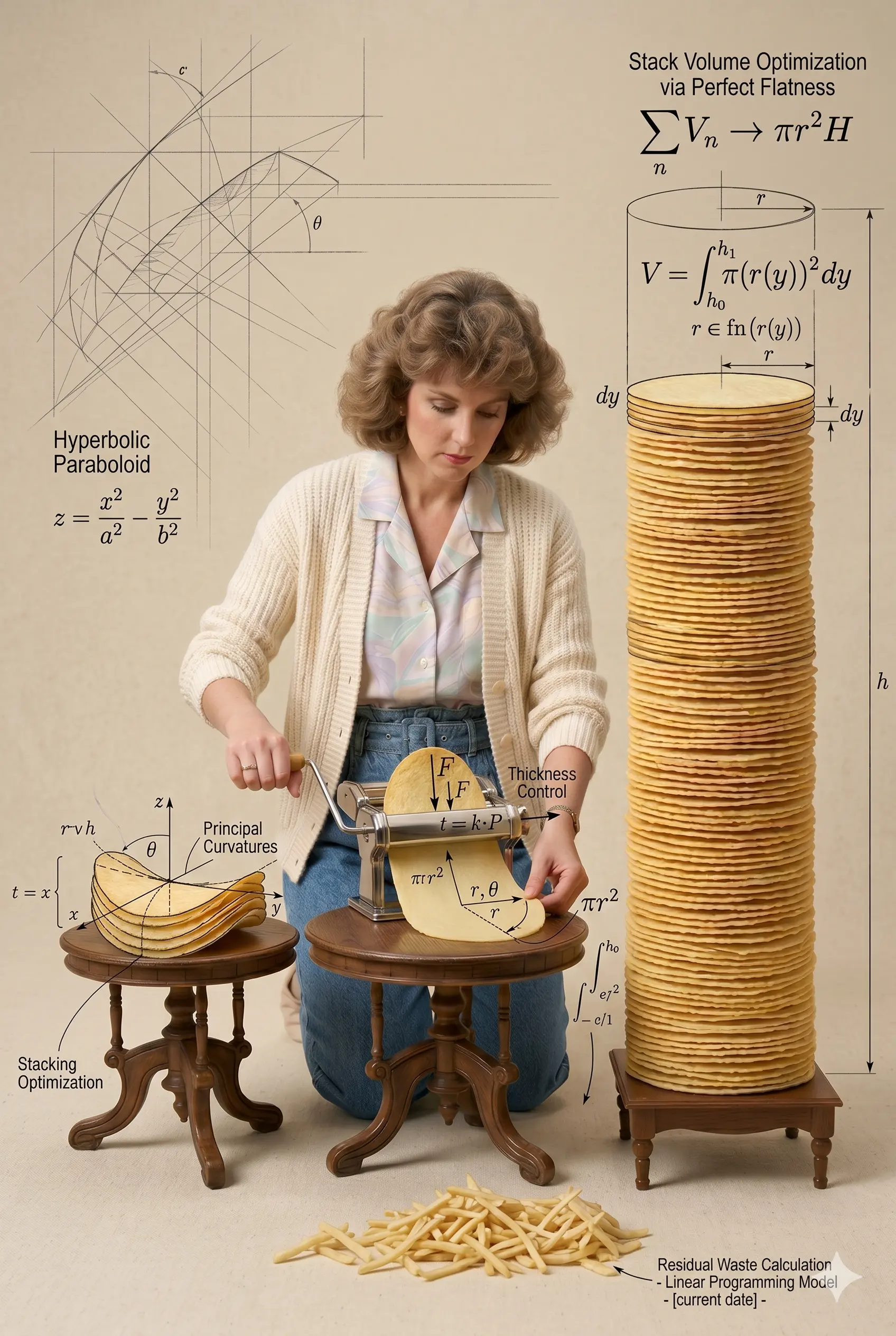
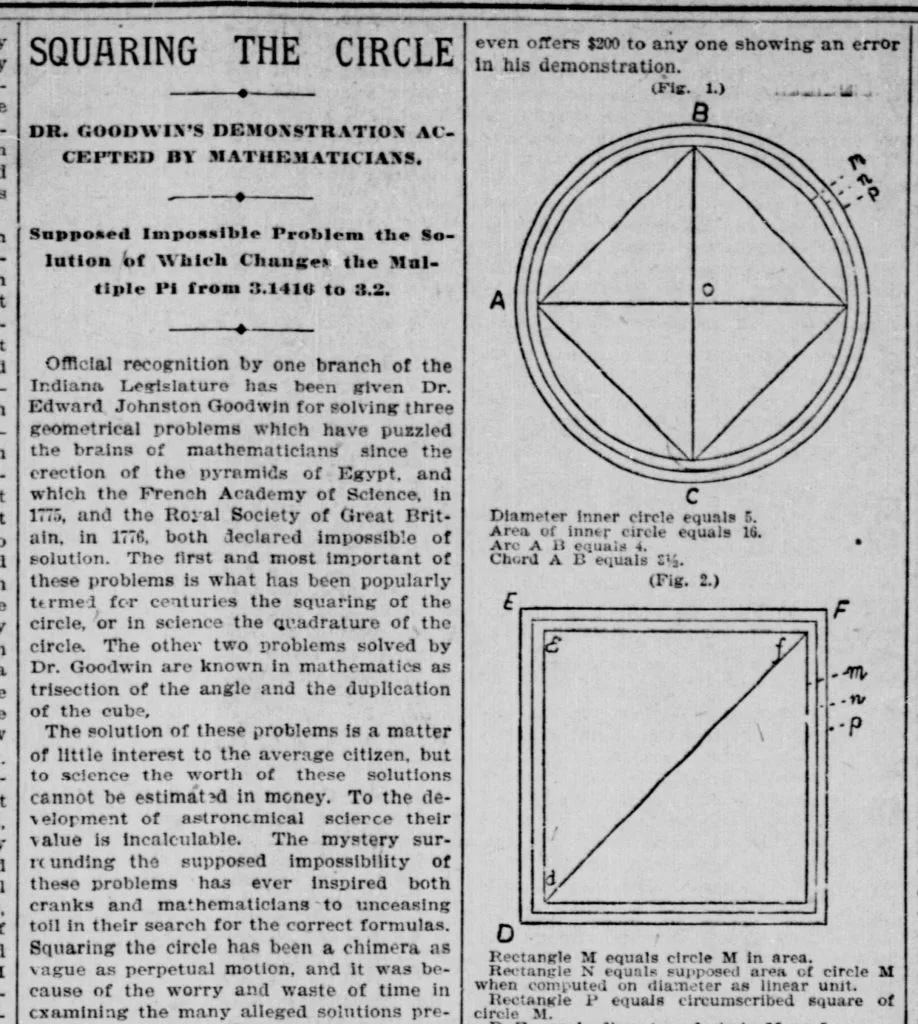
On Abakcus, this sits next to other stories that put serious tools on unlikely questions — from the geometry of a Pringle to the Indiana legislature's attempt to vote on π. Here, π shows up quietly in the neck model — not as politics, but as circumference.

The paper that nobody asked for, and everyone needed
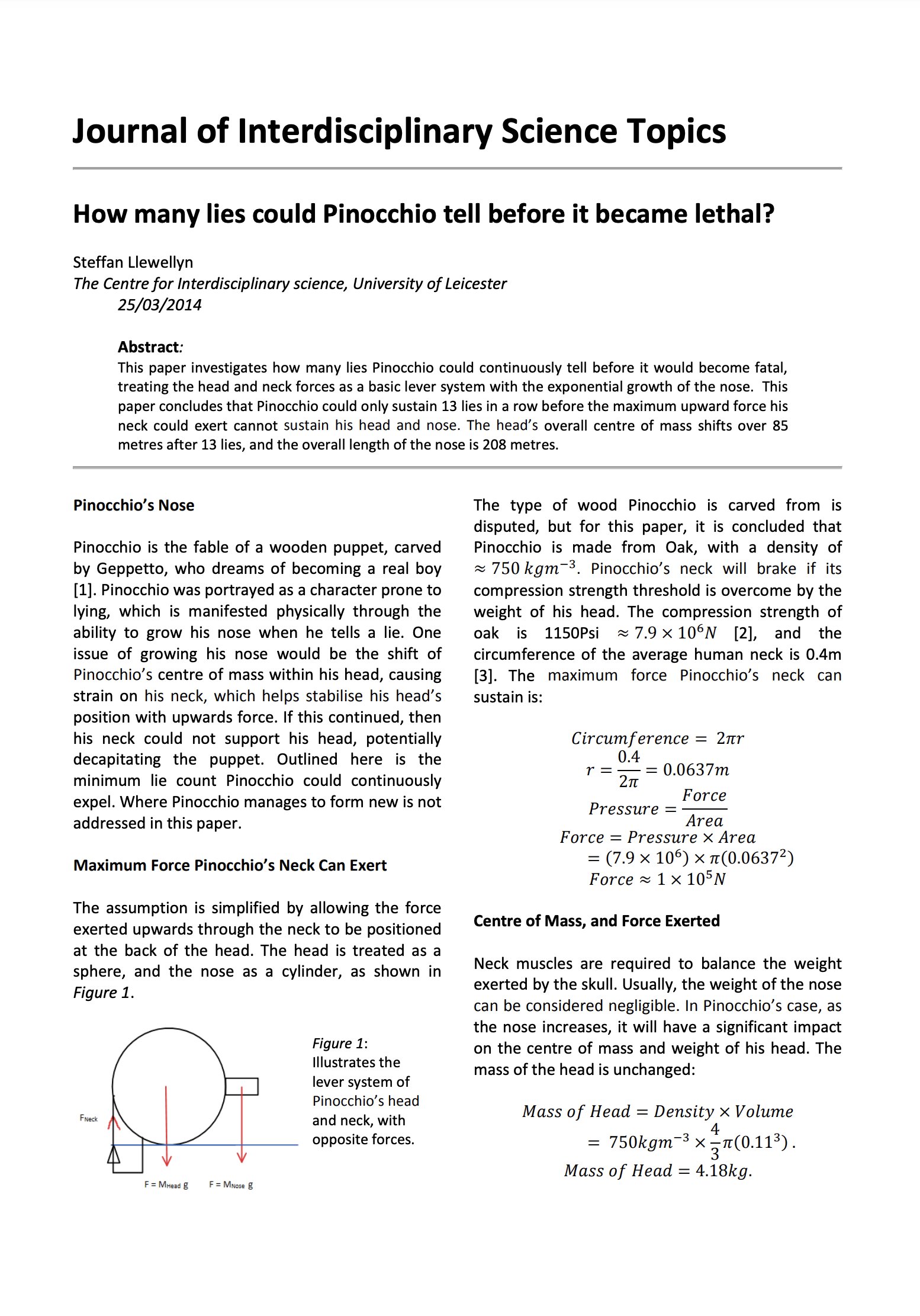
In 2014, Steffan Llewellyn of the University of Leicester submitted a paper to the Journal of Interdisciplinary Science Topics under the title “How many lies could Pinocchio tell before it became lethal?” The journal — which exists specifically to publish rigorous analyses of questions nobody actually needed answered — accepted it. The paper runs two pages, includes two graphs, and reaches a precise conclusion through Newtonian mechanics applied to an Italian children's character.
The setup is straightforward: Pinocchio's nose grows when he lies. Disney's version, working from Carlo Collodi's 1883 original, shows the nose doubling in length with each lie. The paper asks what happens to the structural load on Pinocchio's neck as this process continues. The head and neck are modelled as a lever system. The nose is a cylinder of oak. The neck is a column of oak. The physics is real. The subject is a puppet.
What Pinocchio is made of, and why it matters
The material choice is disputed in the source literature — the original novel never specifies the wood. Llewellyn resolves this by assuming oak, a reasonable default for Italian carpentry in the 1880s. This gives a density of approximately 750 kg/m³. The mechanical properties of oak are well-documented: its compression strength is 1,150 psi, or roughly 7.9 × 10⁶ N/m².
The head is modelled as a sphere of radius 11 cm — anatomically plausible for a puppet. The nose starts at 1 inch (2.54 cm) in length and 2 cm in diameter, and doubles in length with each lie while maintaining constant density. The neck is treated as a cylinder, with the circumference of an average human neck used as the reference: 0.4 m.
One hundred thousand newtons. That is the maximum downward force Pinocchio's neck can sustain before compression failure — before, in the paper's careful phrasing, “the supporting neck snaps.” This is the number Llewellyn spends the rest of the paper trying to reach through successive doublings of the nose. The same circumference–radius relationship underpins how we read angles and lengths on the unit circle— here, applied to a neck.
The lever system, and why the nose is worse than its weight
A growing nose is not simply a weight problem. It is a torque problem. The head and neck form a lever, with the neck muscles providing the upward force at the back of the skull to counterbalance the weight acting at the centre of mass of the combined head-and-nose system. As the nose extends forward, the centre of mass of the whole assembly shifts toward the front of the face. The lever arm lengthens. The required upward force at the neck increases accordingly — and this happens faster than the weight of the nose alone would suggest.
The initial mass of the head is calculated as follows: a sphere of radius 0.11 m, oak density 750 kg/m³, gives a head mass of 4.18 kg. The initial nose — 2.54 cm long, 1 cm radius — has a mass of 0.006 kg. Negligible. The initial force applied by the head-nose system to the neck is 4.51 N. Against a failure threshold of 100,000 N, Pinocchio has considerable margin.
The exponential nature of the problem
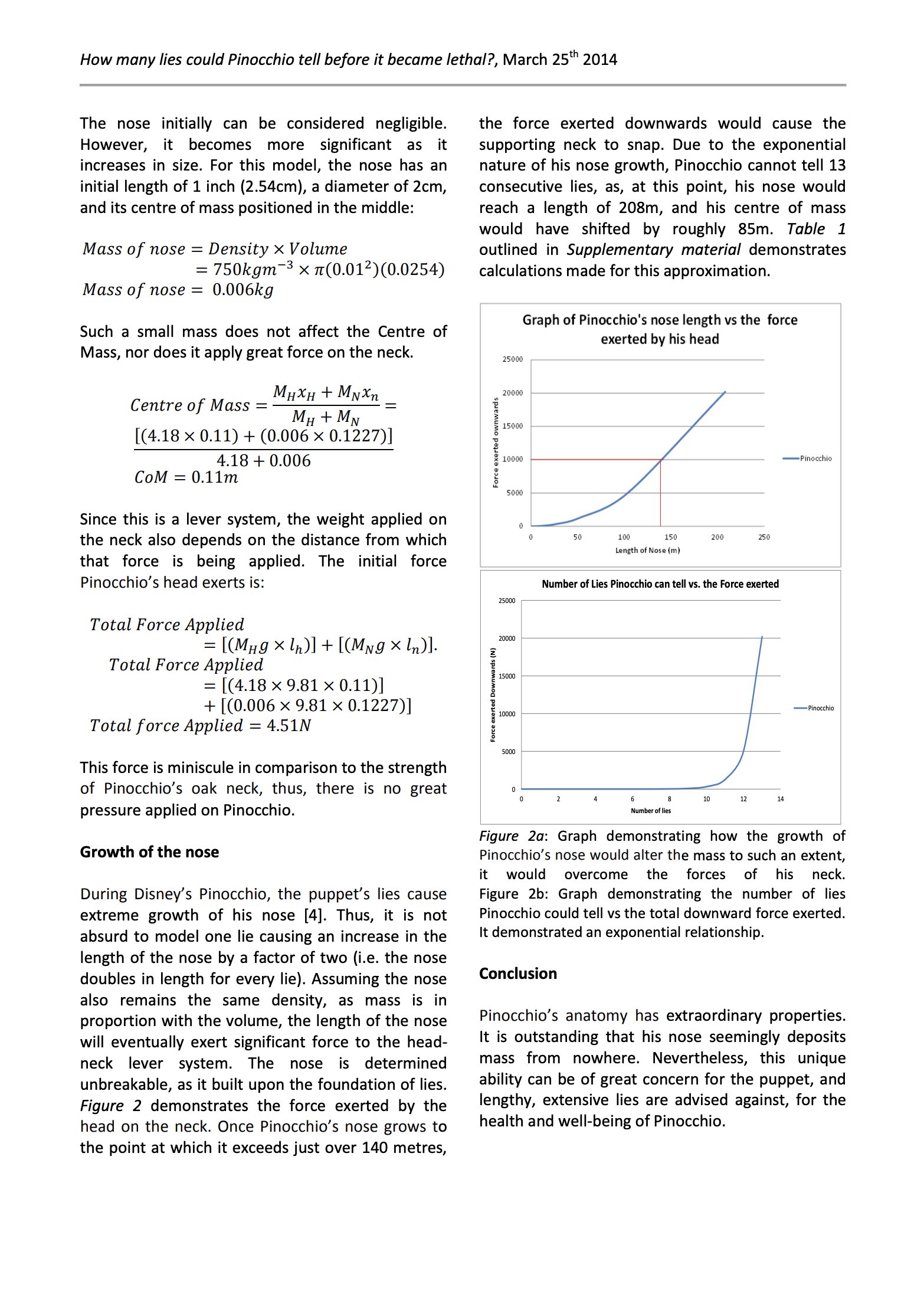
The nose doubles with each lie. This means the growth is exponential, not linear. The first several lies change nothing of structural consequence. By lie 7, the nose is 163 cm long — still manageable. By lie 10, it is 13 metres. By lie 12, it is 52 metres and the force applied to the neck has reached approximately 10,000 N — one tenth of the failure threshold.
Lie 13 is the catastrophic one. The nose reaches 208 metres in length. The mass of the nose — doubling with each lie under the paper's cylindrical model — becomes overwhelming. The total downward force applied to the neck crosses 100,000 N. The neck fails.
| Lie # | Nose length | Nose mass (kg) | Force on neck (N) | Status |
|---|---|---|---|---|
| 0 | 2.54 cm | 0.006 | 4.51 | Fine |
| 1 | 5.08 cm | 0.048 | 4.98 | Fine |
| 3 | 20.3 cm | 0.77 | 9.04 | Fine |
| 5 | 81.3 cm | 12.4 | 53.8 | Fine |
| 7 | 3.25 m | 198 | 812 | Fine |
| 10 | 26.1 m | 12,700 | 49,500 | Dangerous |
| 12 | 104 m | 50,900 | 99,400 | Critical |
| 13 | 208 m | 203,800 | ~100,000+ | Neck snaps |
The centre of mass, which started effectively at the centre of the head (0.11 m from the neck), has shifted to approximately 85 metres in front of Pinocchio's face by lie 13. The lever arm is 85 metres long. The weight at the end of it is the equivalent of a large truck. The neck of a puppet, however well made, does not survive this.
The shape of the failure curve
The relationship between number of lies and force on the neck is exponential with an inflection that makes the danger almost invisible until it is too late. Lies one through ten produce forces that remain comfortably below the failure threshold. The doubling happens silently in the background. Then, in three lies, the force goes from one tenth of threshold to past threshold. There is no warning slope. There is a cliff.
The shape is characteristic of all exponential processes: a long, deceptively flat beginning, followed by a nearly vertical rise. Had the nose grown linearly — say, by a fixed amount per lie rather than doubling — Pinocchio could have continued for centuries. Doubling is what makes it lethal at thirteen.
What the paper doesn't address, and what that means
Llewellyn is careful to note that the paper does not address where Pinocchio's nose mass comes from. Each lie doubles the nose length; under the cylindrical model (constant radius), volume — and mass — double with each lie. By lie 13, the nose has accumulated over 200,000 kg — the mass of several loaded freight cars — from a 6-gram starting point. The paper flags this as “extraordinary” and declines to speculate further.
This is the correct scientific approach. The paper is not a paper about the metaphysics of wooden puppet anatomy. It is a paper about structural mechanics, and it holds the problematic assumptions constant while solving the mechanics correctly. The nose deposits mass from nowhere; this is stipulated; given this stipulation, here is when the neck breaks.
The paper also declines to address where Pinocchio manages to form new nose material — whether from the air, from metabolic processes, or from some violation of conservation laws specific to enchanted carpentry. The conclusion notes only that this “unique ability can be of great concern for the puppet, and lengthy, extensive lies are advised against, for the health and well-being of Pinocchio.” This is the entire practical recommendation. It is, under the circumstances, sound advice.
Why this paper exists, and what it represents
The Journal of Interdisciplinary Science Topics is a course-based publication at the University of Leicester, designed to teach undergraduate students how to construct a scientific argument and submit it for peer review. The assignment is deliberately open: take any question and apply physics to it. The questions that emerge — whether the Death Star could destroy a planet, how many calories Jack Sparrow burns in a sword fight, whether Batman could survive his cape glide — are chosen for tractability, not gravity.
What makes Llewellyn's paper good, within its genre, is the precision of the mechanics. The lever system is correctly modelled. The centre-of-mass calculation is properly weighted. The failure criterion uses real material data for real oak. The exponential growth is applied consistently. The result — 13 lies, 208-metre nose, 85-metre centre-of-mass displacement — follows from the assumptions with no mathematical errors.
There is also something genuine in the result. Exponential growth that seems harmless for ten steps, then becomes catastrophic in three, is not a phenomenon unique to wooden noses. It appears in compound interest, in epidemic spread, in feedback loops of every kind — and in sequences that look innocent until they aren't, a theme we touch in pieces from the Fibonacci shelf to the six-book shelf on π. The intuition that Pinocchio's nose is probably fine after ten lies — the intuition that misses the cliff — is the same intuition that misreads exponential processes in every domain. Llewellyn's puppet is a clean, memorable illustration of why that intuition fails.
Source: Llewellyn, S. (2014). “How many lies could Pinocchio tell before it became lethal?” Journal of Interdisciplinary Science Topics, University of Leicester, 25/03/2014.