You cannot legislate a circle — but you can try. The record is public, the vote was unanimous, and the ratio of circumference to diameter was never going to care.
Dates and archival detail below follow the Indiana State Archives “From the Vault” post on the Pi Bill (1897); the legislative arc is also discussed in the scholarly literature, including Hallerburg (1974).
The problem with pi that nobody could solve
Pi is the ratio of a circle's circumference to its diameter. It's irrational — its decimal expansion goes on forever without repeating — and transcendental, meaning it cannot be the root of any polynomial equation with integer coefficients. The transcendence of pi, proved by Ferdinand von Lindemann in 1882, had one significant consequence: squaring the circle is impossible. You cannot, using only a compass and straightedge, construct a square with the same area as a given circle. It cannot be done. The proof is rigorous and complete. (Elsewhere on Abakcus, we stick to the circle you can draw — but the constant is the same one.)
This had been suspected for centuries. Ancient Greek geometers treated it as an open problem. Archimedes approximated pi to within about 0.04% using inscribed and circumscribed polygons. By the 18th century, mathematicians had established that the task was almost certainly impossible even if they hadn't yet proved it. By 1882, the impossibility was settled.
None of this stopped Dr. Edward J. Goodwin of Solitude, Indiana.
Dr. Goodwin's discovery
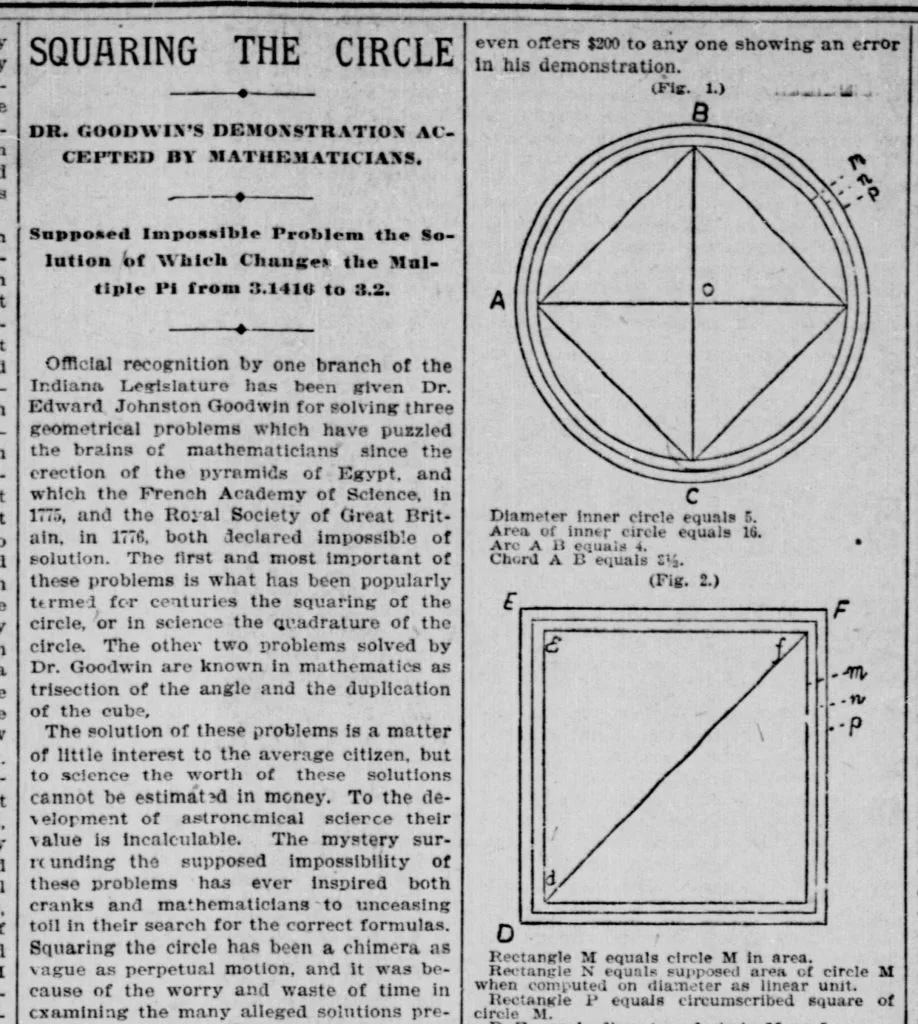
Goodwin was a physician, not a mathematician. In the late 1880s he became convinced he had solved the three classical problems of antiquity: squaring the circle, trisecting an angle, and duplicating the cube — all three of which had by then been formally proved impossible. He claimed the solution to squaring the circle had been revealed to him in March 1888. By whom, the record doesn't specify with precision.
His calculations were internally inconsistent. Different passages in his work imply different values of pi: 3.2 in some places, 4 in others, and in one remarkable stretch of reasoning, approximately 9.2376. The text was written in a style that mixed geometric diagrams, prose assertions, and conclusions that didn't follow from the premises in any traceable way.
The actual value. Irrational, transcendental, non-negotiable.
Goodwin's primary claim. The value the bill implicitly enacted.
Implied elsewhere in Goodwin's own paper. He didn't notice the contradiction.
In 1894, Goodwin submitted his paper, titled "Quadrature of the Circle," to the American Mathematical Monthly. It was published with the note "published by request of the author" — the journal's way of making clear that the editors had not reviewed or endorsed the content. It appeared anyway.
The bill
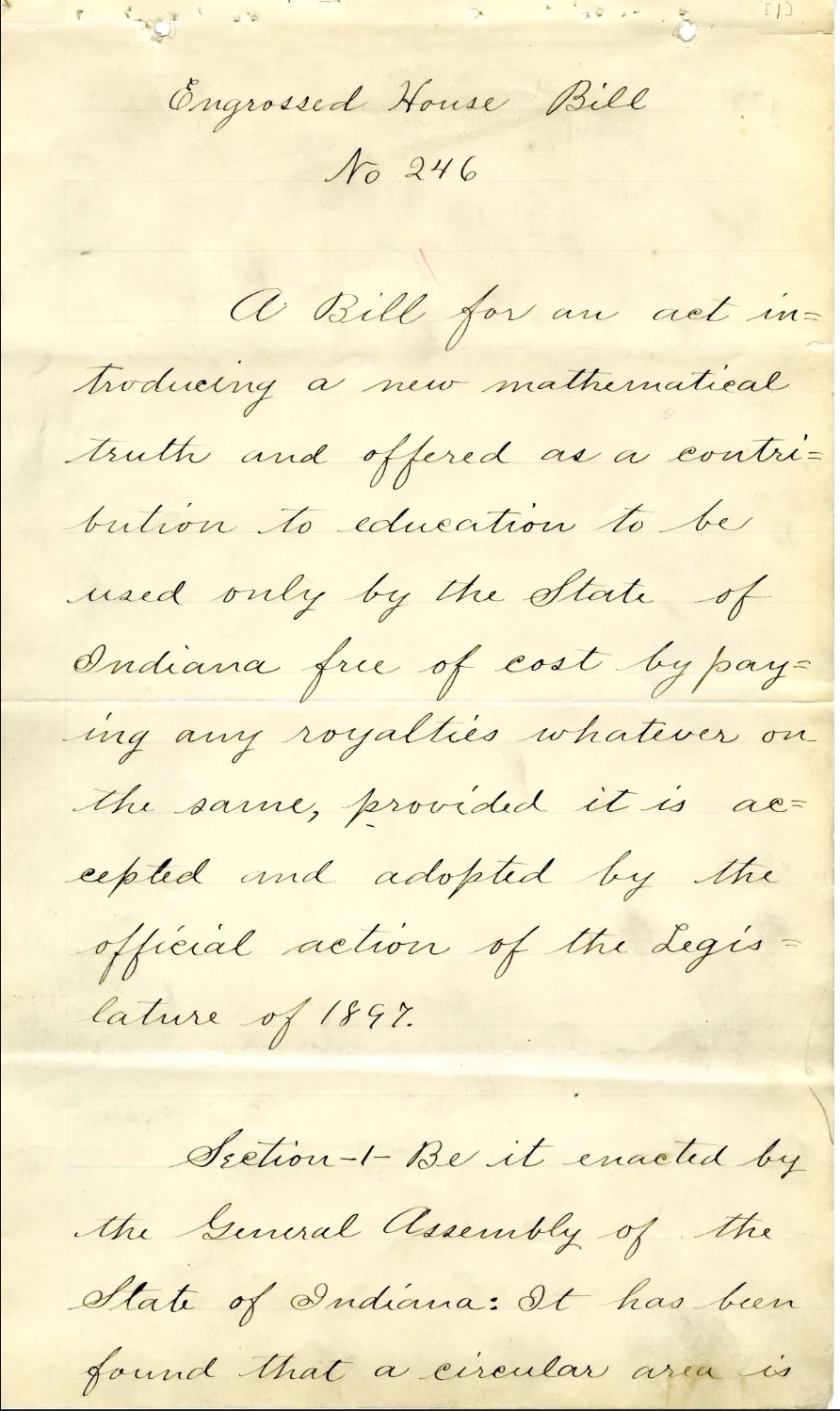
In January 1897, Goodwin persuaded Indiana state representative Taylor I. Record to introduce House Bill No. 246. Its official title: "A Bill for an act introducing a new mathematical truth and offered as a contribution to education to be used only by the State of Indiana free of cost by paying any royalties whatever on the same, provided it is accepted and adopted by the official action of the Legislature of 1897."
House Bill No. 246 — Indiana General Assembly, 1897
The bill never states "pi equals 3.2" directly. Instead it contains statements such as: "the ratio of the diameter and circumference is as five-fourths to four" — which implies π = 16/5 = 3.2 — alongside other passages that imply different values entirely. The text is not so much wrong as it is incoherent: a sequence of geometrical claims that cannot all be simultaneously true.
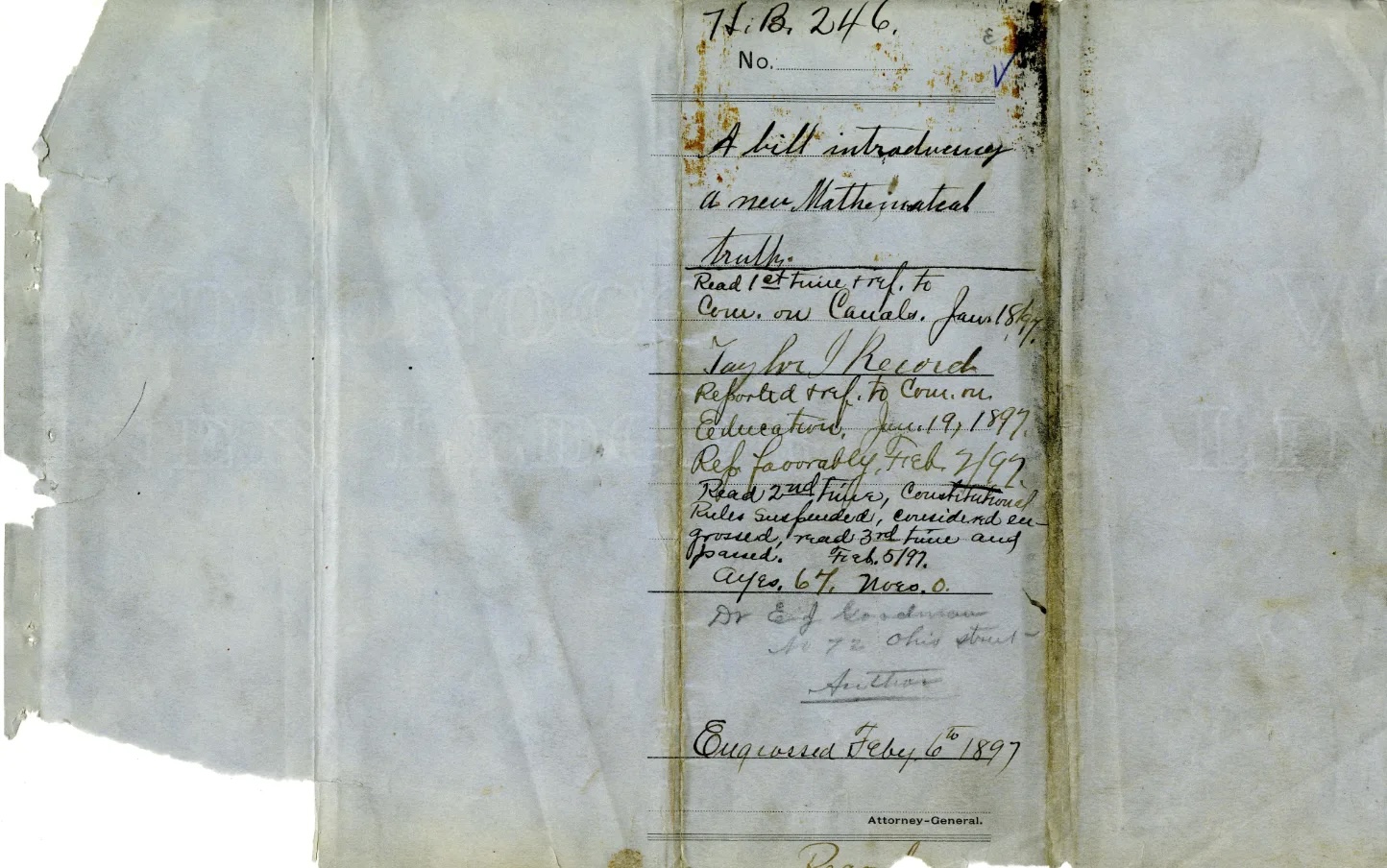
The bill was referred first to the House Committee on Canals — a detail that has amused historians ever since, though the referral may have been procedural rather than sardonic. It was then sent to the Committee on Education, which recommended it favorably. Indiana's State Superintendent of Public Instruction apparently offered no objection.
On February 6, 1897, the House suspended the rule requiring bills to be read on three separate days. House Bill No. 246 passed 67 to 0.
Sixty-seven elected representatives voted unanimously to change the value of a mathematical constant. Not one voted against. Not one abstained.
Professor Waldo
Clarence Abiathar Waldo was head of the mathematics department at Purdue University. He happened to be at the Indiana statehouse on February 6th — the same day the bill passed the House — for unrelated reasons involving the university's budget appropriation.
Someone offered to introduce him to Dr. Goodwin. Waldo declined, saying he already knew as many crazy people as he cared to. He then read the bill.
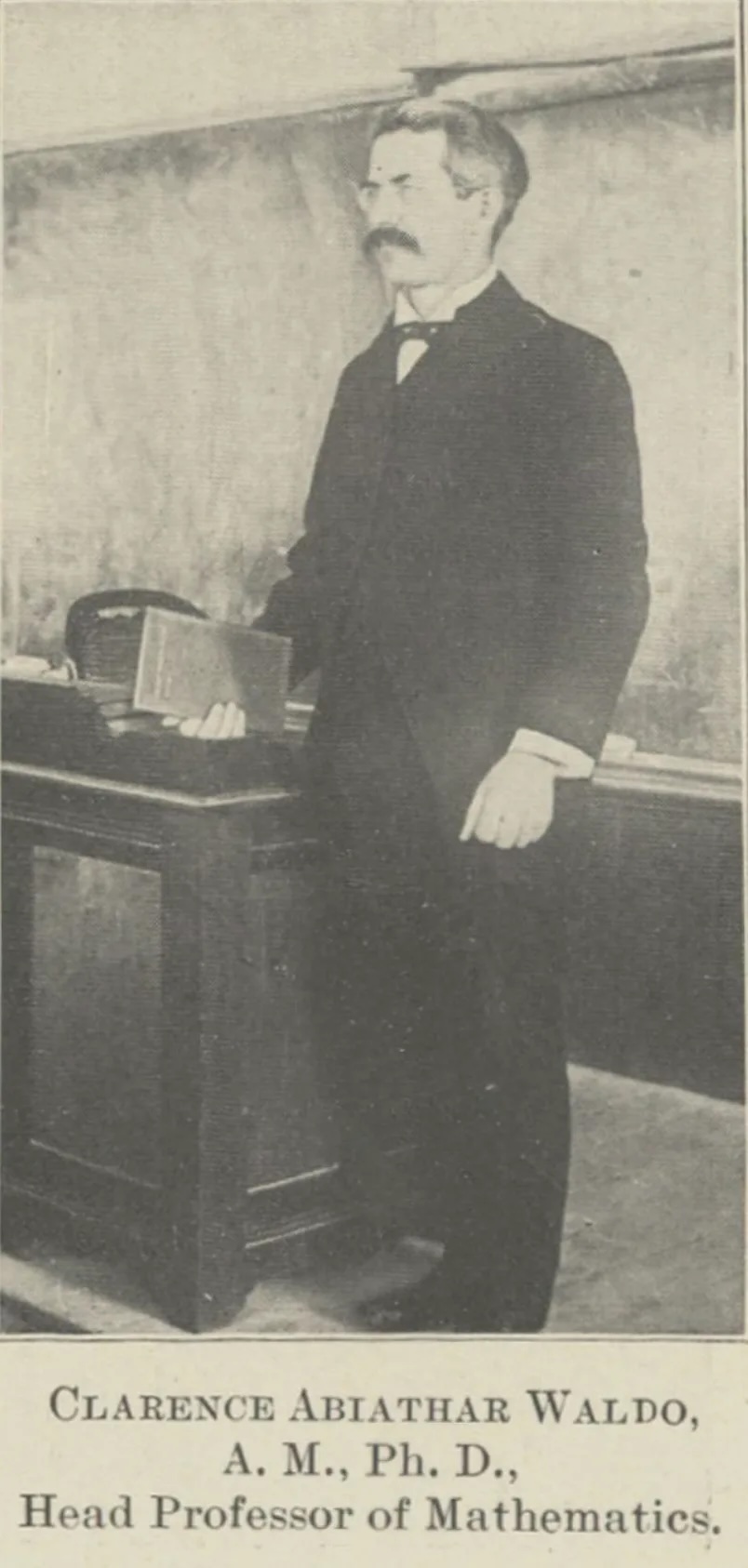
Before the Senate vote, Waldo spent the evening briefing individual senators on the mathematical situation. He didn't need elaborate arguments. He needed to explain, to people who had not thought carefully about it before, that the ratio of a circle's circumference to its diameter is a fixed fact about geometry — not a policy choice, not a convention that could be updated by statute, not something Indiana had standing to modify. He appears to have made this point clearly enough. (Equations on a wall are a different kind of public math — carved in stone, not voted on.)
When the bill came before the Senate, it was read aloud. The senators spent approximately half an hour discussing it — "laughing," according to contemporary accounts. Senator Orrin Hubbell described it as "utter folly." The bill was tabled indefinitely. It was never formally killed; it simply stopped moving. It remains, technically, pending.
How it happened
The standard explanation is that the House members didn't understand mathematics well enough to spot the error. That's probably true of most of them. But it misses something: the bill was presented as a contribution to education, offered to Indiana free of charge, validated by publication in a mathematical journal (however nominally), and sponsored by a member in apparent good faith. Voting against it would have required either mathematical expertise or a willingness to publicly call a colleague's guest a fraud. Neither was the path of least resistance.
There's also something structurally familiar about what happened. The bill's language was technically opaque — no legislator could easily verify whether its geometric claims were correct or not. The author had credentials (medical, not mathematical, but credentials). The bill was framed as an educational benefit. No organized opposition existed until Waldo appeared. The committee that reviewed it was not staffed with mathematicians.
The conditions that let House Bill No. 246 pass 67–0 are not specific to 1897 Indiana. They're the conditions under which non-experts routinely defer to confident claimants in domains they can't independently evaluate. The only thing unusual about this case is that the domain was mathematics, where the error could eventually be demonstrated without ambiguity — and that a mathematician happened to be in the building.
Aftermath — the short and long versions
- 1894Goodwin publishes "Quadrature of the Circle"Printed in the American Mathematical Monthly "by request of the author." Not peer-reviewed. The journal adds no endorsement.
- January 1897House Bill No. 246 introducedReferred first to the Committee on Canals, then to Education. Recommended favorably.
- February 6, 1897Passes the House, 67–0Three-day reading rule suspended. No votes against. No abstentions. Forwarded to the Senate.
- February 1897Waldo briefs the SenateProfessor Waldo speaks to senators individually the evening before the Senate vote. The bill is read aloud in the chamber to considerable laughter.
- February 12, 1897Tabled indefinitelySenator Hubbell calls it "utter folly." The bill is shelved. It is never formally repealed because it was never formally enacted.
- 1916Waldo publishes an accountHis documentation appears in the Proceedings of the Indiana Academy of Science — the primary historical source for the Senate evening's details.
Goodwin continued to believe he had squared the circle. He died in 1902, still convinced. His paper remains accessible in the archive of the American Mathematical Monthly. Waldo returned to Purdue and apparently never had to explain what he'd been doing at the statehouse that particular afternoon.
What it is actually about
The Indiana Pi Bill is usually told as a comedy — sixty-seven grown men voting to change the value of pi, saved at the last moment by a mathematician who happened to be passing through. That version is accurate as far as it goes.
But what makes the story durable is the more uncomfortable version: a legislature operating entirely within normal procedures, in good faith, managed to nearly enact something mathematically absurd. Nobody was corrupt. Nobody was acting unusually. The committee did its job. The sponsor believed in what he was proposing. The House voted the way House committees expect them to vote on favorably-reported education bills.
The rescue came not from the system working but from a single individual with domain expertise arriving by coincidence. If Waldo's budget hearing had been scheduled for a different week, the bill would have reached Governor James A. Mount for signature. Whether he would have signed it is unknown. The Governor was not a mathematician either.
Pi would not have changed. The universe is not subject to Indiana statute. But Indiana's school system would have been legally required to teach a false value — and the error would have had to be corrected eventually, expensively, by someone willing to explain to the legislature that they had been wrong. That conversation, whenever it came, would not have been a comedy.
Elsewhere on Abakcus: Paper that stands up · Four equations on a wall · A shelf built on a sequence · Six books about π worth reading