The questions a kid had to answer to get into MIT 157 years ago are the same questions kids answer today. What changed isn't the math — it's everything else.

The exam is real
You can find it in the MIT Institute Archives & Special Collections. Seven questions, one page, dated June 7, 1869. It covers the MIT entrance exam for the academic year 1869–1870 — the first year the institute required a formal qualifying test at all. Before that, admission to MIT was essentially open.
The school opened in 1865, just after the Civil War, with 15 students. Tuition was $100 for the year. The “conditions for admission” in the 1865 catalogue required only that candidates be at least sixteen years old and demonstrate a “competent training” in arithmetic, geometry, English, and the “rudiments of French.” Legible handwriting, the catalogue added, was “particularly important.”
Why no exam until 1869
MIT was four years old and desperate for tuition revenue. The object of the test wasn't to whittle down a massive applicant pool — it was simply to ensure incoming students could handle the coursework. In 1867, faculty had already found it “necessary to ask parents of some incompetent and inattentive students to withdraw them from the school.” The exam was a floor, not a filter.
By 1869, the French requirement and the handwriting requirement had both been dropped. Algebra had been added. The MIT Corporation decided that incoming students should sit formal qualifying exams in English, Geometry, Arithmetic, and Algebra. The algebra section is the section that caught people's attention in 2024 — mostly marvelling at how straightforward it looks.
The seven questions
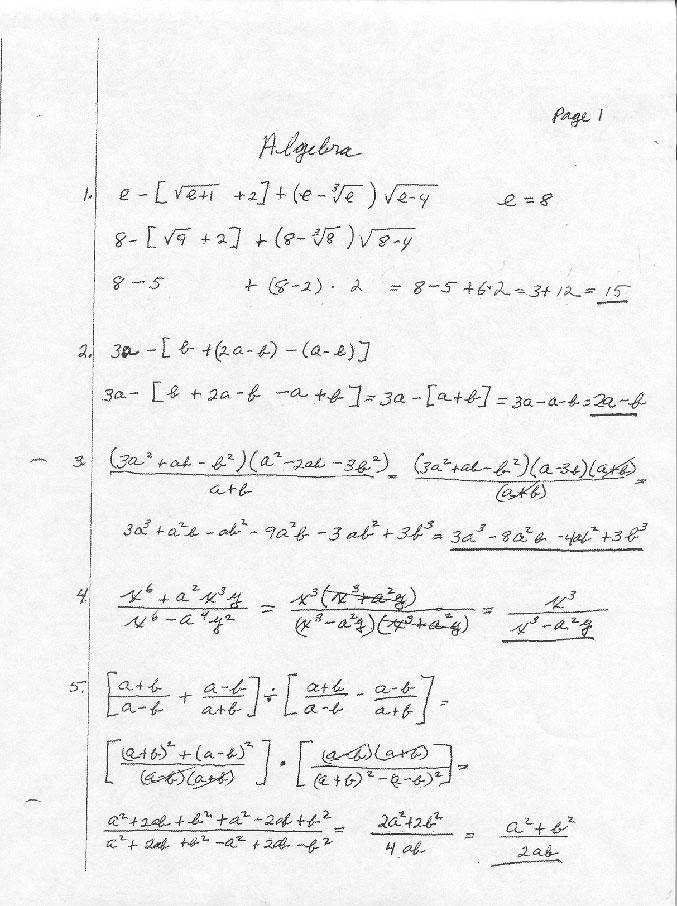
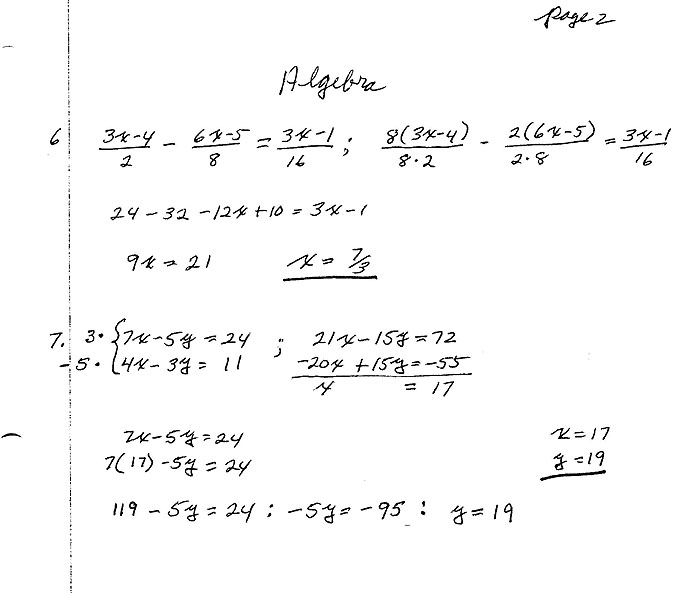
All seven questions are what any contemporary high school student would recognise as standard algebra. Question 1 substitutes a value and evaluates an expression with roots — the kind of substitution exercise that underpins angle evaluation on the unit circle as much as it did MIT entrance exams. Questions 2 and 5 ask for algebraic simplification. Question 3 involves polynomial multiplication and division. Question 4 reduces a fraction with variable terms. Questions 6 and 7 are equations to solve.
Question 7 — “Solve 7x − 5y = 24, 4x − 3y = 11” — is a two-variable system of linear equations. It appears in essentially the same form in every algebra textbook currently in use. The answer sheet, also preserved in the MIT archives, shows the working: multiply the first equation by 3, the second by 5, subtract, get x = 17 and y = 19. Clean, mechanical, unchanged.
What MIT was testing in 1869 isn't what MIT tests today. But the algebra itself is identical. The questions didn't get harder. Everything around them did.
The answers, in 19th-century handwriting
The MIT Archives note that the answer sheet was completed by a 20th-century person and “won't always match those that might have been given by 19th century applicants.” This is a detail worth pausing on: there is no original answer sheet from 1869 applicants. We have the questions, but not the answers that passed or failed. The archive is reconstructed.
The handwriting on the answer sheet is elegant and deliberate in a way that fills the page differently from modern working — tighter spacing, the algebraic notation slightly different in style. But the mathematics is identical to what a calculator-less 21st-century student would produce with a pen and paper.
Then vs. now — what actually changed
1869 entering class
~15–20
students total
2024 entering class
~1,100
from ~26,000 applicants
1869 tuition
$100
per year
2024 tuition
$63,000
per year (before aid)
The exam wasn't designed to find the best students in the country. It was designed to find students who wouldn't fail out. The bar was: can you handle this? Not: are you one of the top 4% of applicants in the country? The mathematics of the test reflected that purpose. Seven questions that establish a baseline, not a ranking. The same seven questions, 157 years later, do something completely different — they sort among tens of thousands of applicants who can all already answer them.
The reaction, and what it missed
When the exam resurfaced in 2024, the most common response was “I could have gotten into MIT in 1870.” But this was only the algebra section; the full exam included English, Geometry, and Arithmetic too; and there were no calculators, so everything was done by hand.
One observation that landed: the questions were designed to require almost no calculation — they test algebraic manipulation, not arithmetic fluency. That's a deliberate choice that still informs how algebra is taught. The questions didn't get harder. The competition did.
The deeper thing about this exam is not that MIT's standards were lower in 1869. It's that the foundational vocabulary of algebra was already settled enough by then to function as an entrance requirement. And 157 years later, it still is.
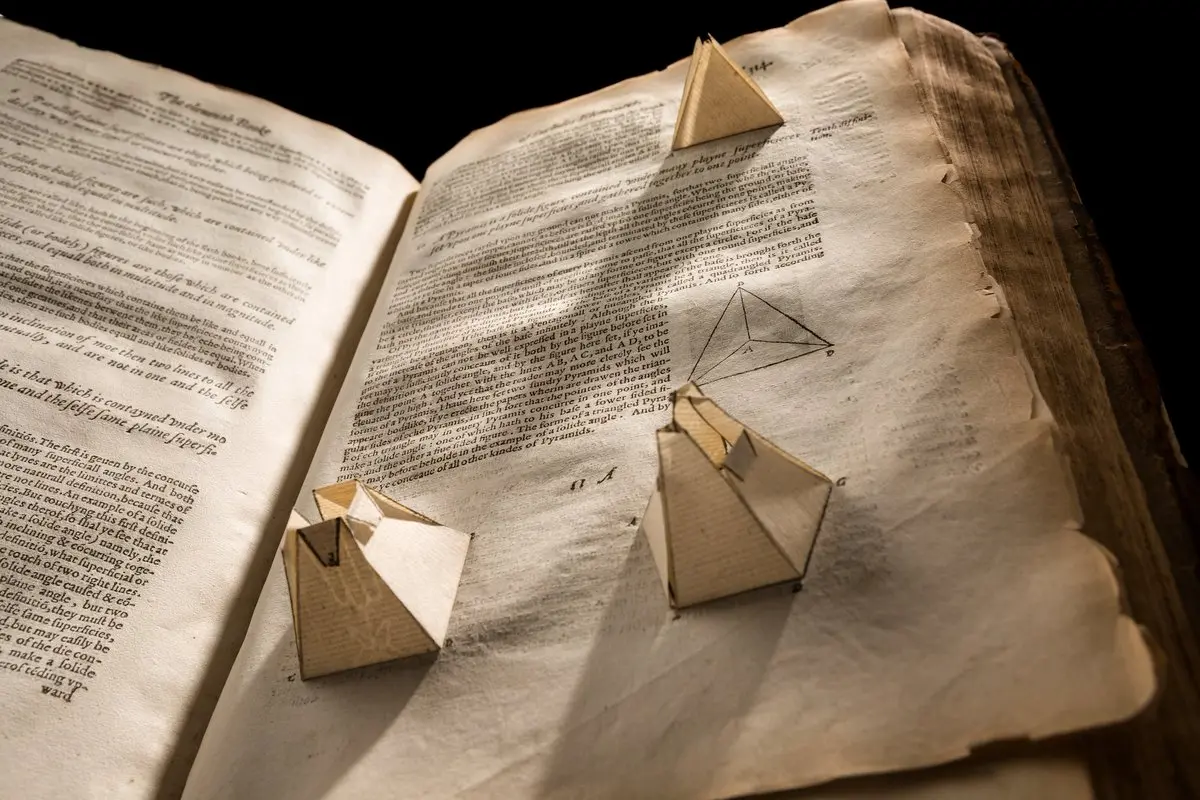
A student sitting the 1869 MIT entrance exam today would need no explanation of what any question is asking. The notation is slightly archaic, the square root symbol is written differently, but the underlying mathematics is identical. The same durability shows up elsewhere in the history of mathematical documents — in Henry Billingsley's 1570 English translation of Euclid, a book that still teaches the same geometry Euclid wrote. The medium ages. The mathematics doesn't.
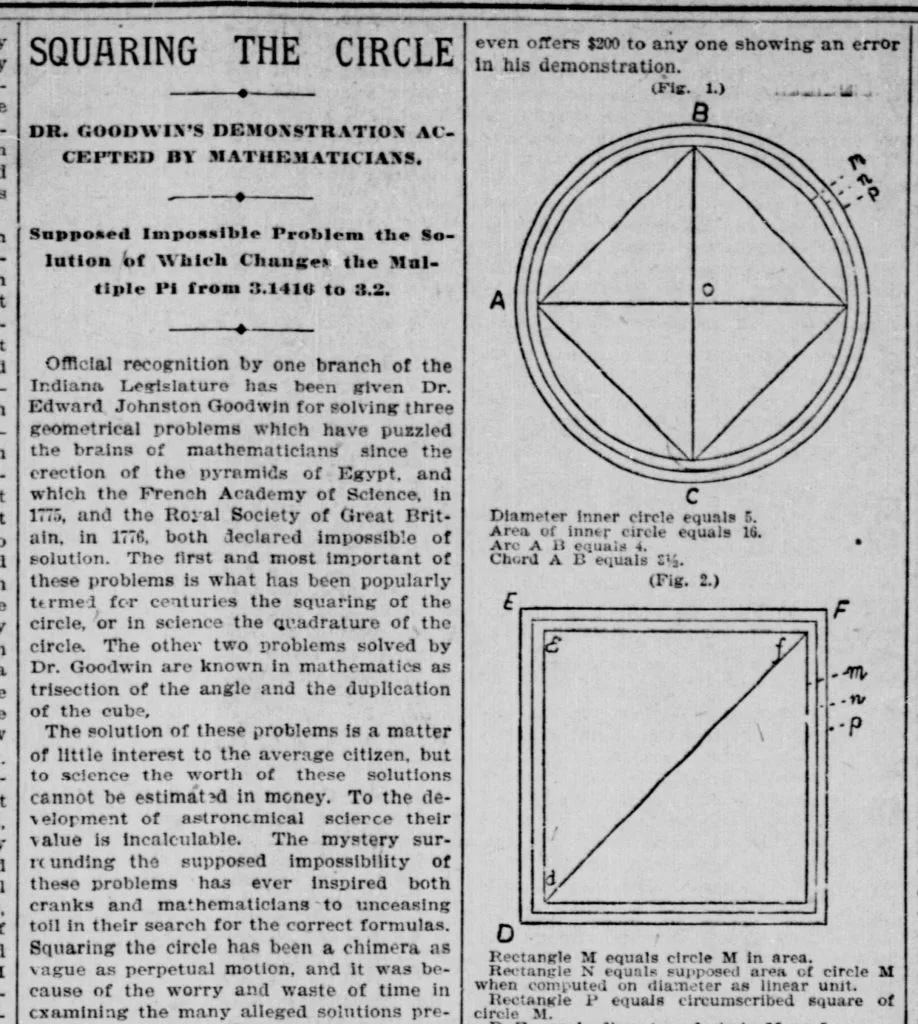
In 1897, Indiana's legislature tried to make the mathematics comply with legislation instead. The Indiana Pi Bill passed the House 67–0 before a mathematician stopped it. The 1869 MIT exam is the opposite impulse: mathematics as the fixed point, and everything else — admissions, tuition, selectivity — arranged around it.
What changed is who gets to take the test, how many people apply, and what the test is used to decide. The questions are the same. The exam is completely different.
Source: MIT Alumni — “Could you have gotten into MIT in 1869?” · MIT Institute Archives & Special Collections.