Stone doesn't explain — it commits. On this building, the commitment is to four integrals and everything they imply, from radio to the color of sunlight.
What's on the wall
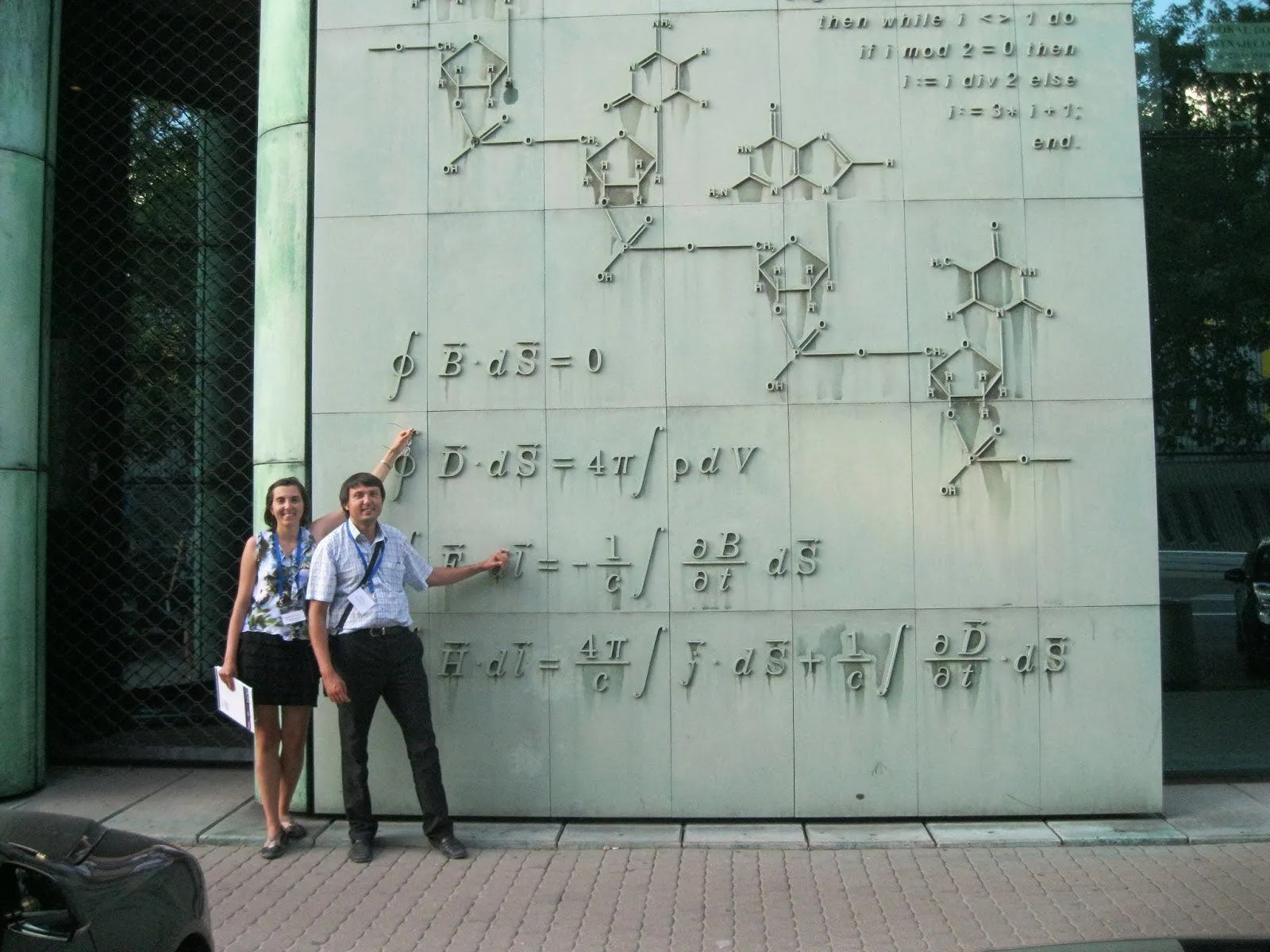
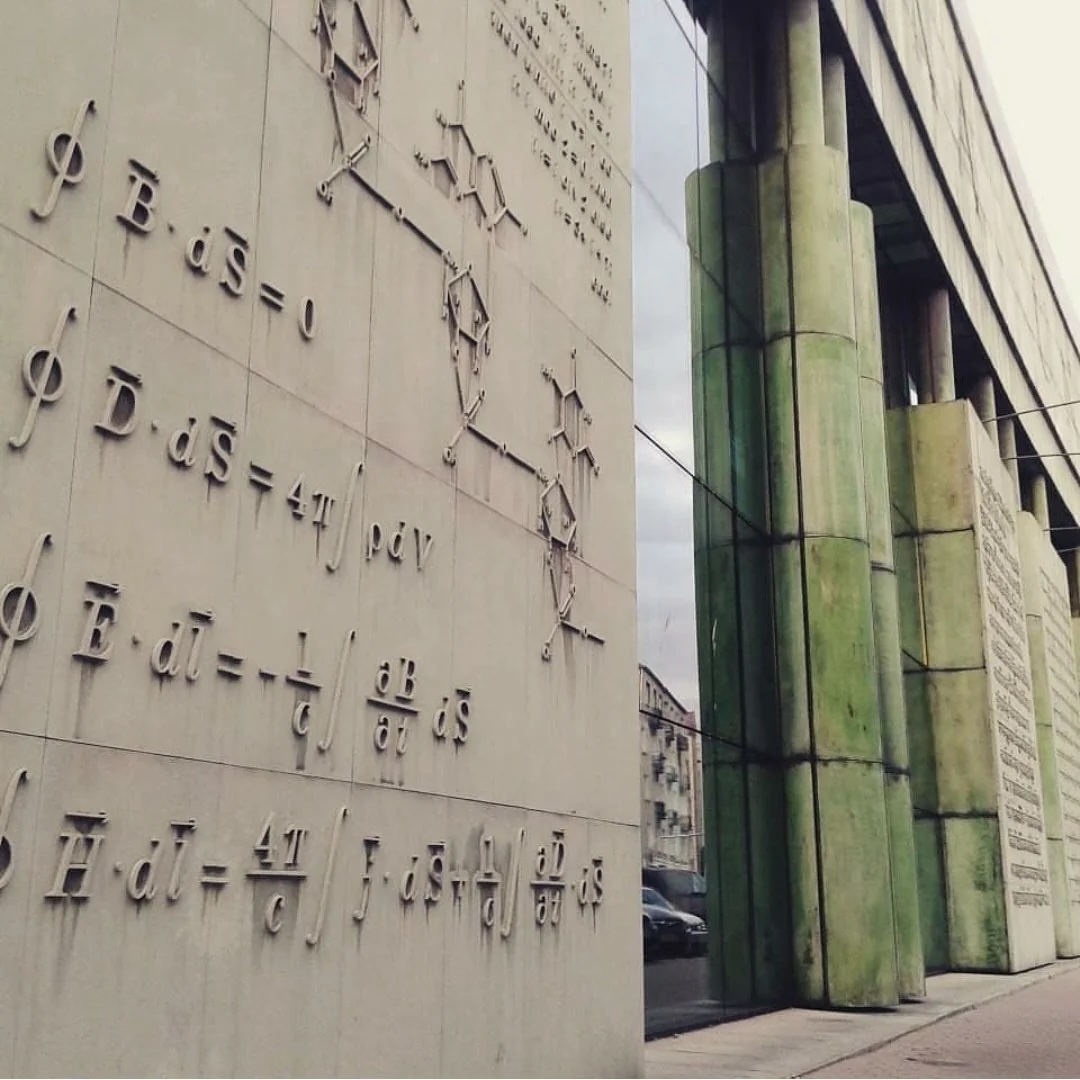
On the exterior of the physics library at Warsaw University, four equations are carved into the concrete in relief. They're large enough to read from the pavement. They've been there since the building was constructed in the 1970s. They are not decorative in any abstract sense — they are the actual, complete, integral form of Maxwell's equations, the four relations that describe how electric and magnetic fields behave and interact.
Most university buildings put the institution's name above the door, or a motto, or nothing at all. Warsaw chose to put electrodynamics on the wall. The decision was made without apparent irony, and the equations have remained there ever since, accumulating decades of Warsaw weather.
The wall — schematic rendering
What the equations actually say
Maxwell's equations are four statements about fields. Together they describe everything that can happen with electricity and magnetism: how charges generate electric fields, why magnetic monopoles don't exist, how a changing magnetic field induces an electric one, and how current and changing electric fields produce magnetic ones.
The version on the wall is the integral form — the one that describes behavior over surfaces and loops, rather than at individual points. It's the more physically intuitive formulation, and also the more visually substantial one. Each equation is a closed surface or line integral, which means each one comes with an integral sign and a circle through it, the typographic signature of a statement about the whole rather than the local.
That last term deserves a moment. Before Maxwell, Ampère's law related magnetic fields to current but said nothing about changing electric fields. Maxwell added the displacement current term, and in doing so closed the equations into a self-consistent system. A consequence of that closure: the equations predict waves that propagate at a speed equal to the ratio of two electrical constants. When Maxwell computed that speed, it matched the measured speed of light. He had not set out to explain light. He ended up explaining light.
Why the integral form, specifically
Maxwell's equations have two standard forms: differential and integral. The differential form — using divergence and curl operators — is more compact and more general, the version you typically find in graduate textbooks. The integral form is older, more explicit, and in some ways more connected to the physical phenomena being described. It's also more legible on a wall.
Warsaw chose the integral form. This is a real choice, not a default. The differential form would fit on a smaller surface and reads as a tighter set of symbols. The integral form sprawls a little — each equation has more to it, more visual weight. Carved in stone at human scale, the equations read as statements. The integral signs, the closed surface symbols, the partial derivatives — they're all there, unhidden.
The differential form is more elegant. The integral form is more honest about what the equations are actually doing.
There's also something appropriate about displaying the pre-vector, integral formulation on a building that predates the era when differential forms became the default pedagogy. These are the equations as physicists in the first half of the twentieth century would have written them — the form Maxwell himself would have recognized most readily, more or less. (Geometry with a different kind of modularity lives elsewhere on this site — rectangles instead of fields.)
What the wall is saying, if anything
Most institutions that put text on their buildings choose something intentionally vague: a founding date, a motto about knowledge or light, a coat of arms with a Latin phrase no one translates. These are signals of tradition, not content. They say: something important happened here, or aspires to happen here, without committing to anything specific.
Maxwell's equations are specific. They are not a sentiment. They are not an aspiration. They are a set of claims about how the physical world behaves — claims that have been verified to extraordinary precision for over a century and a half, claims that underlie every piece of electrical technology built since the 1860s. Putting them on the wall is a different kind of statement than putting a motto there. It's closer to putting a proof on the wall, or a theorem. (Another Abakcus piece asks what happens when you put Euclid on the page in English — flaps, folds, and the same insistence that abstraction meet matter.)
Some universities put "knowledge is power" over their doors. Warsaw put the equations that make radio, radar, and fiber optics work. The difference in ambition is not subtle.
The question of audience
Who is the wall for? The honest answer is: mostly people who already know what the equations are. A student walking past who hasn't taken electrodynamics yet sees four lines of symbols with integral signs. They register "mathematics" and move on. Someone who has worked through Maxwell's equations looks at the same wall and sees something specific — they can name each equation, know what it says, recall where the tricky parts are in the derivations.
In that sense, the wall functions more like a reference than an explanation. It doesn't teach. It marks. It says: the physics building is here, and the physics that governs electromagnetic phenomena is here with it, in stone, at street level, exposed to the same weather as everything else in Warsaw. (Symbols you learn to read once — a different wall, same idea: pattern over rote.)
That's an unusual thing for a building to do. Most buildings try to communicate something to everyone. This one communicates something specific to a subset and implicitly acknowledges that the subset is small. There's a certain confidence in that — the equations don't need to be explained, and the building doesn't try to explain them. They're just there, the way a load-bearing wall is just there: structural, undecorated, doing the thing they do.
Elsewhere on Abakcus: Unit circle · Paper that stands up · One fox. Four years.