Schematic detection record, 2019–2023. Rambo showed up on infrared camera traps roughly once a quarter for four and a half years. The last frame that contains him is dated 9 October 2022. Everything after it is the evidence for his death.
The number everyone repeats about this fox is 10,400. It is almost always printed as 10,400 traps, and that is the wrong unit. The field record says 10,400 trap nights. The difference looks pedantic and is not, because the trap night is the only figure in the whole story you can actually compute with.
I want to take the arithmetic seriously here, because the Rambo story is usually told as a caper — cunning animal outwits scientists — and the caper version buries what makes it worth reading. The scientists were not outwitted. They ran into a structural property of eradication that shows up wherever you try to remove every last member of something, and that has nothing to do with intelligence, theirs or the fox’s.
Eleven animals in a year, one animal in four and a half
The Pilliga project sits inside a 35,632-hectare reserve in north-west New South Wales, jointly managed by the Australian Wildlife Conservancy and the NSW National Parks and Wildlife Service. Within it, a predator-proof fence was closed in July 2018 around a 5,800-hectare triangle. The plan was standard and had worked elsewhere: seal it, empty it of feral cats and foxes, then return at least six locally extinct mammals — greater bilby, western quoll, western barred bandicoot, brush-tailed bettong, bridled nailtail wallaby, plains rat.
Eradication began in 2019. Within roughly a year, six feral cats and five red foxes were gone. Then there was a sixth fox, and the sixth fox took until October 2022.
Set those two phases side by side as rates and the shape of the problem appears immediately. Eleven animals in about twelve months is roughly 0.9 removals per month. One animal across the following fifty-four months is 0.02. The same team, the same fence, the same techniques, and a fifty-fold collapse in effectiveness — with no change in method to explain it.
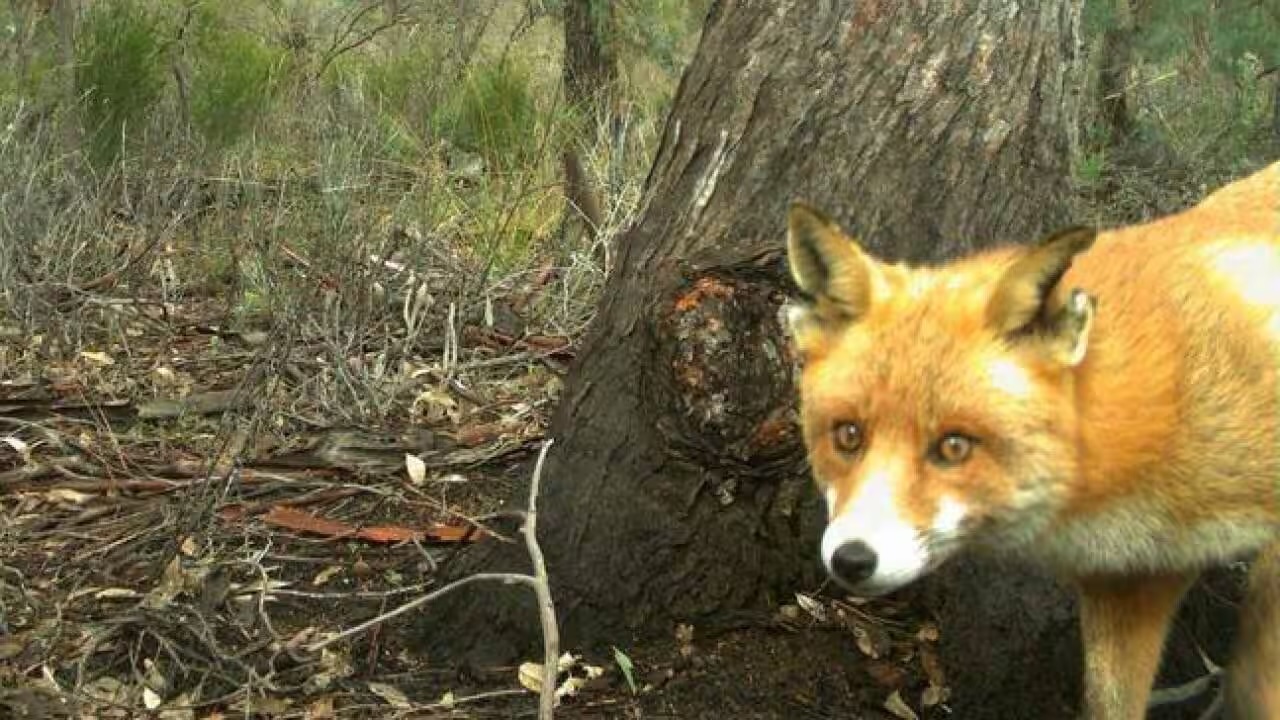
The animal in the photographs
He was probably born in 2018, inside the fence, the year it closed. He is believed to have lost his mother to a trap and a sibling to a 1080 bait, which is the standard explanation offered for his wariness, and which I would treat as plausible rather than established — nobody watched him watch it happen.
What is documented is less romantic and more interesting. He was photographed by infrared cameras about once every three months. In three years he was seen by human beings exactly twice: once in 2019, when he wandered into a staff camp, and once in 2020, when scent dogs flushed him. Scat analysis found he was living largely on insects, which is not what red foxes do.
That last detail is the one I keep returning to. An apex predator, alone in a fenced enclosure with no competitors, was eating beetles. Refusing every baited, human-handled, human-scented food source in a landscape that had been systematically stripped of prey leaves you with insects. His survival strategy had a price, and he paid it every night for four years.
The traps were not defeated by an animal who was smarter than the traps. They were defeated by an animal who had stopped treating any human-touched object as food.
The tally, and the unit that keeps getting lost
Here is the record as the field figures were reported, next to the version that circulates. Numbers do not survive retelling intact — a legislature once came within one vote of rounding π off by statute — but a lost unit is a quieter kind of damage than a wrong value, because nothing about the sentence looks broken afterwards.
A trap night is an effort unit. It exists precisely so that it can be multiplied against a per-night probability of capture. Compress it into “traps” and you have thrown away the exposure count, which is the only thing that lets you ask the question worth asking: what would this animal’s capture probability have to be for that record to happen at all?
What 10,400 trap nights actually implies
Take the crudest possible model. Suppose each trap night carries some fixed, independent probability p that this particular fox walks into it. Then the chance he clears all of them is (1 − p)10400, which falls off a cliff:
Surviving the trap line
(1 − p) raised to the power of the trap nights survived. Drag to change p, the per-trap-night capture probability for one individual. The marker sits at 10,400.
Chance of clearing all 10,400 trap nights at this capture probability
35.3%
At one chance in a thousand per trap night — still a very cautious fox — clearing 10,400 of them has a probability of about three in a hundred thousand. At one in two thousand it is about half a percent. For his four-and-a-half-year run to be no more surprising than a coin landing heads, his capture probability had to sit near one in twenty thousand per trap night.
The five foxes removed in the first year presumably sat orders of magnitude above that. Nobody wrote down their individual values, and that is exactly the gap: the project had a number for foxes and no number for this fox, because the model that produced the plan was built on a mean.
Eradication is governed by a minimum, not a mean
Population models work on averages: average bait acceptance, average trap encounter rate, average home range. Applied to a population, they are excellent. They tell you how much effort removes ninety percent, and they are right.
But an eradication does not finish at ninety percent, or at ninety-nine. It finishes when the single most trap-averse animal inside the fence is gone. The completion date is set by the minimum of the distribution of p across individuals, and a model calibrated on the mean carries no information about where that minimum lies. It cannot, in principle: the mean of a distribution and its extreme tail are separate quantities.
This is why fenced eradications feel qualitatively different from ordinary predator control, and I think it is the genuinely counterintuitive part. Out in open country you never meet the tail. You are holding density down, there is always another animal to remove, and the reluctant individuals get diluted by immigration and turnover. Seal a perimeter and you have removed the dilution. You have guaranteed that the last thing standing between you and the objective is the least catchable animal in the enclosure, with nothing else to work on, and no way to swap it out.
The fence did not just keep foxes out. It also promised, in advance, that the project would end in an argument with an outlier. A line drawn on the ground never does only the one job it was drawn for — that is as true of a wire fence as it is of a boundary with a fruit tree leaning over it.
The fence inside the fence
You cannot release bilbies into an enclosure containing a fox who has spent years refining his hunting under low-prey conditions. So the project did the only thing available: it built a second predator-proof fence, 680 hectares, inside the first, and put the reintroductions in there. Greater bilbies and bridled nailtail wallabies went in, and did well.
680 out of 5,800 hectares is 11.7 percent. For three years, the conservation programme operated on a ninth of its own reserve, and one fox held the rest. It is an unusual thing to be able to say about a seven-kilogram animal, and it is a straightforward consequence of the previous section: the project could not proceed at the mean, so it retreated to a perimeter small enough to guarantee.
How you decide an animal is gone
He was last photographed on 9 October 2022. Ten days later a major flood came through the Pilliga and submerged the traps set along his favoured creek line. Another flood followed the next month. On 2 December 2022 a preliminary call was made that he was gone. The public announcement came in March 2023, after months of monitoring with 97 cameras and repeated raking of the sandy roads on both sides to check for prints.
But absence of detection is not detection of absence, and the strength of the inference depends entirely on how often you would have expected to see him if he were alive. Which is where his own defining trait turns around and bites the people trying to declare victory.
What silence is worth
Detections modelled as a Poisson process. Starting from an even prior, this is the chance the animal is still alive given a run of months with nothing on camera. A toy model, not the project’s own analysis — the point is the comparison between the presets.
Probability the animal is still there, given the silence
16.1%
An animal that turns up on camera weekly is convincingly gone after a month of silence. An animal that turns up once a quarter is not. Under this model, five silent months leaves roughly a one-in-six chance he was still there, and the preliminary December call — less than two months after the last photograph — was made at something closer to one in three.
That is not a criticism of the decision. It is the reason the decision was not made on silence alone. Two floods that put water over his core range, 97 cameras where there had been far fewer, and raked sand roads with no prints all do real work: the floods raise the prior probability of death, and the extra cameras and the tracking raise the detection rate, which is what converts silence into evidence. The project understood the problem well enough to attack both terms.
The trait that made him uncatchable also made him undetectable, and so it degraded the very inference used to conclude he was gone. He was hard to remove and, for the same reason, hard to write off.
Adaptations tend to have this double edge. The reason an owl can fly without making a sound is a comb of feather serrations you can photograph and measure; the trait is legible precisely because it does one job extremely well. Rambo’s trait did two, and the second one was aimed at the record itself.
The part nobody can close
- Jul 2018Predator-proof fence closed around 5,800 hectaresRambo is probably born inside it the same year.
- 2019Eradication beginsWithin about a year, six feral cats and five foxes are removed. A sixth fox is not.
- 2019, 2020Seen by humans, twiceOnce wandering into a staff camp, once flushed by scent dogs. Otherwise he exists only on infrared.
- by 2021A second fence, 680 hectares, inside the firstBilbies and bridled nailtail wallabies are released into the inner zone instead.
- 9 Oct 2022Last photographTen days later, floodwater covers the creek line where his traps were set.
- 2 Dec 2022Preliminary declaration that he is goneMonitoring continues across 97 cameras and raked sand roads.
- Mar 2023The Conservancy announces he is most likely deadNo body is found. The larger reserve is treated as predator-free and reintroductions proceed.
There is one more thing, reported in a 2024 follow-up, that keeps the file open. During the flooding, a section of fence was taken down for several hours to let the swollen creek run through. Which means the alternative to drowning is that he simply walked out of the enclosure that had defined his entire life, at the one moment it was open, and went to live in the rest of the Pilliga.
Nobody knows. And I notice that the project’s own language shifted at the end: not removed, which is what the plan called for, but most likely dead. That is the honest phrasing, and it is quietly the phrasing every eradication ends in. You can prove an animal is present. You can only ever accumulate reasons to stop looking.
Sources and a correction
Dates, figures and events here follow the reporting in the ABC (2021), the Sydney Morning Herald (2022), the Guardian (2023 and a 2024 follow-up), Australian Geographic, SBS, the Australian Wildlife Conservancy’s own material, and the collation in the Wikipedia entry for Rambo (fox). The two calculations are mine, and they are deliberately simple models rather than reconstructions of the project’s analysis.
An earlier version of this page repeated the widely circulated figures as “10,400 traps” and “73 stakeouts”, dated the events from 2017, and listed quolls among the animals returned to the reserve. The correct units are trap nights and shoot nights, the fence closed in July 2018 with eradication beginning in 2019, and the species released into the inner enclosure were greater bilbies and bridled nailtail wallabies. Corrected on 9 September 2026.