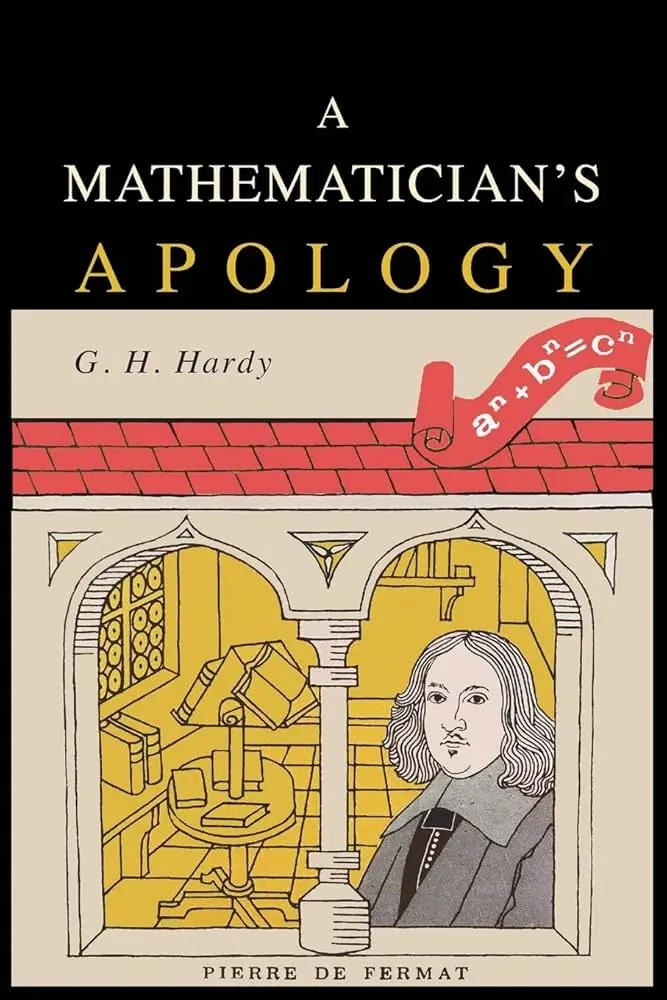
“It is a melancholy experience for a professional mathematician to find himself writing about mathematics.” Hardy wrote that in 1940. He was sixty-two, his mathematical powers were gone, and he knew exactly what it meant to write a book instead of proving theorems.
The title is deliberately misleading. An apology, in the classical sense — the sense Hardy intends — is not an expression of regret. It is a formal defense, a justification. Plato’s Apology is Socrates defending his life before the court that will condemn him to death. Hardy’s Apology is a mathematician defending his life’s work before no court in particular, because by 1940 he no longer needed anyone else’s verdict. What he needed was his own.
Hardy was 62 when he wrote it. He had survived a heart attack the year before. His mathematical powers — and he had no illusions about this — were gone. “Exposition, criticism, appreciation, is work for second-rate minds,” he writes in the opening pages. By writing this book, he was admitting that he had become a second-rate mind. The Apology is a great book written by a man who believed that writing books was what you did when you could no longer do the thing that mattered. That contradiction is what gives it its strange, irreducible weight.
Book Details
Full Title
A Mathematician’s Apology
Current Edition
Cambridge University Press, Canto Classics (with C. P. Snow foreword, 1967 onwards)
ISBN
9780521052078
Published
Cambridge University Press, 1940
The central argument: mathematics as art
Hardy’s defense of mathematics rests on a single, radical claim: pure mathematics is an art form. Not a science. Not a tool. Not a language. An art — and one of the highest. The mathematician’s patterns must be beautiful. The ideas must fit together harmoniously, like colors in a painting or words in a poem. And the measure of a piece of mathematics is not whether it is useful, but whether it is beautiful.
This position leads Hardy to a conclusion that most people find either provocative or liberating: the most beautiful mathematics is, by his definition, useless. Pure mathematics — number theory, Hardy’s own field — has no direct application to the physical world. It makes nothing. It improves nothing. It explains nothing that needed explaining for any practical purpose. Hardy considers this not a defect but a distinction. Applied mathematics, he argues, is by comparison vulgar — bound to the contingent, the approximate, the merely real. Pure mathematics exists in a world of perfect objects and eternal truths, and that is precisely why it is worth doing.
When the world is mad, a mathematician may find in mathematics an incomparable anodyne. For mathematics is, of all the arts and sciences, the most austere and the most remote, and a mathematician should be of all men the one who can most easily take refuge where the world’s turmoil can cause him least distress.
— G. H. Hardy, A Mathematician’s ApologyHardy was writing in 1940 — the year the Blitz began. The timing is not incidental. The Apology was written at the edge of catastrophe, by a man whose health was failing, whose best work was behind him, and whose country was at war. The claim that pure mathematics is harmless — that it can be neither weaponized nor corrupted by the real world — carries particular weight in that context. Hardy had spent years arguing, from a pacifist position, that the most abstract mathematics was also the most moral, because it was untouched by the uses to which applied science could be put.1
Hardy’s three criteria for mathematical beauty
Hardy does not just assert that mathematics is beautiful. He attempts to define what beauty in mathematics means. His criteria are three:
Hardy’s Criteria for Mathematical Beauty
- Unexpectedness — The result must surprise. A proof that arrives where it was always obviously going produces no aesthetic experience. The best proofs take unexpected routes to inevitable conclusions.
- Inevitability — Once seen, the conclusion must feel as though it could not have been otherwise. Surprise and necessity are not contradictory in mathematics; they coexist in every beautiful proof.
- Economy — There must be no waste. Every element of the proof must earn its place. A beautiful proof is one from which nothing can be removed without destroying it.
Hardy illustrates these criteria with two examples he considers among the most beautiful in all of mathematics: Euclid’s proof of the infinitude of primes, and the proof that √2 is irrational. Both are short. Both require no machinery beyond basic arithmetic. Both arrive at conclusions that seem, once reached, entirely inevitable — and yet both take routes that a reader encounters for the first time with something close to shock.
The infinitude-of-primes proof goes back to Euclid’s Elements: assume there are finitely many primes; multiply them all together and add one; the resulting number is divisible by none of your list — contradiction. Twenty-three centuries old. Still, by Hardy’s criteria, perfect.
The proof that √2 is irrational is equally austere. Assume √2 is rational, write it as a fraction in lowest terms, square both sides, show that both numerator and denominator must be even — which contradicts the lowest-terms assumption. Both proofs are, Hardy notes with evident satisfaction, completely useless. No application of either theorem has ever been required for the building of a bridge or the winning of a war.
“A young man’s game”
The most famous — and most contested — claim in the book is this: mathematics is a young man’s game. Hardy lists the evidence with the precision of someone who has thought about it for decades. Galois died at twenty-one. Abel at twenty-seven. Riemann at forty. Newton, perhaps the greatest of all, stopped doing mathematics at fifty and never produced an original idea thereafter. Hardy’s conclusion is explicit: no mathematician over fifty has ever initiated a major mathematical advance.2
Hardy was writing this at sixty-two, years past the threshold he had set. The cruelty of the position is self-administered. He does not make the claim in order to exclude others — he makes it in order to account for himself. His powers were gone. He knew it. The Apology is in part an attempt to find a dignified way of naming that loss.
The “young man’s game” thesis has been debated ever since. Counterexamples exist — mathematicians who produced significant work past fifty, past sixty. But the core observation is harder to dismiss than the counterexamples suggest. The kind of originality Hardy is talking about — the ability to see a problem in a way no one has seen it before, to invent the tools needed to solve it, to sustain the concentration required to carry it through — does appear to peak early. Hardy is not making a sociological claim. He is making a phenomenological one, grounded in what he had observed across a lifetime of mathematics.
C. P. Snow’s foreword: the other half of the book
Since 1967, the Apology has been published with a long biographical foreword by C. P. Snow, the novelist and scientist who was Hardy’s close friend during his Cambridge years. Snow’s foreword has become, for most readers, inseparable from the text — and it changes the book’s emotional register entirely. Where Hardy is austere, Snow is warm. Where Hardy analyzes his own decline with clinical detachment, Snow mourns it on his behalf.
Snow describes the Apology as “a passionate lament for creative powers that used to be and that will never come again.”3 He fills in what Hardy left out: the personality, the friendships, the cricket, the eccentricities. Hardy was, Snow writes, unorthodox, radical, ready to talk about anything — and constitutionally incapable of suffering pretension. He refused to have his photograph taken. He covered mirrors in hotel rooms. He rated great mathematicians by comparing them to great cricketers — his highest compliment was to be placed in what he called the Bradman class.5
The foreword also gives the Apology its tragic frame. Hardy had several strokes after 1939 and spent his final years unable to do mathematics, unable to play cricket, largely confined to his rooms. When he was awarded the Copley Medal — the Royal Society’s highest honor — he responded: “Now I know that I must be pretty near the end.” He died in 1947. Snow’s portrait makes it impossible to read the Apology as pure philosophy. It is philosophy written by a specific person in a specific crisis, and Snow ensures the reader never forgets it.
Graham Greene and the question of audience
When the Apology was first published in 1940, Graham Greene called it — alongside Henry James’s notebooks — the best account ever written of what it felt like to be a creative artist.4 Greene was not a mathematician. He was responding to something else: the texture of Hardy’s account of what it is like to live inside a discipline, to care about it more than about anything else, to feel its demands and its rewards and its specific, irreplaceable form of satisfaction.
This is why the book works for readers who will never prove a theorem. Hardy is not explaining mathematics. He is describing a certain relationship to a certain kind of work — a relationship characterized by total commitment, high standards, impatience with mediocrity, and the knowledge that what you are doing is, in the deepest sense, worth doing regardless of whether anyone else agrees. The mathematics is the occasion. The subject is the life of the mind.
“I have never done anything ‘useful.’ No discovery of mine has made, or is likely to make, directly or indirectly, the least difference to the amenity of the world.”
Hardy says this without embarrassment. He says it, in fact, with something that reads very much like pride. And this is perhaps the most important thing the Apology does: it refuses the demand that intellectual work justify itself by its applications. The pursuit of beautiful, useless, eternal truth is, Hardy insists, reason enough. It does not need to build anything or cure anything or enable anything. It needs only to be done, and done well, and done with the kind of seriousness that recognizes its own standards and will not settle for less.
Who should read this book
Anyone who has ever wondered why mathematicians do what they do. Anyone who has ever been told that the purpose of knowledge is its application. Anyone who has reached a point in their work — in any discipline — where they could feel their best years behind them and needed language for that experience. The Apology is short enough to read in an afternoon and dense enough to think about for years.
It is one of the few books about mathematics that is also a great piece of prose — spare, unsentimental, exact, and underneath its austerity, quietly heartbroken. Richard Feynman, writing a generation later, argued from a different angle for the same conclusion: that mathematics done for beauty and curiosity produces something no utility-first curriculum can replicate. The two books together make a case that neither makes alone.
For readers who want Hardy’s formal context — the philosophy of mathematics that runs beneath his aesthetics — Bertrand Russell’s Introduction to Mathematical Philosophy (1919) was written in the same Cambridge tradition, from the same conviction that mathematics touches something outside of time. The two books are twenty years apart and nearly perfect companions.
Sources
- 1.Hardy, G. H. A Mathematician’s Apology. Cambridge University Press, 1940. All direct quotations are from the 2012 Cambridge University Press edition (ISBN: 9780521052078).
- 2.Hardy’s “young man’s game” thesis and the list of Galois, Abel, Riemann: A Mathematician’s Apology, §4. Also discussed in: European Mathematical Society review, euro-math-soc.eu ↗
- 3.Snow, C. P. Foreword to A Mathematician’s Apology. Cambridge University Press, 1967 edition. Snow’s description of the book as “a passionate lament.”
- 4.Greene, G. “The Austere Art.” The Spectator, Vol. 165, December 20, 1940, p. 682. Greene’s review placing the Apology alongside Henry James’s notebooks.
- 5.Khan, H. R. “G. H. Hardy, the mathematician who loved cricket.” ESPNcricinfo, September 18, 2014. Hardy’s cricket rankings and the Bradman postcard to Snow. espncricinfo.com ↗
G. H. Hardy — A Mathematician’s Apology
Cambridge University Press, 1940 · abakcus.com