Author
Bertrand Russell
Published
1919
Written
Brixton Prison, 1918
Pages
208
Genre
Philosophy / Mathematics
Publisher
George Allen & Unwin
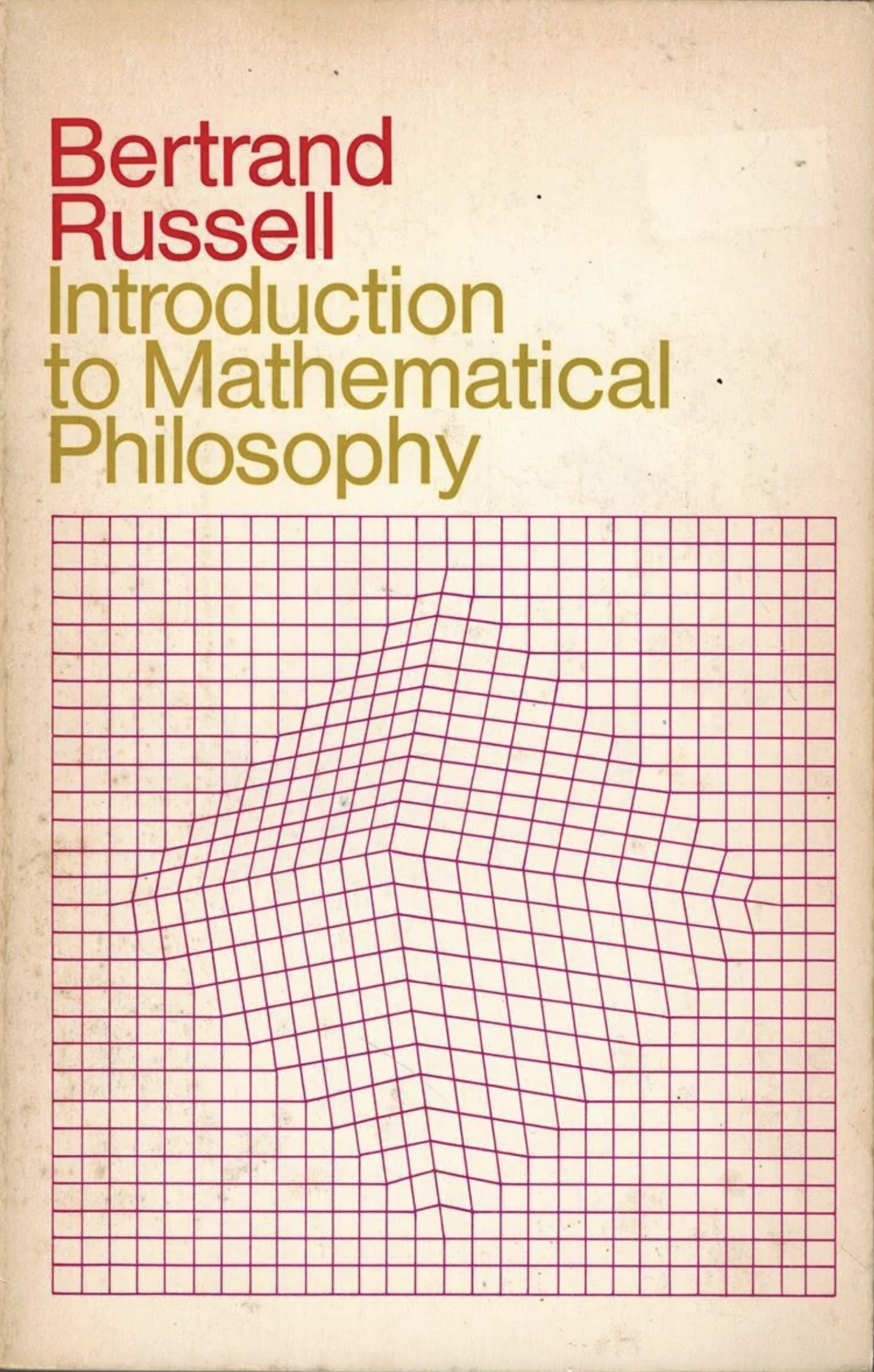
n 1918, Bertrand Russell was convicted of making statements likely to undermine military recruitment. The sentence was six months in Brixton Prison. He divided his days into three equal parts: four hours of writing, four hours of reading philosophy, four hours of reading everything else. Before the end of May — his first month inside — he had all but completed the manuscript of this book. Introduction to Mathematical Philosophy is what happens when one of the sharpest minds of the twentieth century is given a cell, a desk, and nothing urgent to do.
“I found prison in many ways quite agreeable. I had no engagements, no difficult decisions to make, no fear of callers, no interruptions to my work. I read enormously; I wrote a book… I was rather interested in my fellow-prisoners, who seemed to me in no way morally inferior to the rest of the population, though they were on the whole slightly below the usual level of intelligence as was shown by their having been caught.”
The book's stated purpose is to make accessible the ideas Russell had developed with Alfred North Whitehead in Principia Mathematica — three dense volumes of symbolic logic that had appeared between 1910 and 1913 and were read, in full, by approximately no one. Introduction to Mathematical Philosophy is the translation of that project into prose a non-specialist could follow. Russell claimed it required no prior knowledge of mathematics. This is technically true and slightly misleading, in the way that saying swimming requires no prior knowledge of water is technically true.
Wittgenstein was completing the Tractatus Logico-Philosophicus at roughly the same time, as a prisoner of war in Italy. Two of the twentieth century's foundational texts in logic, written simultaneously, by men behind different sets of bars.
What Russell is actually doing in this book is asking a question most people never think to ask: what is the number 3? Not three apples, not the symbol 3, not the word — the number itself. What kind of thing is it? Where does it live? If all the apples in the world disappeared, would 3 still exist? His answer, built carefully over eighteen chapters, is that numbers are not things you discover in the world but logical constructions — definitions that work with perfect consistency and require nothing outside of pure logic to justify them. This is the doctrine of logicism, and Russell defends it with the patience of someone who has nothing else scheduled for the afternoon.
“Very few people are prepared with a definition of what is meant by ‘number,’ or ‘0,’ or ‘1.’ It is not very difficult to see that, starting from 0, any other of the natural numbers can be reached — but we shall have to define what we mean by ‘adding 1,’ and what we mean by ‘repeated.’”
Bertrand Russell — Introduction to Mathematical Philosophy, Chapter I
The book's most famous chapter is not about numbers. It is about descriptions — specifically, Russell's “theory of descriptions,” which addresses sentences like “The present King of France is bald.” France has no king. The sentence is neither true nor false in any obvious way. Before Russell, this was a headache philosophers managed by shrugging. After Russell, it became a precise logical problem with a precise logical solution: the sentence contains a hidden existential claim that can be unpacked and evaluated. The bald king turns out to be a grammatical illusion, not a metaphysical problem. This is the kind of move Russell makes throughout the book — taking something that seems puzzling or irreducibly vague and showing that the puzzle is in the language, not in the world.
On Russell's Paradox — The Wound That Produced the Book
In 1901, Russell discovered that a set of all sets that do not contain themselves as members both must and cannot contain itself. This paradox threatened to collapse Frege's entire logical program — the project of grounding all of mathematics in pure logic. Russell spent the next decade trying to repair the damage. Principia Mathematica was the repair. This book is the explanation of why the repair was necessary.
The paradox is not resolved in these pages so much as circumnavigated. Russell builds an elaborate theory of types — a hierarchy of logical categories that prevents the dangerous self-reference from arising in the first place. It works. Whether it is ultimately satisfying is a question Russell leaves open, with a candor that is one of the book's more disarming qualities.
Russell's prose is a category of its own. He was, unusually for a technical philosopher, also a brilliant writer — he won the Nobel Prize in Literature in 1950, not for this book but for his popular essays, and the quality of his sentence-making is visible even here, where the subject matter is not exactly designed for elegance. He explains the concept of infinity, for instance, by pointing out that the natural numbers have a peculiar property: there are as many even numbers as there are natural numbers, because you can put them into perfect one-to-one correspondence. The even numbers are a proper subset of the natural numbers, and yet there are exactly as many of them. This is not a paradox, Russell says. It is the definition of infinity — a set that can be matched exactly with one of its own proper subsets. The explanation takes two paragraphs and requires no equations. It is the same instinct that drives the proofs in the oldest arguments in mathematics — start only from what you know, and say exactly what follows.
Who is this book for? Russell said it was for people with limited mathematical knowledge and no experience with formal logic. This is honest about the entry point but optimistic about the ascent. The early chapters — on natural numbers, series, ordinals — are genuinely accessible. The later chapters on propositional functions and classes are not difficult so much as unfamiliar, requiring a kind of mental gear-change that some readers find exhilarating and others find exhausting. The book rewards patience in the way that technical books written by naturally gifted explicators always do: the difficulty is real, but so is the payoff. If you have already encountered the questions Russell is asking in debates about whether definitions create or discover mathematical objects, this book will feel like the argument you were circling but could never quite locate.
“Logic is concerned with the real world just as truly as zoology, though with its more abstract and general features.”
Bertrand Russell — Introduction to Mathematical Philosophy
What the book permanently installs in a careful reader is a kind of suspicion — not the anxious kind, but the productive kind. A suspicion that the words we use most confidently (“number,” “infinity,” “class,” “existence”) are doing much more work than we give them credit for, and that the work they are doing is worth examining. Russell examines it slowly, from a cell in Brixton, with a four-hour daily writing schedule and no interruptions. The result is a book that has been in continuous print for over a century. It turns out that being arrested for opposing the war was, intellectually speaking, the best thing that ever happened to the foundations of mathematics.