Mathematics · Proof · Real Analysis
The Proof That 0.999… Is Exactly Equal to 1
It looks strange. It feels wrong. But 0.999… is not “almost 1” or “approaching 1” — it is exactly, precisely, completely 1. Here is the elegant geometric series proof that settles the matter.
Few mathematical facts produce as much discomfort as this one: the decimal 0.999…, with its infinite string of nines, is not a different number from 1. They are the same number — two representations of a single value. The discomfort usually comes from a subtle confusion between a number and its decimal expansion. 0.999… and 1 are no more “different numbers” than 1/2 and 2/4 are.
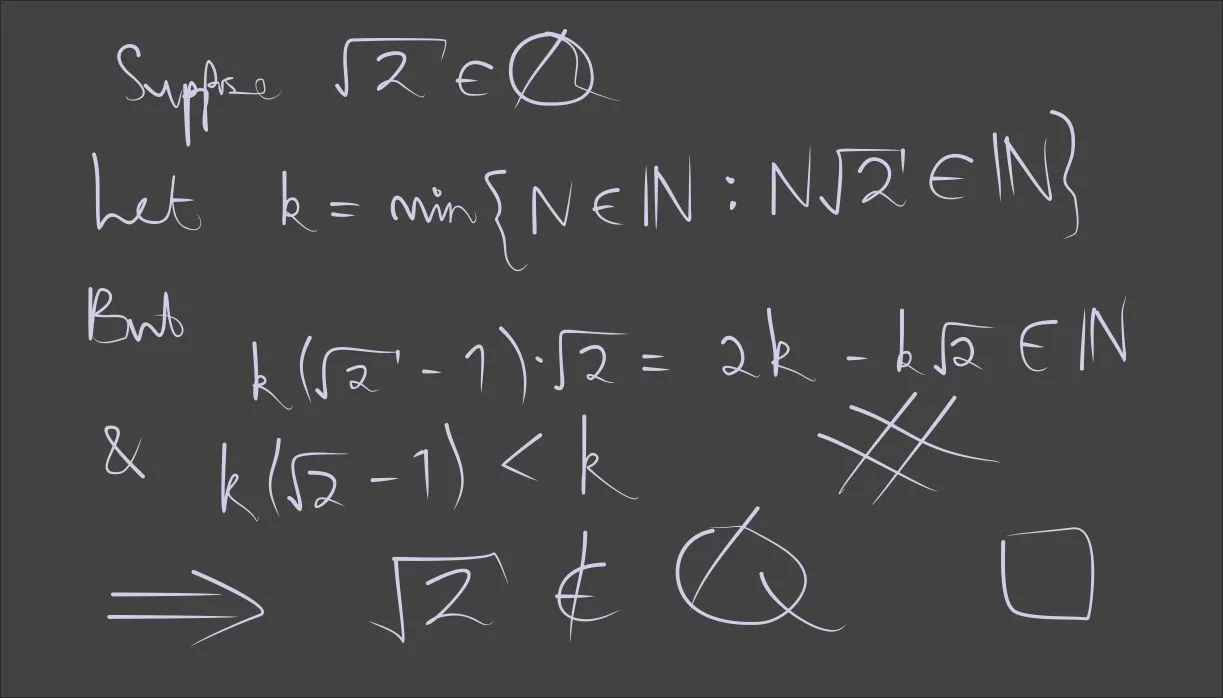
The clearest way to see why is through the theory of geometric series. The argument takes five steps and requires nothing beyond high school algebra — it has something in common with the spirit of the proof that √2 is irrational: a simple setup, a clean chain of logic, and a conclusion that feels impossible until it is obvious.
0.999… = 0.9 + 0.09 + 0.009 + 0.0009 + …
Each term is one digit further to the right of the decimal point.
= 9/10 + 9/100 + 9/1000 + 9/10000 + …
The numerator is always 9; the denominator runs through powers of 10.
= (9/10) · ( 1 + 1/10 + (1/10)² + (1/10)³ + … )
The expression in parentheses is a geometric series with first term 1 and ratio r = 1/10.
= (9/10) · ( 1 / (1 − 1/10) )
= (9/10) · ( 1 / (9/10) )
= (9/10) · (10/9)
Substituting r = 1/10 into the geometric series formula.
= 90/90 = 1
Numerator and denominator cancel completely.
0.999… = 1
Not approximately. Exactly.
■ Q.E.D.
Why does this feel wrong?
Our intuition insists there must be a gap — some infinitely small distance between 0.999… and 1. But in the real number system, two numbers are equal if and only if their difference is zero. The difference between 0.999… and 1 is not an incredibly small number: it is precisely zero. There is no gap, because there is no room for one.
This is the same friction you feel the first time you learn that a legislature once tried to redefine π by law: the result of mathematics does not depend on whether it feels comfortable. The real number system is not obligated to match our intuitions about infinitely long decimals.
The Feynman Technique is built around exactly this distinction: knowing the name of something is not the same as understanding it. Most people who object to 0.999… = 1 know what decimals are. They have not yet understood what infinity does to them.
If these questions about numbers and limits leave you wanting more, six books about π approach the same territory from different directions — none of them textbooks, all of them worth your time.
0.999…
“Oh god, it never ends…”
1
“Take it easy, bro. I got you.”