Step by step
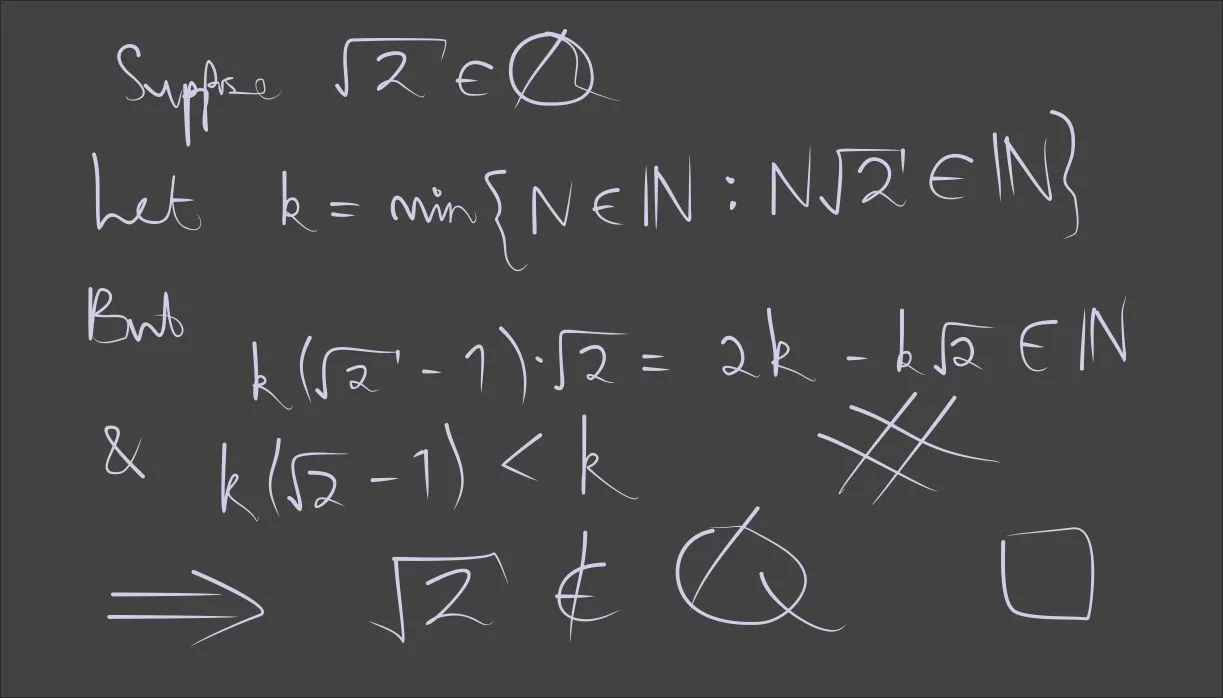
We assume √2 is rational and look for a contradiction. If √2 = p/q for some integers p, q, then multiplying both sides by q gives q√2 = p, an integer. So the set S = { N ∈ ℕ : N√2 ∈ ℕ } is nonempty — q is in it. By the well-ordering principle, S has a smallest element k.
Now consider the number k(√2 − 1). Two things are true about it simultaneously, and together they are fatal.
The two facts
Fact 1: k(√2 − 1) is in S. Multiply it by √2:
k(√2 − 1) · √2 = 2k − k√2
Both k and k√2 are integers by assumption, so 2k − k√2 is an integer. This means k(√2 − 1) · √2 ∈ ℕ, which is exactly the condition for membership in S.
Fact 2: k(√2 − 1) < k. Since √2 < 2, we have √2 − 1 < 1, so k(√2 − 1) < k.
An element of S that is strictly smaller than the smallest element of S. The assumption that √2 ∈ ℚ must be false.
Why this proof is different
The classical proof — the one in Euclid — writes √2 = p/q in lowest terms, squares both sides, and derives that both p and q must be even, contradicting the lowest-terms assumption. It works, but it requires the machinery of common factors and reduced fractions.
This proof needs none of that. It never writes √2 as a fraction. It never mentions even numbers. The only arithmetic it uses is that 1 < √2 < 2 — which follows from 1² = 1 and 2² = 4 — and that the difference of two integers is an integer. Everything else is the well-ordering principle doing its job.
A proof that proceeds by structure rather than by calculation tends to be one you understand rather than merely remember — the distinction the Feynman Technique is built around. Once you have seen why the descent is unavoidable, the result is obvious. Before you see it, no amount of arithmetic makes it feel necessary.
The Pythagoreans discovered that √2 is irrational — that the diagonal of the unit square cannot be expressed as a ratio of whole numbers — and reportedly found it disturbing enough to suppress. They were not the last to want mathematics to behave differently: the Indiana Pi Bill of 1897 attempted to settle the value of π by legislative vote. The proof above answers its own question with rather more finality than any bill could. If such a ratio existed, there would have to be a first natural number witnessing it. There isn't.
If the irrationality of √2 made you curious about π — another number that refuses to behave — six books approach it from equally oblique angles: history, category theory, and at least one very well-timed pun.