Author
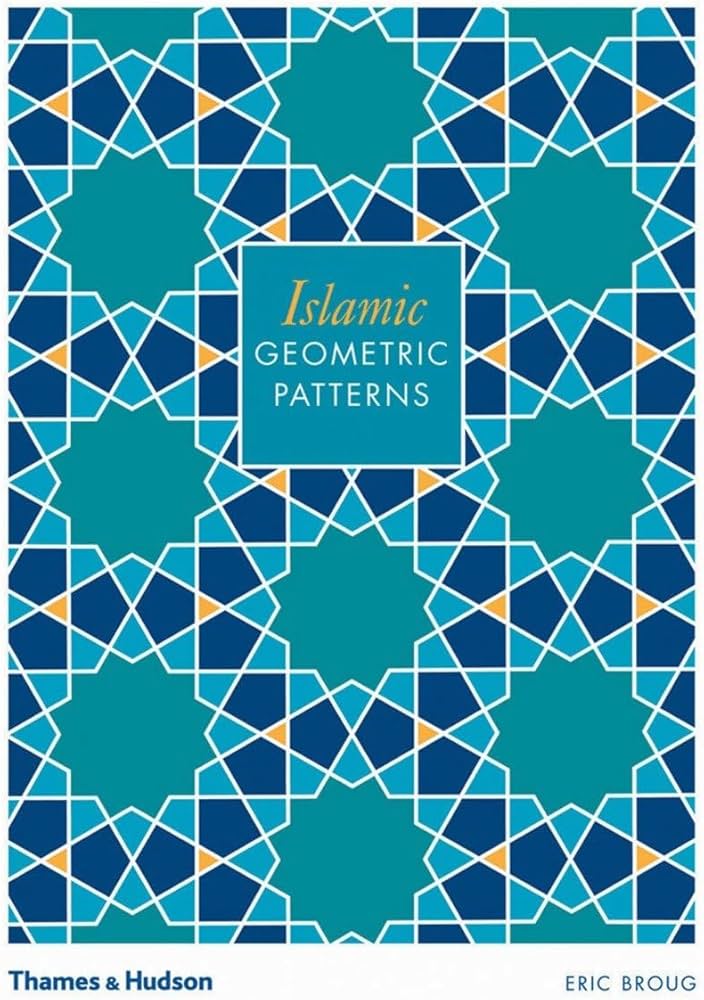
Eric Broug
Publisher
Thames & Hudson
Pages
144 pp., 200+ illus.
Subject
Islamic geometric patterns
No calculator. No trigonometry. Only a circle and a straight line — and from there, an entire world unfolds.
hen I first opened this book, I expected a textbook. A few pages in, I realized I was holding something else entirely: a set of step-by-step instructions that quietly interrogates its own feasibility. Every construction sequence carries an unspoken question: “Can you actually do this?”
Eric Broug studied the history of Islamic art and architecture at SOAS in London, and his aim here is clear and unassuming: to teach the geometric patterns found in Islamic architecture, placed in their historical context. The toolkit required is equally plain — a pencil, a ruler, a compass.
No calculator. No trigonometry. Only a circle and a straight line — and from there, an entire world unfolds.
Three families, one world
The book is organized around three foundational pattern families: the square, the hexagon, and the pentagon. These three forms account for nearly all geometric production across the Islamic world. Broug doesn't explain the mathematics — he demonstrates it. You draw the circle, trace the arcs, locate the intersections, complete the pattern. The result in front of you is the same design found on the walls of the Great Mosque of Córdoba. The Umayyad Mosque in Damascus. Cairo. Baghdad. Samarkand.
Each of the book's 23 patterns comes from a real building. Broug prefaces every set of instructions with a brief historical note — where the pattern was made, when, and in what context. These notes are dry without being lifeless: “This pattern dates from 12th-century Syria and was originally executed in stone inlay.” Then you pick up your pencil.
A few buildings in the book
- Córdoba — Great Mosque
- Damascus — Umayyad Mosque
- Cairo — Sultan Hassan Complex
- Baghdad — Mustansiriya Madrasa
- Samarkand — Shah-i-Zinda
The geometry that lived in the hand
Where the book becomes genuinely interesting is at its midpoint — the turn from beginner patterns to intermediate and advanced. Early on, everything is legible: thick lines, wide steps, minimal room for error. As complexity increases, the situation changes. Now there are six, seven, eight overlapping circles. A deviation of one millimeter corrupts the next ten steps. And here the book implies something it never states: the craftsmen who originally made these patterns — who applied them flawlessly onto stone or tile — were not calculating. They knew geometry not from memory but from the hand.
Broug is candid about how little we know of these craftsmen. They are anonymous. Unsigned. They left no names, only patterns. That is a different kind of persistence. The same anonymity runs through much of the Islamic scholarly tradition — a 12th-century astronomical manuscript from Khwarazm, copied and recopied for three centuries, carries virtually no trace of the copyists who kept it alive. What mattered was the knowledge, not the name.
What the anonymous masters left behind outlasted their names — because what becomes pattern sidesteps time entirely.
The book has real limitations. Broug's step counts occasionally run longer than necessary — several readers have noted this, pointing out sequences that could be shortened without any loss of accuracy. The criticism is fair. But this is a pedagogical choice, not an oversight. His intended audience is not the mathematician; it is the person whose hands want to learn something their eyes have admired from a distance.
A more significant gap: the book is almost entirely silent on meaning. The relationship between Islamic geometry and theological thought, the logic of infinite repetition, the reasons figural representation was displaced by abstraction in certain contexts — these questions live at the margins. Broug teaches the construction and leaves the interpretation to you. Those who want the deeper framework will find it elsewhere — in Keith Critchlow, for instance, or in the broader scholarly literature on Islamic visual culture.
What happens in the classroom
As a mathematics teacher, I'll say this plainly: the book works in a classroom. When students hold a ruler instead of a screen, something shifts. Geometry stops being abstract and becomes something they can ruin, correct, and finish. When the pattern closes, no answer key is needed — the eye knows immediately. That experience is not something a problem set can replicate.
This book is for
- Mathematicians, designers, and art history enthusiasts who want to understand how geometry became ornament.
- Teachers looking for something that proves geometry can be built, not just solved.
- Anyone who has ever looked at an Islamic tile and wondered how the line got there.
- Those who prefer to work slowly, in pencil, with a compass — and who don't mind getting it wrong the first time.
Broug's book is a construction manual, a compressed history, and a quiet exercise book, all at once. It makes no dramatic promises. It delivers what it says it will. That is rarer than it sounds.
¹ The revised 2019 edition adds seven new patterns from Turkey, Morocco, Syria, Spain, and Pakistan — including a design from the Ak Medrese in Niğde, one of the few Anatolian examples in the book.
² For a more scholarly treatment, Broug's Islamic Geometric Design (Thames & Hudson, 2013) covers the same territory with greater historical and analytical depth. The Islamic Design Workbook offers a more hands-on companion volume.
In short
The kind of book your hands want to learn from, while your mind wonders why it's taking so long. The compass keeps turning.
Eric Broug — Islamic Geometric Patterns
Thames & Hudson, 2008 · Revised edition: 2019 · abakcus.com