History of Science · Islamic Astronomy · 1221 — 1383
The Astronomy Textbook That Outlived an Empire
Written in Khwarazm the year before the Mongols destroyed it, copied by hand 162 years later in a newly Ottoman corner of Anatolia — and studied in classrooms across the Islamic world for six more centuries.
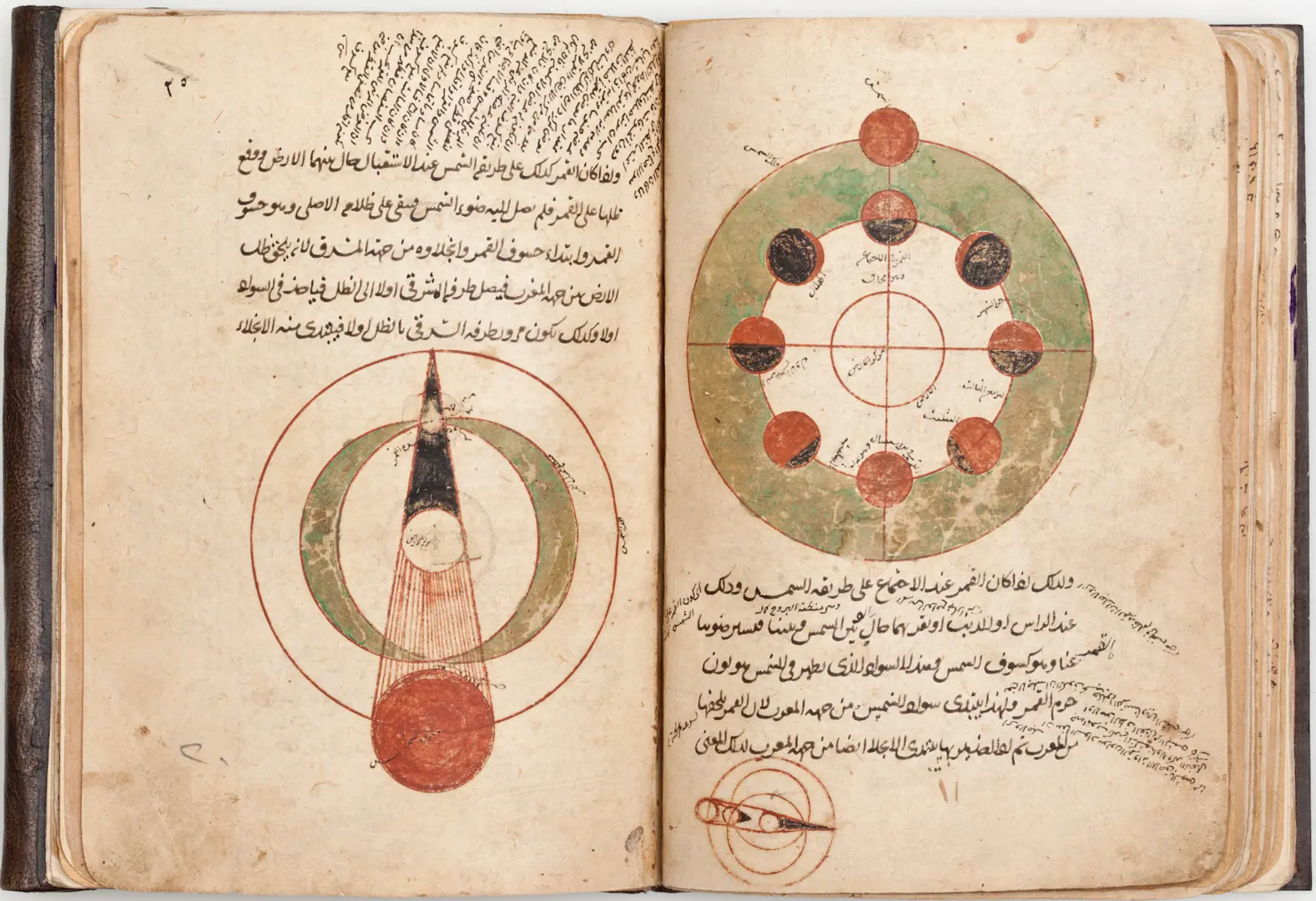
The manuscript in the photographs was copied on a July day in 1383 in a town called Ayasoluk, on the western edge of Anatolia. The text inside it had been written 162 years earlier, in a city that no longer existed. Between composition and this copy, an empire had risen, collapsed under the Mongol invasion, and been gradually replaced by another. The text survived all of it.
Mahmud ibn Muhammad ibn 'Umar al-Jaghmini was a scholar from Khwarazm — the Central Asian empire centered on the Amu Darya river, which in the early thirteenth century was one of the most intellectually active regions in the Islamic world. He composed two works that became standard texts: a medical treatise condensing Ibn Sina's monumental Canon, and an astronomical compendium titled Al-Mulakhkhas fi al-Hay'ah al-Basita — “The Epitome of Plain Theoretical Astronomy.” He died in 1221, the year the Mongol army under Genghis Khan swept through Khwarazm and erased the civilization that had produced him.
The Mulakhkhas survived. More than survived: it became the most widely copied Arabic astronomy textbook ever written. Thousands of manuscript copies are known; the number of commentaries, supercommentaries, and translations into Persian and Turkish runs into the hundreds. It was taught in madrasas from Morocco to Samarkand until well into the nineteenth century. Whatever the Mongols destroyed, they did not destroy this.
What the Book Contains
The Mulakhkhas is, by design, an introduction — not an advanced treatise. Al-Jaghmini explicitly wrote it for students, stripping away the complex mathematical proofs that filled more sophisticated astronomical texts of his era. What remains is the theoretical framework: how the celestial and terrestrial worlds are structured, how the heavenly orbs move and relate to each other, and how their motions can be understood geometrically. The book is Ptolemaic — it accepts and explains the geocentric model of the cosmos — but it presents that model with exceptional clarity.
The structure is compact: an introduction on the nature of simple and complex bodies, followed by two sections. The first covers the celestial sphere — the order of the planets, the Sun's motion, lunar phases, eclipses, and the geometry of orbits. The second turns to the Earth: geography, the division of the inhabited world into seven climatic zones, and the mathematical tools needed to understand terrestrial and celestial positions together, including elements of trigonometry and the foundations of judicial astrology.
“The work does not contain complex mathematical calculations — but it provides the theoretical framework within which such calculations can be understood.”— Library of Congress catalogue note on the Mulakhkhas
This deliberate accessibility is what made the Mulakhkhas so durable. Harder texts required harder prerequisites. Al-Jaghmini's compendium could be used as the first serious encounter with astronomical theory, and students who outgrew it could move to one of the many commentaries. Good introductions are rarer than good treatises — they require not just knowledge but a specific kind of pedagogical judgment: knowing what to leave out. It is the same conviction that Feynman brought to mathematics education seven centuries later — that the first encounter with a subject should be honest, not technically exhausting.
Reading the Diagrams
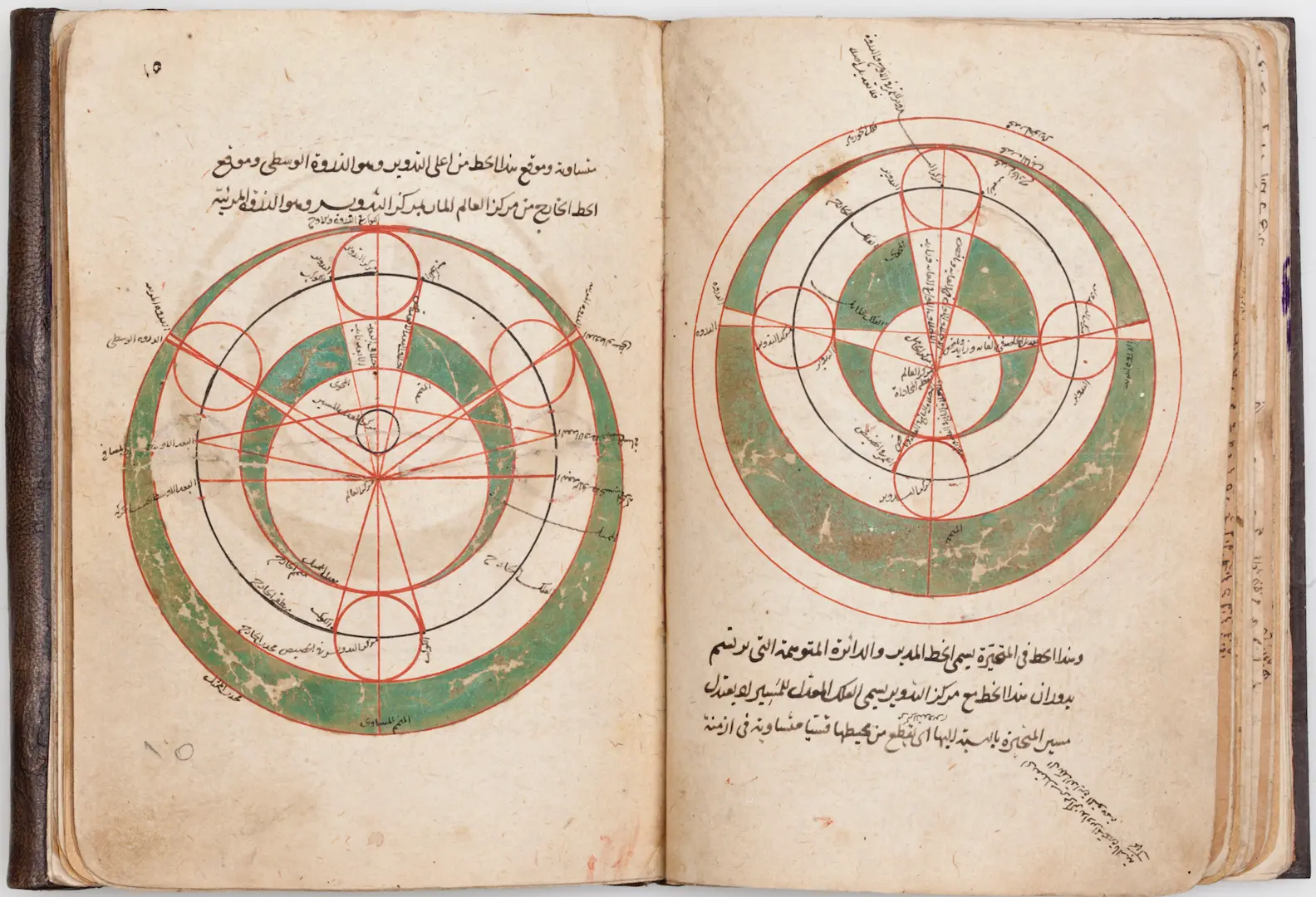
The Ayasoluk copy contains 25 coloured diagrams, painted in the characteristic palette visible in the photographs: a deep terracotta red for the Moon in its phases, a muted green for the outer orbital bands, red-orange ink lines for the geometric constructions. Against the warm cream of the aged paper, the diagrams read as cosmological objects in their own right — not merely explanatory illustrations, but arguments made in colour and line. The effect is not unlike what Alejandro Guijarro found on physics blackboards at Oxford and Cambridge: scientific notation that transcends its own utility and becomes something else entirely.
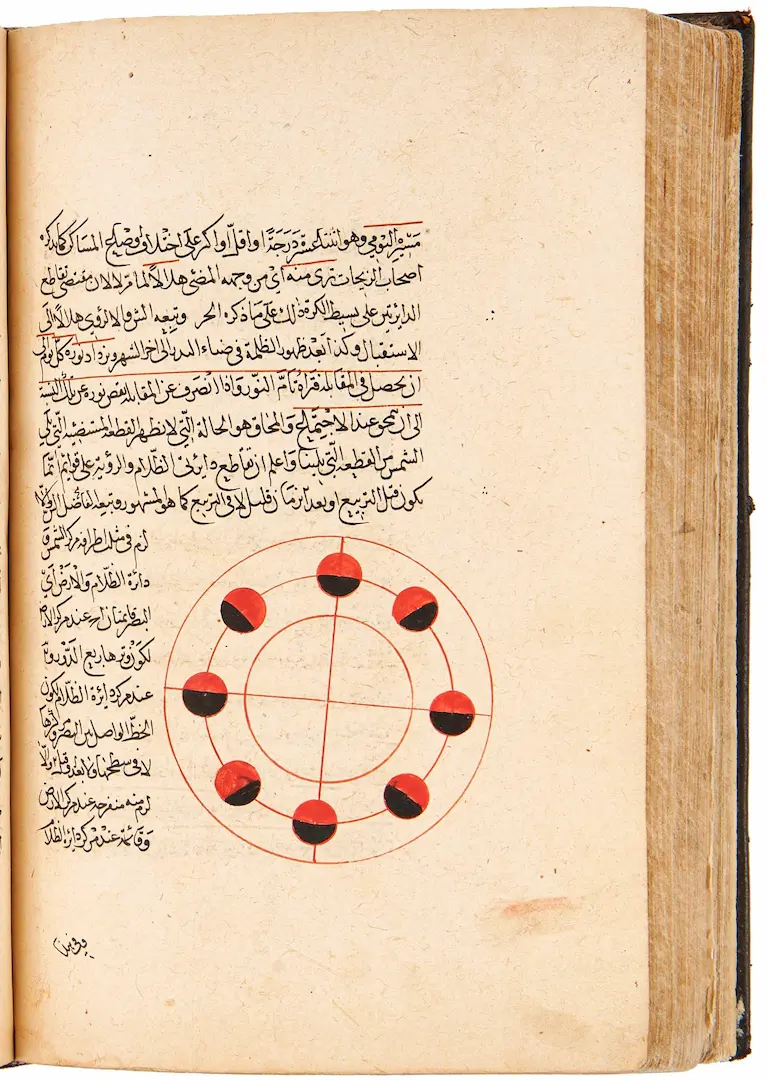
Left page, lower diagram. The Sun (large red disc at bottom) aligns with the Moon (white sphere) and the Earth behind it. Red radiating lines show the shadow cone cast during totality. The green band is the lunar orbital path.
Right page, upper diagram. Eight discs arranged around a circular orbit, each showing a different illumination state of the Moon — from new moon (fully dark) through crescent, quarter, gibbous, to full. The Sun is implied at centre-right.
Lower spread, both pages. Concentric green and cream bands represent nested celestial spheres. Red geometric lines — radii, diameters, intersection arcs — illustrate the mathematical relationships between orbital paths.
The diagrams follow a consistent colour grammar: red for the Moon, green for orbital bands, red-orange for geometric construction lines. This system recurs across many surviving copies of the Mulakhkhas, suggesting a shared illustrative tradition passed between scribes.
The Scribe and the Scriptorium
At the end of the manuscript, on folio 29b, the scribe recorded himself. His name was Qutb al-Din ibn Muhammad al-Nakidi, and he completed the copy on July 18, 1383, in a place he called Ayathulugh — the Arabic rendering of Ayasoluk, now Selçuk in western Turkey, the town adjacent to the ruins of ancient Ephesus.
The detail matters. In 1383, Ayasoluk had only recently come under Ottoman control. The region had been contested for decades — Byzantine, various Turkmen principalities, and finally Ottoman. The existence of a manuscript copy, carefully made with 25 coloured diagrams and signed by a named scribe, implies the existence of a functioning scriptorium. Not just a copy of a book, but an institution that could support the copying of books — a library, teachers, students, the infrastructure of learned culture — had already taken root in this frontier town within years of its coming under new rule.
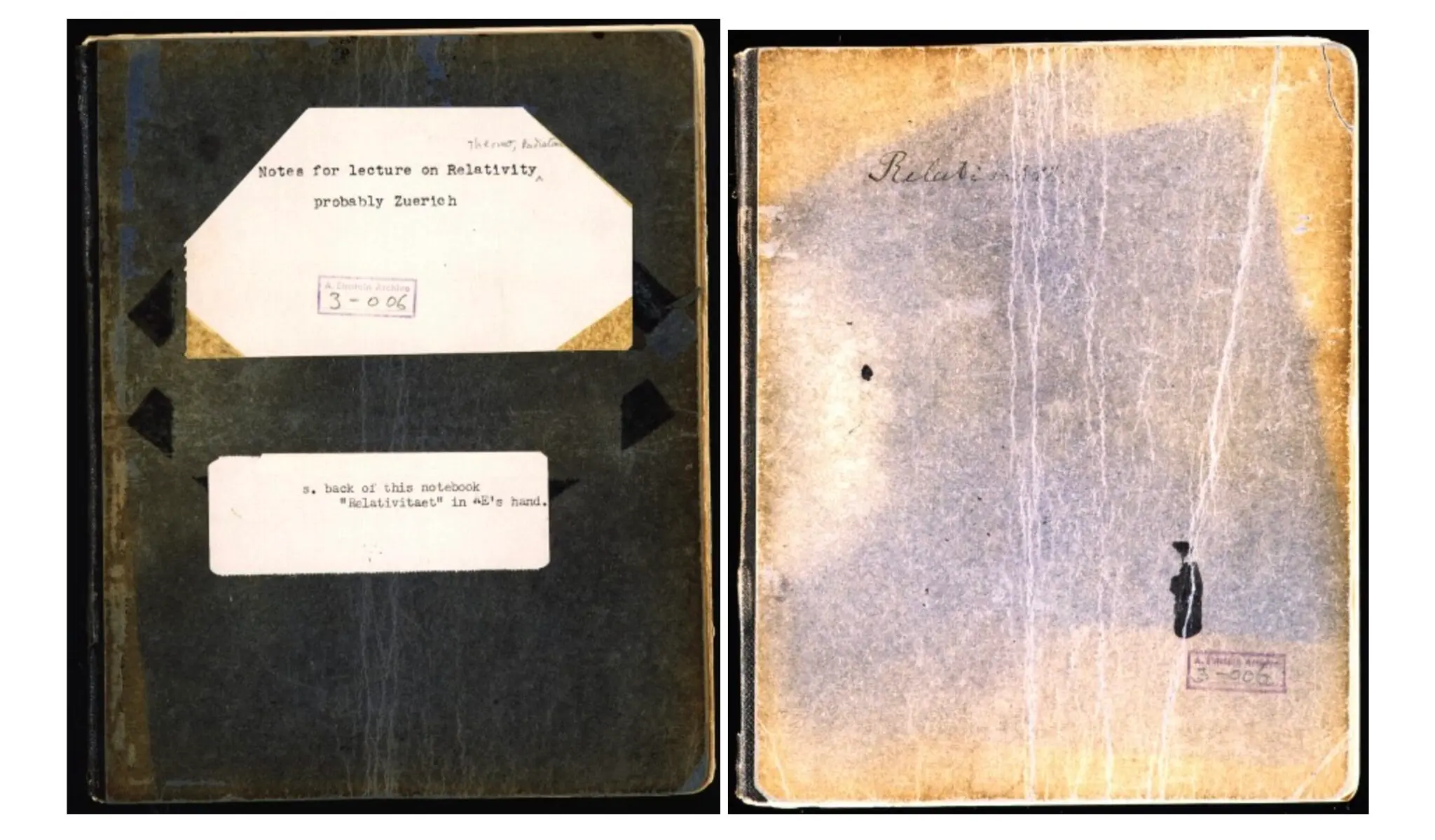
This is almost certainly the earliest manuscript known to have been written and illustrated in Ayasoluk. As a piece of historical evidence, it is a small proof that intellectual continuity does not wait for political stability to fully resolve. One thinks of Einstein's Zurich notebook — another document made at a moment of transition, its pages containing the wrong turns and provisional solutions of a mind working toward something it could not yet fully see.
A Textbook's Afterlife
What is it that makes a textbook last seven centuries? The Mulakhkhas was not the most sophisticated astronomical text of its era. Al-Jaghmini himself drew on older traditions, presenting a Ptolemaic system that had already been under active revision for a century by Islamic astronomers working on its internal inconsistencies. Later scholars — particularly those at the Samarkand observatory under Ulugh Beg in the fifteenth century — made advances that rendered parts of its model obsolete.
But the Mulakhkhas was not trying to be at the frontier. It was trying to be the threshold — the text that allowed a student to stand at the door of the discipline and see, clearly, what was inside. The same logic applies to Henry Billingsley's 1570 English Euclid: a text made accessible to a wider audience, with folded paper models where proofs had been abstract, outlasts many of the more technically advanced works of its era precisely because it lowered the cost of entry.
Copies of the Mulakhkhas are preserved in libraries from Istanbul to Cairo, from the British Library to the Library of Congress. Each is a separate act of transmission — a scribe deciding that this text was worth their time, their ink, and their skill. The Ayasoluk copy, made in a newly Ottoman Anatolian town in the summer of 1383, is one of those acts. Its 25 coloured diagrams are not decorations. They are the visual argument for why the sky is ordered, and how we came to understand that order.
Source
Mahmud ibn Muhammad ibn 'Umar al-Jaghmini, Al-Mulakhkhas fi al-Hay'ah al-Basita (Compendium of Plain Astronomy), c. 1220–1221. The Ayasoluk copy (1383), copied by Qutb al-Din ibn Muhammad al-Nakidi, is documented at Google Arts & Culture. For a critical edition and English translation, see: F. J. Ragep, Jaghmīnī's Mulakhkhaṣ: An Islamic Introduction to Ptolemaic Astronomy, Springer, 2016.