Mathematics Education · Richard P. Feynman
How Should Math Be Taught to Children?
In 1965, Feynman read through 500 pounds of textbooks on behalf of California's curriculum committee and wrote the sharpest critique in the history of mathematics education. Sixty years on, the problem he described is still with us.
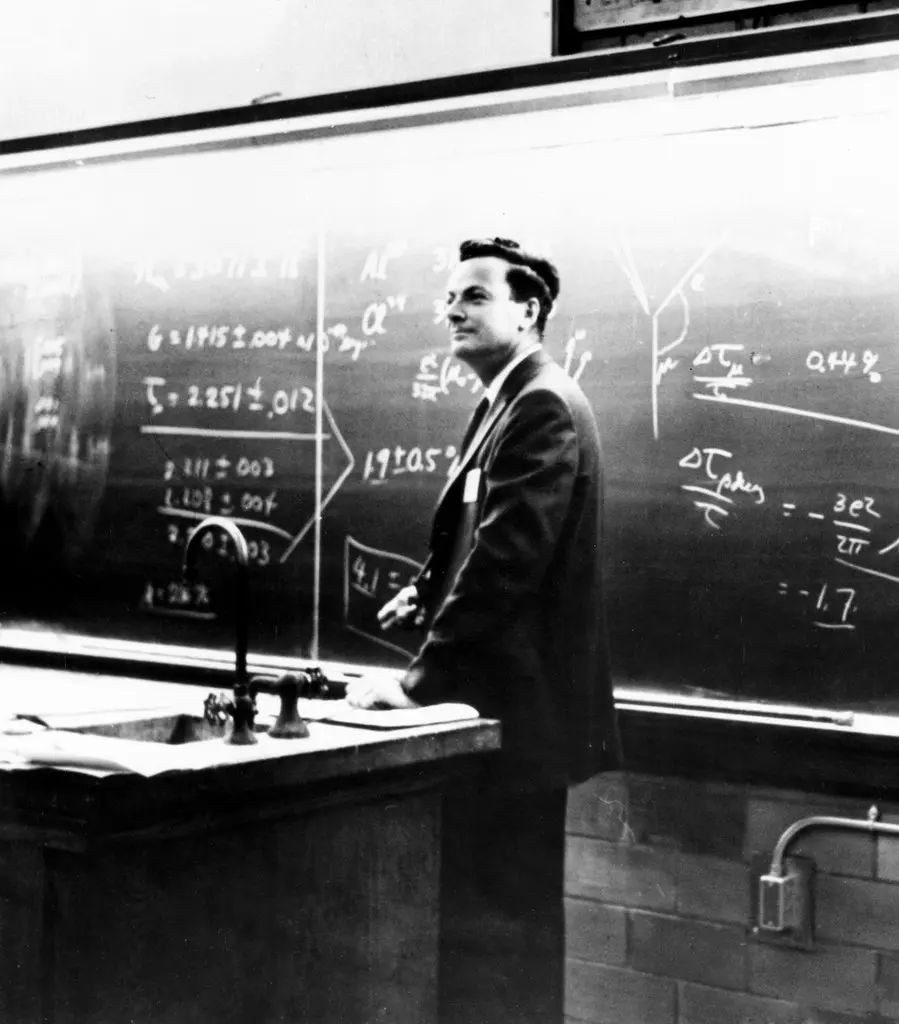
Richard Feynman was a Nobel Prize–winning physicist. But in 1964, he was appointed to the California State Curriculum Commission with a clear assignment: evaluate the new mathematics textbooks proposed for elementary schools. Eighteen feet of shelf space and 500 pounds of books were placed in front of him. He read all of them. A year later, he published New Textbooks for the 'New' Mathematics in Engineering and Science — and reading it today still stings.
What bothered Feynman was not wrong content. Most of the mathematics in the books was correct. What bothered him was the spirit — or rather, the absence of one. The books presented mathematics not as a practice of free thought but as a collection of rules to be memorized. And that, in Feynman's view, was a betrayal of mathematics itself.
“The successful user of mathematics is practically an inventor of new ways of obtaining answers in given situations.”— Richard P. Feynman, 1965
The Problem Is Mindset, Not Method
Feynman drew a sharp distinction in his essay: the difference between the pure mathematician and the person who uses mathematics. The pure mathematician is concerned with the logical consistency of axioms; the connection of symbols to the real world is not his concern. But the engineer, the physicist, the economist — any practitioner — needs exactly that connection. Feynman's frustration came from the fact that the 1960s “new math” reform was trying to impose the language and attitude of pure mathematicians onto elementary school children.
The problem was not the content of the curriculum. The problem was the mental rigidity embedded in the assumption that every problem has one correct method. Feynman put it plainly: how many different ways are there to solve 17 + 15 = 32? Counting on fingers, writing it out, computing mentally, grouping into piles — all are valid. But the old textbooks taught only one.
Consider the problem 29 + 3. Under the old curriculum, this problem was off-limits for first and second graders — because it requires carrying, and carrying wasn't introduced until third grade. Yet a child who has learned to count can solve it immediately by simply thinking: 30, 31, 32. Feynman's point was that this method should never have been forbidden.
Thinking Like a Detective
Feynman's most powerful analogy was the detective. A detective solving a crime doesn't look for “the correct method” — he works from clues, makes guesses, tests them, and adjusts. When everything finally fits, he has his answer. Mathematics works exactly the same way. But school teaches the opposite: learn the rule first, then apply it. That sequence conceals the very nature of mathematical thinking.
Feynman formulated it like this: the question should not be “What is the right way to do this problem?” but “How do I get the right answer?” The second question admits an almost unlimited variety of approaches — and that variety is mathematics.
This detective instinct — working from clues toward an answer rather than executing a predetermined procedure — is the same habit Feynman applied when teaching himself anything new. The technique he developed for learning is inseparable from how he believed mathematics should be approached from the start.
Three Principles, One Framework
At the end of the essay, Feynman laid out a clear framework. Three conditions that would make the “new” mathematics worth teaching:
Freedom of thought must come first
There is no single correct path to a solution. Children should be able to reach the right answer by any method — counting, guessing, grouping, reasoning from first principles. The constraint applies to wrong answers, not to unorthodox methods.
Don't teach words instead of ideas
Technical jargon cannot substitute for understanding. "The intersection of the set of lizards with the set of sick animals" says nothing more than "the sick lizards." Feynman found that the textbooks of his era were drilling children in the vocabulary of pure mathematicians without teaching them any actual mathematics.
Every subject must earn its place
No topic should be introduced without explaining why it exists. If a concept cannot be connected to the real world, to engineering, to science, or to any genuine question — Feynman's conclusion was unambiguous: it is not worth teaching.
Clarity, Not Precision
Feynman's least-cited but most penetrating observation was about language. The textbooks of his era used technical formality in the name of “precision”: carefully distinguishing a number from a numeral, a symbol from the object it represents, a ball from a picture of a ball. Feynman pushed back on all of it.
The real problem in communication, he wrote, is not precise language — it is clear language. “Color the ball red” is clearer than “Color the picture of the ball red.” The second formulation actually introduces uncertainty that didn't exist before: should you color the entire square area in which the ball image appears, or only the part inside the circle? Precision, pursued for its own sake, manufactures doubts out of nothing.
This lesson remains sharp today. A mathematics education that begins with abstract definitions and never connects to the real world kills the thing that mathematics actually requires — a free, curious, inventive mind willing to approach a problem from any angle. It is the same failure that MIT's 1869 entrance exam was never guilty of: those seven questions demanded genuine reasoning, not vocabulary.
“It will not do simply to teach new subjects in the old way. The point is to teach an attitude of mind toward numbers and toward mathematical questions — precisely the attitude that proves so successful later in technical applications.”— Richard P. Feynman, 1965
Sixty Years Later
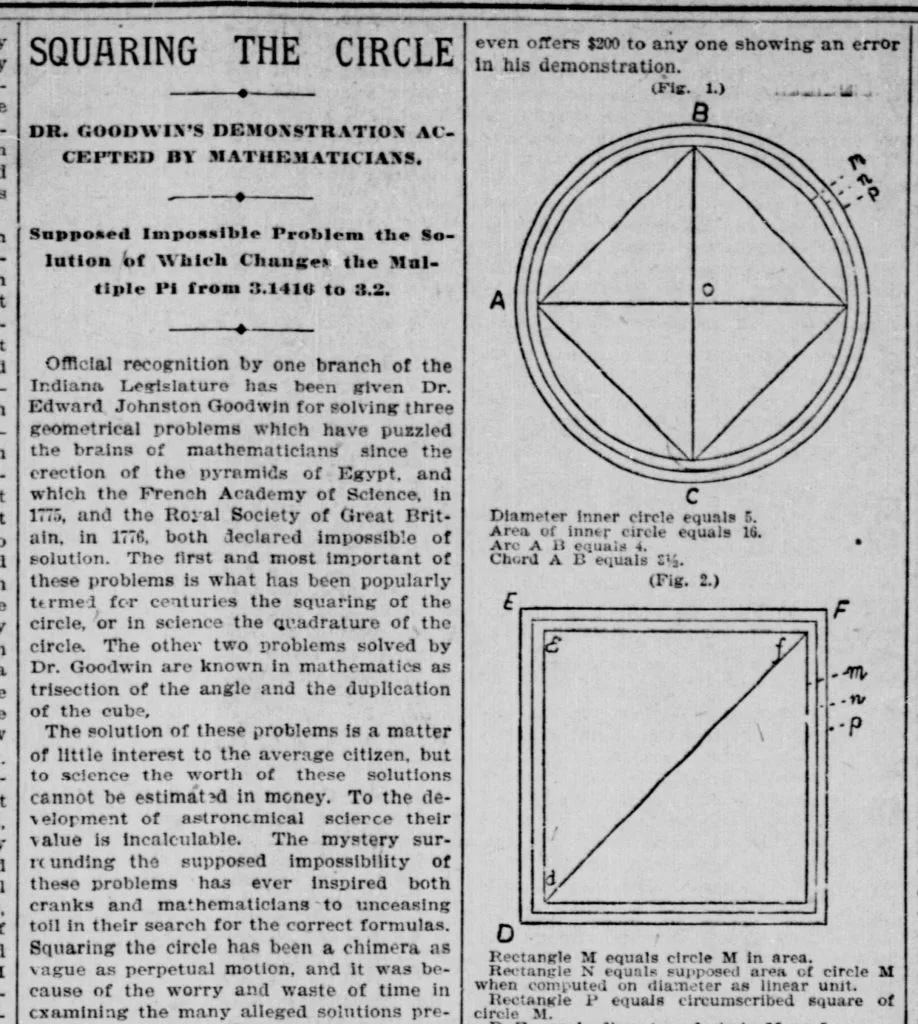
Feynman wrote this in 1965. Since then, mathematics education has passed through dozens of reforms, curriculum overhauls, and new pedagogical movements. And yet the core problem he identified — mental rigidity, purposeless abstraction, the myth of the one correct method — keeps reappearing in new clothes. It is, at some level, the same confusion that led Indiana's legislature to vote on the value of π seventy years before Feynman picked up those 500 pounds of books: a deep discomfort with mathematics as living, open-ended inquiry.
Perhaps Feynman's real lesson was this: teaching mathematics means teaching the intellectual freedom that mathematics lives inside. Everything else is just technique.
Source
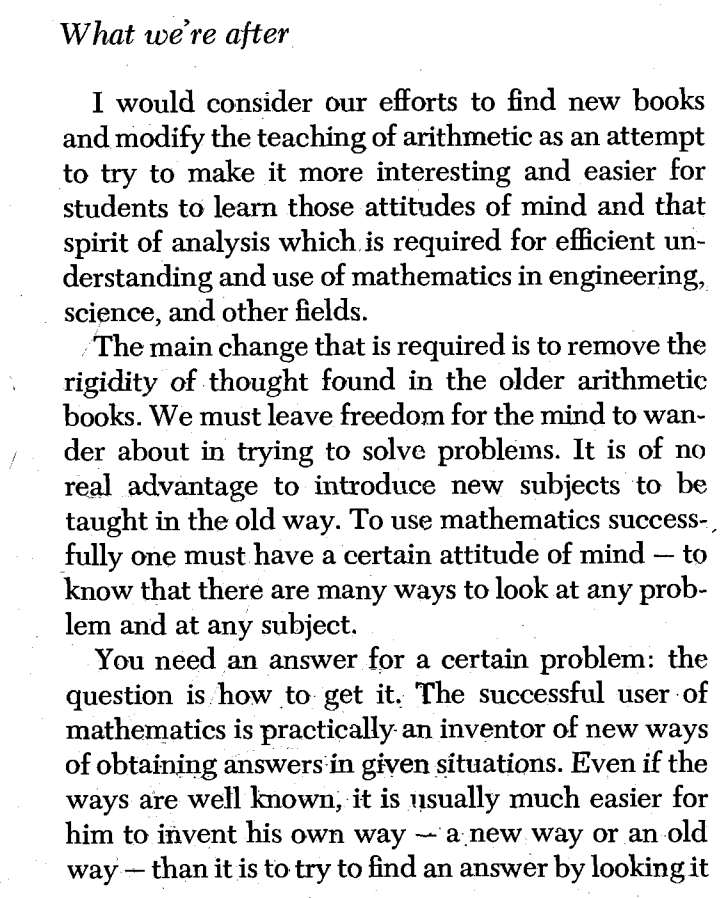
Richard P. Feynman, “New Textbooks for the ‘New’ Mathematics” — Engineering and Science, Vol. XXVIII, No. 6, March 1965, pp. 9–15. Full text available through the Caltech archives.