Between special relativity and November 1915 lies a notebook — half thermal physics, half gravitation — where the right mathematics appears, then gets set aside for the wrong reasons.
Narrative, page references, and facsimile links follow John D. Norton's Einstein's Zurich Notebook (University of Pittsburgh), including the “For more” section with archive URLs and further reading.
What Einstein was trying to do
Newton's gravity is a force acting at a distance: two masses pull each other with a strength that falls off as the square of the separation. The formula is exact enough to predict planetary orbits, tides, and the return of comets. No experiment contested it for two centuries.
Einstein contested the picture underneath the formula. Forces acting instantaneously across empty space sat badly with him even before special relativity — and after 1905, the discomfort became a logical problem. Special relativity said nothing travels faster than light. Newton's gravity was instantaneous. The two theories couldn't both be right.
His replacement was geometric. Gravity, in Einstein's revision, is not a force at all. It is the curvature of spacetime produced by mass. The Earth doesn't pull the Moon toward it; it warps the geometry of the space around it, and the Moon follows the straightest available path through that warped geometry. The path closes back on itself — what we call an orbit — not because something is pulling, but because straight lines in curved space are curves.
This insight arrived around 1907. Writing it down as a precise, self-consistent mathematical theory took eight more years. The Zurich Notebook covers the most intense stretch of that effort: a period of roughly six months, beginning in late summer 1912, when Einstein moved from Prague to Zurich to take up a position at ETH.
The physical object
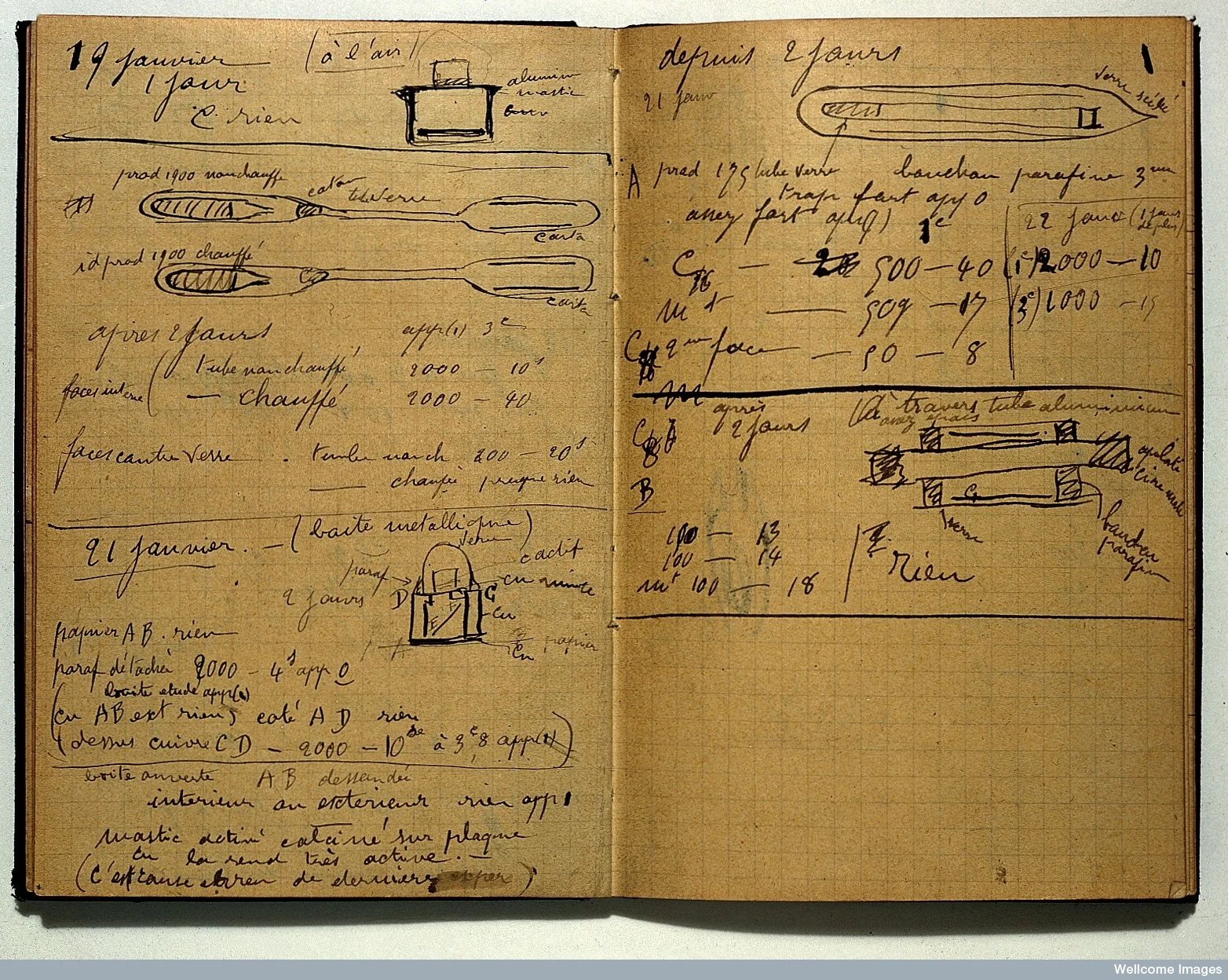
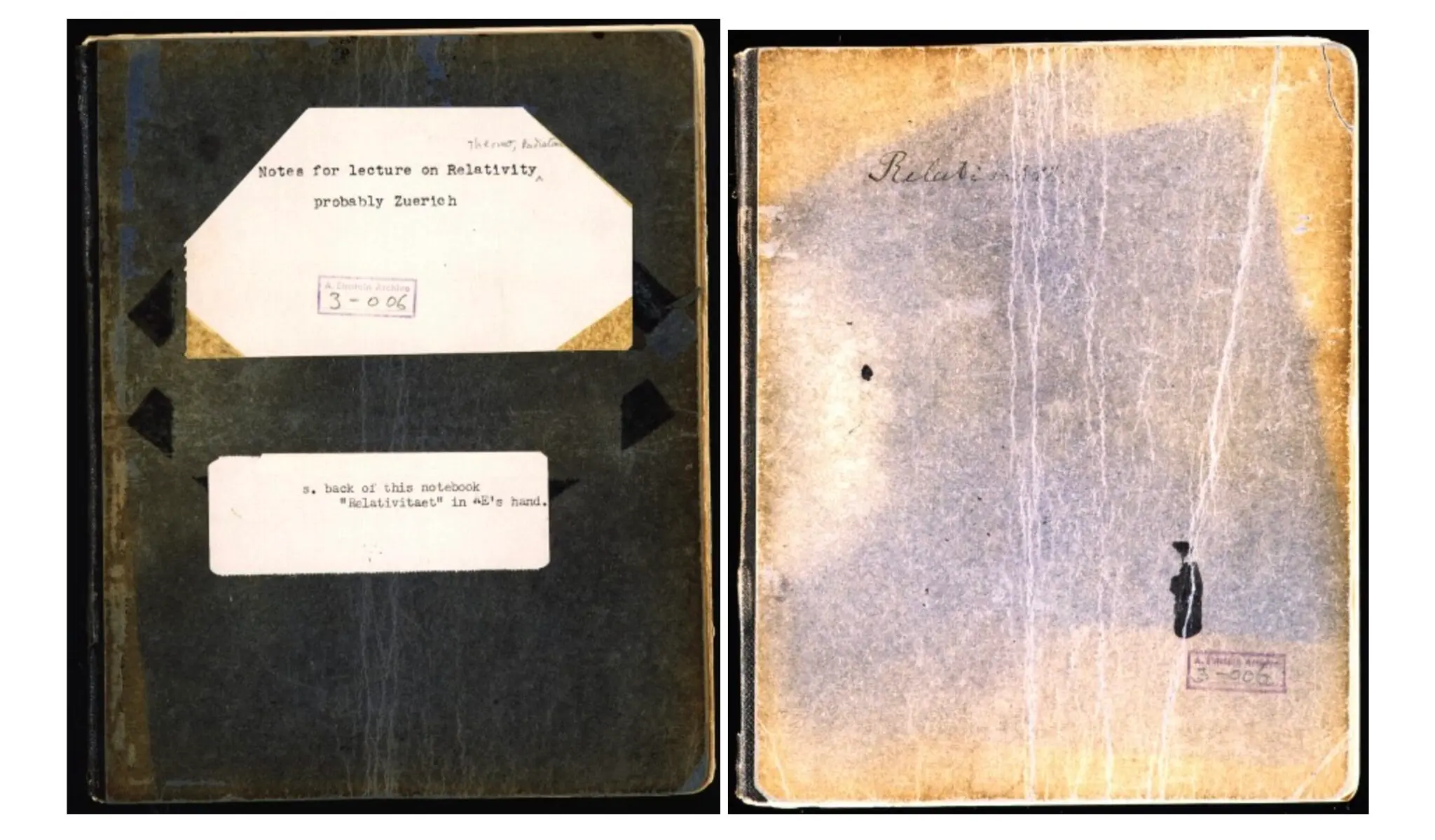
The notebook surfaced among Einstein's papers when he died in Princeton in 1955. It is small and brown, roughly the size of a paperback. It has two front covers because Einstein used it from both ends simultaneously — a habit that gives the document a slightly disorienting quality when read cover to cover.
Dukas end — On one cover, Einstein's secretary Helen Dukas typed a label: “Notes for lecture on Relativity, probably Zuerich.” Inside this cover, against all expectation, are recreational mathematical puzzles: a railway shunting problem and the 64=65 area illusion. Then Minkowski's four-dimensional spacetime formalism. Then, without warning, the line element of general relativity.
“Relativität” end — The opposite cover has “Relativität” in Einstein's own handwriting. Inside, nine pages of statistical-thermal physics — the Planck formula, the 1909 fluctuation formula. Then a heading: “Gravitation.” The serious work resumes and the two halves eventually meet in the notebook's physical middle.
The notebook is held at the Albert Einstein Archives at Hebrew University in Jerusalem and has been fully digitized. The gravitational sections were first analyzed in depth by John Norton in 1984. A complete scholarly edition, including facsimile, transcription, and commentary, was published as part of the multi-volume Genesis of General Relativity project (Springer, 2007), edited by Jürgen Renn and collaborators.
The 64=65 illusion, and the question it raises
Before the field equations, before the metric tensor, before any of the physics — there are doodles. Inside the “Relativität” cover, Einstein sketched two recreational puzzles. One involves the shunting of railway cars on branching tracks, a classic combinatorial puzzle. The other is the 64=65 area paradox.
The 64=65 area paradox — where the unit hides
The trick: cut an 8×8 square into four pieces along two diagonal lines, then reassemble the pieces into a 13×5 rectangle. The square has area 64; the rectangle has area 65. One unit of area has apparently been conjured from nothing.
The fallacy is geometric. The two diagonal cuts have slopes of 2/5 and 3/8 — which look identical on a hand-drawn grid but are not equal. When the pieces are reassembled, they don't fit together flush. A thin parallelogram runs the length of the apparent seam, invisible to a casual eye, containing exactly the missing unit of area. The “diagonal” across the rectangle is not actually straight: it bends very slightly at the joint.
Einstein knew the puzzle was wrong. He sketched it trying to locate where the deception lay. John Norton, who has studied the notebook more carefully than anyone, notes that the question this leaves — why was Einstein working through this puzzle at all, and who was he planning to show it to — remains unanswered. His sons Hans Albert and Eduard were ten and seven at the time.
The warmup: electrodynamics in four dimensions
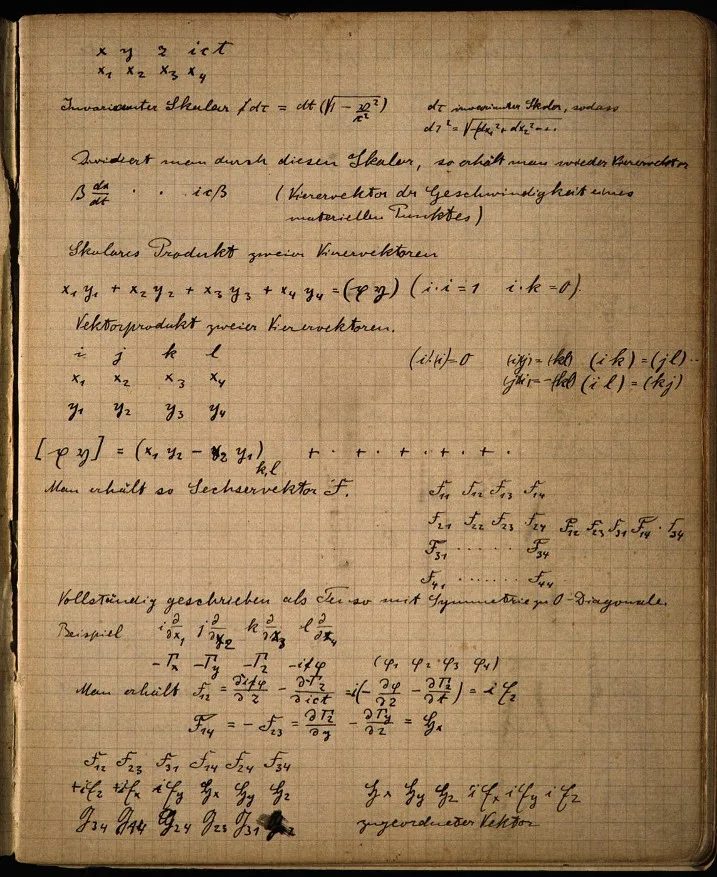
The facing page — directly opposite the puzzle sketches — contains serious physics. Einstein lays out Minkowski's four-dimensional spacetime approach, starting with the four coordinates (x, y, z, ict) = (x₁, x₂, x₃, x₄) and working through scalar products, four-vectors, six-vectors, and the operations defined on them. This is Einstein reacquainting himself with the mathematical machinery of special relativity before attempting to extend it. (Maxwell on a wall in Warsaw is a different kind of monument — but the same lineage.)
The development continues for thirteen pages — electrodynamics, thermal physics, the invariant scalar for a material particle. It is thorough and unhurried. Then, without transition or announcement, the notebook turns a corner.
The line element — written for the first time
At the top of a page, with no preamble, appears the expression that defines the geometry of curved spacetime:
ds² = Σ Gμν dxμ dxν
This expression defines how to measure the spacetime interval between two nearby events. In flat spacetime the coefficients Gμν reduce to a simple diagonal matrix. If they don't — if the metric is not flat — then the geometry is curved, and that curvature is gravity. Finding how source masses determine the coefficients Gμν (the metric tensor) is the central problem of the entire notebook.
Norton's assessment: this is quite possibly the first time Einstein wrote this expression anywhere. He used capital G for the coefficients initially, shifting to lowercase g within a few pages — the notation that became standard in all subsequent work.
The lower half of the same page already attempts to do something with this expression. Einstein chooses a “Spezialfall” — a special case — where the metric is nearly flat, with only the G44 = c² component deviating from its special-relativistic value. He tries to apply the gravitational field equation from his 1912 static-field theory. It's rudimentary. He knows it.
On the facing page, he asks what Norton calls a beginner's question: looking at the coordinate divergence of the metric tensor, he writes in the margin — “Ist dies invariant?” — is this invariant? Does the expression remain the same if you change the coordinate system? The computation that follows immediately shows that it is not. He moves on.
What is conspicuously absent from these early pages is any sign of the Ricci-Levi-Civita tensor calculus — the modern mathematical toolkit for handling curved spacetime. Instead Einstein is using older methods due to Beltrami, working out what invariant quantities can be constructed from a scalar φ. He is doing the best he can with the tools he has, but the right tools aren't in his hands yet.
The geodesic page — a classical detour that hits the target
Three pages later, one of the most remarkable pages in the notebook appears. Einstein sets aside the general theory and works through a standard problem in classical physics: if a mass moves freely but is constrained to the surface of a curved object, what path does it trace on that surface? The answer, derived via the calculus of variations, is the geodesic — the curve of shortest distance on the surface.
The result is, as Norton puts it, eerily close to the central idea of general relativity:
Einstein is working through the classical case with variational calculus, deriving the condition δ∫ds = 0. He is, in essence, practicing the mathematical structure that his new theory would require — but in a familiar, safe arena. Tilman Sauer was the first historian to identify what Einstein was actually doing on this page; Norton notes that until Sauer pointed it out, it was virtually impossible to see.
He was one page away from the central idea of his own theory, working it out in a context where the answer was already known, as if rehearsing a move before making it in the real game.
“Stimmt” — and the moment it was earned
We flip the notebook and start from the other end. After nine pages of thermal physics — Planck formula, fluctuation calculations — a new heading appears: “Gravitation.” The work from this side dives immediately into conservation of energy and momentum for matter in curved spacetime.
Einstein starts from the geodesic equation — the equation of motion for a freely-falling point mass, written as an Euler-Lagrange equation — and applies it to a cloud of non-interacting dust particles in free fall. He arrives at what we now recognize as the condition that the covariant divergence of the stress-energy tensor Tμν must vanish. This is a fundamental requirement of the theory.
But Einstein isn't sure his derivation is valid. The operator acting on Tμν might or might not be generally covariant — invariant under coordinate change. To test it, he replaces Tμν with the metric tensor gμν and asks whether the result is zero or transforms as a four-vector (as it should, if the operator is covariant). It comes out zero.
Norton's comment on this moment: “If Einstein was feeling a little smug, he had every right to it.” He had used an argument rooted in physics to generate a mathematical result that Ricci and Levi-Civita had arrived at from the opposite direction, by pure formalism. The smugness was warranted.
The missing tool: Grossmann and the Riemann tensor
The pages that follow the Stimmt moment are increasingly elaborate. Einstein searches for invariant quantities by examining the determinant G of the metric tensor, probing it for combinations that might serve as a gravitational field tensor. He identifies a “hypothesized gravitation tensor” — vermutlicher Gravitationstensor. The machinery is getting heavy, but something is still absent.
What's missing is the Riemann curvature tensor — the fourth-rank object from which, as every modern relativist knows, the gravitational field equations can be almost directly read off. Without it, Einstein is trying to build a cathedral without the keystone. The Ricci-Levi-Civita tensor calculus, which provides systematic methods for generating invariants from the metric tensor's derivatives, is nowhere in the notebook's early pages.
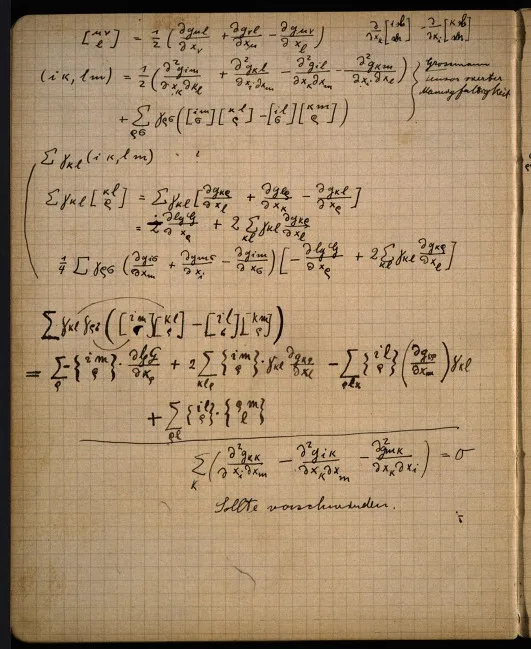
Then it appears. On a later page, at the top, Einstein writes the formula for the Riemann tensor in the old “four-index symbol” notation, (iκ,lm). Next to it, in the margin, are three words:
Einstein had the right tool. He contracted the fourth-rank Riemann tensor to produce the second-rank Ricci tensor. For this to work as a gravitational tensor, it had to reduce to the Newtonian form in the weak-field limit — and that required three of its four second-order derivative terms to vanish.
Getting those three terms to vanish without destroying the rest of the structure would occupy the remaining pages of the notebook — and ultimately fail.
Three attempts and a retreat
The battle with those unwanted terms produced pages of increasingly labored calculation. One computation was cut off mid-page with the annotation:
Einstein tried three distinct strategies to recover the Newtonian limit from the Riemann tensor:
- Attempt 1: the harmonic coordinate conditionThe section heading says everything: Nochmalige Berechnung des Ebenentensors — “Once again the computation of the surface tensor.” Einstein applies what we now call the harmonic coordinate condition (Δφ = 0) to restrict the coordinate system to one where the Newtonian limit can be recovered. It works. He writes at the bottom of the page: Resultat sicher. — “The result is certain.” Then, on the very next page, examining static fields as a special case, he makes an assumption — that in the Newtonian-limit coordinates, only the g44 component of the metric varies — that is simply wrong. The harmonic condition vanishes from the notebook and never returns.
- Attempt 2: a reduced Ricci tensorHe writes down a reduced form of the Ricci tensor as a new “presumed gravitation tensor” with broad covariance, imposing a new coordinate condition to recover the Newtonian limit. This approach generates a dispute among historians: the majority view holds that Einstein inserted this condition as a new physical assumption, fatally restricting the theory's covariance; Norton holds a minority view that Einstein saw it as a free coordinate choice, then rejected it for other reasons. Whatever the correct interpretation, the proposal does not survive the page.
- Attempt 3: coordinate restriction by tensor conditionRather than stipulating a coordinate condition directly, Einstein asks that the coordinate restriction be expressed as a requirement that a certain quantity transform as a tensor. He can then show that the resulting expression has Newtonian form. This approach is ingenious. It also does not survive many pages.
By mid-1913, the notebook ends in what Norton calls “complete capitulation.” Einstein and Grossmann publish the “Entwurf” paper — gravitational field equations of unknown and probably limited covariance, not derived from the Riemann tensor. The notebook contains a summary of the Entwurf derivation written with unusual neatness across two facing pages, as if transcribed later from another source, after the result was already settled.
The two years that followed
With the Entwurf equations published, Einstein entered what Norton describes as “a darkness in which he would wander restlessly and with increasing discomfort for over two years.” He knew something was wrong. He couldn't find what.
The correct equations were within reach the whole time. The Riemann tensor approach that the notebook had repeatedly attempted and abandoned was, in fact, the right approach. The stumbling block — the assumption that only g44 varies in the Newtonian limit — was simply wrong, and once that assumption was dropped, the path to the correct equations opened.
In November 1915, in a four-week sprint that Einstein described as the most intense intellectual effort of his life, he returned to the Riemann tensor and found the generally covariant field equations. The gravitational field equations of general relativity — which the Zurich Notebook had been reaching toward, and failing to reach, for sixty-odd pages — were submitted to the Prussian Academy on November 25, 1915.
The correct answer was on the page in 1912. Einstein had the Riemann tensor. He had the contraction to the Ricci tensor. He had the Newtonian-limit requirement. He rejected it because of a wrong assumption about static fields — an assumption he wouldn't identify as wrong for three more years.
What the notebook actually shows
The published papers of general relativity present a finished argument: clean, tightly structured, pointing inexorably to the correct conclusion. The Zurich Notebook shows what the argument looked like before it was an argument — while it was still a series of attempts, reversals, wrong turnings, and recoveries.
The notation changes mid-notebook as Einstein learns better tools. Calculations are cut off with “too involved” and restarted from different angles. The word Stimmt appears on a good page; wahrscheinlich unrichtig on a bad one. The Entwurf derivation is copied in neatly at the end, as if to put a clean face on a process that had been anything but clean.
Norton's framing is precise: Einstein had circled the correct equations in 1912, recognized them as candidates, and then rejected them on the basis of a physical argument that seemed compelling at the time. He was not making a mathematical error. He was making a physical judgment — that the Newtonian limit required the metric to take a certain form in weak fields — that turned out to be incorrect. The mathematics was fine. The physics assumption wasn't.
This is the thing the notebook makes concrete: even in the most consequential piece of theoretical physics produced in the twentieth century, the path from idea to equations was not a sequence of insights but a sequence of attempts, most of which failed. The 64=65 puzzle is on the same cover as the first written-down line element of general relativity. Both are the work of the same mind, in the same few months, on the same pages — one unsolved, one barely started, both staring at a deception they couldn't quite locate. (The unit circle is a different kind of curve — but the same stubborn habit of hiding what you think you see.)