Mathematics · Art · Golden Ratio
Rafael Araujo’s 20+ Mesmerizing Geometrical Masterpieces
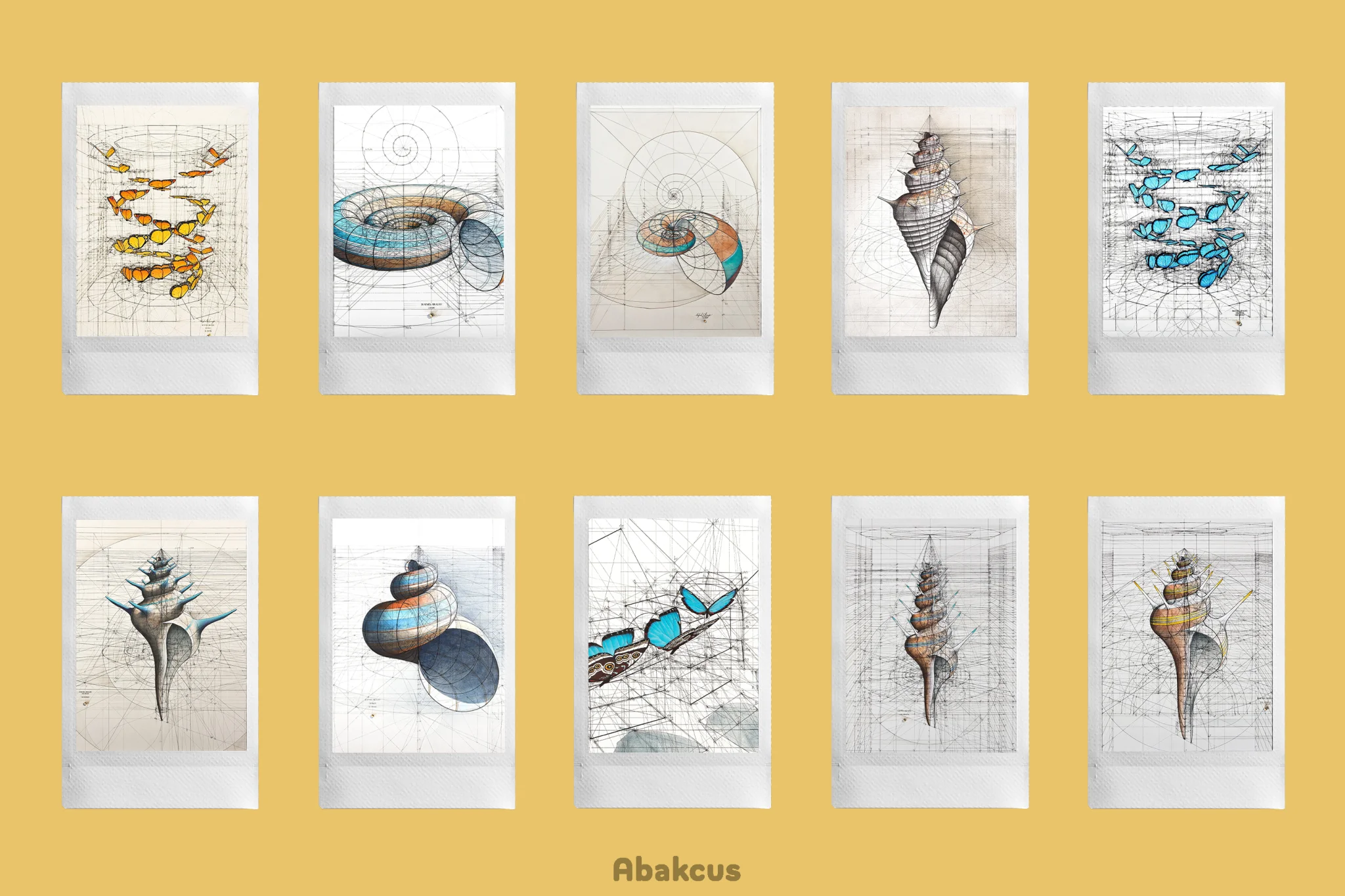
To celebrate Rafael Araujo’s talent and vision, we have curated a selection of his most stunning illustrations — showcasing the elegance and intricacy of the Golden Ratio, drawn entirely by hand.
Rafael Araujo is a Venezuelan architect and illustrator who has spent more than four decades doing something that should not be possible: producing drawings of breathtaking mathematical precision entirely by hand. No CAD software. No digital tools. Just a lamp for light, a ruler, a compass, and a protractor — and a patience that borders on the superhuman.
By incorporating the golden spiral and helixes into his compositions, Araujo establishes a harmonious blend of science and art, using these structures as the foundational skeleton for his stunning depictions of shells, butterflies, and flowers. The result is a collection of drawings where vivid natural elements sit on top of their geometric guiding lines — the scaffolding left deliberately visible, like the steel frame of a cathedral left exposed for all to admire.
“Through the thorough use of geometry, I try to attain and worship the platonic perfection of Nature.”
This is not a metaphor. Araujo literally constructs nature from mathematics outward. He begins with the numbers — Phi, the Fibonacci sequence, the properties of the double helix — and builds the organic form on top of them. A shell is not drawn as a shell; it is derived from a spiral, the way a theorem is derived from an axiom.
No Room for Error
Every line Araujo lays down in ink is permanent. There is no undo. “Working by hand, with ink on canvas, my main concern is to be aware of what I’m always doing. Errors are paid dearly.” A single misplaced arc in hour ninety-seven of a hundred-hour drawing means starting over. This awareness gives his work a quality that no algorithm can replicate: the quiet tension of a human being holding complete concentration across an enormous span of time.
Araujo has cited M.C. Escher as an early inspiration — both artists share an obsession with perspective, mathematical structure, and the uncanny space where logic produces beauty. But where Escher bent reality into impossible architecture, Araujo holds the mirror up to nature and shows us that the impossible is already there, hiding in a nautilus shell.
TED Talk — Rafael Araujo
Araujo’s TED Talk on how he uses the Golden Ratio and pure geometry to recreate the hidden mathematical order of nature — entirely by hand.
The Geometry of Growth
At the heart of Araujo’s practice is the Golden Ratio — the number Phi (φ ≈ 1.618), which appears with remarkable regularity in the proportions of living things. Sunflower seed arrangements, nautilus shells, the branching of trees, the spacing of leaves on a stem: all reflect what botanists call phyllotaxis, the tendency of organic structures to grow in patterns governed by the Fibonacci sequence. Araujo’s illustrations do not merely depict these structures — they re-enact the mathematics that generates them.
What makes his work visually arresting is precisely the decision to leave the construction lines in the final piece. A Blue Morpho butterfly sits at the center of an intricate web of spirals, cones, and helixes — the geometry that “explains” the butterfly visible all around it. The viewer encounters the organism and its mathematical genesis simultaneously. In the same spirit that physics posters make abstract equations beautiful, Araujo’s drawings make the invisible mathematics of nature visible.
Nautilus Cross Section
ink on paper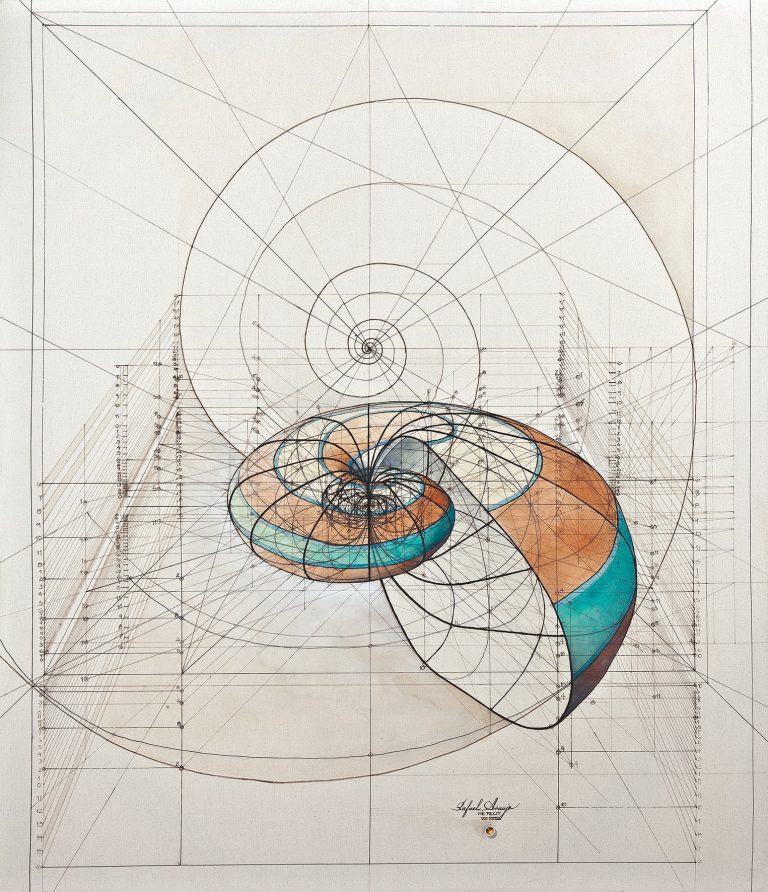
The chambers of a nautilus shell follow a perfect logarithmic spiral — each one a fixed proportion of the last, governed by Phi. Araujo draws the cross-section from the spiral outward, building the shell the way nature builds it: one ratio at a time.
45 Degrees Cone Shell 2
golden ratio proportions · ink on canvas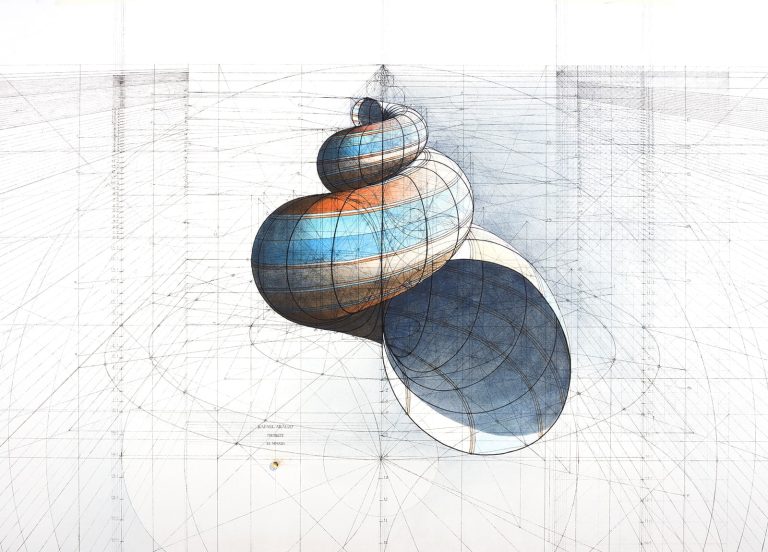
Murex
spiral construction · ink on paper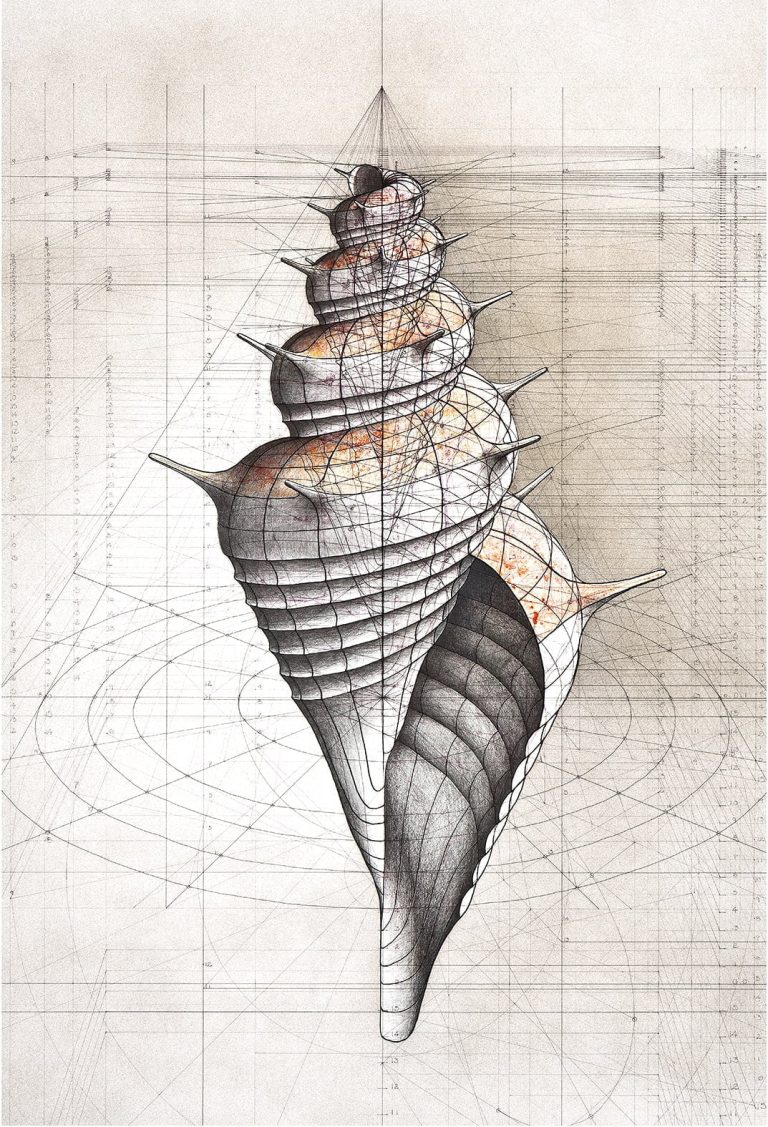
Blue Stripes Shell
ink on paper, 2015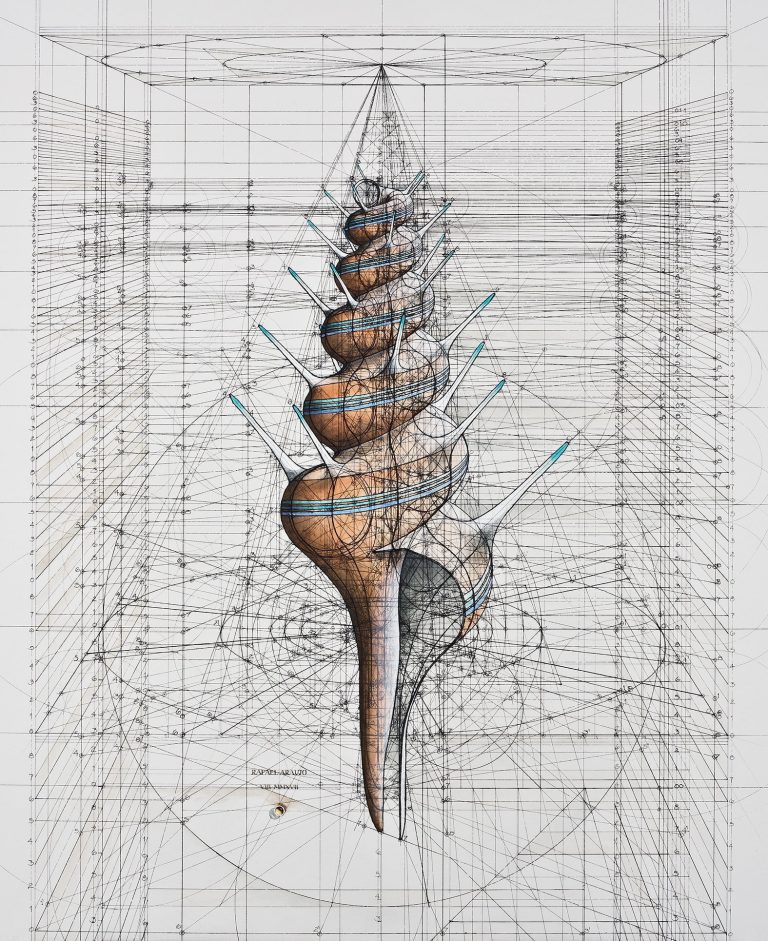
Semi-Flat Shell
ink + acrylic on canvas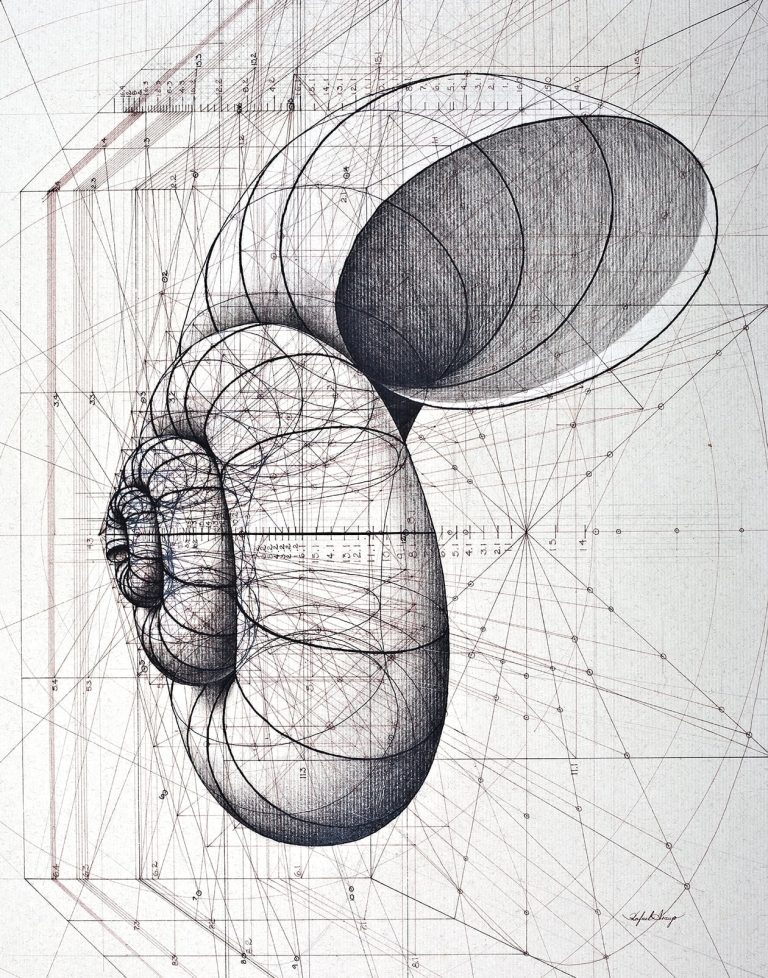
45 Degrees' Shell
growth sequence · ink on paper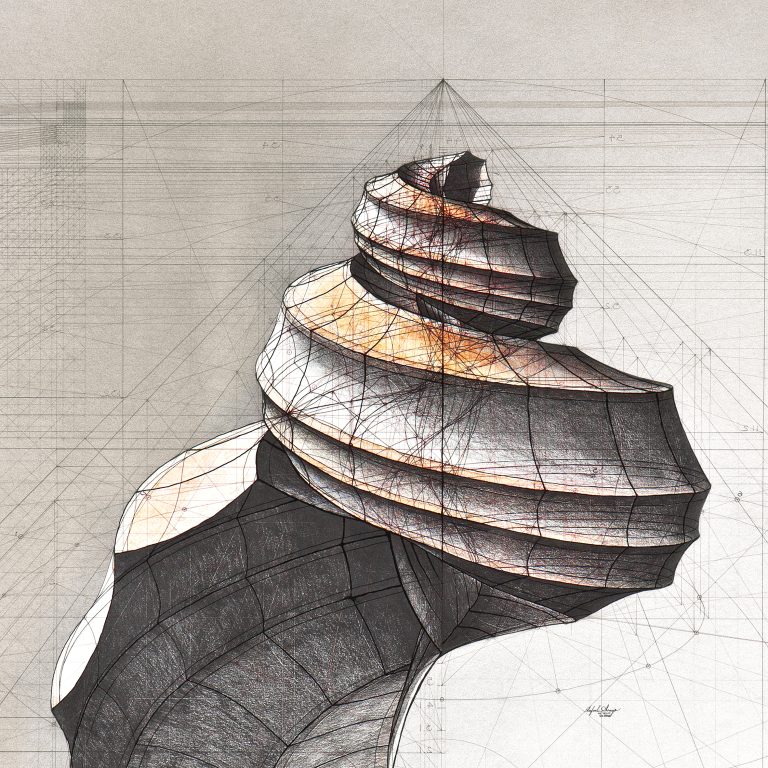
Blue Spikes' Shell
ink on paper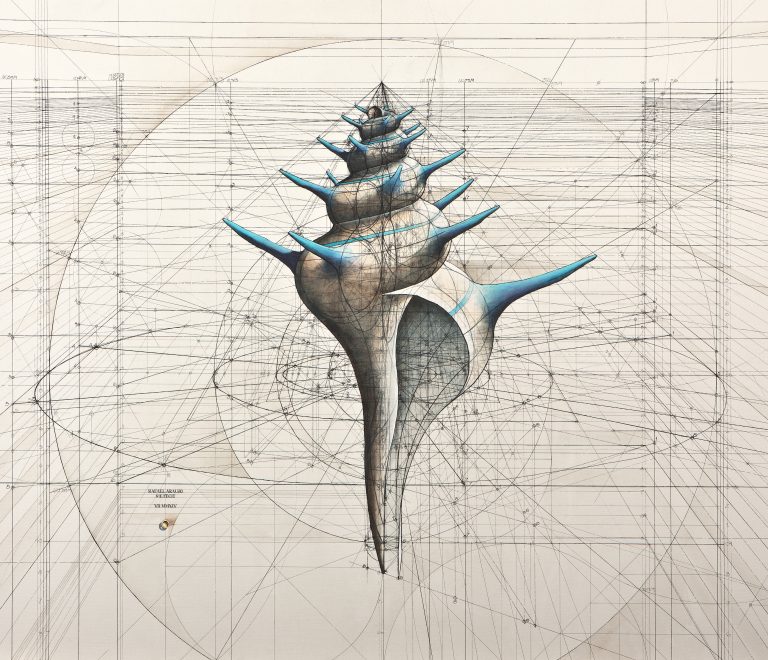
Flat Shell
ink on paper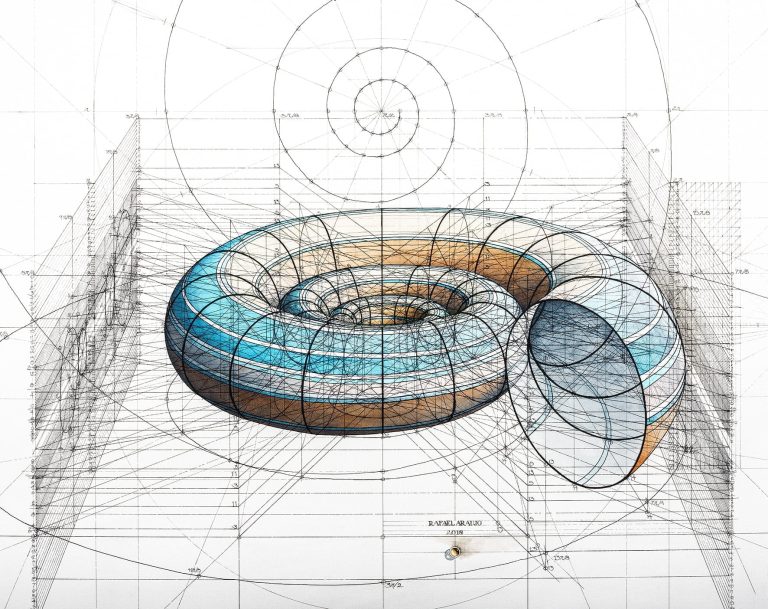
Golden Shell
pencil and ink on paper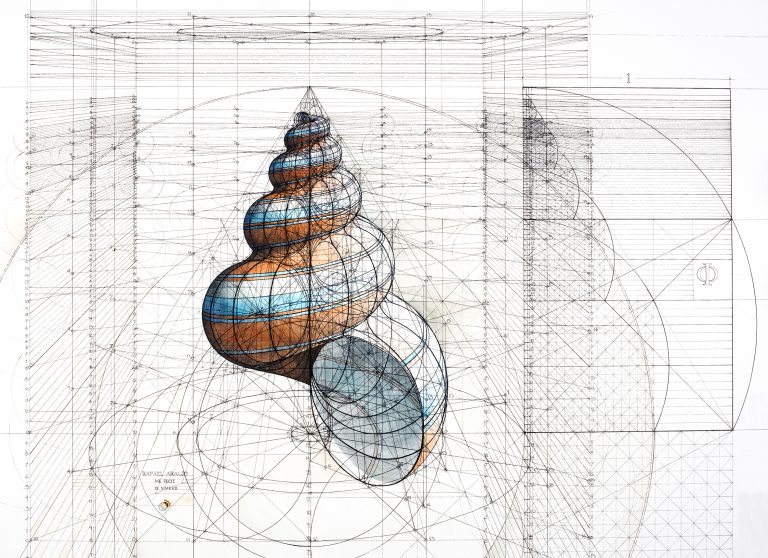
Phoebis Triple Helix
ink + acrylic on canvas, 2015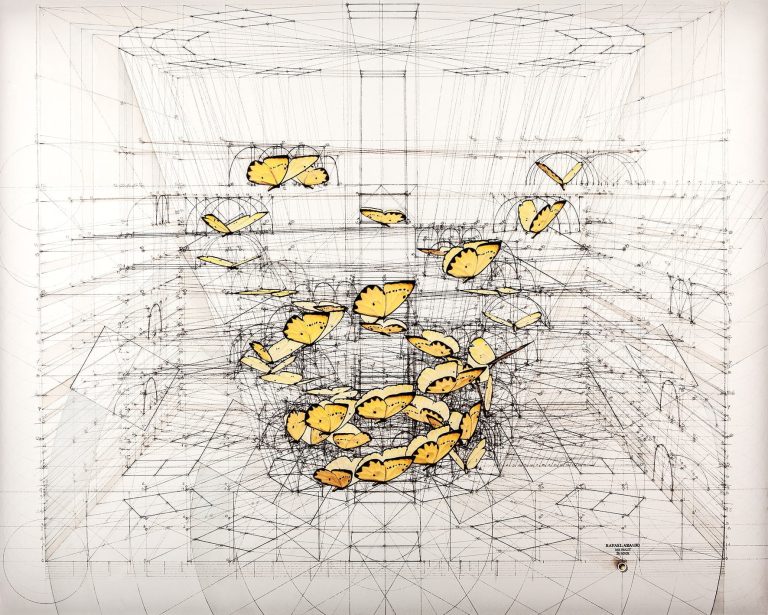
The defining image of Araujo’s practice: a Phoebis butterfly suspended at the convergence of a triple helix. The insect’s symmetry is not assumed — it is proved, step by step, by the geometric armature surrounding it.
Slim Cone Double Helix
ink on paper, 2015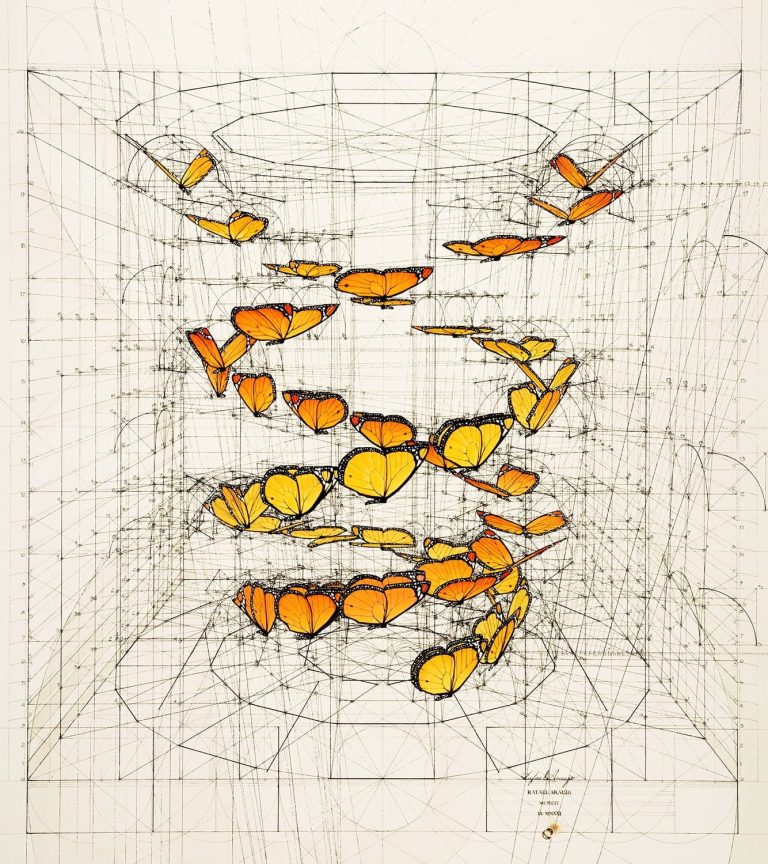
Monarch butterflies arranged along two interlocking helices inside a cone. The geometry dictates where each insect sits — the spiral is not decorative, it is the structure.
Morpho Sequence 1
ink on paper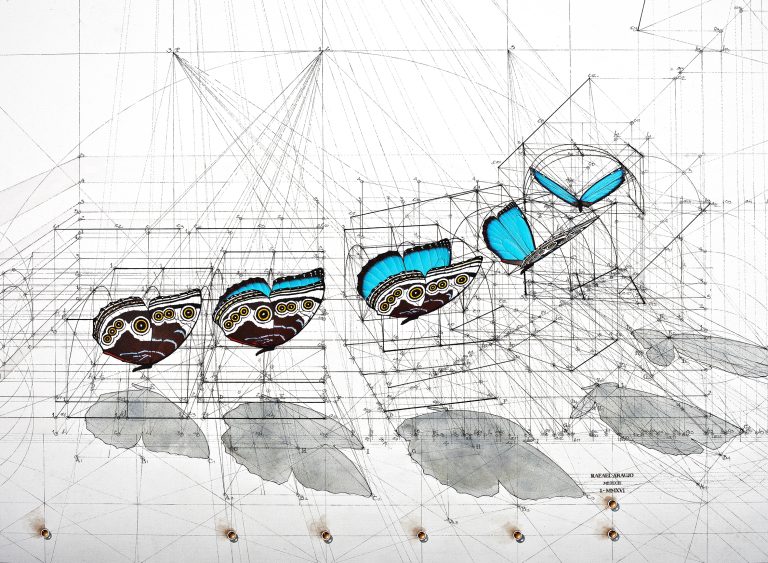
Monarch Water Mirror
Fibonacci growth sequence · ink on paper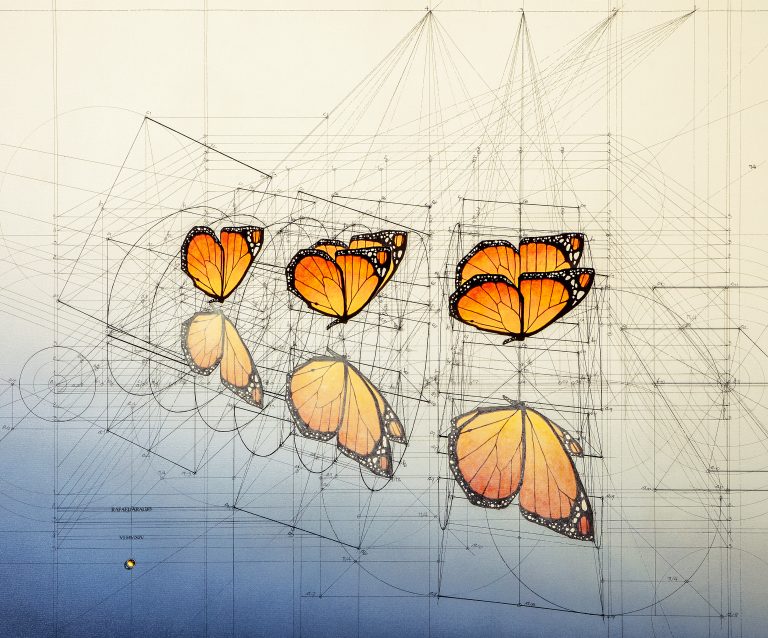
Phyllotaxis is the phenomenon by which plants arrange their leaves, seeds, or florets in Fibonacci patterns. Araujo’s hand-plotted version makes the underlying grid explicit — the dots are not decoration, they are data points in a spiral sequence.
The Coloring Book That Invites You In
In 2016, Araujo took his work one step further by publishing his Golden Ratio Coloring Book — a collection of 25 hand-drawn illustrations printed on thick, acid-free 9.8 × 9.8 inch paper, designed to be colored in by the reader. The book was printed in Verona, Italy, and each page is printed on one side only, to prevent bleed-through from watercolors, gouache, markers, or gel pens.
The concept is elegant: Araujo supplies the geometry and the line work; you supply the color and the time. Every illustration includes a grayscale guide to help readers understand how to build up depth and shadow. In this way, the coloring book becomes something closer to an apprenticeship — a way of learning to see the Golden Ratio by actually following its lines with your own hand.
A Spiritual Connection to Nature’s Code
For Araujo, the Golden Ratio is not merely a compositional device — it is a philosophical stance. His deliberate choice to leave construction lines visible in finished works is a declaration: these are not just beautiful objects, they are transparent about how beauty works. The scaffolding is the art.
In an age where stunning digital imagery can be generated in seconds, there is something quietly radical about a man at a drafting table in Caracas, spending a hundred hours laying down ink with a compass and a protractor — producing images that look, to the untrained eye, like output from a supercomputer. The images invite you to look twice. And then, if you are paying attention, to look at the natural world itself with new eyes.
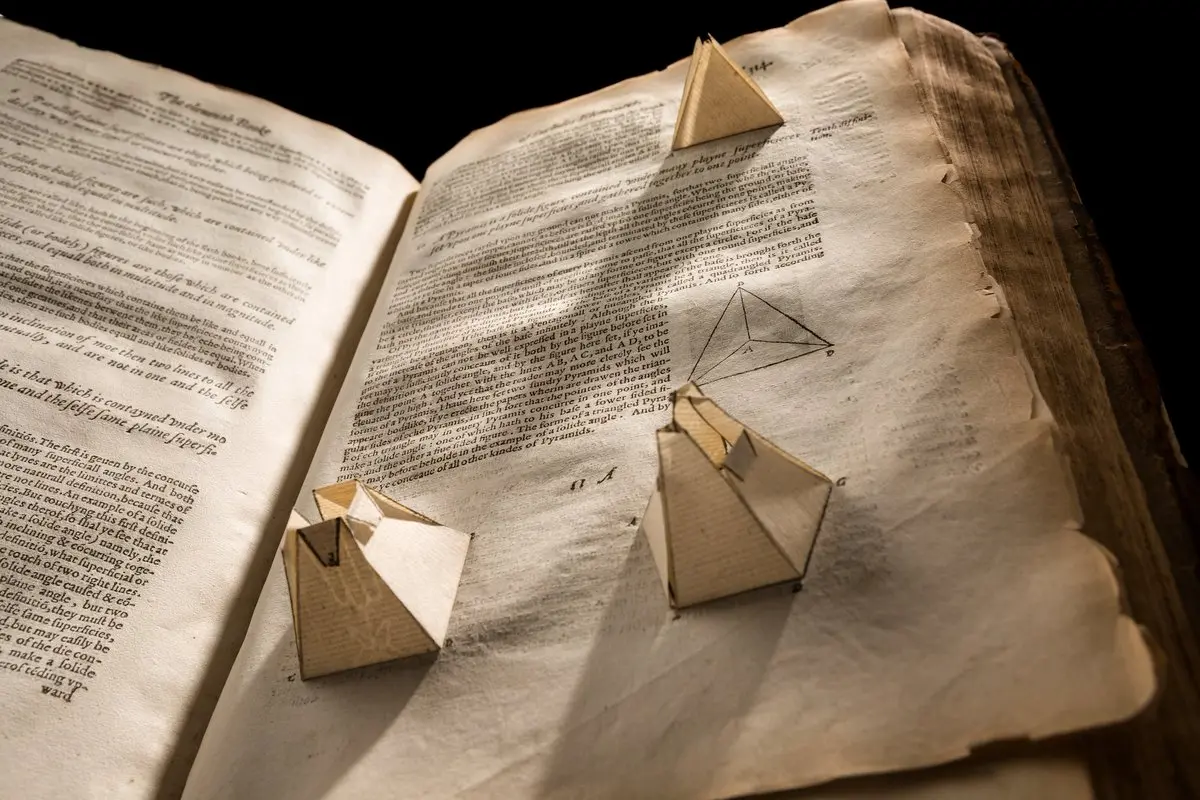
You can explore Araujo’s full body of work at his official website, and bring his geometry into your own hands with the Golden Ratio Coloring Book. For more mathematical artistry, don’t miss Oliver Byrne’s color-coded Euclid — another example of mathematics made radically, visually alive.