Some books are not read. They are seen.
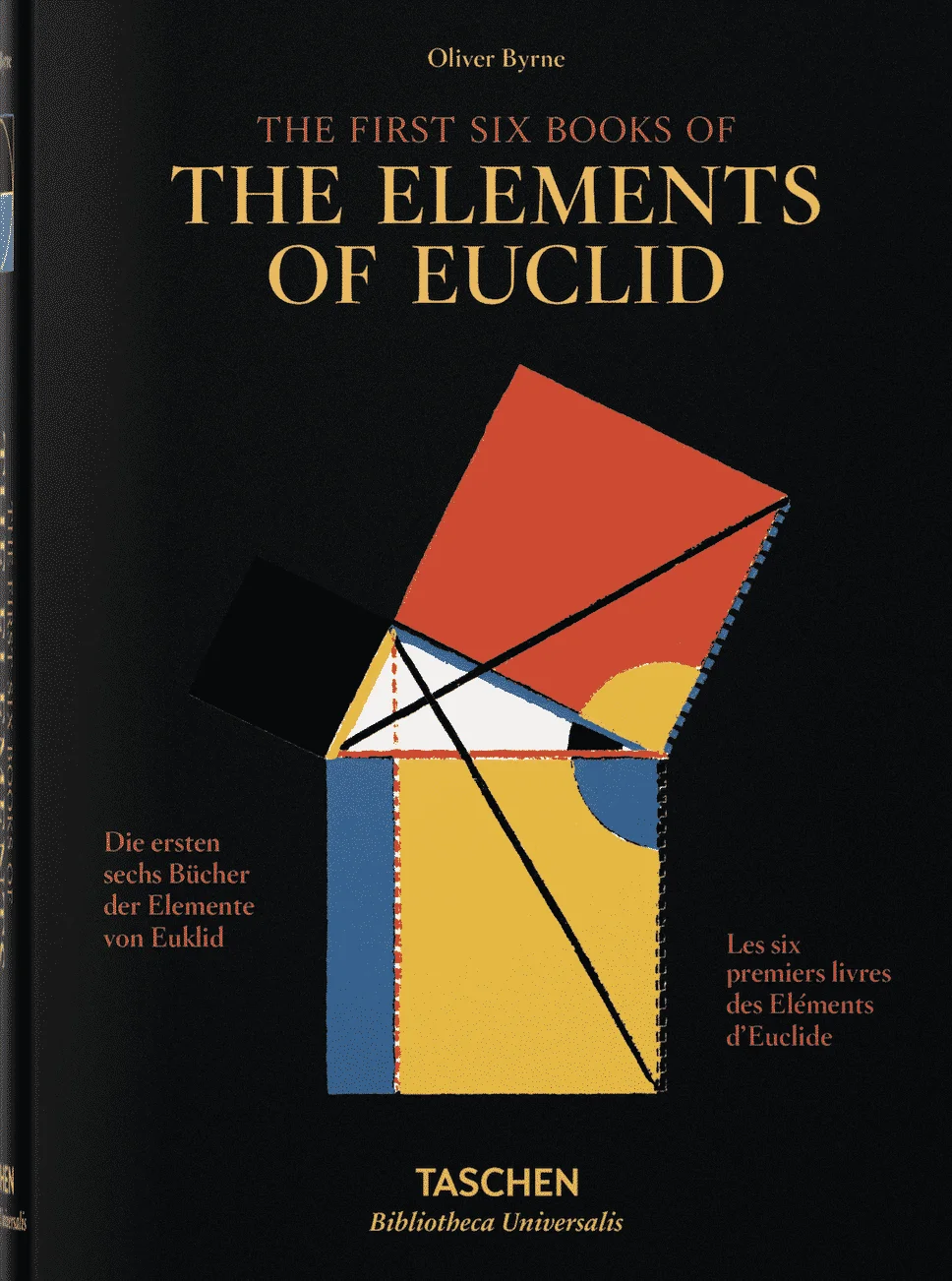
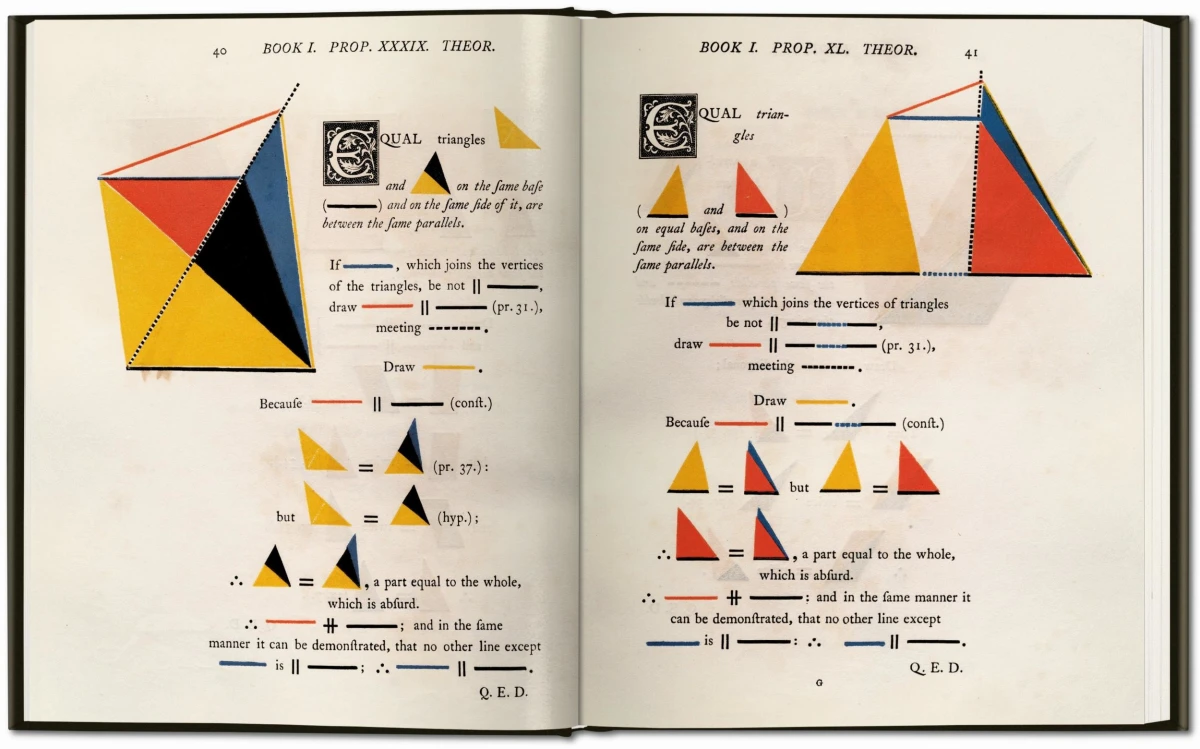
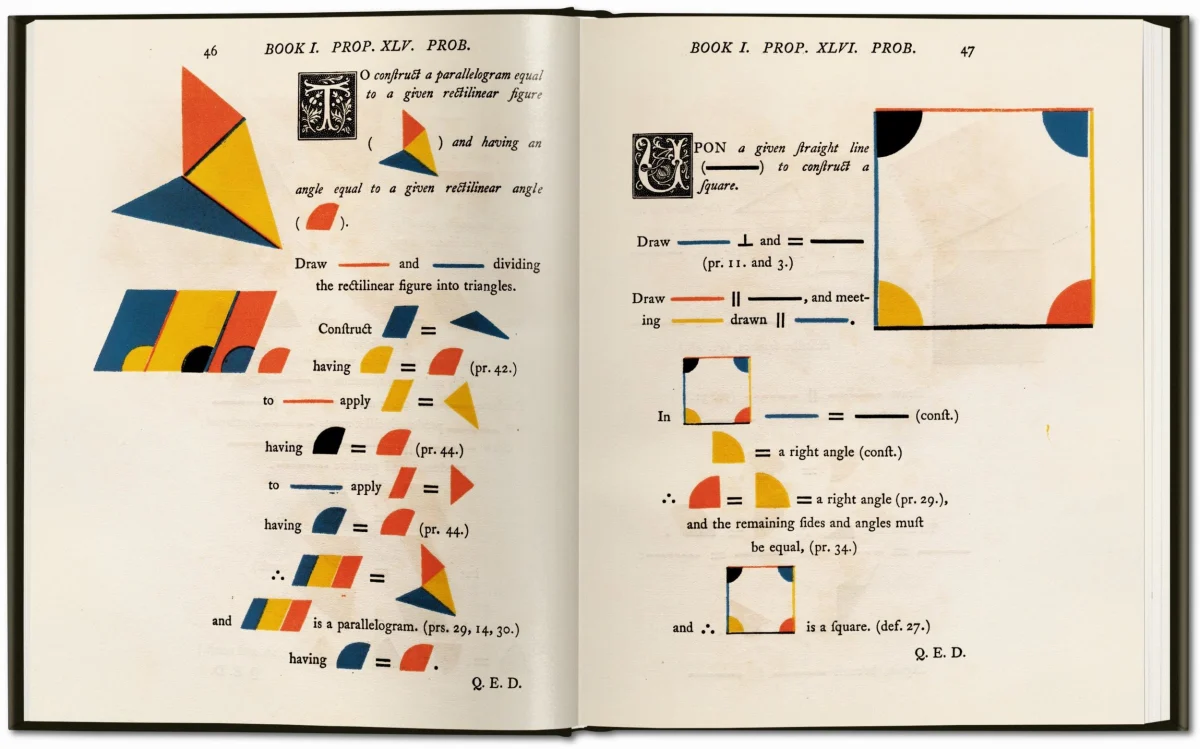
liver Byrne's 1847 interpretation of Euclid's Elements is one of those rare moments when mathematics becomes image. Theorems that had been taught for over two thousand years using letters and symbols were retold, by Byrne, entirely in colour: red, yellow, blue, and black. A line segment was no longer labelled “BC” — it was a yellow line. An angle was no longer expressed as a sequence of letters — it was a blue triangle.
The result remains astonishing today: the most abstract corners of mathematics translated into a visual language the eye can grasp before the mind has even caught up.
How Byrne rewrote a theorem
Traditional notation
Let line segment AB be bisected at point C, such that AC = CB…
Byrne's method
A red line meets a blue line at a yellow point — equal halves made visible at a glance.
The second most printed book in history
One thing must be understood about Euclid's Elements: this is the second most printed book in history. For centuries it was studied not merely as a mathematics text but as a model of correct thinking — of how to build a sound argument, how to prove something step by irrefutable step. Newton read it. Spinoza wrote his entire philosophy in geometric proof form. Lincoln studied the Elements from cover to cover before becoming a lawyer — because he wanted to learn how to demonstrate that something was true. (The Indiana Pi Bill of 1897 is a good reminder of what happens when legislators lose sight of Euclid's standard of proof.)
Euclid's Elements has never stopped inspiring visual reinvention. Henry Billingsley's 1570 English edition included paper pop-up solids that readers could fold out of the page — three-dimensional geometry rendered tactile. Byrne's question, in 1847, was different and no less radical: what if all of this could simply be shown?
Before Mondrian, Byrne. Before the Bauhaus, Byrne. A mathematics textbook from 1847 that looks like it was designed last year.
Designers speak of Byrne's book with reverence today because its red-yellow-blue-black palette, flat geometric forms, and the precision living inside apparent simplicity look uncannily like the most important design movements of the twentieth century — movements that would not arrive for another eighty years. Perhaps beauty and truth really do draw from the same source. The proof that √2 is irrational, which Euclid himself established, carries exactly that same quality: once seen, it cannot be unseen.
TASCHEN's edition presents the original in its full large format, with complete fidelity. William Rankin's introduction places Byrne in context — mathematically, visually, culturally. But again: you do not open this book for the words.
Those who read Euclid before Byrne
Physicist
Isaac Newton
Read the Elements as a young student and modelled the structure of Principia Mathematica on its method of proof.
Philosopher
Baruch Spinoza
Wrote his Ethics entirely in Euclidean form — definitions, axioms, propositions, proofs.
Statesman
Abraham Lincoln
Studied all six books before practicing law. He wanted to know what it meant to truly prove something.
Once you are inside, you get lost. You follow a theorem: a red line begins here, a blue area intersects it, a yellow segment extends beyond. The steps are so clear, so visible, that instead of saying “I understand” you find yourself saying “I see.” And the distance between those two things is the whole point of Byrne's project.
This book is for
- Those who love mathematics and want to see it from a completely different angle.
- Designers and visual thinkers curious about how images can carry rigorous knowledge.
- Anyone who has ever wondered how something abstract can suddenly become concrete.
- Those who want a book that doesn't just sit on a shelf — but stays open on a table.
Two thousand years of thought, given back to the eye. That is what this book does. And every time you open it at a random page and find yourself surprised that something so old can feel so immediate — you understand exactly what Byrne was after. Mathematics was always visible. It was only ever being told in the wrong language.
In short
One of the most quietly radical books ever printed. Byrne didn't simplify Euclid — he revealed him. TASCHEN's edition gives this masterpiece the physical presence it has always deserved.
Oliver Byrne — The First Six Books of the Elements of Euclid
TASCHEN, 2010 · Original edition: London, 1847 · abakcus.com