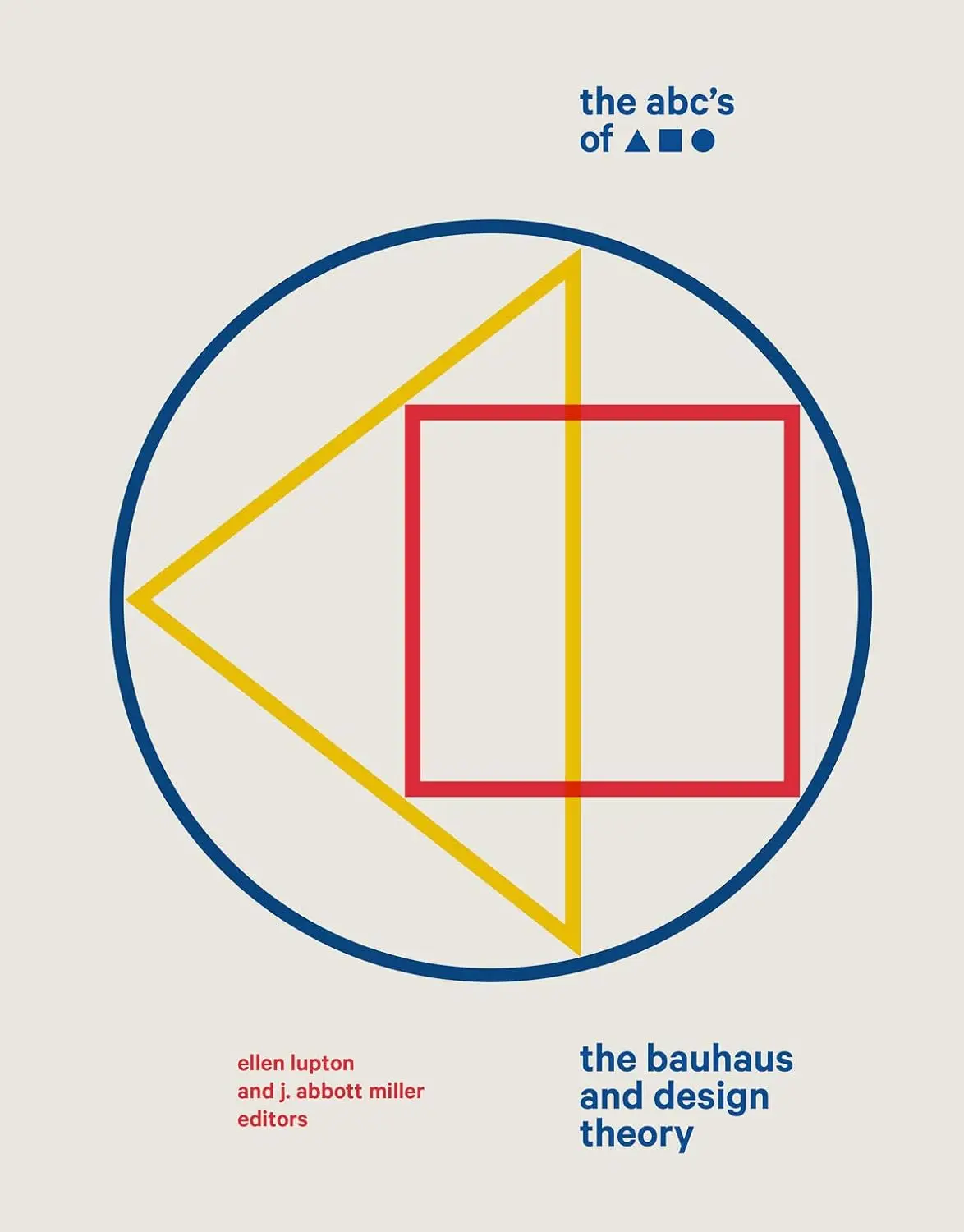
Ellen Lupton and J. Abbott Miller’s slim, sharp primer on the Bauhaus — still the clearest book on why those three shapes changed everything.
In 1919, Walter Gropius opened a school in Weimar. He called it the Staatliches Bauhaus — the State Building House. It lasted fourteen years before the Nazis shut it down in 1933. Fourteen years was enough. The Bauhaus rewired twentieth-century architecture, typography, furniture, ceramics, photography, and graphic design. Beneath all of it ran a single question: what is the smallest unit of visual language?
The answer arrived in three forms: the triangle, the square, and the circle. These were the Bauhaus alphabet. Ellen Lupton and J. Abbott Miller’s The ABC’s of Triangle, Square, Circle — first published in 1991, reissued with a new preface in 2019 — decodes that alphabet in sixty-nine pages. The Wall Street Journal called it the book that does what no other Bauhaus book does. That is not an overstatement.
Kandinsky’s Questionnaire: which color belongs to which shape?
In 1923, Wassily Kandinsky circulated a questionnaire at the Bauhaus. The instructions were simple: fill in a triangle, a square, and a circle using the three primary colors — yellow, red, and blue. One color per shape. Kandinsky’s expected answer was fixed: yellow triangle, red square, blue circle. He believed there was a universal correspondence between form and color — something wired into perception, independent of culture or training.
Visual — Kandinsky’s 1923 Color-Form Assignment
forward-moving
material
expanding outward
Kandinsky’s hypothesis: yellow = triangle, red = square, blue = circle. The 1923 questionnaire produced strong consensus — partly, researchers later argued, because everyone at the school already knew the expected answer.
The questionnaire seemed to confirm Kandinsky’s hypothesis. Subsequent independent research cast doubt on that consensus: most Bauhaus students and faculty already knew the theoretical ideal before filling in their answers, which likely skewed the results. Whether or not the correspondence is universal, the equation proved enormously generative. Peter Keler built a cradle from it. Herbert Bayer drafted a wall mural. Joost Schmidt designed exhibition posters. In the furniture workshop, designers like Erich Dieckmann were working through the same formal reduction — stripping chairs to their essential geometry, asking what a tubular steel frame looked like when the decorative was removed entirely. The triangle-square-circle triad became the visual identity of the school itself.
The Bauhaus has become the opening chapter in the narrative of twentieth-century design — the most widely known, discussed, published, imitated, collected, and exhibited moment in modern design history.
— Lupton & Miller, The ABC’s of Triangle, Square, Circle
The book as manifesto
Lupton and Miller were both young designers when they wrote this book in 1991. They had met at Cooper Union — and married the same year the book appeared. The ambition was not only intellectual but formal: the book itself had to enact Bauhaus principles. Typography, layout, visual hierarchy — all of it had to demonstrate the theory rather than merely describe it. Editorial concept, typographic craft, and physical making had to converge in a single object. They chose sixty-nine pages. Less room, sharper argument.
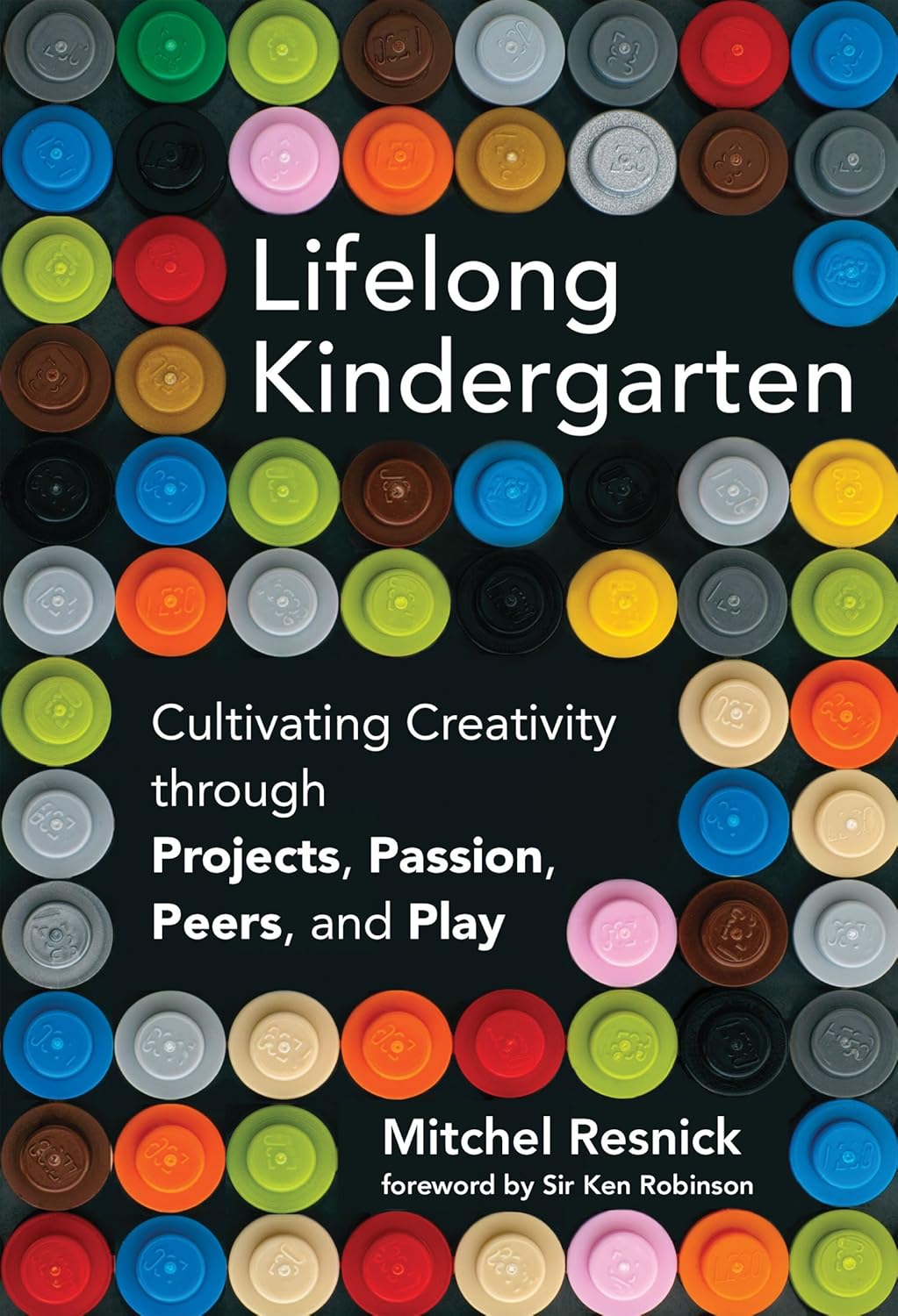
What made the book genuinely new in 1991 was its range of reference. Bauhaus histories already existed by the dozen. Lupton and Miller ignored the standard political chronology and opened the frame instead: psychoanalysis, geometry, early childhood education, popular culture. Friedrich Froebel’s kindergarten wooden blocks and the principle of learning through making. Gestalt psychology. The grammar of modern advertising. The Bauhaus was not presented as a style but as a theory of how seeing is learned — and how that learning can be designed.
Accomplishes what the other books on the Bauhaus don’t, which is to demonstrate, in concise language and clear graphics, exactly how Bauhaus design theory works in practice.
— The Wall Street Journal
Ellen Lupton: thirty years, thirty-one books
The career that began with The ABC’s ran for thirty years at Cooper Hewitt, Smithsonian Design Museum, where Lupton served as Senior Curator of Contemporary Design from 1992 until 2022, when she was named Curator Emerita. Over that span she organized twenty-two exhibitions and published thirty-one books. Thinking with Type (2004) is used as a course text in design programs around the world. In 2007, she received the AIGA Gold Medal for Lifetime Achievement — the field’s highest honor.
What separates Lupton from most curators is that she is also a working designer. Every exhibition came with a book she designed herself. Every idea passed through InDesign before it reached a wall label. She has described design as her secret advantage: where another curator waits for help, she can work directly with the content. The ABC’s was the first demonstration of that advantage, and it still reads like one.
Who should read this book
Sixty-nine pages raises an obvious question about audience. Not Bauhaus specialists — they already know the material. Design students, certainly, but also anyone who has ever wondered why geometry carries such deep aesthetic weight. Why does a triangle feel dynamic? Why does a circle feel infinite? Why does a square feel grounded? These are intuitive questions, but their answers live at the intersection of perceptual psychology, educational history, and visual theory. Lupton and Miller give those answers in sixty-nine pages, without clutter, without performance.
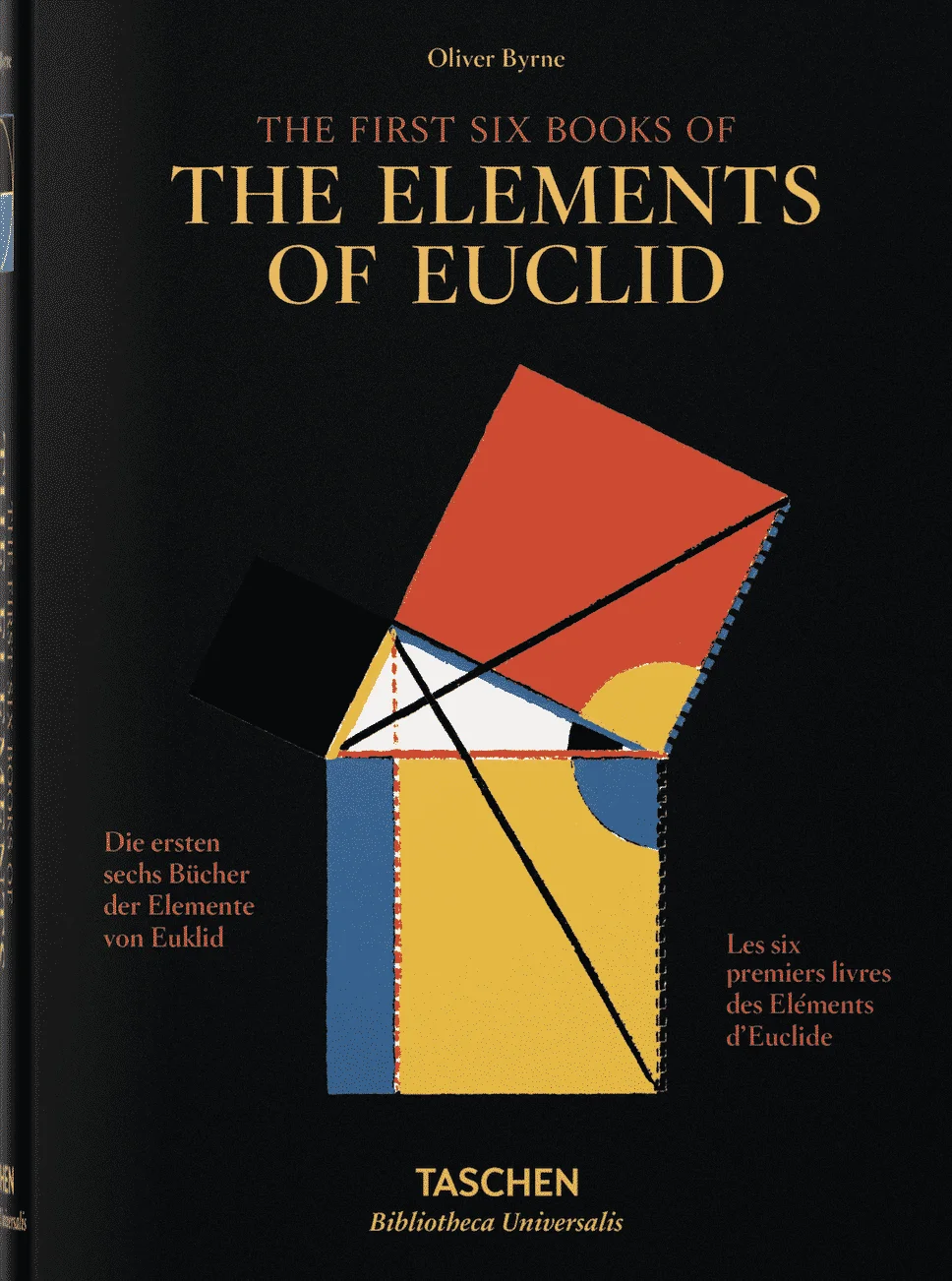
For readers with a mathematical background, the book opens an unexpected door. The Bauhaus theory of primary forms is not geometry in any rigorous sense — but the conviction that three shapes, at their most reduced, can carry a complete theoretical system resonates with how mathematics thinks about axioms. The same impulse — that a mathematical idea can be expressed in physical form — shows up in something like the Fibonacci shelf, where the proportions of every module are derived from the Fibonacci sequence. The belief that visual language has a grammar, that the grammar can be isolated and taught, that reduction reveals rather than impoverishes — these are not so distant from the habits of mathematical thought. Oliver Byrne understood this when he rebuilt Euclid’s Elements in red, yellow, and blue in 1847 — seventy-two years before the Bauhaus opened its doors.
Sources
- 1.Makin, A. D. J.; Wuerger, S. M. “The IAT shows no evidence for Kandinsky’s color-shape associations.” Frontiers in Psychology 4:616 (2013).
- 2.Getty Research Institute — “Primary Forms.” Bauhaus student course work, 1919–1933.
- 3.BmoreArt. “Ellen Lupton on Writing with Design.” February 2023.
- 4.TypeRoom. “Ellen Lupton: celebrating 30 years of thinking with type at Cooper Hewitt.”
- 5.Lupton, E.; Miller, J. A. The ABC’s of Triangle, Square, Circle: The Bauhaus and Design Theory. Princeton Architectural Press, 2019. ISBN: 9781616897987.
Ellen Lupton & J. Abbott Miller — The ABC’s of Triangle, Square, Circle
Princeton Architectural Press, 2019 · abakcus.com