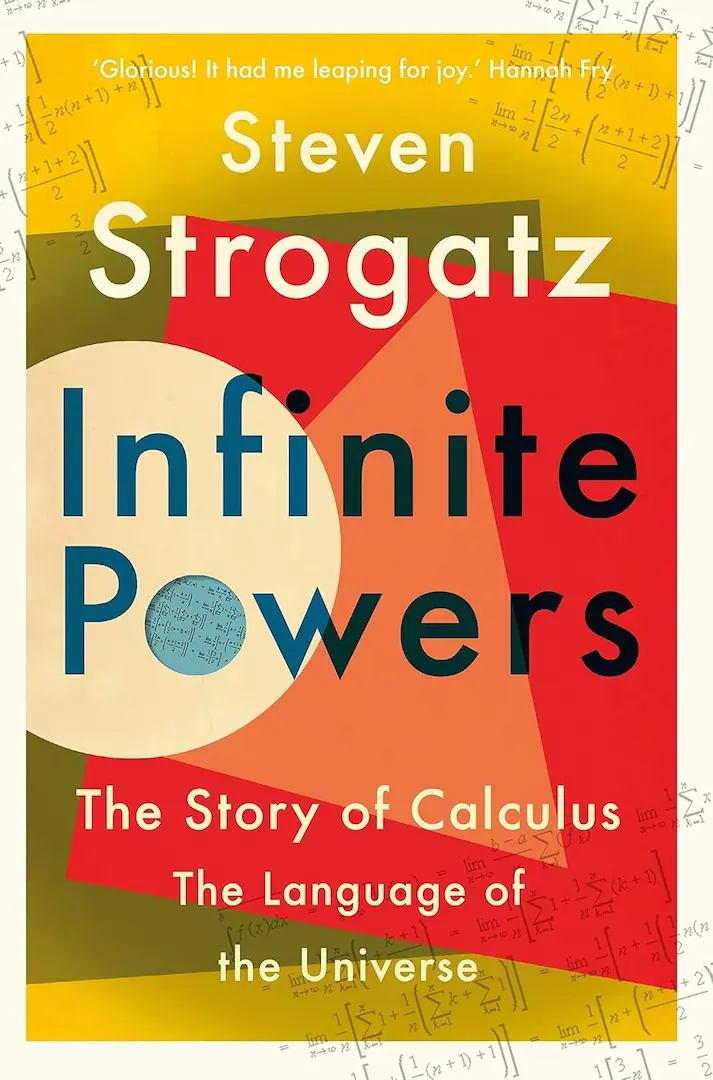
Author
Steven Strogatz
Publisher
Houghton Mifflin Harcourt
Year
2019
Pages
384
Position
Professor of Applied Mathematics, Cornell
Recognition
NYT Bestseller · Royal Society finalist
ention the history of calculus and most people expect the Newton–Leibniz dispute. Who got there first? The English say Newton, the Germans say Leibniz. The fight is so well-documented that any book with “history of calculus” on the spine seems obligated to take sides. Strogatz sets that expectation aside gently but firmly. The real question isn't who invented it, he says. The real question is: was calculus always already there?
Archimedes didn't invent calculus. But he wrote its DNA two thousand years early. Strogatz shows this in the first three chapters with a clarity that leaves no room for doubt.
His answer is yes. The central claim of the book is this: the infinity principle — the core idea underneath calculus — was already in use two thousand years before Newton, in the work of Archimedes. What did Archimedes do to find the area of a circle? He divided it into an infinite number of thin slices, treated each slice as an approximate triangle, and added them all together. That is a complete description of integral calculus. Archimedes was doing this in the third century BC. Which means the idea of taming infinity — breaking a complicated thing into infinitely many simple parts, analyzing each, and reassembling — belongs not to Newton, not to Leibniz, but to humanity.
The book moves forward from there: Galileo's experiments with falling bodies, Kepler's planetary orbits, Newton's laws of gravity, Leibniz's symbolic notation, Maxwell's equations of electromagnetism, Fourier's heat waves, and finally the detection of gravitational waves in 2015. At each stop, the same structure appears: the infinity principle is brought to bear on a problem, and the world becomes one step more legible. Strogatz moves through this chain chronologically but never monotonously. Each chapter builds on the previous one while being complete as its own story.
Strogatz's gifts as a writer are clearest here. He is a professor of applied mathematics at Cornell, one of the most cited mathematicians in the world — but you don't think about any of that while reading, because he never tries to impress you. He thinks alongside you instead. “Let's look at it this way,” he says. “Here is where Archimedes's genius appears: notice, nobody had thought of this.” That tone — curious, warm, entirely without arrogance — holds steady across the entire book.
A Scene
Slice a circle like a pizza. Peel the slices apart, flip alternating ones, arrange them side by side — the shape that emerges starts to look like a rectangle. Push the number of slices toward infinity and the rectangle becomes exact. The area formula falls out on its own. Reading this, it's difficult not to think: why didn't anyone show me this in school?
The “pizza proof” in the first chapter makes this concrete. Strogatz isn't giving you a formula. He's giving you an intuition. And once the intuition arrives, the formula is already obvious. This is the same spirit that drives Feynman's approach to understanding — not memorizing the answer but deriving it from first principles until it feels inevitable.
Later chapters include the mathematical modeling of AIDS — how calculus shaped antiviral drug research by modeling how HIV spreads through the body. The discovery of Neptune — the only planet predicted by mathematics before it was observed through a telescope. Gravitational waves — vibrations Einstein predicted in 1915 using differential equations, confirmed by the LIGO experiment a full century later. Each example makes the same point: calculus is not a calculation tool. It is the language reality is written in.
Feynman said calculus is the language God talks. Strogatz's book is the story of how humans learned to speak it, and what they found when they did.
As a mathematics teacher, I can say this plainly: this book is one of the best answers available to the question every student eventually asks — “why am I learning calculus?” The usual classroom answer is “for university” or “you'll need it in engineering.” Strogatz's answer is different: because without this language, a large part of the universe stays silent. It doesn't sound like an exaggeration by the time he says it, because by then he has already proved it.
There is a limitation worth naming. The final section — the future of calculus — is noticeably thinner than everything before it. Strogatz touches on artificial intelligence and complex systems but loses some of the narrative clarity that makes the earlier chapters so compelling. It reads as though the book's main argument had already been made, and the last chapter was obliged to continue anyway. This is a minor complaint. Three hundred pages of what comes before it carry the weight easily.
Steven Strogatz
Professor of Applied Mathematics at Cornell University. One of the most cited mathematicians in the world. Author of Sync and The Joy of X. William Dunham wrote of him: “Strogatz is, at present, the best mathematician among writers and the best writer among mathematicians.”
If this book speaks to you, these will too
In short
Calculus is not a set of rules invented by two seventeenth-century rivals. It is the accumulated effort of twenty-three centuries of people trying to speak honestly about a world that never holds still. Strogatz tells that story with the warmth of someone who genuinely believes you should know it.
¹ William Dunham wrote: “Strogatz is, at present, the best mathematician among writers and the best writer among mathematicians.” This is not an exaggeration.
² Strogatz corresponded extensively with Cornell mathematics historian John Stillwell and other colleagues while writing the book. The footnotes carry traces of that research — returning to them after a first read is its own separate experience.
³ “The Infinity Golem” — Strogatz's term for the philosophical difficulty of conceiving infinity, the nemesis of the infinity principle. The tension running from Zeno's paradoxes through Cauchy and Weierstrass's epsilon-delta definitions is not easy to convey without technical machinery. Very few writers pull it off. Strogatz does.
Steven Strogatz — Infinite Powers: How Calculus Reveals the Secrets of the Universe
Houghton Mifflin Harcourt, 2019 · abakcus.com