he most common mistake people make about Feynman is calling him “a fascinating physicist.” The description is accurate and dangerously incomplete at the same time. Yes, he was a Nobel-winning architect of quantum electrodynamics — but this book is not about that Feynman. It is about the man who cracked safes at Los Alamos to drive security officers to the edge of sanity, played bongo drums professionally in a nightclub, learned samba in Brazil, earned a certificate in auto body repair, and approached every single one of these things with identical seriousness.
“I want to understand physics, and the only way to do that is to do everything.”
A paraphrase of the book's animating spirit
The book wasn't written by Feynman — it was spoken by him. His physicist friend Ralph Leighton recorded and compiled years of stories. That difference is felt on every page.
The title is already a manifesto. Surely You're Joking — the phrase was spoken by the faculty wife at a Princeton tea party after Feynman answered the question “Do you want lemon or milk?” with “Both, please.” He spent the rest of his life hearing that sentence. His choices were never the expected ones, and he never seemed to notice that they were supposed to be.
Why has this book been read by hundreds of thousands of engineers, mathematicians, designers, painters, and doctors — many of whom cite it as something that changed how they move through the world? The answer, I think, is this: Feynman demonstrated that curiosity is a rigorous enough occupation on its own. In an era saturated with productivity discourse — deep work, focused output, deliberate practice — curiosity is typically sold as a luxury, something you earn after the real work is done. Feynman reversed that hierarchy completely. And then he won the Nobel Prize.
A Scene
Feynman notices a plate wobbling in the Cornell cafeteria. The precession frequency is exactly twice the spin frequency. Nobody asked him to look at this. It has no practical application. He spends hours working out the relationship — purely because, as he puts it, it “looked amusing.”
A few years later, the same equations feed directly into his work on quantum electrodynamics — the work that earns him the Nobel Prize.
The chapter ends: “That's what I got from playing around.”
Most readers shelve this as memoir. But it is a disguised epistemology — a radical argument about how knowledge is actually For Feynman, truly understanding something meant reinventing it from scratch. Not knowing the formula; deriving it. This is why he taught the same course differently every single year, rebuilding each argument from first principles, finding a new path to the same destination every time. His lectures on physics became a monument not because he explained things clearly, but because the thinking inside them was visibly alive.
One of the least discussed but most unsettling sections of the book is Feynman's time in Brazil. He teaches physics in Rio for a spell, and gradually realizes that his students can answer every question on every exam — and understand essentially nothing. The educational system has severed the connection between words and objects so completely that students know the name of every fish without ever having seen water. He said this in the 1950s. It describes a classroom somewhere near you today.
What made Feynman extraordinary was not his intelligence — history is full of intelligent people nobody remembers. What made him Feynman was that he never fully left childhood. Cracking locks, picking safes, outwitting systems, wrong-footing expectations: all of it runs on the same fuel — they say that's how it works, so let's actually check. That question is the engine of both his physics and his life. He never bothered to keep them separate.
Recommend this book to anyone who uses expertise as a wall. Anyone who says “that's not my field” while meaning “that's not safe to be curious about.” Anyone who has ever felt that the serious work and the interesting work are two different things that must be kept apart. Feynman never built that wall. He learned biology, made paintings good enough to sell, exploited security gaps instead of reporting them, and joined a group of Mexican performers who guessed professions from city names. He did all of this after the Nobel.
“There are no unimportant questions. Only minds that have decided in advance what matters.”
An inference from how Feynman worked
One last thing: this book will not teach you anything directly. You will not learn to solve Feynman's equations, crack his locks, or improve your bongo playing. But when you close it, you will find it difficult not to notice that there are wobbling plates everywhere — and to wonder, just for a moment, what might happen if you stared at one long enough. Very few books manage that.
In short
Feynman spoke it, Leighton wrote it down. But this is not a memoir — it is a document of what happens when curiosity is treated as the only serious work there is.
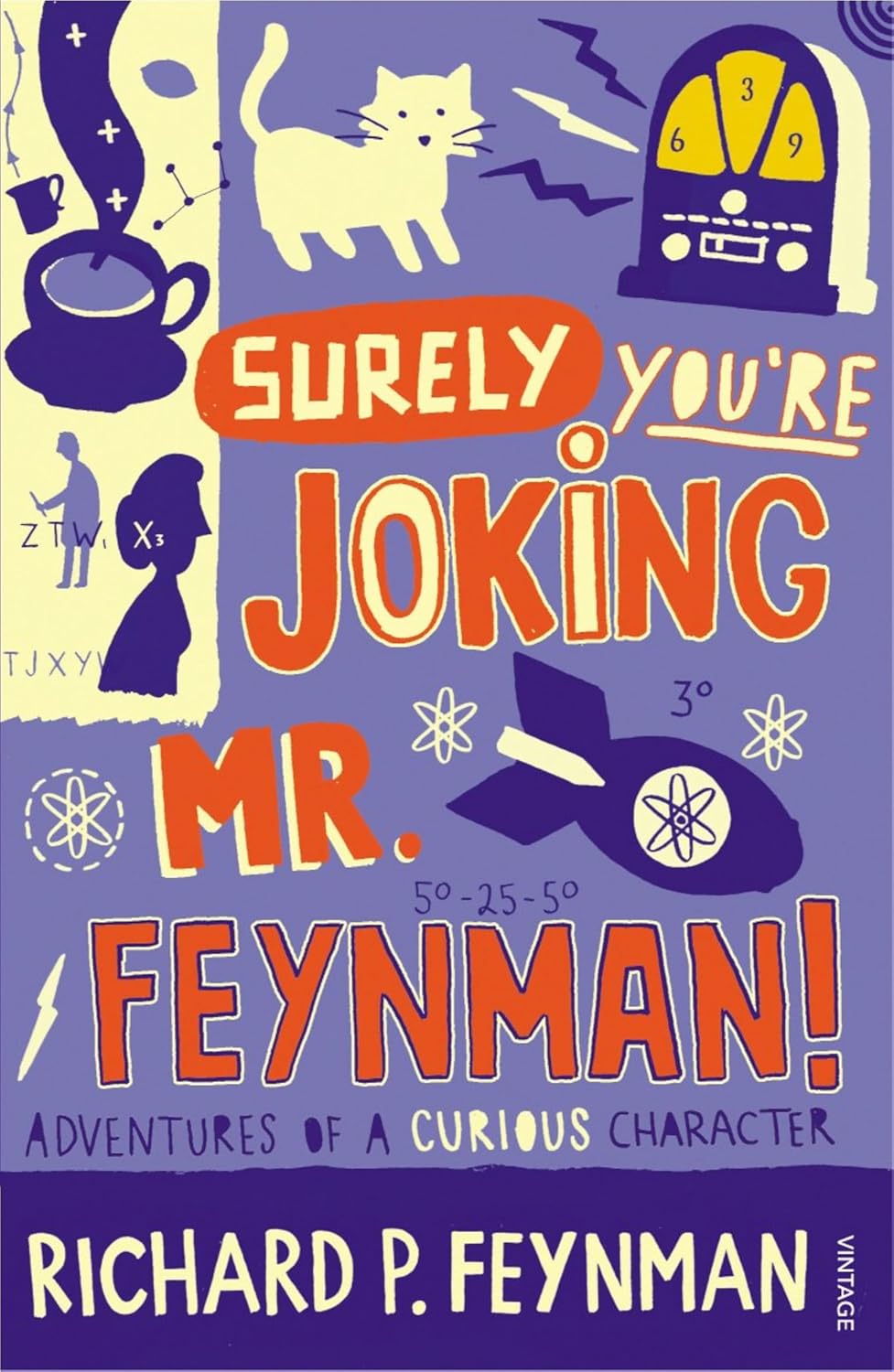
Richard P. Feynman — Surely You're Joking, Mr. Feynman!: Adventures of a Curious Character
W. W. Norton & Company, 1985 · abakcus.com