Free Resource · Mathematics · 1910
Calculus Made Easy
The prologue says it plainly: "What one fool can do, another can." Silvanus P. Thompson wrote that in 1910. The book has never gone out of print — and someone converted it to HTML by hand so you can read it for free today.
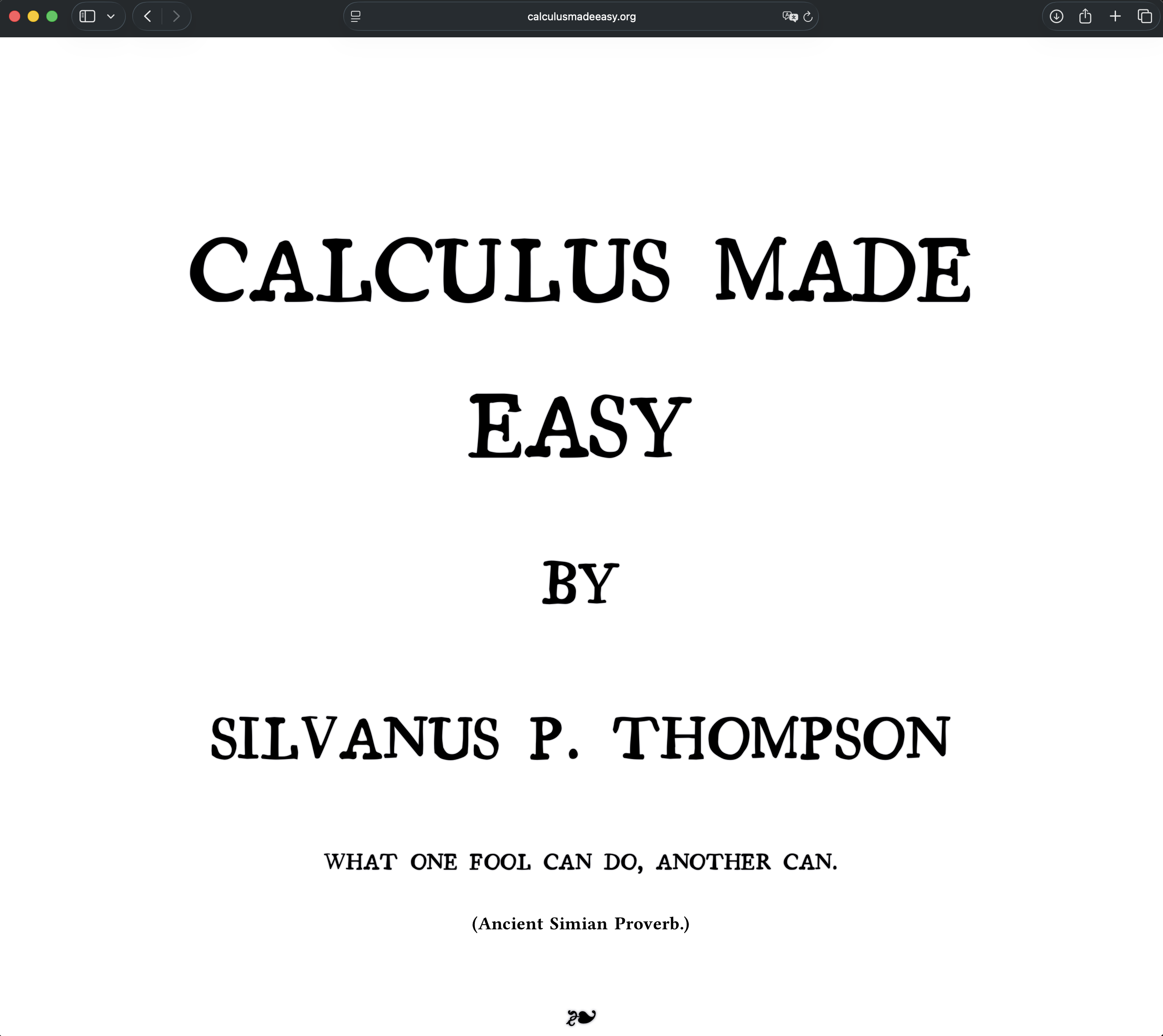
Silvanus P. Thompson wanted to teach calculus without frightening anyone. In 1910 he wrote a book with that intention and put this in the prologue: "What one fool can do, another can." That is not the kind of opening sentence you find in calculus textbooks. Most of them are written as though the reader is being evaluated from a distance. Thompson did the opposite.
Calculus Made Easy addresses the reader the way you'd expect a thoughtful person to talk to someone who doesn't know the subject yet but wants to. The first chapter is titled "To Deliver You From The Preliminary Terrors." It explains why symbols like dx and dy look so threatening and why they shouldn't. Thompson isn't concealing the mathematics — he's placing it in front of the reader in the right order. Derivatives, integrals, maxima and minima, the geometric meaning of differentiation — each one follows from the last. The sequence is the argument.
Compare this to the approach Richard Feynman took with physics: both men believed that understanding comes before formalism, not after it. The instinct to strip a subject down to what it actually requires — and no more — is rare in technical writing, and it tends to produce books that outlast their authors by a long margin.
“Thompson doesn't simplify calculus. He presents it the way it actually is — not as a foreign language, but as a continuation of things you already know.”
The chapter titles are a tell. "Simplest Cases." "What to do with Constants." "Introducing a Useful Dodge." That is not the language of a textbook. That is the language of someone talking to you. The mathematician John Baez has written that this is how he learned calculus — his uncle gave him a copy. The software developer Zed Shaw put it differently: "If you want to understand how to teach complexity to others, you must read it." Neither of them describes the book as a calculus resource. Both describe it as a resource on how to explain things.
Three Layers of Volunteer Work
Thompson died in 1916. After the book left copyright, Project Gutenberg archived it as a PDF. Then someone — a small group of named contributors and an anonymous proofreading team — converted that PDF to HTML by hand, page by page, formula by formula. The design was borrowed from Mark Pilgrim's 2009 Dive Into HTML5, which was itself released under an open license. Three layers of volunteer work stacked on top of one another: Thompson's book, Project Gutenberg's archive, and a hand-built HTML conversion.
The result is calculusmadeeasy.org. Formulas render correctly in the browser. Navigation between chapters is clean. There is no shortage of free calculus resources online, but most are either video-based or gated behind a registration form. This site asks for neither. A URL and a browser are enough.
It's worth noting the parallel with Oliver Byrne's 1847 edition of Euclid, which replaced every proof with a color diagram for a similar reason: to make abstract reasoning approachable before the symbols arrive. Both books are over a century old. Both are still being read — and, in different ways, still being preserved by people who found them useful enough to spend time on.
The Real Achievement Is Psychological
Thompson's achievement isn't primarily pedagogical — it's psychological. The place where calculus loses most students isn't the symbols; the symbols are actually simple once you know what they mean. It loses them in the relationship they form with the subject before they've understood any of it. The feeling that this isn't for them tends to arrive before the first equation.
Every page of the book is working against that feeling. This is also what the Feynman Technique isolates — the method of explaining something as if to someone who knows nothing, which forces you to identify exactly where your own understanding has a gap. Thompson was doing this for calculus in 1910. The reason the book is still in print is that the problem it solves — the psychological barrier more than the technical one — has not changed.
The epilogue is short and worth reading. Thompson closes with: "And so we end this work. It was not so hard, was it?" He puts that sentence at the end, not the beginning. The placement is the point. By the time you reach it, you've already done the work — and the question is rhetorical because you already know the answer.
Thompson was forty-eight when he wrote this book, and already an established physicist — he had serious academic work in electrical engineering and magnetism. Calculus Made Easy became his best-selling book and has never gone out of print. A revised edition by Martin Gardner was published in 1998.
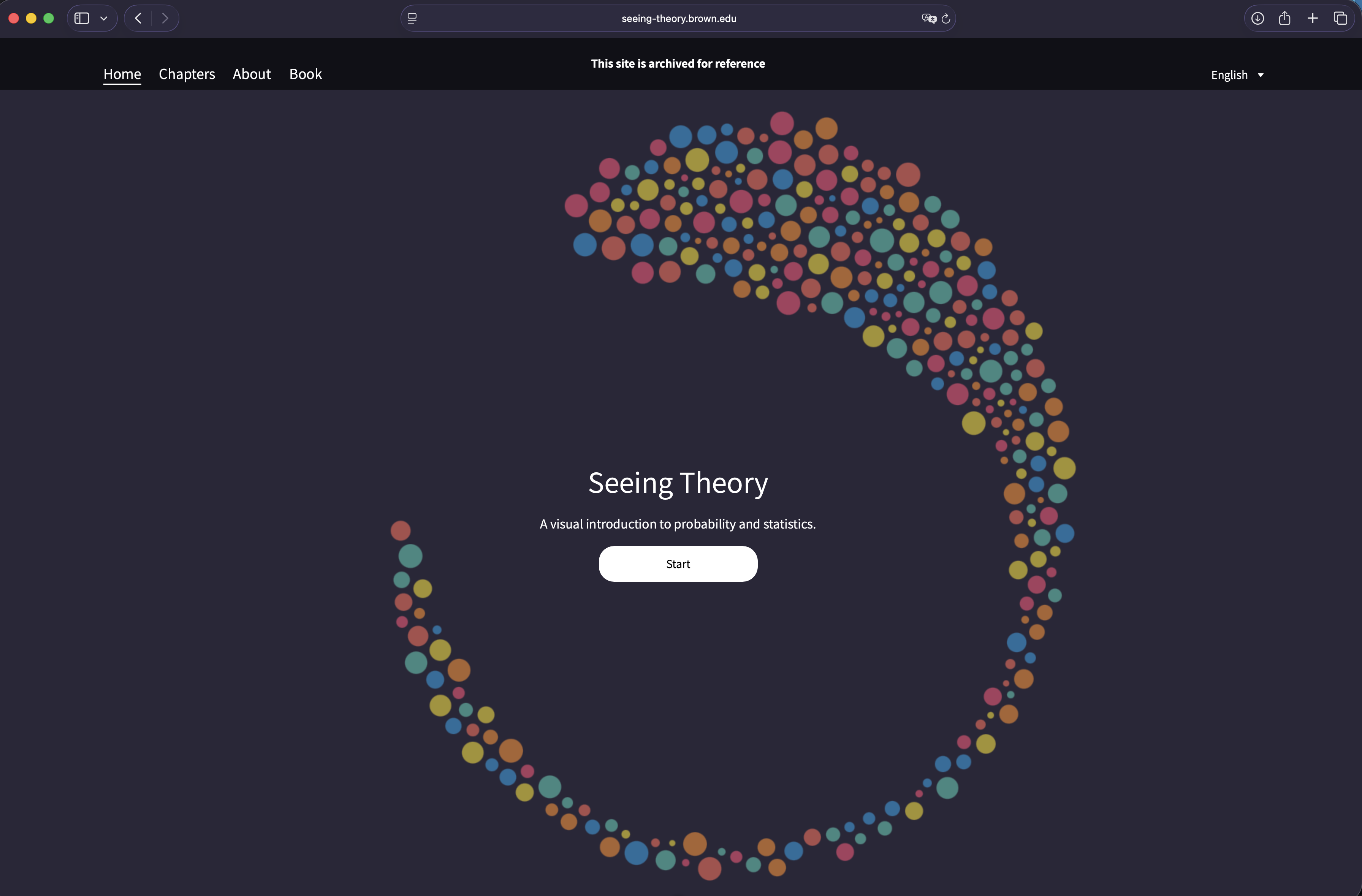
If you want to see a similar spirit applied to visual mathematics, Seeing Theory does for probability and statistics what Thompson does for calculus: it removes the obstacle that isn't really mathematical and replaces it with something you can look at directly.
Visit
Calculus Made Easy by Silvanus P. Thompson is available at calculusmadeeasy.org. Free to read in the browser. Originally published 1910; revised edition by Martin Gardner published 1998.