Interactive · Google AI × NOAA · 2019
Pattern Radio: Whale Songs
Google AI and NOAA trained a model on 187,000 hours of underwater recordings. Then they opened 8,000 of those hours to anyone with a browser.
In the 1960s, scientists discovered that humpback whales were not just making sounds — they were singing. Structured, evolving, repeating songs that changed from season to season across entire ocean populations. Sixty years later, nobody knows why.
Pattern Radio: Whale Songs is a collaboration between Google AI and NOAA's Pacific Islands Fisheries Science Center that turns that mystery into something you can scroll through. The site hosts more than 8,000 hours of underwater recordings from around the Hawaiian Islands, labeled by a machine learning model trained to detect humpback calls within a much larger archive of 187,000 hours of audio — audio that, if played straight through, would take more than 19 years to hear.
The tool does not explain whale song. It shows you where it is, and lets you look.
Total archive
187K
hours of NOAA underwater recordings
Public access
8,000
hours open for anyone to explore
Manual scan time
19+
years if listened to straight through
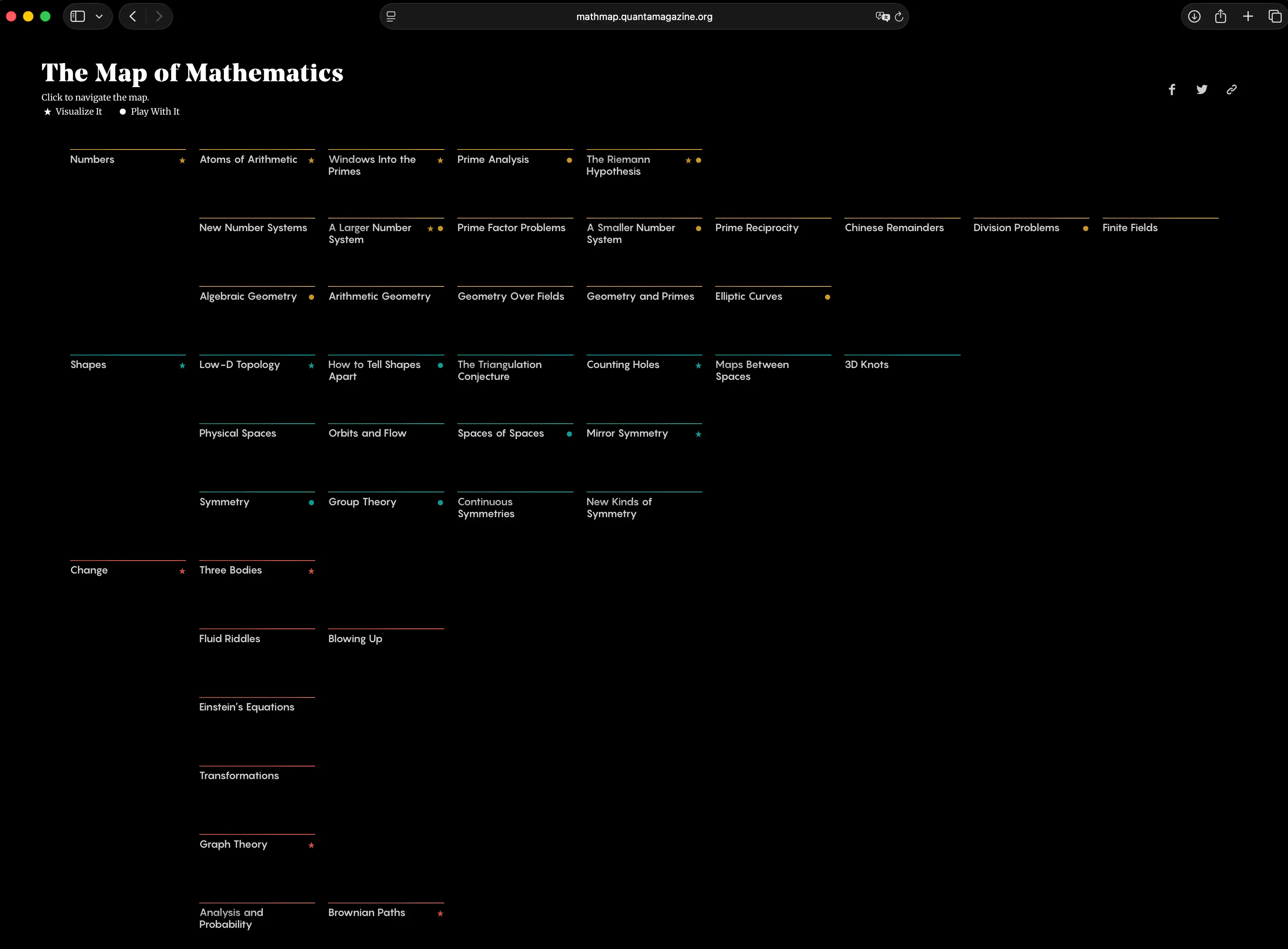
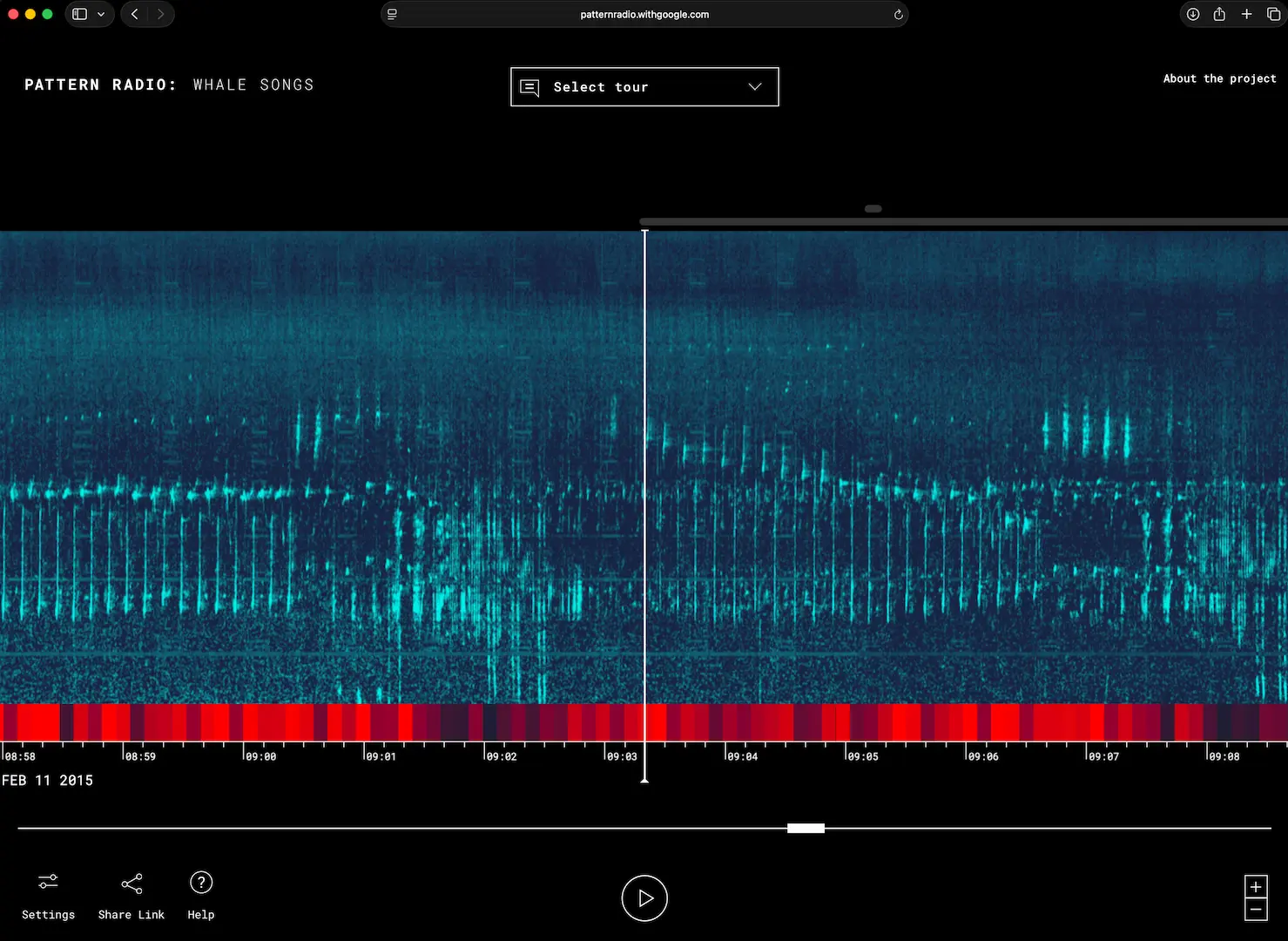
The interface is a spectrogram — a visualization of sound as frequency over time. You can zoom in to the resolution of a single call: the shape of one humpback phrase, the low rumble of a passing ship, an unidentified noise that has no name in the literature yet. Or you can zoom out to see months of ocean at once, the AI's heat map glowing where whale activity concentrates. It is the same kind of legibility that Quanta's Map of Mathematics achieves in a different domain — a dense dataset made navigable by a good visual structure. The model also highlights repetitions within songs, showing the internal structure that scientists are still trying to decode.
The discovery record is already concrete. When the model was applied to the full archive, it confirmed known migration patterns around the Hawaiian Islands and found humpback song at Kingman Reef — a location where it had not been previously observed. That kind of result does not come from browsing. It comes from a classifier running at scale, finding signal in a dataset no human team could audit by hand.
What the Interface Does
Zoom from individual whale phrases to months of ocean sound on a single continuous timeline.
The trained model highlights regions of humpback activity, so you spend less time scanning and more time listening.
Color-coded overlays show which sounds repeat and at what tempo — the internal grammar of a song.
Not everything is labeled. Ships, fish, and unidentified underwater noise appear in the same recording, waiting.
The model itself was built by Google Research in partnership with NOAA PIFSC, starting in 2018. It was trained specifically on humpback vocalizations, then extended to a multi-species classifier that later identified Bryde's whale “Biotwang” calls in the western North Pacific — calls whose seasonal patterns had not been mapped before. The same architecture, applied to a different species, produced new population data.
The visualization was built by Google Creative Lab. The underlying classifier was developed by Google AI Research in collaboration with NOAA's Pacific Islands Fisheries Science Center. Dr. Ann Allen, Research Oceanographer at NOAA PIFSC, provided the marine biology expertise that shaped how the model was trained and what it was trained to find.
The question of what whale song is — what function it serves, why it changes, why males across thousands of miles converge on the same melody within a single season — remains open. The data Pattern Radio makes available is not an answer to any of that. It is a window into how science gets done when the dataset is too large for human attention. And occasionally, as with Seeing Theory's visual approach to statistics, the window itself becomes the discovery.
Pattern Radio does not make any of that complexity visible. It gives you a year of ocean, a cursor, and a pair of headphones.
At a Glance
Collaborators
Visit
Pattern Radio: Whale Songs is a collaboration between Google AI and NOAA's Pacific Islands Fisheries Science Center, freely accessible at patternradio.withgoogle.com. Launched June 2019.