Somewhere in the gap between “mushroom” and “color” lives an assumption most people have never had reason to question. Mushrooms are brown, or sometimes white, or occasionally an alarming red. They are not, in any obvious way, a palette. Julie Beeler spent years disagreeing with that assumption — quietly, in the forests of Oregon, in a garage full of dried fungi and pots of warm water, producing swatches of wool and silk in colors that have no synthetic equivalent.
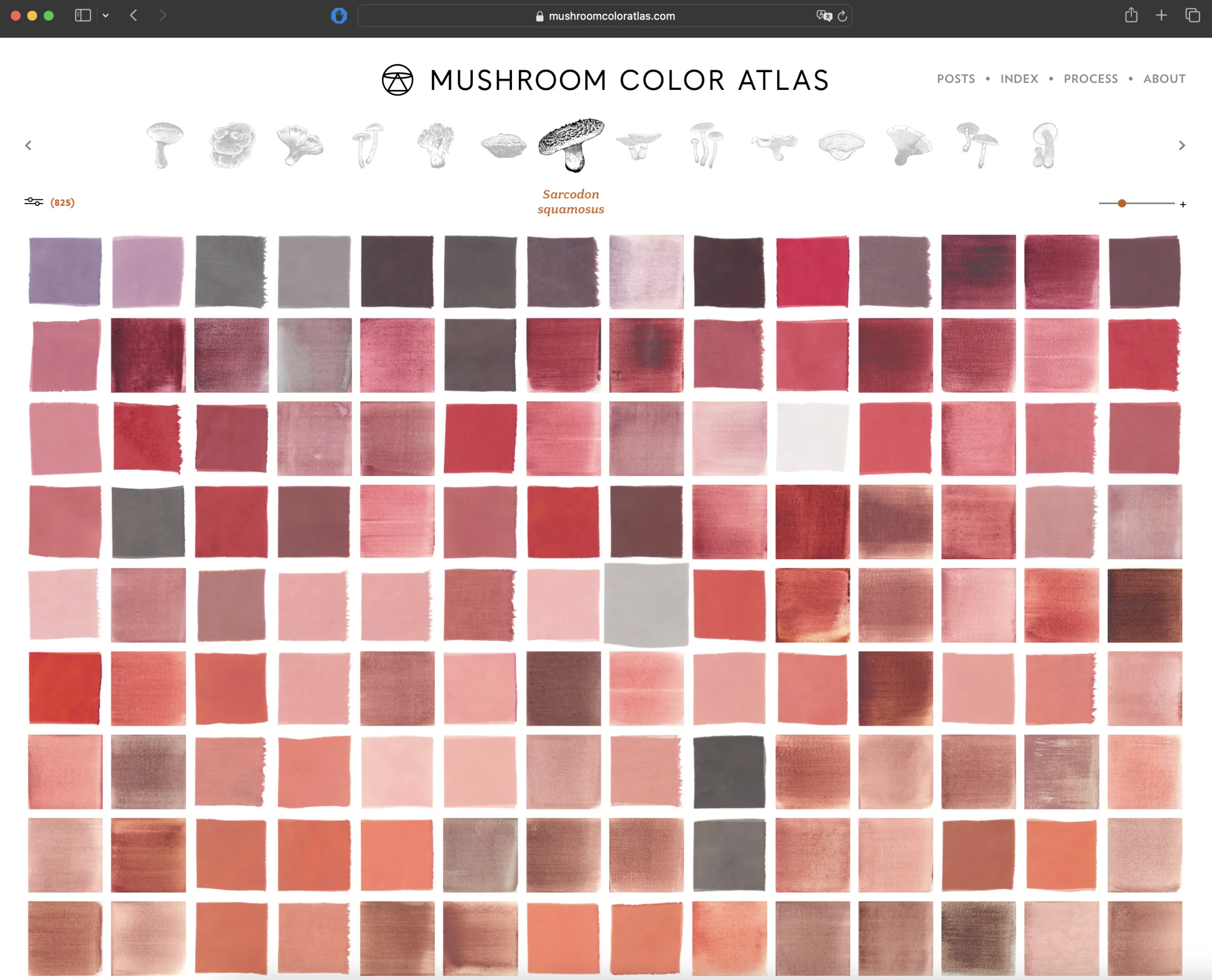
The Mushroom Color Atlas is the record of that disagreement. Launched in 2021 as an interactive website, it now catalogs over 825 colors derived from more than 40 species of dye mushrooms, each filterable by species, mordant, fiber type, and pigment chemistry. It is also, quietly, one of the better-designed scientific databases on the web: clean enough to be navigated by someone who has never heard the word “mordant,” deep enough to satisfy someone who has been dyeing with fungi for decades.
Mushroom Color Atlas — Julie Beeler
825 colors. 40+ species. Every variable documented.
How It Works
Beeler taught herself by studying the work of Miriam Rice, who dedicated her life to mushroom color experimentation from the 1970s onward. Rice died in 2020 at 96. The Atlas is, among other things, a continuation of that tradition.
The process Beeler documents is older than industry and stranger than it sounds. You forage a mushroom — preferably older specimens, which have developed more pigment — dry and store it, then steep it in warm water like a very particular tea. Into that bath goes natural fiber: wool, silk, or linen, pretreated with a mordant. Change the mordant and you change the color. Change the pH of the bath and you change it again. The same mushroom, processed differently, produces a different outcome. This variability is not a flaw. It is the point.
On Mordants — The Variable Nobody Talks About
A mordant is a mineral salt that creates a chemical bond between dye and fiber. Change the mordant and you change the color — sometimes dramatically. The same Dyer's Polypore mushroom on alum-mordanted wool yields warm ochre. On iron-mordanted fiber from the same bath: a deep khaki-green. The Atlas maps all of these variations. There is no single “mushroom color” — there are only conditions.
Alum
Produces warm, clear tones — the baseline mordant for most natural dyeing.
Iron
Shifts colors toward grey and olive. Called “saddening” the dye — an evocative description of what it does.
Copper
Enriches and deepens greens. Combines well with lichen-bearing mushrooms.
Chrome
Deepens and mutes. Produces the most complex, lightfast results.
Color as Landscape
“Color evades language. It's an experience. And we're all experiencing it.”
Julie Beeler, founder of the Mushroom Color Atlas
What makes the Atlas more than a craft reference is what it implies about color itself. The synthetic dye industry — born in the mid-19th century when William Perkin accidentally produced mauveine from coal tar — severed the connection between color and place. Before that rupture, a dyer's palette was a map of their landscape: what grew locally, what could be found in season, what mineral the local water happened to carry. Color was not chosen from a Pantone sheet. It was negotiated with the environment.
This is the same logic that runs through Dinara Kasko's pastry geometry or the Victorian fancy-turning catalogues: material sets the terms, and the maker works within them. The constraint is not a limitation. It is the whole system of meaning.
The Companion Book
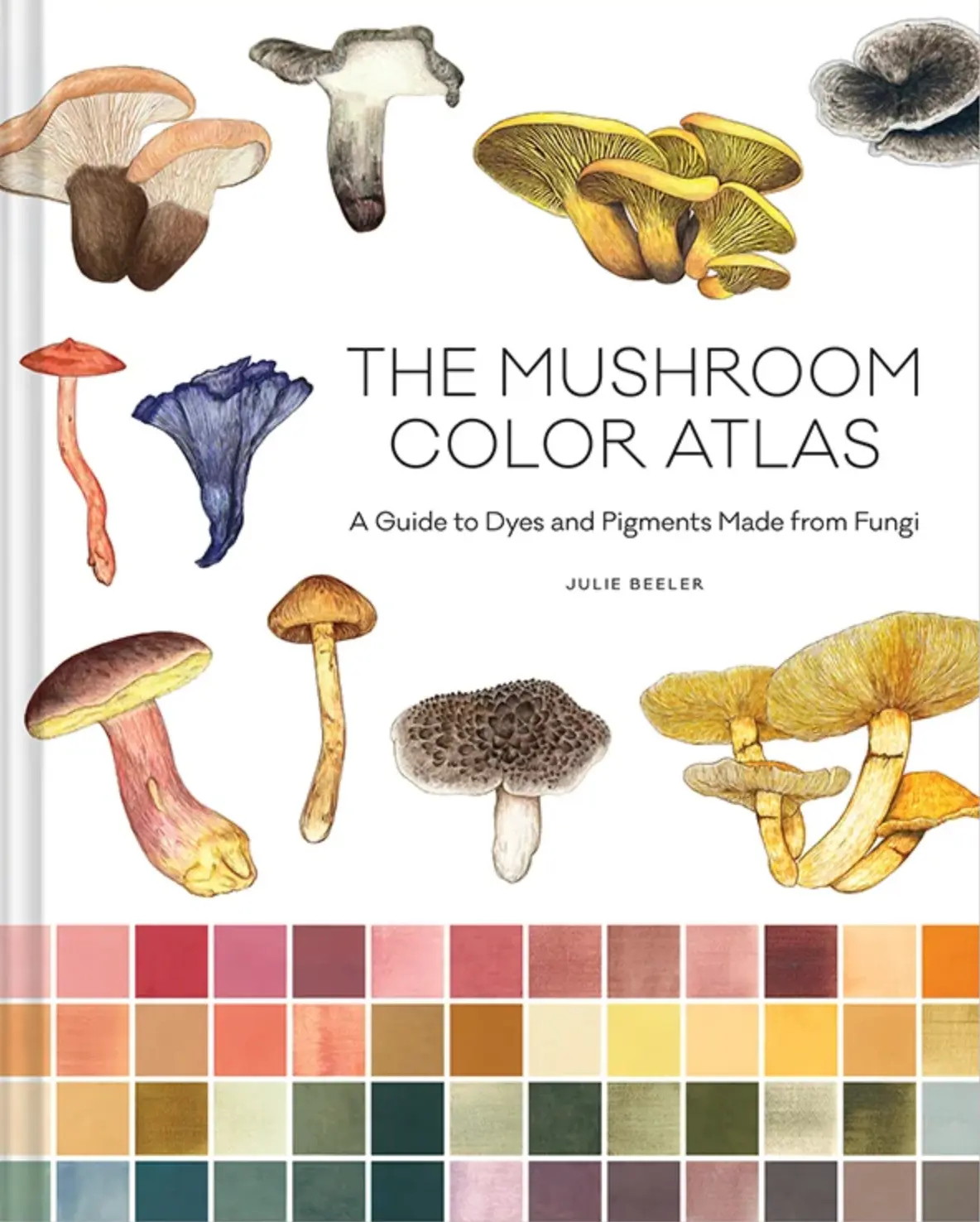
Companion Book
The Mushroom Color Atlas
Equal parts art book, field guide, and color distillation workshop. 500 color swatches, botanical illustrations by Yuli Gates, step-by-step dyeing instructions. Published by Chronicle Books.
View on Amazon →The companion book, published by Chronicle Books, distills the same material into a physical object that is itself an argument for the project. The decision to use black-and-white botanical illustrations alongside full-color swatches was deliberate: the mushroom, rendered in ink, steps back so the color can step forward. You are not looking at a field guide. You are looking at what the mushroom already contained, before anyone thought to ask.
The 826th color in the Atlas — whenever it is added — will come from a mushroom that grew somewhere specific, was foraged by someone paying attention, and was coaxed into a hue by a set of decisions made with hands and eyes. That chain of custody from forest floor to fiber is exactly what synthetic processes eliminate, and exactly what the Atlas makes visible again.