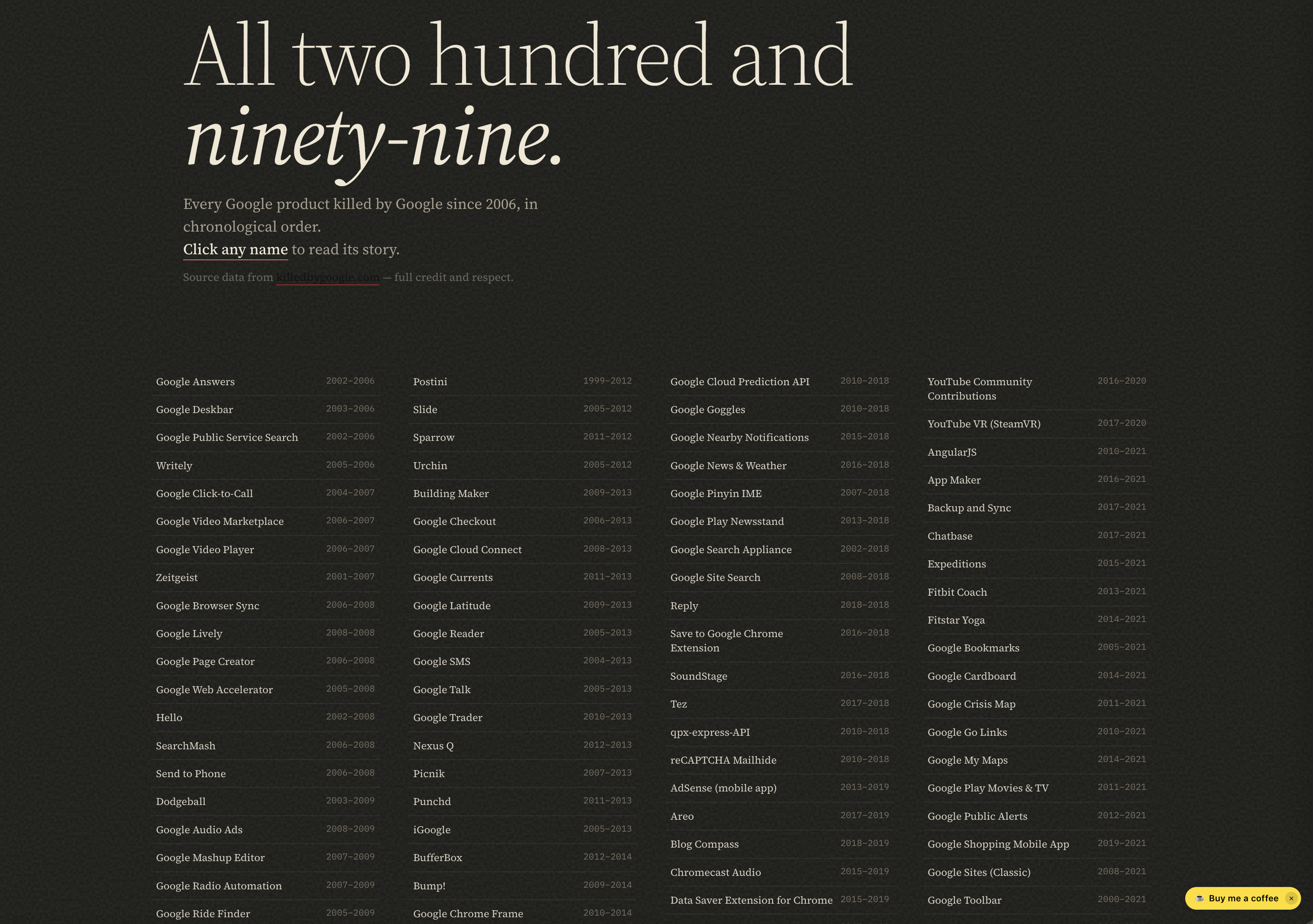
There is a website called killedbygoogle.com. It lists every product, service, and hardware device that Google has shipped and subsequently discontinued since 2006. As of today the count stands at 299. The average lifespan of a Google product: 5.2 years. Long enough to build a habit. Short enough to break it without warning.
A data visualization published by sheets.works takes this dataset and does something useful with it: it plots the retirements against time, annotates the spikes, and tells the story underneath the numbers. That story turns out to have a very specific shape — the kind that becomes obvious only once someone makes the data visible.
Killed by Google — Visualized
299 discontinued products, chronological order, with context.
The numbers
since 2006
lifespan
alone — the record
Retirements by Year
The data has two obvious anomalies. In every other year, Google retires a median of 13 products — maintenance-level churn. Then there are 2011–2012, and then 2019. Together these three years account for 86 of the 299 retirements, nearly 29% of the total, compressed into 36 months out of 240.
April 2011: More Wood Behind Fewer Arrows
Larry Page returned as CEO on April 4, 2011. Three months later, on the Q2 earnings call, he said it plainly: more wood behind fewer arrows. Aardvark — a social search startup acquired for $50 million — shut down. Google Buzz wound down. Google Notebook was retired. By the end of 2012, 49 products had been discontinued in what engineers called the great refocus.
Google Reader — which at the time had around 30 million active users — was gone. Google Health was gone. iGoogle was gone. Google Video was gone. The acqui-hire became the era's mechanism: buy a company, absorb the engineers, close the product. Sparrow, the most beloved Mac email client of its era, ended active development within months of acquisition. Google Wave, promoted as the future of communication, was abandoned less than three months after its public launch.
“More wood behind fewer arrows.”
— Larry Page, Q2 2011 Earnings Call, July 14, 2011
2019: The Year of Focus
Sundar Pichai's 2019 produced 37 shutdowns in twelve months — more than any other year before or since. In March 2019 alone, Google published a cluster of shutdown notices covering Inbox, Allo, Hangouts on Air, and Google+. Then hardware: Daydream, the VR platform. Google Clips, the AI camera. Chromecast Audio — discontinued. Then infrastructure: goo.gl, the URL shortener that thousands of developers had built workflows around; Google Cloud Messaging; Google Fusion Tables, which had become the data visualization tool of choice for journalists.
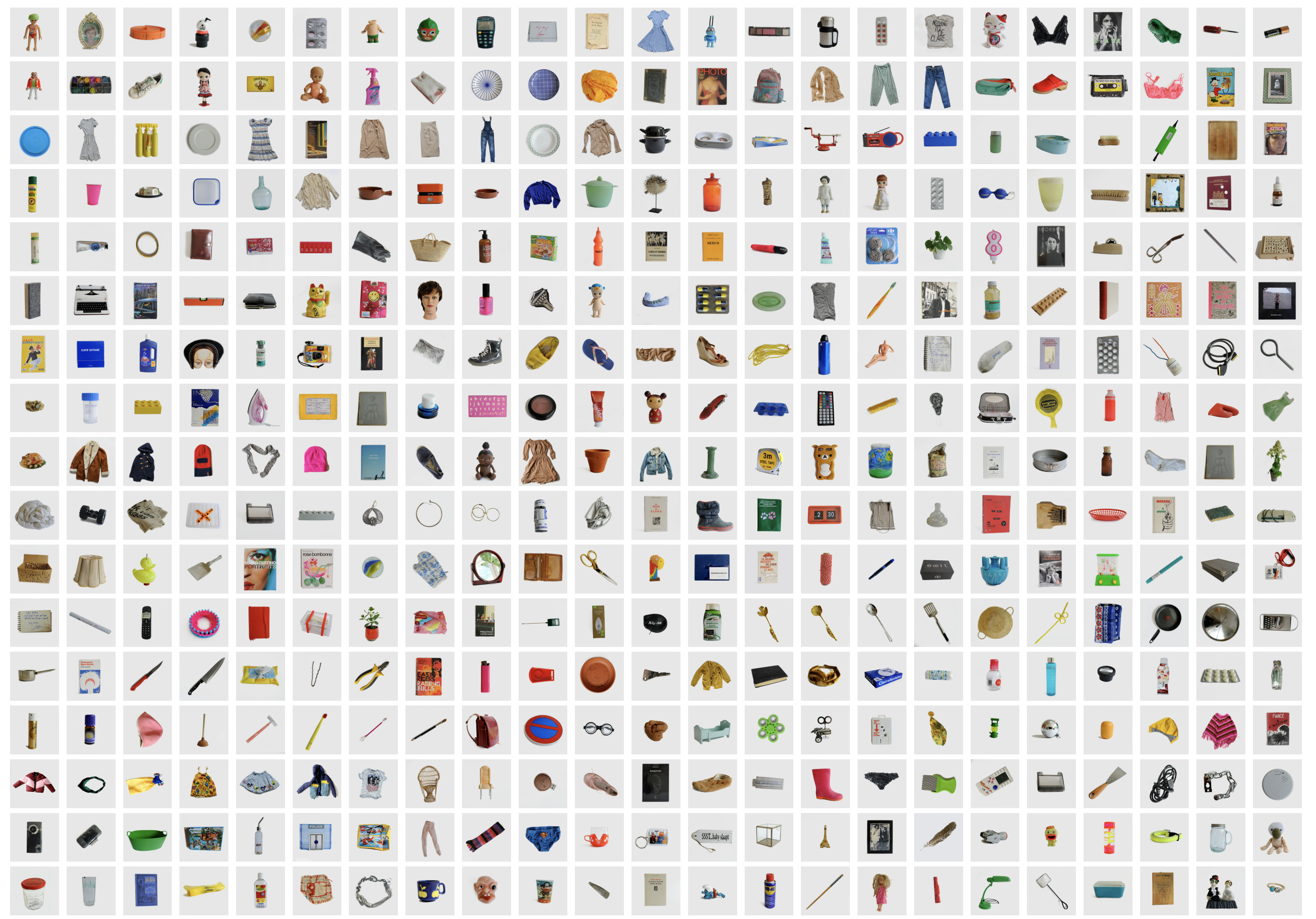
Where Page's refocus was drawn out over two years, Pichai's arrived in a wave. Both spikes were deliberate. Both had a phrase attached. What changed between them was the scale: Page was pruning experiments; Pichai was retiring products that people actually used every day. The quiet side of this is what Barbara Iweins discovered in her own inventory — most things accumulate without anyone deciding they should.
Most of them wound down on a normal Tuesday.
— sheets.works
What the Visualization Shows
The visualization presents all 299 products in chronological order and then narrows to the two corporate moments that explain the shape of the timeline. The bar chart is the key artifact: fourteen years of roughly stable attrition interrupted twice by the same pattern, a new executive's first act of discipline translated directly into a list of shutdowns.
The ending note is dry and accurate. Google currently maintains at least five separate ways to send a message: Google Chat, Google Meet, Google Messages, Google Voice, and Gmail Chat. By the next refocus, some will join this list. The visualization does not pretend to know which ones. It simply observes that the pattern has run twice, and leaves the inference to the reader — the same move Feynman described as the only honest way to know if you understand something.