Free Tool · Literature · Open Source
Literature Clock
There are 1,440 minutes in a day. Someone has matched each of them to a passage from world literature. Open the site and you find out it's 2:47 — because Tolstoy already wrote that minute.
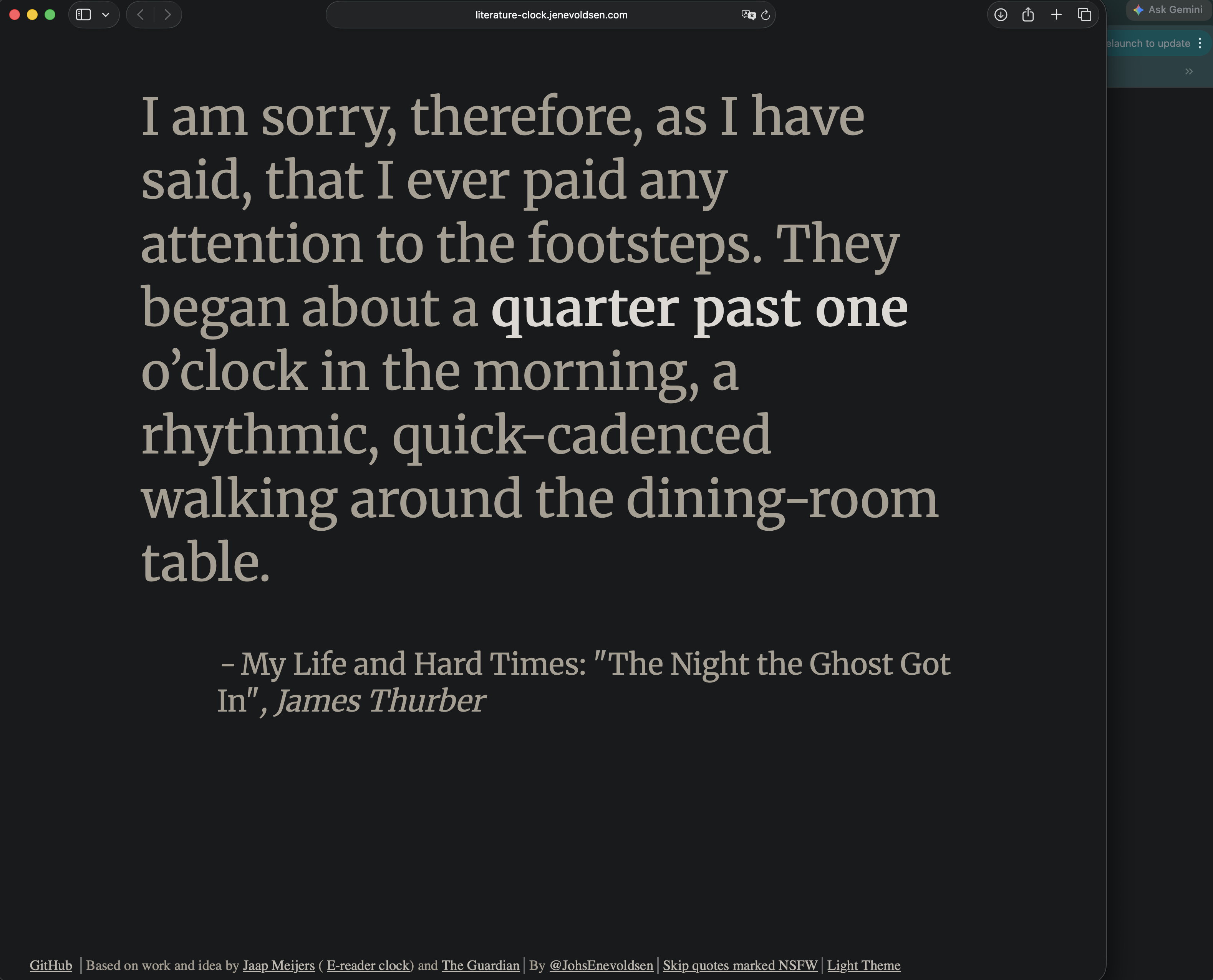
Open the site and you find a sentence from world literature containing the current time — the hour highlighted, the book and author below it. A minute later, a different book, a different sentence. The one after that, another. It works as a clock, but what it's actually doing is something else: showing how writers have used time.
That sounds like a small distinction. It isn't. When a novelist writes "it was three o'clock," the sentence rarely just tells you the time — it anchors a scene, signals a wait, frames a turning point. Virginia Woolf marks the hour differently than Hemingway does. Chekhov's three o'clock feels different from Fitzgerald's. Literature Clock lays this out minute by minute. Look at it once and it's a curiosity. Leave it open for an hour and you've read an accidental anthology.
What appears at 3:00? Maybe Macbeth. Maybe a Kafka character waking up. Maybe a train passing through the middle of the night.
The more interesting question is this: how many minutes of the day has some writer already named? Midnight is overrepresented — there are many quotes. Five in the morning, very few. Three in the afternoon, surprisingly many. This distribution isn't random; it says something unintentional about which hours carry weight in the imagination and which ones writers let pass unmarked. Some minutes have multiple matching quotes and the site picks one at random. Some minutes have none — the display goes blank. Those gaps say something too.
Three Generations of One Idea
The project has a clear lineage. Dutch designer Jaap Meijers built a real desk clock from an e-reader in 2012 — a physical object that displayed a literary quote and changed it every minute. The Guardian noticed and moved the idea to the web. Johs Enevoldsen built his own version and put it on GitHub. The quotes live in a CSV file; each row maps a minute to a book to an author. The database grows through community contributions — anyone can add a quote. At every step in this chain, someone spent their own time connecting minutes to literature.
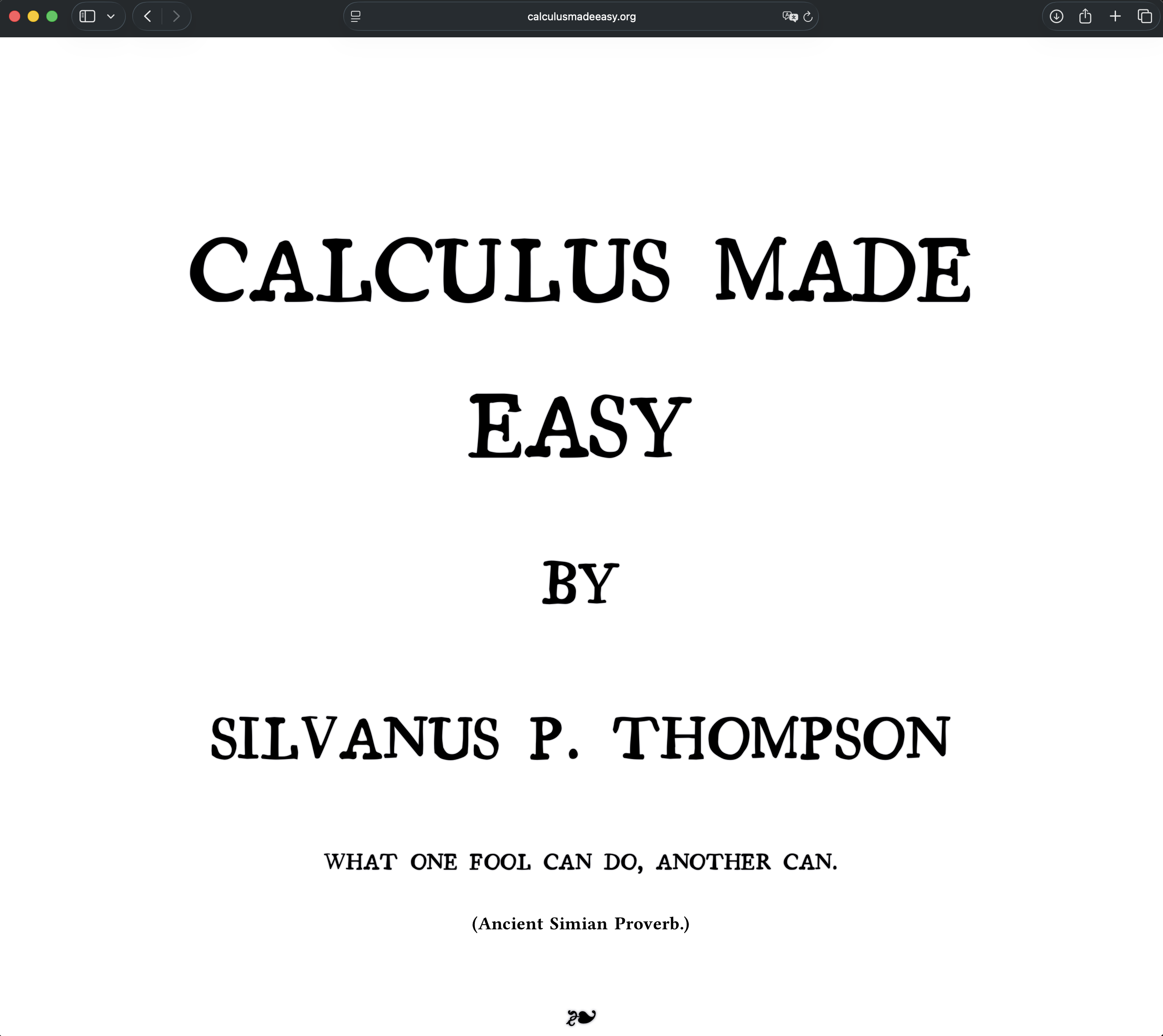
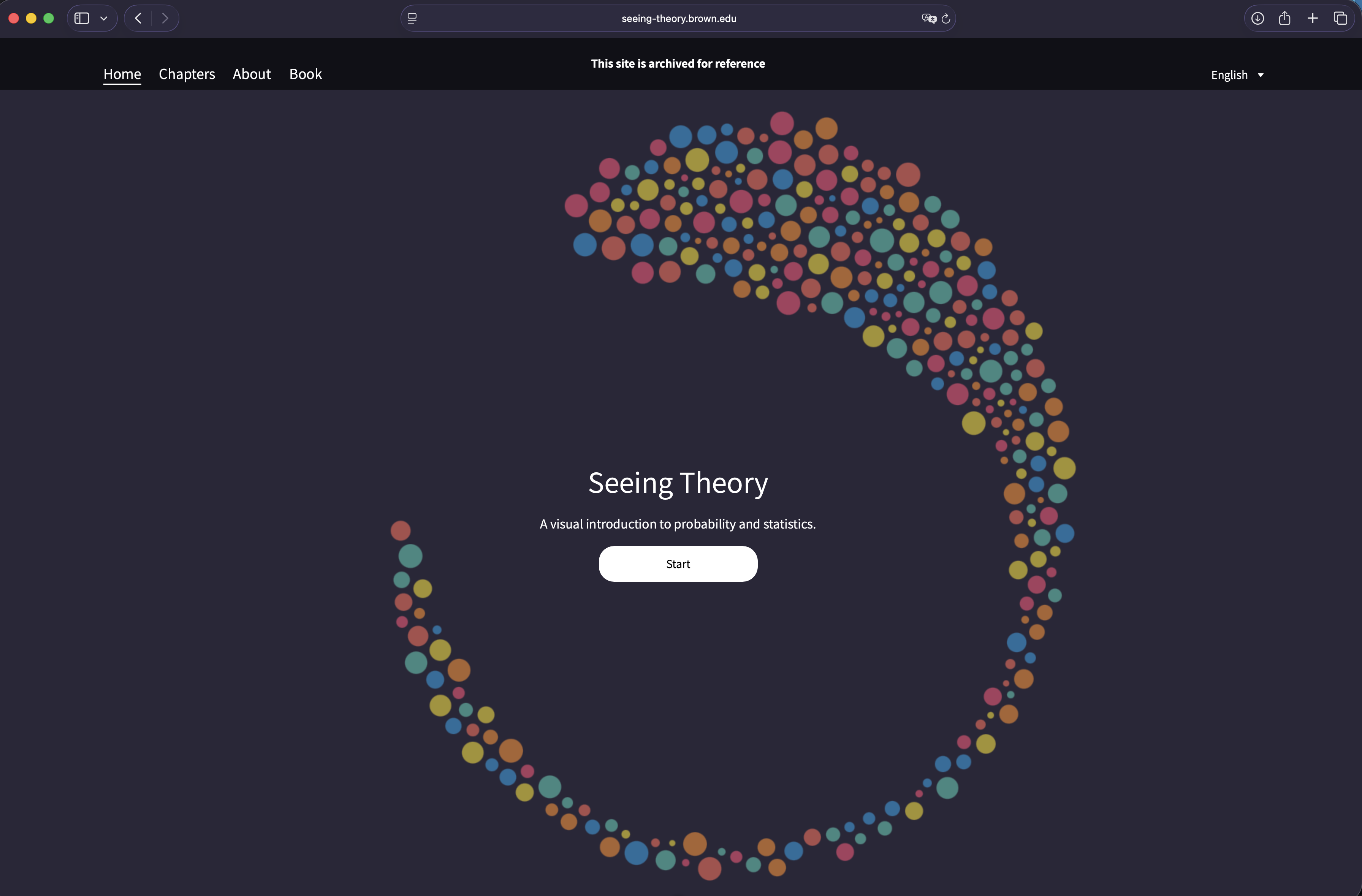
This is the same spirit behind Calculus Made Easy— Thompson's 1910 book converted to HTML by volunteers — and behind Seeing Theory: people spending real time making something they found valuable available to anyone with a browser.
The Clock — 2010
Literature Clock makes most sense alongside Christian Marclay's video installation The Clock. In 2010, Marclay edited a 24-hour film from thousands of clips drawn from world cinema — each clip showing or stating the exact time at which it was screened. Watched in a theater, the film and the clock outside are always synchronized. Marclay won the Turner Prize for it. Literature Clock is the same idea pressed onto paper: cinema replaced by books, a major installation replaced by a single browser tab.
Both ask the same question: what happens if, instead of numbers, we use the people who lived inside time to tell it? Not indicators but sentences. Not a dial but a voice. The distance between time as an objective fact and time as a felt weight — Literature Clock measures that distance once a minute, with a quote.
The quotes are stored in a public CSV file on GitHub. Each row contains the time, the highlighted phrase, the surrounding passage, the book title, and the author. Anyone can submit a pull request to add a missing minute. Enevoldsen's site also includes an option to skip quotes marked NSFW — the existence of that option implies something about what happens in literature at certain hours.
The Physical Object
When an idea works, someone will eventually try to sell it. The Literature Clock idea followed that path. It became a real desk clock called the Author Clock — solid white oak housing, brass base, e-paper display. The kind of screen that looks like paper, doesn't glare, doesn't strain the eyes. Over 13,000 quotes, more than 2,500 authors, seven centuries of literature. The quote changes with each minute — or you can adjust the interval: every five minutes, every half hour, every hour. It connects to WiFi and new quotes arrive automatically. It's sold at the MoMA Design Store. That last detail says something about where the object has positioned itself.
The difference between the free website and the physical object is this: one appears when you check the time, the other sits on your desk continuously. In the second case, the book is there even when you're not looking. The Author Clock's e-paper screen has no backlight — a deliberate choice. The screen wants to look like a page. The ambition running through all three generations of this idea is the same: make literature present in ordinary time, not just in reading time.
This is a different kind of encounter with books than the one Oliver Byrne's 1847 Euclid offers — that book asks you to sit down and work. Literature Clock asks nothing. It just runs. The reading happens peripherally, in the margin of whatever else you're doing. Some minutes you'll notice it. Most minutes you won't.
Visit
Literature Clock by Johs Enevoldsen is free and open source at literature-clock.jenevoldsen.com. The source code and quote database are on GitHub. Original concept by Jaap Meijers, 2012.