Design · Bauhaus · 1931
Drawing a Chair 64 Times
Erich Dieckmann didn't sketch a chair. He systematically dismantled one — row by row, assumption by assumption — until what remained was barely a chair at all. And in doing so, he mapped the entire grammar of sitting.
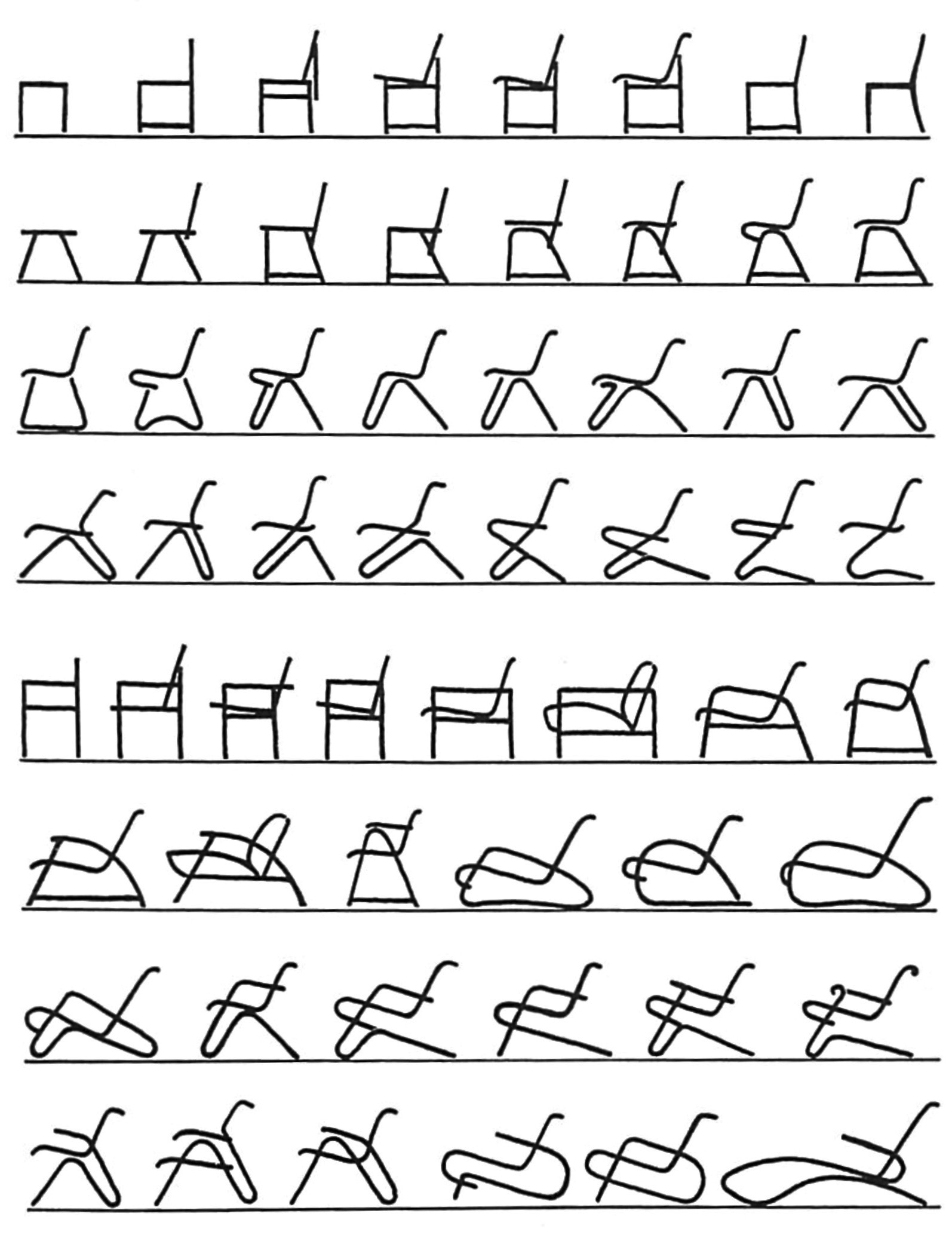
A single page from Erich Dieckmann's 1931 book Möbelbau contains 64 drawings of the same chair. They begin as rigid rectangles and end as abstract loops of line. In between lies one of the most methodical acts of design thinking the Bauhaus ever produced.
The caption at the bottom of the page reads: “Das Profil prägt den Charakter des Stuhles” — the profile determines the character of the chair. It sounds like a truism. It is, in fact, a research program compressed into a single sentence.
Dieckmann's argument was precise: a chair's front view tells you almost nothing. Two chairs can look identical from the front and be entirely different objects — one rigid and punishing, one yielding and ergonomic. The intelligence of a chair lives in its profile. That's the view that reveals the angle of the seat, the lean of the back, the tension between the support structure and the body it receives. If you want to understand what a chair is doing, you turn it sideways.
Eight rows of eight drawings each — from strict geometry to near-abstraction. Not a catalog of finished designs, but a map of the design space itself.
The Forgotten Bauhaus Master
Erich Dieckmann (1896–1944) is the designer who didn't survive his own century's memory. While Marcel Breuer's tubular steel chairs became icons of modernism — reproduced, collected, installed in museum lobbies — Dieckmann's equally rigorous work quietly disappeared. He was, by most accounts, Breuer's peer at the Bauhaus furniture workshop in Weimar. He succeeded Walter Gropius and Breuer as artistic director of the furniture department at the State College of Crafts in Weimar. He furnished what is considered the most comprehensively Bauhaus-outfitted private residence in Germany — Otto Bamberger's Villa Sonnenhaus. And yet.
He is primarily known for wooden furniture: geometrically strict, standardized for affordable production, built from beech and cherry and rush wickerwork. The tubular steel experiments — the subject of that remarkable page — sit at the edge of his practice, less visible but no less intelligent.
“A piece of furniture has either grown organically, always developed from individual parts with a view to its intended purpose — or it has been cobbled together from an elephant's body, a bay leaf, a spider's leg.” — Erich Dieckmann, Möbelbau, 1931
Reading the Chart
The 64-drawing page is not a mood board. It is a morphological matrix — a systematic traversal of a design space. Each row represents a distinct structural logic; each column within a row represents a progressive transformation of that logic. Read left to right, the transformations feel almost evolutionary. Read top to bottom, the rows represent a kind of descent: from the architecturally legible to the structurally alien.
The box. Pure rectangle. Four right angles, vertical back, flat seat. The chair as architectural module — honest, rigid, and almost hostile to the human body. The starting point is the refusal of ergonomics.
First tilts. The back leans. The seat begins to angle. The geometry relaxes fractionally toward the body's natural posture — but the structure remains rectilinear, still anchored to the table it came from.
Curves enter. The back becomes a single curve. The legs begin to diverge. The profile starts to describe a sitting body rather than a containing volume. Structure and form begin to be the same thing.
The cantilever logic. Legs dissolve into a continuous sweep of material. The chair no longer has four separate points of contact with the floor — it has two. The metal tube's elasticity is being explicitly invoked.
Armrests appear. A new structural element introduces horizontal tension. The profile becomes more complex — but the complexity is additive, not ornamental. Each element is load-bearing.
The lounge threshold. The seat angle steepens past upright. These are no longer working chairs — they're chairs designed for rest. The profile's character changes entirely without a single added component.
Structural inversion. The support logic begins to fold back on itself. Some profiles look structurally impossible — until you realize the tube's continuous path is the structure, not a frame around it.
Near-abstraction. The final row. The recognizable chair has almost entirely dissolved. What remains are gestures — loops, arcs, crossings — that are still, technically, chairs. The profile has become calligraphy.
Why Tubular Steel, and Why It Matters
Tubular steel arrived in Bauhaus furniture around 1925, most famously in Breuer's Wassily chair. But the material's real promise was structural, not aesthetic. A steel tube is simultaneously a beam, a spring, and a continuous line. It can carry load in compression, flex under weight, and trace a three-dimensional path through space — all without joints or connections that would be required in wood. It allows a chair to be a single continuous element, if the designer chooses to exploit that possibility.
Dieckmann's chart is, at its core, an exploration of what happens when you take that possibility seriously from the very beginning of the design process. The top rows ask: what if we built in metal the way we build in wood? The bottom rows ask: what if we didn't? The same instinct drives hyperbolic paraboloid geometry in industrial design — the form arises not from aesthetics but from the structural logic of the material itself.
In wood, structure and form are separate concerns — the frame carries the load, the surface receives the body. In tubular steel, a single continuous path can do both simultaneously. Dieckmann's chart traces the moment that distinction collapses.
Method as the Work
What makes this page remarkable is not any single drawing on it. It is the act of making all 64 together, sequentially, as a demonstration of method. Dieckmann is not presenting finished chairs. He is presenting a way of thinking about chairs — one that requires you to separate the question “what does a chair look like?” from the question “what is a chair doing?”
This is a deeply Bauhaus sensibility. The school's deepest conviction was that form should arise from function, that the shape of an object should be legible as a record of the decisions that produced it. What Dieckmann adds to this — and what makes Möbelbau still worth reading — is the systematic insistence on traversing the entire possibility space before committing to any point within it.
Most designers, encountering a brief for a tubular steel chair, would produce several sketches and refine the most promising. Dieckmann produced 64. Not because he was indecisive — because he understood that the only way to know where you are in a design space is to have mapped it first. It is the same logic behind Victorian ornamental turning: an exhaustive systematic traversal of form, driven not by taste but by method.
The Title's Argument
Return to the caption one more time: Das Profil prägt den Charakter des Stuhles. The profile determines the character. This is a claim about where meaning lives in a designed object.
It is also a quiet rebuke to the dominant Bauhaus image of furniture as pure geometry: the front view, the orthogonal projection, the plan. Dieckmann is saying that a chair's personality — its hospitality or hostility, its invitation to rest or its demand for alertness — is encoded in the view most design drawings omit. The side. The profile. The thing you see when a chair has been turned to face away from you. The same principle governs furniture built on mathematical sequences: the proportions that matter most are rarely the ones you notice first.
He died in Berlin in November 1944, three days after his forty-eighth birthday. His work was largely forgotten for decades. The 64 drawings survived. They are still, among other things, the clearest single-page argument for design research over design intuition that the twentieth century produced.
Source
Erich Dieckmann, Möbelbau: Holz, Rohr, Stoff (Furniture Construction: Wood, Tube, Fabric), Weimar, 1931. The drawing estate of Erich Dieckmann — approximately 1,600 objects — was acquired by the Kunstbibliothek Berlin and digitised between 2017 and 2019. A retrospective exhibition, Chairs: Dieckmann!, was presented jointly by the Kunstgewerbemuseum and Kunstbibliothek Berlin.