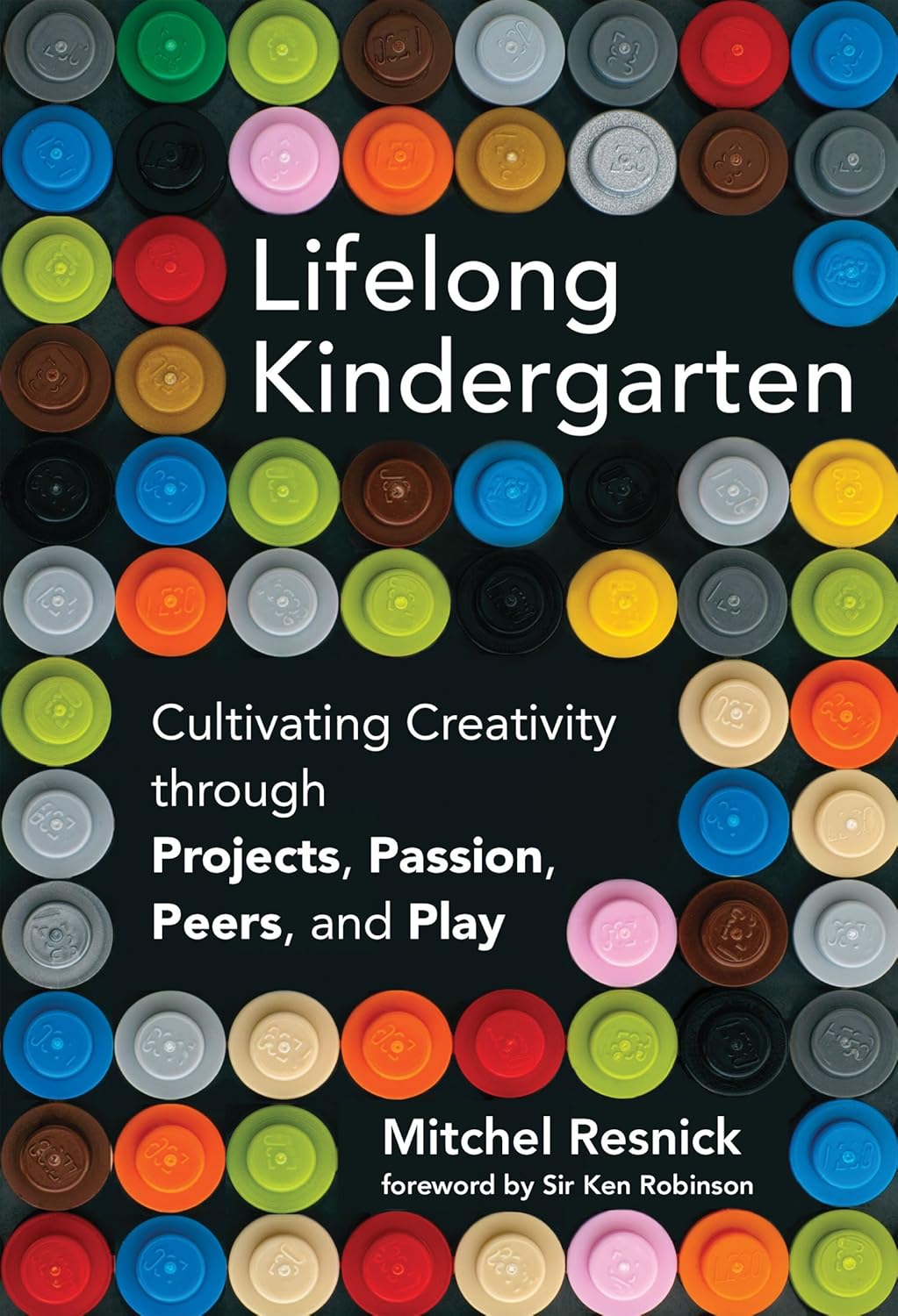
ithcel Resnick opens his book with a deceptively simple yet deeply unsettling question: Why are kindergarteners more creative than virtually anyone else who walks in and out of a school building?
Because no one tells them they're wrong. No one expects a single correct answer. You build a block tower, it falls, you try again. You mix the paint incorrectly, an unexpected color appears, and you delight in it. Play is not the tool — it is the point. Then first grade arrives, and everything changes.
Resnick is the founder of MIT Media Lab's Lifelong Kindergarten group — the team behind Scratch. But this is not a technology book.
Not a technology book
Used by hundreds of millions of children worldwide to learn to code, Scratch is actually the tangible output of the ideas in this book. But Resnick's goal isn't software design — it's understanding how creativity gets killed, and showing how to revive it.
The real thesis is quieter: the kindergarten approach to learning — building, experimenting, sharing — is not something children grow out of. It's something that gets taken from them.
The four pillars
Resnick organizes his framework around four P's. They're not a sequential list — they form a spiral that feeds itself. Real learning deepens by cycling through this loop again and again.
1st P
Projects
Building something from A to Z yourself. Integrated making, not isolated exercises.
2nd P
Passion
Driven by intrinsic curiosity, not external rewards. What makes learning meaningful.
3rd P
Peers
Creating, sharing, and learning alongside others. Creativity rarely grows in isolation.
4th P
Play
A mental freedom where mistakes are normal and experimentation is encouraged.
The book's most powerful concept
Beyond the four P's, Resnick introduces a design principle that applies to classrooms, tools, and entire educational systems.
Design principle
Low floor
Make it easy to start. The first step should never feel intimidating.
High ceiling
But don't cap it. Those who want to go deep, should be able to.
Wide walls
No single right path. Leave room for wildly different approaches.
Resnick applies this not just to Scratch — but to classroom design, lesson planning, and even to society itself. There were moments while reading where I had to stop and reach for a pen. Especially his writing on the difference between “a child completing something from A to Z” versus “a child taking a small step from B to C.” The first is learning. The second is passing a test.
Resnick isn't angry — he's solutions-oriented. It's easy to complain; it's hard to provide dozens of real examples of what actually works. He does the latter. And that's what makes this book readable.
By the time you reach the last page, you realize something: Resnick isn't writing for children at all. He's writing for us adults — for those magnificent beings who were once kindergarteners. And here's the better news: that child is still here. Just a little dusty.
In short
A rare combination: it both inspires and offers a concrete framework. Most creativity books only manage one. This one earns a permanent spot on the shelf.
Mitchel Resnick — Lifelong Kindergarten: Cultivating Creativity through Projects, Passion, Peers, and Play
MIT Press, 2017 · abakcus.com