ou probably assume that a theorem has exactly one correct proof. From the outside, that is how mathematics looks: cold, single-track, beyond argument. You either arrive at a conclusion or you do not, with no gray zone in between. Yet Philip Ording, a professor of mathematics at Sarah Lawrence College, did something disarmingly simple to overturn that assumption. He took an ordinary, almost boring equation and proved it ninety-nine different ways.
The theorem Ording chose is so modest it would not trouble a high-school student. Find the roots of a cubic equation. Here is the single sentence around which the whole book revolves:
If x³ − 6x² + 11x − 6 = 2x − 2, then x = 1 or x = 4.
The one proposition the book proves 99 times
A single line is enough to show this proposition is true. But finding the answer was never Ording's concern. His concern is how many different roads can lead to it, and what each road reveals about mathematics itself. In this way the book stops being a collection of proofs and becomes an atlas of style. It belongs on a very particular shelf: books that each orbit a single mathematical problem until the question becomes a world of its own.
The shadow of Queneau
Ording's idea did not appear out of nowhere. 99 Variations on a Proof grew directly out of the French writer Raymond Queneau's 1947 book Exercises in Style (Exercices de style). In it, Queneau retold a completely trivial incident on a bus in ninety-nine different literary modes: once in formal language, once in slang, once as a sonnet, once using only exclamations. The incident itself never changed; only the manner of telling did. And the reader slowly realized that the real subject was not the event, but the form.
Queneau was also one of the founders of Oulipo, the Paris-based circle of writers — stretching from Italo Calvino to Marcel Duchamp — that had set out to rethink literature through mathematical constraints and formal play. That same hunger to dissolve the border between mathematics and writing produced Nicolas Bourbaki, the mathematician who never existed: a collective of French mathematicians rebuilding their field from scratch a few streets and a few years away. Ording simply inverts the logic. If writers could use mathematics as a tool, then a mathematician could carry the methods of literature into mathematics.
The story being told is always the same; what changes is the voice telling it. In mathematics, the situation is no different.
Ninety-nine voices
The real magic of the book lies in the range of its proofs. In some variations Ording dives into history, solving the same equation in the language of a medieval mathematician, rhetorically and in words. In others he descends into modern abstraction, reaching for topological, algebraic, or computational methods. And in still others he turns fully experimental, transforming the proof into a poem, a color palette, or an electrostatic analogy.
A few variations from the book
- № 01
Medieval
The proof is built in the language of the age before symbols, entirely verbal and rhetorical.
- № 11
Topological
The same roots are seen through an entirely different lens, via the continuous deformation of form.
- № 28
Doggerel
The algebra is squeezed into rhyming, metered verse, with the logic left intact.
- № 53
Chromatic
The steps of the proof are coded in color; the eye sees the logic before it reads it.
- № 91
Psychedelic
A deliberately unconventional presentation that pushes against the boundaries of form.
Ording places a commentary beside each variation. These commentaries lift the book out of mere virtuosity and turn it into a genuine work of thought. Because the underlying question is this: if we can reach the same truth by ninety-nine roads, then what makes a proof good? Is it correctness, clarity, elegance, or the understanding it awakens in the mathematician who reads it? It is the same question G. H. Hardy tried to answer with his three criteria for mathematical beauty, and Ording's ninety-nine answers make Hardy's austerity look almost shy.
A note on “elegance”
Mathematicians use the phrase “elegant proof” often but define it rarely. Ording's book goes straight at that vagueness: elegance is not a property of logic, it is a judgment of style. The same lines may strike one mathematician as breathtaking and another as dull.
The French mathematician Étienne Ghys offered a fitting comparison when describing the book. In one of Molière's plays, a character asks in how many ways he might declare his love. The words of the same sentence shift position, but the meaning never changes. To Ghys, this is exactly what Ording was doing: ninety-nine separate declarations of love to a single mathematical truth.
Why mathematics is a style
The real legacy this book leaves the reader is not the technical skill on its pages. What Ording quietly proves is that mathematics, like literature, is an act of writing. When a mathematician constructs a proof, they do not merely find the truth; they decide how to present it, what to emphasize, what to pass over in silence. The sum of those decisions is that mathematician's style.
To an outsider, mathematics looks like a matter of pure logic and skill, measured along a single axis of excellence. Ording gently dismantles that illusion. There is no single way to write good mathematics, just as there is no single way to write well. And that is a lesson that holds for mathematicians as much as for everyone else.
What remains in the end is a vast book of ideas born from a tiny equation. Ording does not teach us what a theorem is. He teaches us how many ways a theorem can be seen. And in doing so, he reintroduces mathematics as one of the most creative things a person can do.
Book Details
Full Title
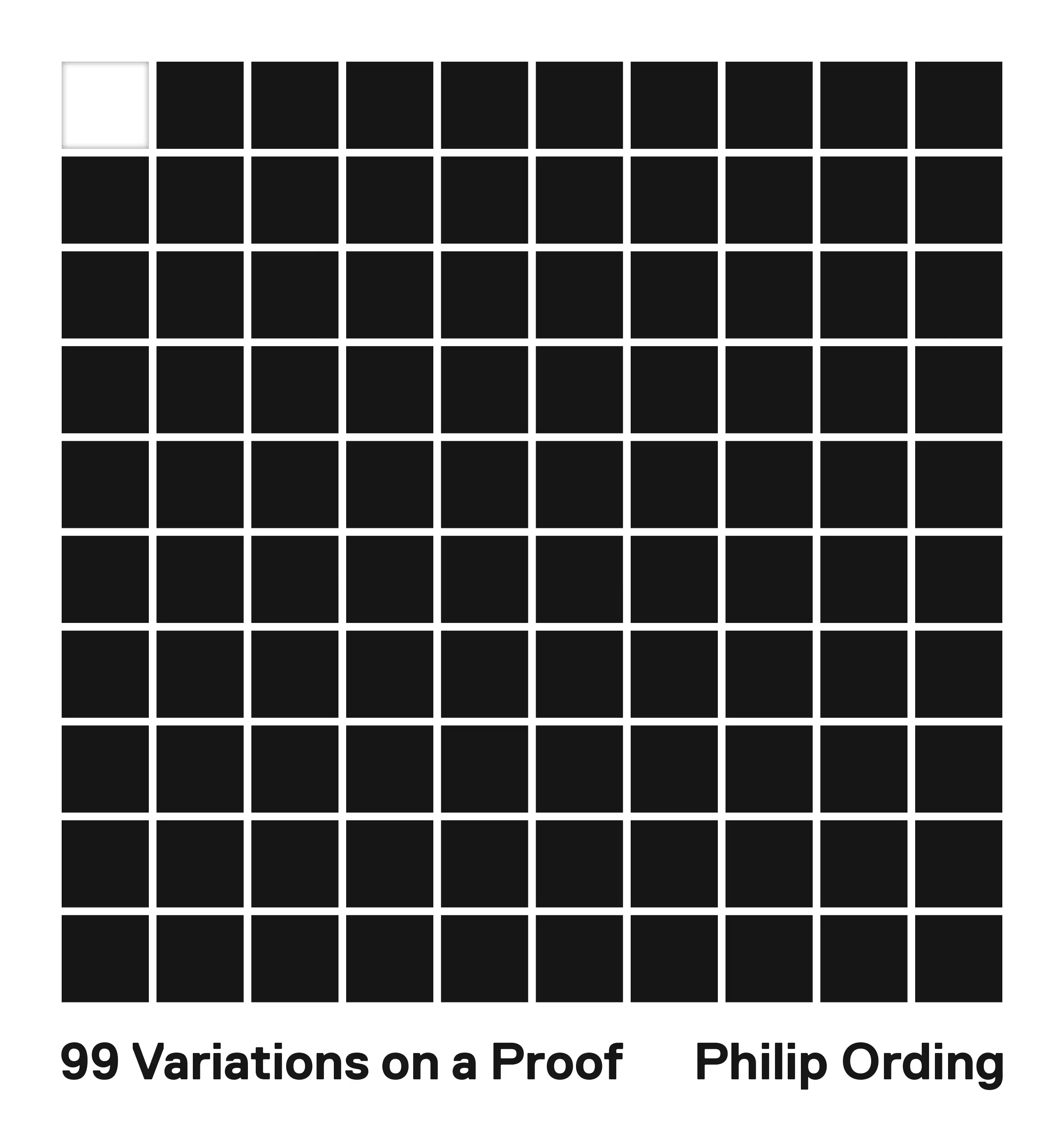
99 Variations on a Proof
Author
Philip Ording
ISBN
9780691158839
Published
Princeton University Press, 2019
Pages
272
Genre
Mathematics · Style
Philip Ording — 99 Variations on a Proof
Princeton University Press, 2019 · abakcus.com