History of Mathematics · Mystery
The Mathematician Who Never Existed
Nicolas Bourbaki is one of the most influential mathematicians of the twentieth century. There is one problem: no such person ever lived.
n the 1940s, an American mathematics journal rejected a paper submitted under the name Nicolas Bourbaki. The reason was brief and clear: the journal only accepted work from real individuals. Bourbaki replied — wittily, sharply, with a trace of arrogance. The journal was within its rights, the reply noted, but the American editor’s confidence that Bourbaki did not exist was perhaps premature. Some time later, Bourbaki applied for membership in the American Mathematical Society. The application was rejected. Same reason: Bourbaki was not an individual.1
It was a joke, but there was something serious behind it. Nicolas Bourbaki was a collective pseudonym chosen in 1934 by a group of young French mathematicians. None of them carried the name alone; all of them carried it together. And under that name, they launched the most ambitious mathematical publishing project of the twentieth century: a series of texts rebuilding modern mathematics from scratch, on entirely axiomatic foundations.
The Shadow of the First World War
The story begins with a military loss. The First World War destroyed a generation of French mathematicians. So many young researchers died at the front that universities afterward were left with either aging faculties or inadequate textbooks — usually both.2 Henri Cartan and André Weil, teaching at the University of Strasbourg, encountered the problem daily. The analysis course they were expected to teach relied on Édouard Goursat’s outdated textbook, and neither of them was willing to pretend it was adequate.
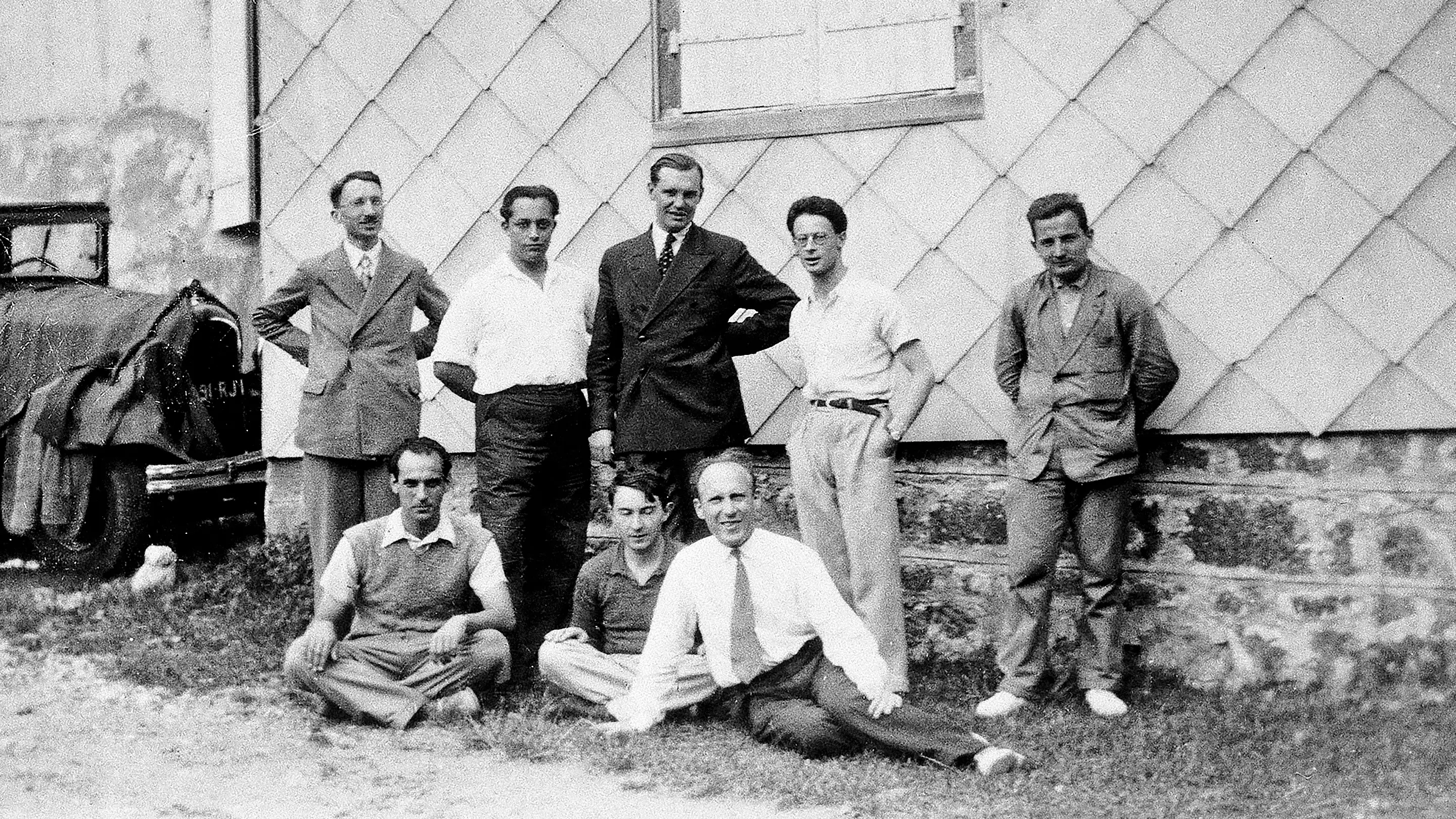
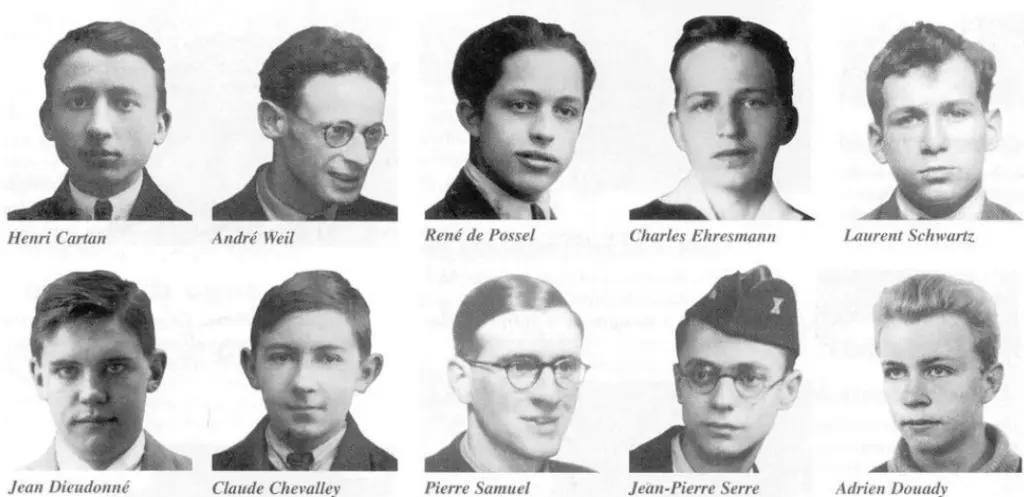
Weil’s solution sounded simple, at least on paper: “We are five or six friends. Let us all get together and sort out these problems once and for all.”3 In late 1934 he sent word to gather at the Café Capoulade in Paris. On December 10, 1934, six mathematicians sat down together: Henri Cartan, Claude Chevalley, Jean Delsarte, Jean Dieudonné, René de Possel, and André Weil. They would write a modern textbook on analysis. They would finish in a few months and return to work.
It took ninety years. And it is still not finished.
The Founding Members
André Weil
Number theory, algebraic geometry. The Weil conjectures. The group's intellectual engine.
Henri Cartan
Complex analysis, algebraic topology. The group's longest-lived member — died at 104.
Jean Dieudonné
The group's voice — wrote the bulk of the published texts. The loudest shouter at meetings.
Claude Chevalley
Algebra, Lie groups. Foundational contributions to group theory.
Jean Delsarte
Analysis. One of the architects of the group's organizational structure.
René de Possel
Early member. Left the group after a few years.
Where the Name Came From
General Charles-Denis Bourbaki was one of the more colorful French military figures of the nineteenth century. He won early campaigns in the Franco-Prussian War of 1870–71, then suffered a catastrophic defeat, then attempted to shoot himself in the head — the bullet missed and he survived. For French school students, his name was familiar and faintly ridiculous. At the École Normale Supérieure, there was an old tradition: to haze first-year students, an upperclassman would dress as “General Bourbaki” and deliver a fake, deliberately absurd mathematics lecture.4
Weil remembered the prank. When the group needed a name for its collective identity, the proposal “Nicolas Bourbaki” was accepted. Nicolas was a conventional French given name; Bourbaki carried the right combination of familiarity, absurdity, and — for mathematicians — a faint military resonance that pleased them. In the summer of 1935, at the group’s first official congress in Besse-en-Chandesse, the name was formally adopted.
How the Congresses Worked
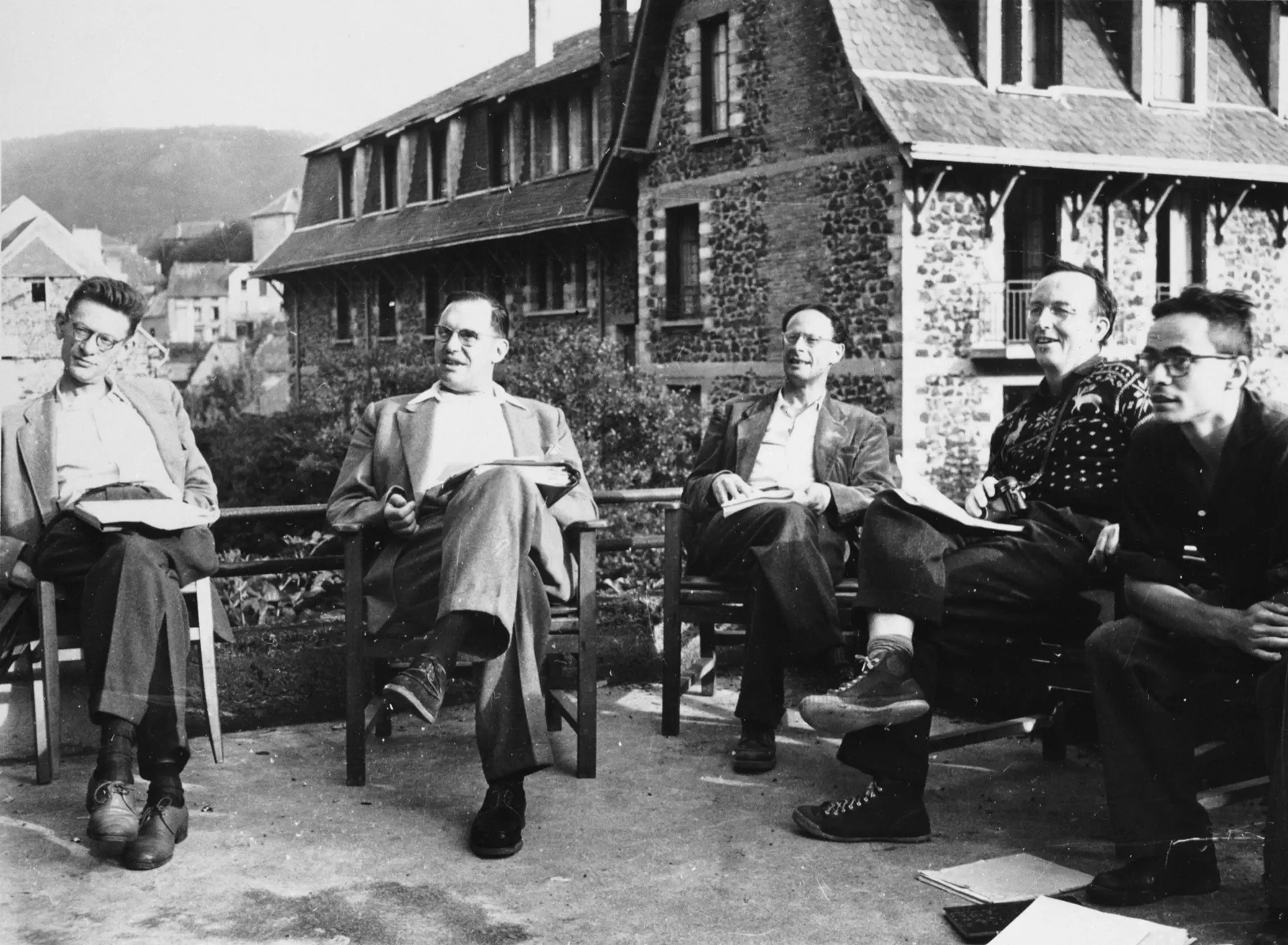
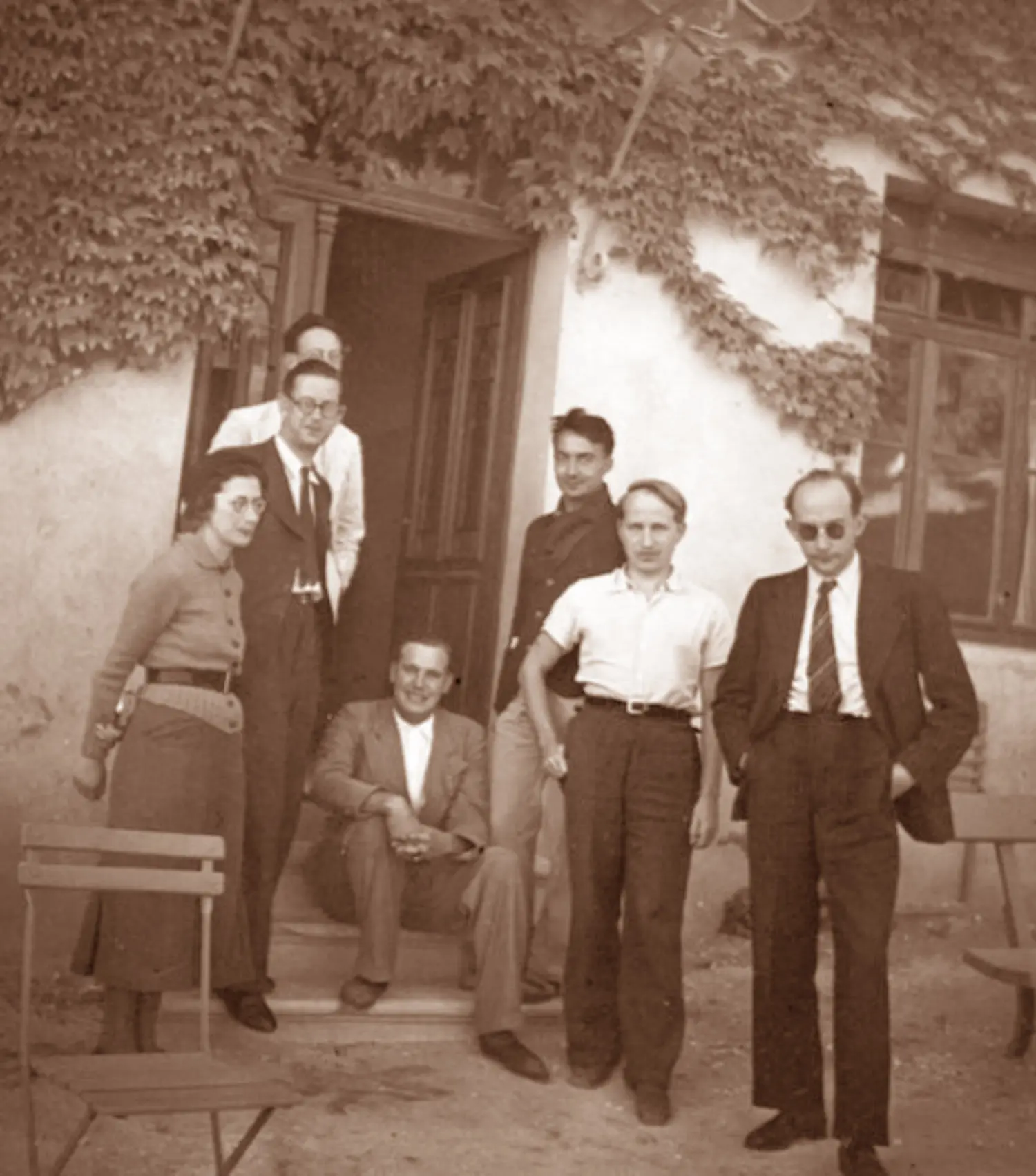
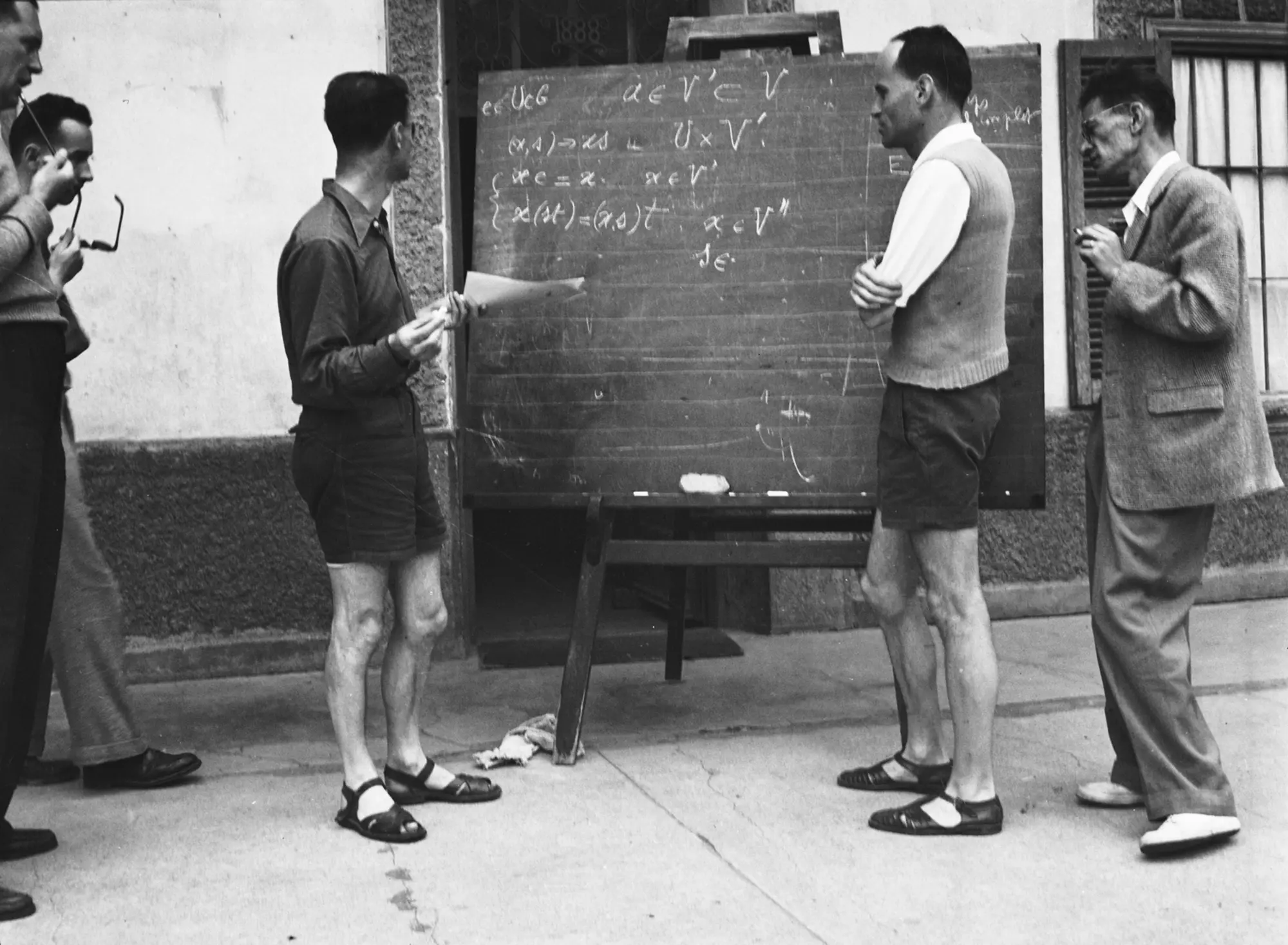
Bourbaki’s working method was unlike anything else in mathematics. The group convened regularly — at meetings they called congrès — usually for several days at a time in small towns in the French countryside. Everyone discussed everything; being a specialist in a given area was not a shield against criticism from those who were not. A draft would be presented, subjected to the most severe critique anyone could muster, and the rule was unanimous consent: no text could be published unless every active member approved it.
The meetings resembled a gathering of madmen. Two or three monologues shouted at top voice, seemingly independently of one another.
— Armand Borel, describing his first Bourbaki meeting in 1949The noise was methodological. The group refused to appoint a leader; decisions were made by consensus. Drafts were revised repeatedly, and often thrown out entirely. A text could spend years in this cycle before being considered ready for publication. Output was slow, but the standard was absolute: no incorrect or careless formulation passed through a Bourbaki text.
The Society’s Unwritten Rules
- →Anonymity: No text carries an individual name. Everything is published as Nicolas Bourbaki.
- →Unanimity: No text may be published without the approval of all active members. A single objection is sufficient to block publication.
- →The age-fifty rule: Active members must retire from the group when they turn fifty. No exceptions.
- →Secrecy: The list of current members is not made public. Former members may discuss their past involvement; active members do not.
- →No authority: The group does not elect a leader. No member has more voting weight than any other.
Éléments de mathématique: Rewriting Mathematics
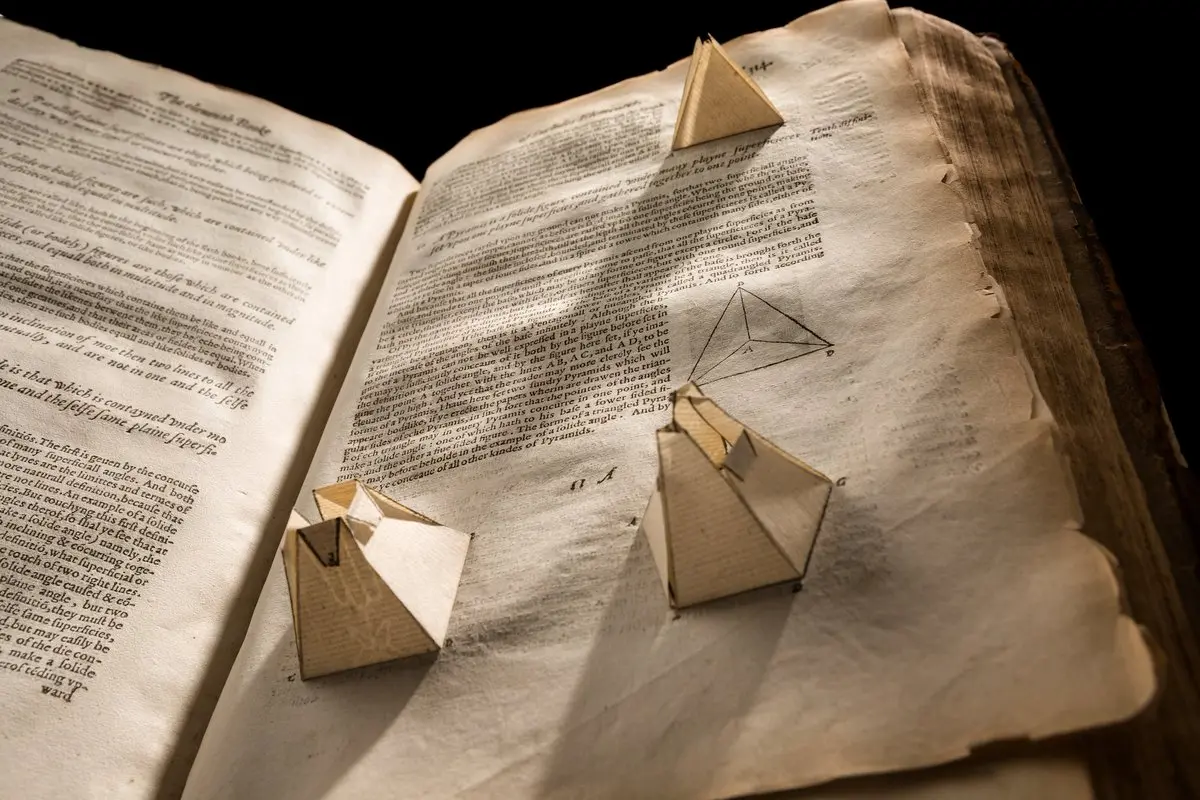
The group’s central project carries the title Éléments de mathématique. The singular form of “mathématique” — rather than the standard French plural “mathématiques” — is a deliberate choice: mathematics is one discipline, not a collection of parts. The conscious reference to Euclid’s Stoicheia is equally intentional: the same axiomatic method, but at the scale of two thousand years of accumulated mathematical knowledge.5 For a close look at what that Euclidean tradition looks like on the page, see the 1570 English edition of Euclid’s Elements — a book that also tried to make abstract geometry tactile and teachable.
The series begins with set theory. From there, everything else was to be constructed: algebra, topology, analysis, Lie groups, spectral theory. Nothing assumed, nothing left undefined. The approach drew on Hilbert’s axiomatic program — but the ambition was far larger. Bourbaki wanted to give mathematics a backbone: a hierarchy of abstract structures from which the entire field could be derived.
Timeline
Grothendieck: The Brightest Member, the Most Dramatic Exit
Alexander Grothendieck is one of the most singular minds in the history of mathematics. He joined Bourbaki in 1949 at twenty-one. Within a few years he had become the group’s most productive member. His contribution was twofold: he wrote directly into the Bourbaki texts, and his own monumental project — Éléments de Géométrie Algébrique, co-authored with Dieudonné — carried Bourbaki’s axiomatic inheritance into algebraic geometry at a scale that redefined the field.
But Grothendieck’s departure was at least as dramatic as his arrival. The dispute was over category theory. Grothendieck argued that the future of mathematics lay in categories and functors rather than set theory. Bourbaki did not agree; voices within the group found the framework too abstract, the foundations too fluid. Grothendieck left in 1968 — on his own terms, before the age limit applied. He subsequently abandoned mathematics altogether, withdrew to the mountains of southern France, and severed all ties with the academic world.6
“Without the language Bourbaki invented, there would be no words to describe contemporary mathematics.”
The Criticism: Abstraction or Sterilization?
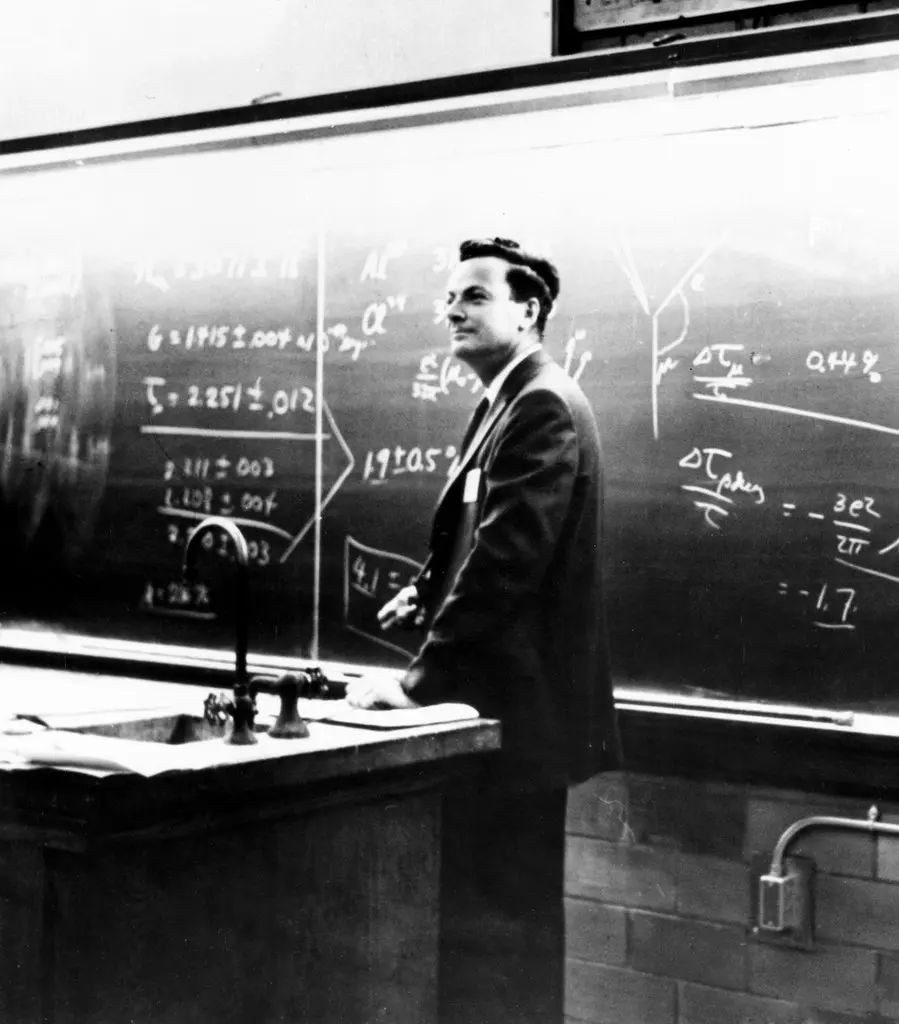
Bourbaki was not universally admired. The sharpest criticism came from the school reform movements of the 1950s and 1960s, which attempted to bring Bourbaki’s abstract language — sets, structures, axioms — into secondary school curricula under the banner of “modern mathematics.” The results were, in most countries, disastrous. Students learned to manipulate abstract structures without understanding what they were for. Teaching children set theory before arithmetic was like teaching grammar before speech. Richard Feynman watched this happen to California’s curriculum and wrote about it with characteristic exasperation.
Bourbaki was not responsible for that application. The group never proposed secondary school reform. But its name and authority became the seal that reformers used to legitimize the project. Critics eventually focused on a more specific complaint: Bourbaki’s texts excluded history, motivation, and geometric intuition. No examples. No diagrams. No “why.” Only definition, axiom, theorem, proof.
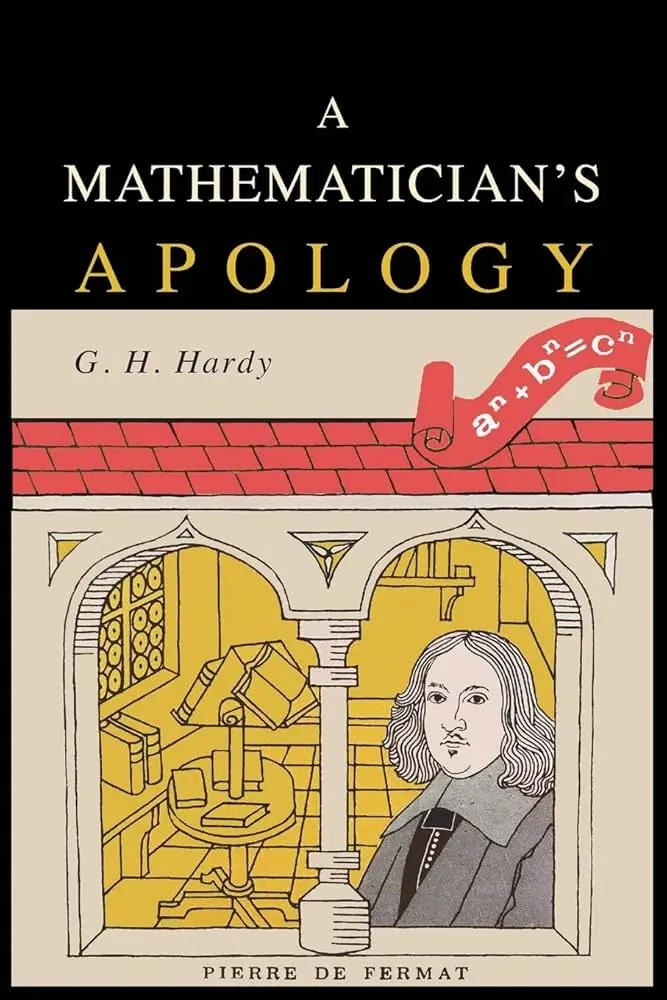
That criticism is not wrong — but it rests on a misunderstanding of what the project was. Bourbaki did not exist to teach mathematics. It existed to write mathematics once, correctly, and in full. The Éléments was not a textbook. It was a reference architecture. Its purpose was not to explain anything to a student but to demonstrate that mathematics could be placed on a self-sufficient, consistent, and complete foundation. Hardy makes a similar distinction in A Mathematician’s Apology: pure mathematics is not useful in the way a hammer is useful, and it was never intended to be.
The Legacy
Today, many mathematicians use the language Bourbaki invented without knowing Bourbaki’s name. Structure, functor, filter, germ, morphism — the standard usage of these concepts in modern mathematics comes largely from the Éléments series. The technical framework of algebra, topology, and functional analysis in particular bears the stamp of Bourbaki’s choices, made in a series of shouted debates in rural French hotels between 1935 and the 1970s.
The group still meets. Current members are still secret. Meeting locations are not announced. The only way to know whether someone is a Bourbaki member is either through the gossip of a former member, or by asking directly — in which case no answer comes. For over ninety years, this organization has operated in mathematics with no institutional funding, no elected leader, no public membership list, and a single shared signature. Nicolas Bourbaki never lived. But the language mathematics speaks today was largely written in his sentences.
Notes & Sources
- 1.AMS membership rejection and the Ralph Boas episode: Mashaal, M. Bourbaki: A Secret Society of Mathematicians. AMS, 2006. Also: Science News, “Founder of the Secret Society of Mathematicians,” August 2019. sciencenews.org ↗
- 2.WWI and its impact on French mathematics: Quanta Magazine, “Inside the Secret Math Society Known Simply as Nicolas Bourbaki,” November 2020. quantamagazine.org ↗
- 3.Weil’s proposal to Cartan: Weil, A. The Apprenticeship of a Mathematician. Birkhäuser, 1992. Autobiography.
- 4.General Bourbaki and the ENS prank: Wikipedia, “Nicolas Bourbaki.” wikipedia.org ↗
- 5.Singular “mathématique” and the reference to Euclid: CNRS News, “Bourbaki and the Foundations of Modern Mathematics,” August 2017. news.cnrs.fr ↗
- 6.Grothendieck’s departure and the category theory dispute: Anacona, M. et al. “On Bourbaki’s axiomatic system for set theory.” Synthese (2014). For Grothendieck’s later life: Jackson, A. “Comme Appelé du Néant.” Notices of the AMS 51:9 (2004).