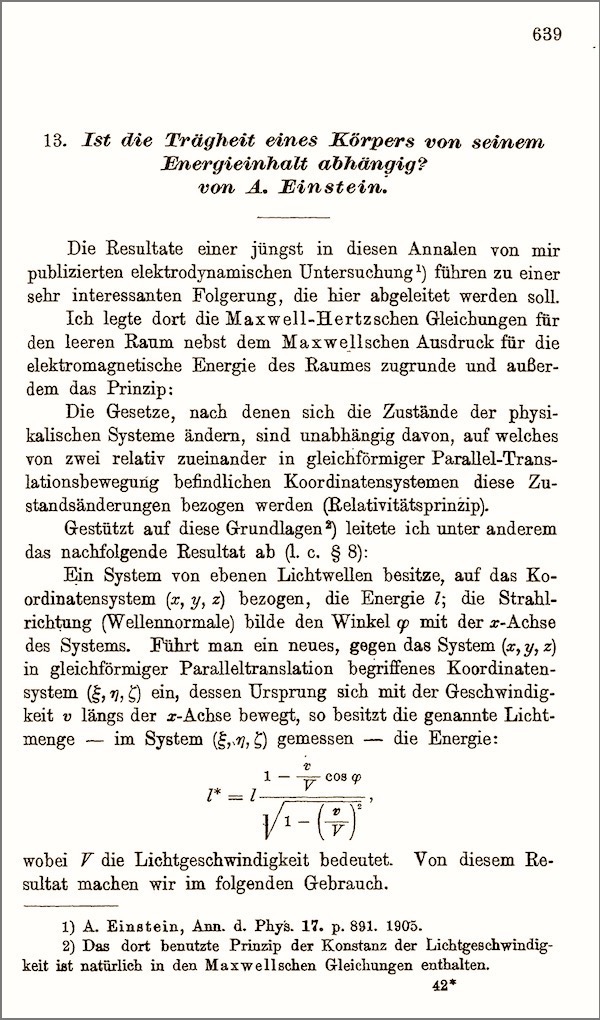
In September 1905, Albert Einstein submitted a three-page paper to the journal Annalen der Physik. Its title was a modest question: Ist die Trägheit eines Körpers von seinem Energieinhalt abhängig? — "Does the inertia of a body depend on its energy content?" The answer was yes, and not only physics but the relationship between numbers and symbols in human language changed with it. Yet nowhere in those three pages did the now-familiar E = mc² appear.
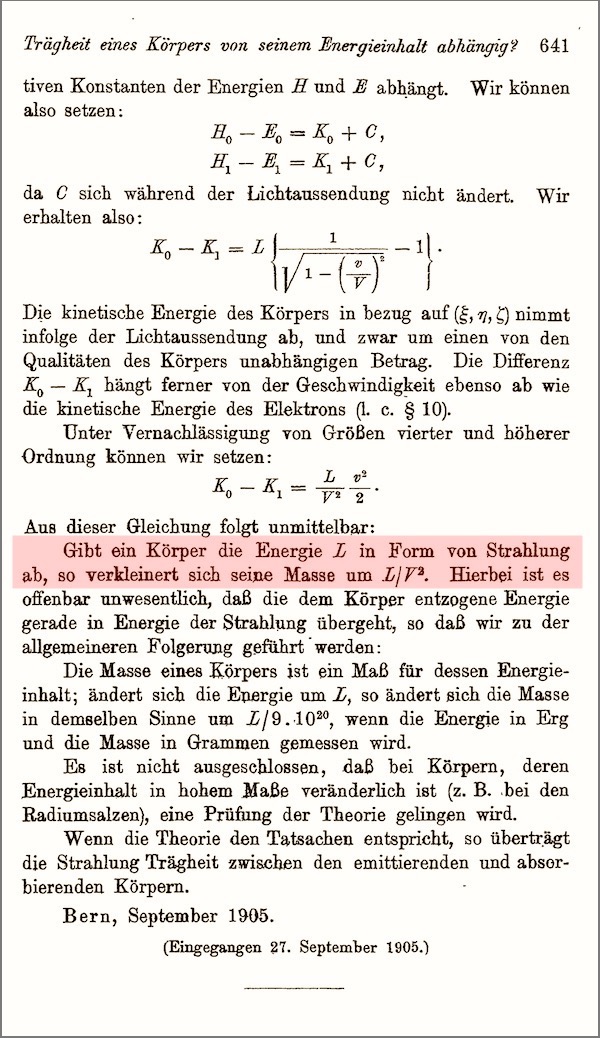
In the 1905 paper the equation took a different form: Einstein used V instead of today's c for the speed of light, and L instead of E for energy. The result itself was expressed differently too. Rather than writing a formula directly, Einstein showed that if a body emits energy in the form of radiation, its mass decreases — and stated the relationship as a proposition.
That sentence on the paper's final page is easy to read past. Typeset in German blackletter, a plain paragraph: "If a body gives off the energy L in the form of radiation, its mass diminishes by L/V²." The world's most famous equation sat there like a question nobody had thought to ask.
"If a body gives off the energy L in the form of radiation, its mass diminishes by L/V²."
Einstein, Annalen der Physik, September 1905
1912: The Formula Appears in Its Familiar Form
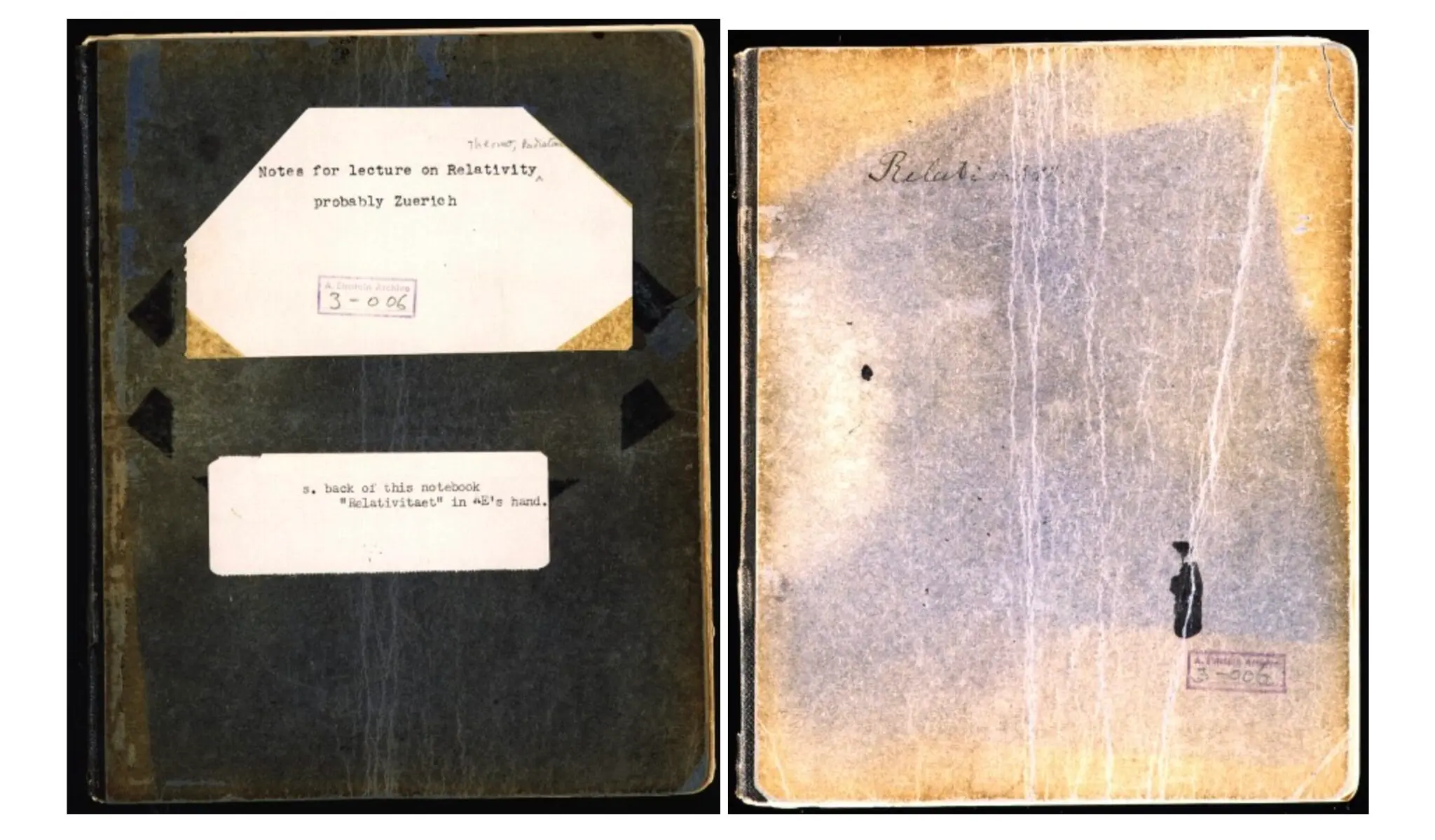
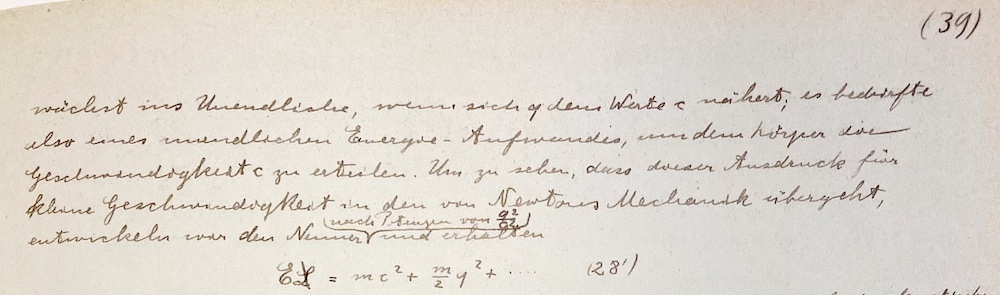
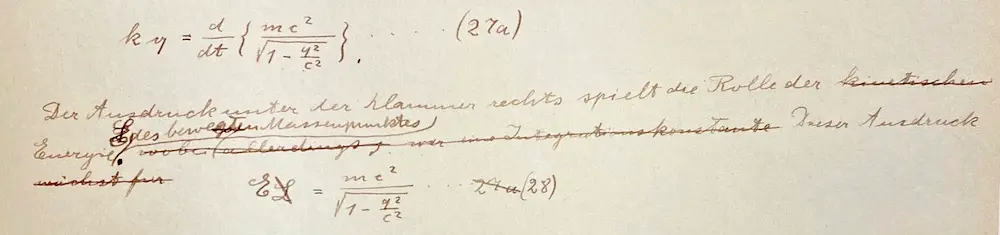
The version we recognize today — written as E = mc², with those specific symbols — did not enter Einstein's handwriting until 1912. Working on lecture notes for special relativity that year, Einstein replaced the L from 1905 with E, though he still wrote q for what we would now call v. The formula looked unfamiliar by today's standards, but the physics was the same.
On that manuscript page, in a note written directly beside the formula, Einstein summarized its physical meaning: the expression grows to infinity as the speed q approaches c — therefore it would require an infinite expenditure of energy to bring a body to the speed of light. The manuscript is now published as Document 1 in Volume 4 of the Collected Papers of Albert Einstein.
A History of the Formula: Looking Back
Whether E = mc² was uniquely Einstein's discovery is a question historians have debated at length. Physicist Tony Rothman, writing in Scientific American, argued that Einstein was neither the first to connect mass with energy nor the person who definitively proved the relationship. This is not an unfair reduction — it confirms a real part of the history.
In 1881, J. J. Thomson calculated that the magnetic field of a moving charged sphere induced an effective mass into the sphere itself. In 1889, Oliver Heaviside simplified this result to m = (4/3) E/c². In 1900, Henri Poincaré showed that for momentum to be conserved in an electromagnetic field, the field had to behave like a fictitious fluid with a mass equivalent of E/c² — but he did not connect this to the mass of any real body. In 1904, Austrian physicist Fritz Hasenöhrl ran a thought experiment involving a cavity filled with heat radiation and arrived at a similar conclusion, though with a fundamental error he later partially corrected.
What made Einstein's 1905 contribution different? According to Rothman, Einstein was the first to equate the mass of an object not just with its electromagnetic field or its motion, but with its total energy content — a conceptually much broader claim. What remained missing was the mathematical proof: Einstein himself acknowledged within a few years that he had fallen back on classical approximations rather than fully applying his own relativistic equations.
| Year | Person / Document |
|---|---|
| 1881 | J. J. ThomsonFirst calculated the “electromagnetic mass” induced by the magnetic field of a moving charged sphere. |
| 1889 | Oliver HeavisideSimplified Thomson's result to m = (4/3) E/c². |
| 1900 | Henri PoincaréShowed the electromagnetic field behaves like a fluid with a mass equivalent of E/c²; did not connect this to real bodies. |
| 1904–05 | Fritz HasenöhrlThought experiment involving a cavity with radiation; reached a similar result but missed a key error. |
| Sep. 1905 | Einstein — Annalen der Physik"Does the inertia of a body depend on its energy content?" — mass-energy equivalence stated in full generality for the first time, using the L/V² expression. |
| 1912–14 | Einstein — ManuscriptE = mc² written in its modern symbols (E and c) for the first time in a known manuscript. The earliest surviving autograph example. |
| Oct. 1946 | Einstein — Letter to SilbersteinThe fourth and last known document containing the equation in Einstein's own hand; sold at auction in 2021 for $1.2 million. |
The 1946 Letter: A Reckoning Between Physicists
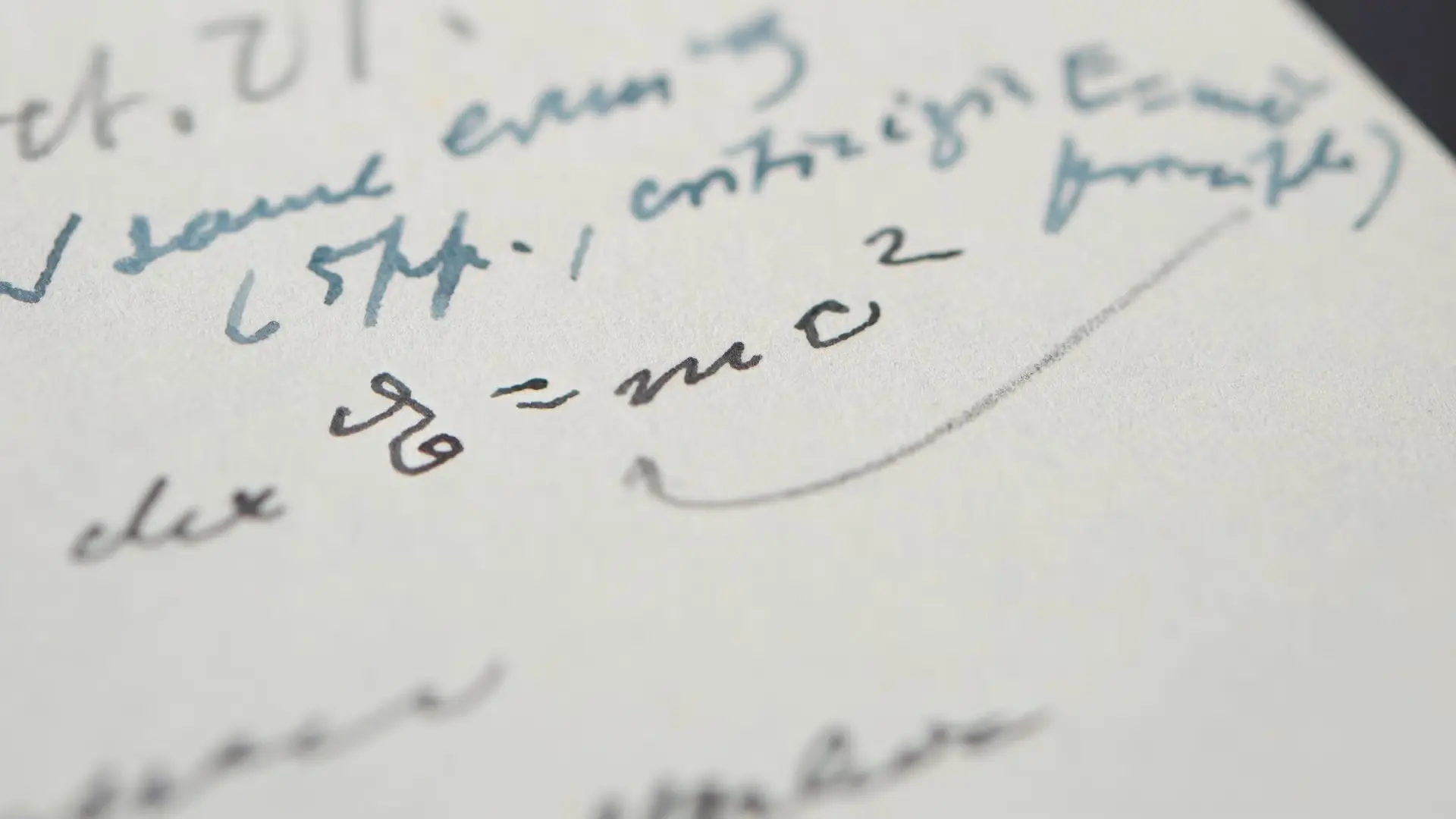
Written on Princeton University letterhead, dated October 26, 1946. The recipient was Ludwik Silberstein, a Polish-American physicist who had spent years challenging and questioning Einstein's theories. The letter's opening is brisk: "Your question can be answered from the E = mc² formula, without any erudition."
Einstein then worked through a system of two equal masses, using the Virial theorem to calculate the energy deficit. He wrote the formula directly — in its now-standard form. The letter remained in Silberstein's personal archives until his descendants sold the collection. At the 2021 auction, five parties entered the bidding; once the price passed $700,000 it narrowed to two, closing at $1.2 million — roughly three times the pre-sale estimate.
The Ongoing Debate About the Equation Itself
E = mc² is not questioned today — decades of experiments have confirmed it. But among physicists there is a persistent, quiet disagreement about what the formula actually means. Some — following the view that Lev Okun argued until his death — hold that the correct equation is E₀ = mc², where E₀ denotes the energy of a body at rest. For a moving body, the full expression is E = mc²/√(1 − v²/c²). The E = mc² of popular culture is, in this reading, a special case valid only for rest energy.
This distinction is ignored in a large share of physics textbooks. Advanced treatments like Landau and Lifshitz's Classical Theory of Fields avoid the formula entirely, while most popular books present it as a universal identity. Einstein himself was inconsistent on the matter; in a 1948 letter to Lincoln Barnett he wrote plainly that the concept of a "moving mass" admits no clear definition, and that it is better to use no mass concept other than rest mass.
The history of an equation covers not just who first wrote it, but what form it has lived in. The paper trail of E = mc² shows how science actually moves — incrementally, with error margins, on the shoulders of several people converging on the same result from different directions. Einstein took a critical step in that sequence. He did not write the sequence alone.
Sources
- Tony Rothman, "Was Einstein the First to Invent E = mc²?", Scientific American, September 2015.
- John D. Norton, "E = mc²", University of Pittsburgh HPS 0410 course notes.
- RR Auction press release, May 2021.
- Einstein Papers Project, California Institute of Technology.
- AP, "Original Einstein manuscripts show first details of E=MC2", March 2012.