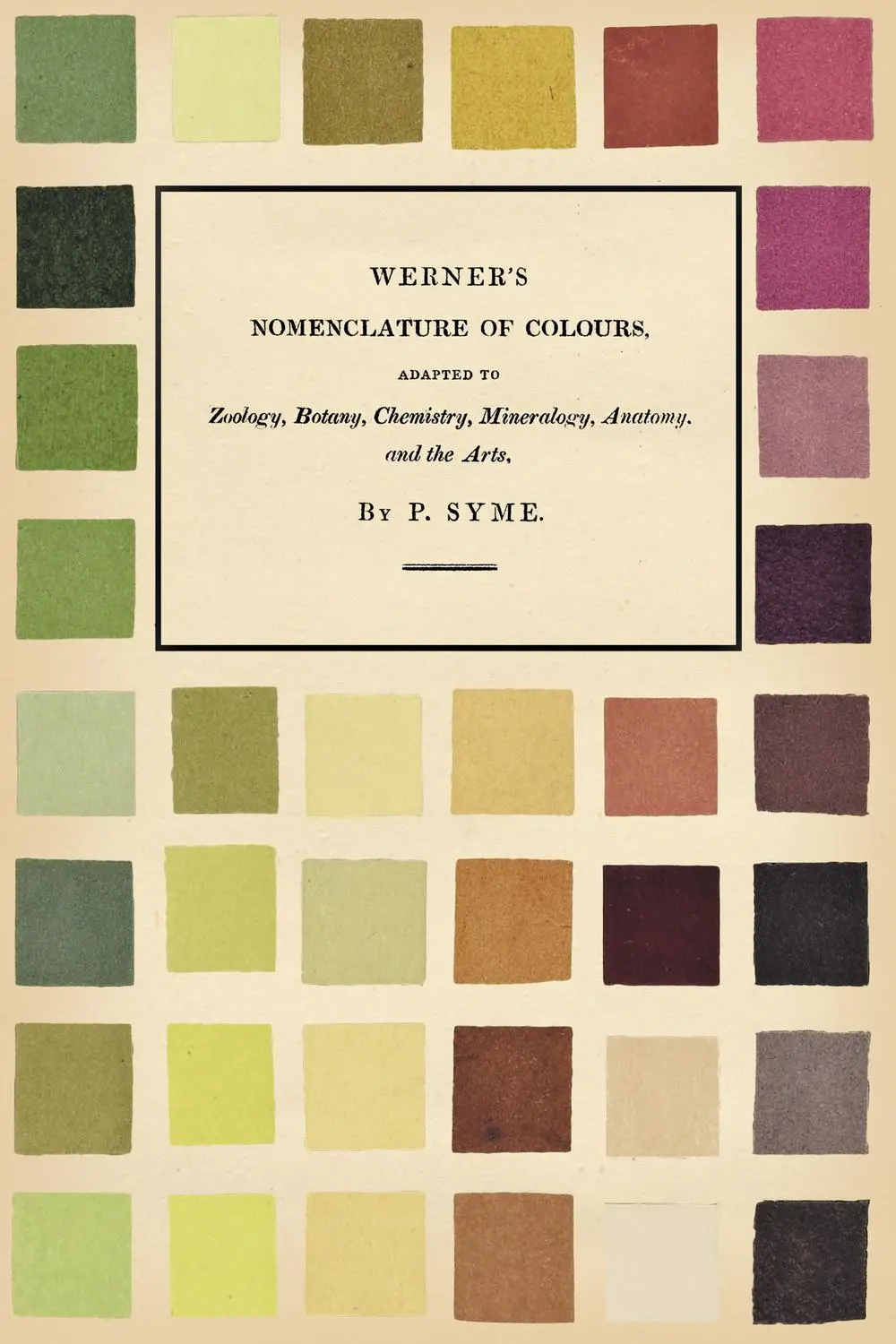
erner's Nomenclature of Colours, first printed in 1814, is a reference book made for naming the colours of the natural world. Its foundation rests on the colour system the German mineralogist Abraham Gottlob Werner developed to describe fossils and minerals. The Edinburgh flower painter Patrick Syme took that system and extended it. He reconstructed each colour by consulting real minerals and added beside it examples from the animal, vegetable, and mineral kingdoms. The result was a small book that fit in a naturalist's pocket and built a shared language for colour.
The problem the book set out to solve may seem strange today. There was no colour photography. When a naturalist saw the feather of a bird or the vein of a stone on a distant continent, he could not carry it home. Specimens fade, paints shift, memory deceives. The only reliable instrument was words. But saying “green” was not enough, because whose green? One person's green in the mind need not be the same as another's. Werner and Syme wanted to remove this ambiguity. They gave each colour a fixed name and a fixed example, so that the colour one scientist wrote down could be read by another in exactly the same way.
Werner's mineral origins
The system begins in science, or more precisely in earth science. Abraham Gottlob Werner was a mineralogist and geologist at the mining school in Freiberg, Saxony. In his 1774 book on the external characteristics of fossils and minerals, he built a classification system for describing stones. When a mineralogist described a stone, he also had to state its colour in precise terms, because colour was often the first clue to a mineral's identity. Werner's list grew from this practical need. He divided colours into certain principal groups and gave each a measured, repeatable name. This was a colour vocabulary built on stones, not on fashion or on poets.
Once Werner's system became known in mineralogical circles, naturalists in other fields wanted to make use of it too. But in Werner's list the colours were described in words, not with a swatch the eye could see. It was a painter who filled this gap.
Syme's contribution
Patrick Syme was a flower painter and a drawing teacher. He lived in Edinburgh, and his flower pieces were admired at exhibitions. Taken with Werner's idea of colour, Syme decided to make these word-described colours visible. He repainted each colour by consulting the real minerals Werner had defined. So the colour swatches in the book were not imaginary. Each one was taken from the colour of a stone that actually existed.
Syme did not only make the system visible, he also extended it. To each of Werner's colours he added three examples from nature. An animal, a plant, and a mineral. So the reader could verify a colour not in one place but in three. If the feather in your hand showed the same tone as the swatch in the book and the flower example beside it, you could be sure you had named the colour correctly. This cross-checking made the system sturdy and useful.
To describe a colour they set a stone, a bird, and a flower side by side. If all three showed the same tone, that tone was now the same for everyone.
How the system works
The book divides colours into several principal classes. Whites, greys, blacks, blues, purples, greens, yellows, oranges, reds, and browns. Within each class certain tones are listed, and each tone has a number, a name, and three examples from nature. The whites section, for instance, opens with “Snow White.” The book defines this as the purest white, a colour free of all intermixture, resembling newly fallen snow. By the same logic, every tone is given both an abstract description and tangible examples.
Most of the colour names are unexpectedly poetic. Names like “Oil Green,” “Arterial Blood Red,” “Skimmed Milk White,” and “Velvet Black” do not seem to belong to the language of a science book. But these names are not arbitrary. Each is tied to something concrete that calls up the same image in everyone's mind. The red of blood flowing from an artery, the white of skimmed milk, the green of olive oil. This concreteness makes the names both memorable and exact. Science and poetry meet on these pages in a harmony rarely seen.
Details
- Author
- Patrick Syme
- Based on
- Abraham Gottlob Werner
- First edition
- 1814 (expanded 1821)
- Colours
- 108 tones
- Classes
- White, grey, black, blue, purple, green, yellow, orange, red, brown
- Method
- Hand-painted colour swatches
An object made by hand
The making of the book was a feat in itself. The first edition ran to only a hundred copies, and every colour swatch was painted by hand, one by one. This work is said to have been done by an Edinburgh engraver, though by some accounts Syme and his family took part as well. Syme himself checked the colour consistency of each volume. That is, the “Indigo Blue” in one copy was checked against the “Indigo Blue” in another so they would look the same. In an age without colour printing, hitting the same tone across a hundred copies demands real care. In this respect the book is both a scientific instrument and an early artist's book.
This handwork gives the book a value of its own today. Original copies are of museum worth. The colours have faded somewhat over two centuries, but that very fading reminds us the book is an object of its time. Reprints preserve these aged tones as they are, offering the reader a world of colour seen through the eyes of the nineteenth century.
Why it still matters
Werner's nomenclature shows how elegant an effort at standardization can be. Today we name colours by numbers through systems like Pantone, but the root of that idea reaches back to books like this. Syme and Werner tried to turn something as slippery and subjective as colour into a language everyone could agree on. And they did it not with a cold system of codes but with nature's own examples. They tied a colour not to a number but to a bird, a stone, and a flower.
Today the book continues to be a source of inspiration for designers, painters, and lovers of nature. Publishers like Smithsonian have reprinted it, and designers like Nicholas Rougeux have brought it back to life in digital form. These pages, where a stone, a feather, and a leaf share the same name, are like a moment when science and beauty came rarely this close. Two centuries on, for anyone searching for the exact name of a colour in nature, Werner's nomenclature is still a book worth opening.
Patrick Syme — Werner's Nomenclature of Colours: Adapted to Zoology, Botany, Chemistry, Mineralogy, Anatomy, and the Arts
Smithsonian Books, 2018 (facsimile of 1814) · abakcus.com