Author
Benjamin Grant
Publisher
Ten Speed Press
Year
2016
Images
200+
Source
DigitalGlobe satellite imagery
Translations
9 languages
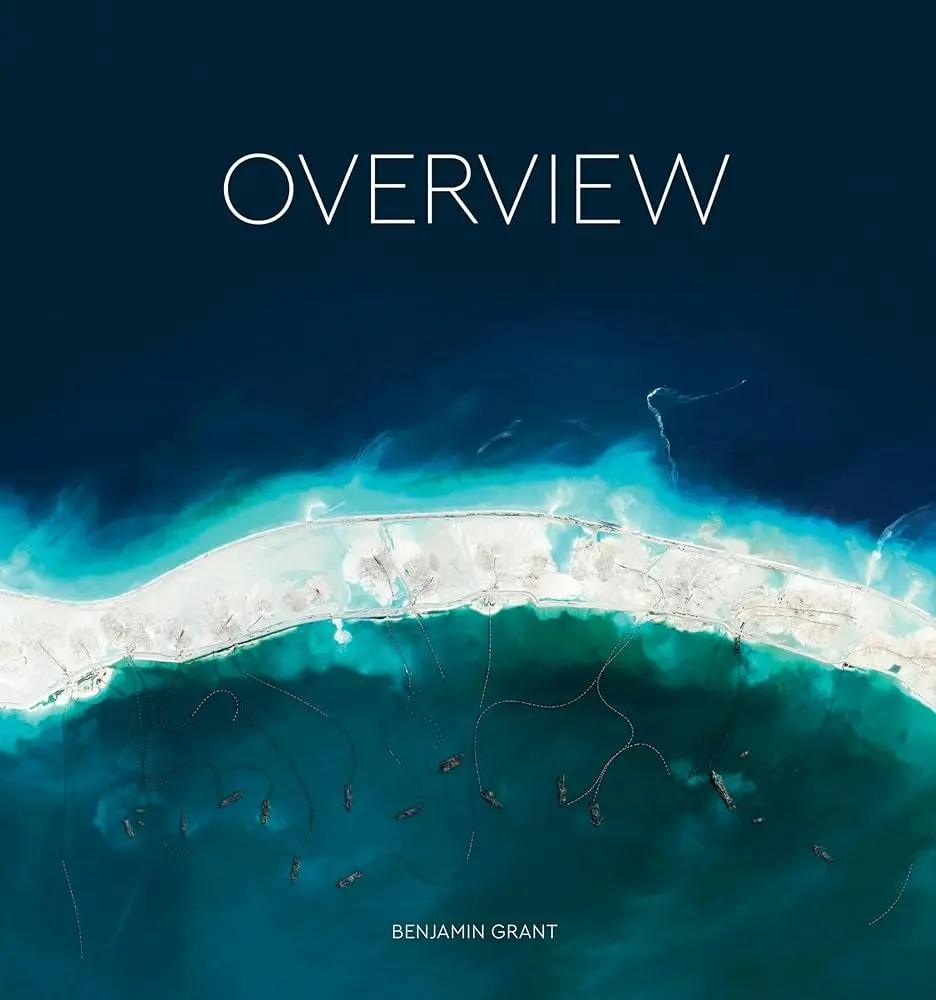
enjamin Grant was preparing for a meeting of a space club he had started. The upcoming talk was about satellites and their role in daily life, so he pulled up a mapping program and typed “Earth” into the search bar — hoping to zoom out and see the whole planet. The map did the opposite. It zoomed in, and settled on a place that matched the search term exactly: Earth, Texas. Population 1,200. Grant didn't find what he was looking for that day, but he found something else — that satellite imagery, viewed from directly above, showed a planet that most people had never actually seen. He started posting one image a day. Three years later, half a million followers. Two years after that, this book.
Taken together, the 200 images form something the individual images don't: a record of what humanity has done to this planet. And the record is not always beautiful.
The title comes from a term coined by science writer Frank White in 1987: the Overview Effect. When astronauts are given the opportunity to look down at Earth as a whole, something shifts in them — borders become meaningless, the fragility of the planet becomes visceral, interconnection becomes undeniable. More than eighty percent of astronauts who have made the journey report some version of this experience. Grant set out to bring that shift to ground level. You don't need to go to space, the book implies. You need to change the angle. The satellite imagery he licenses from DigitalGlobe — stitched together from dozens of high-resolution frames per composite — gives that angle to anyone with a page to turn.
The book is organized into eight chapters. Where We Harvest. Where We Extract. Where We Power. Where We Live. Where We Move. Where We Design. Where We Play. Where We Waste. The final chapter is Where We Are Not — places the human hand has not yet reached. The book saves this for last, and that sequencing is a statement. Hydroponic farms, coal terminals, oil refineries, landfills, vast parking lots, deserts laced with irrigation channels, coastlines stacked with container ports — photographed from above, all of these look almost like abstract art. This is precisely the paradox Grant has captured: human activity at sufficient scale acquires, from sufficient distance, an unintended aesthetic.
A Caption
“This image shows China's largest coal terminal, which processes 580 million tons of coal per year.” You read this after you've already found the image beautiful. You can't un-find it beautiful. That tension is what the book is actually about.
This is Grant's sharpest editorial decision: beauty first, then information. The sequence is deliberate — he gets you inside the image before he tells you what you're looking at. By the time you read the caption, you're already implicated. The Qinhuangdao Coal Terminal in China reads as a moody monochrome canvas. The tulip fields of Lisse, the Netherlands, are a geometric patchwork. The center-pivot irrigation systems of Saudi Arabia are perfect circles drawn in a desert. Grant doesn't editorialize in the captions. He gives you a number — tonnage, acreage, depth — and steps back. The image and the number do the rest. It is the same compositional restraint that makes the best scientific photography so durable: the subject is allowed to speak.
Astronaut Edgar Mitchell, returning from the Moon in 1971, said: “I suddenly realized that everything is connected. Science ignores this relationship, but the relationship exists.” Grant is after the ground-level version of that moment. He delivers it — but by a different route than you expect. The first response to opening this book is beauty. Then you read the caption. And the aesthetic doesn't disappear — but you can no longer look at the image without knowing what it is. Something similar happens with Einstein's Zurich Notebook: documents that look like one thing turn out to be something else entirely once you know what you're holding.
Beauty first, then the caption. Grant lets you in before he tells you what you're standing inside.
The book is categorized as a coffee table book. This is accurate but undersells it. Coffee table books get flipped through. This one doesn't get flipped through — each page holds for a while. Because each image, read alongside its caption, says two things simultaneously: humanity has built extraordinary things on this planet, and humanity has done extraordinary things to this planet. The gap between those two sentences is small. The weight of it is not. What landscape photography at its best does in time, Grant does in altitude: a shift in vantage point that makes the familiar unrecognizable.
In 1968, astronaut Bill Anders photographed the Earth rising above the lunar horizon from Apollo 8. “We came to discover the Moon,” he said afterward, “and we actually discovered Earth.” Grant's book is the long footnote to that sentence. It doesn't require a rocket. It requires only changing the angle — and the willingness to read the number underneath the image.
Benjamin Grant
Creator of the Daily Overview Instagram account (@dailyoverview), active since 2013 with one new satellite image every day. Grant licenses and composites imagery from DigitalGlobe to produce each frame. Overview was translated into nine languages and became an international bestseller. The account is the book's ongoing sequel.
If this book speaks to you, these will too
In short
A satellite photography book that changes its meaning as you read it. The images arrive as beauty. The captions arrive as facts. The gap between those two things is where the book actually lives — and it is a gap that stays open long after you close the cover.
¹ Grant doesn't take the photographs himself — he licenses satellite imagery from DigitalGlobe, then stitches together multiple high-resolution frames to produce a single composite image. Some visuals combine dozens of photographs. The editorial work is as substantial as the photography.
² The Instagram account that started all of this, @dailyoverview, is still active — one new image every day. The book is a selection of 200 frames from that archive. Following the account is like reading the book's ongoing sequel.
³ In 1968, astronaut Bill Anders photographed the Earth rising above the lunar horizon from Apollo 8. “We came to discover the Moon,” he said afterward, “and we actually discovered Earth.” Grant's book is the long footnote to that sentence.
Benjamin Grant — Overview: A New Perspective of Earth
Ten Speed Press, 2016 · abakcus.com