How would you describe the shape of a cloud?
Not round. Not oval. Certainly not smooth. With the tools traditional geometry gives us — circles, triangles, planes — a cloud cannot be described. Neither can a mountain's silhouette. Nor the windings of a coastline, the arms of a snowflake, the branching of a vein, the path of a lightning bolt.
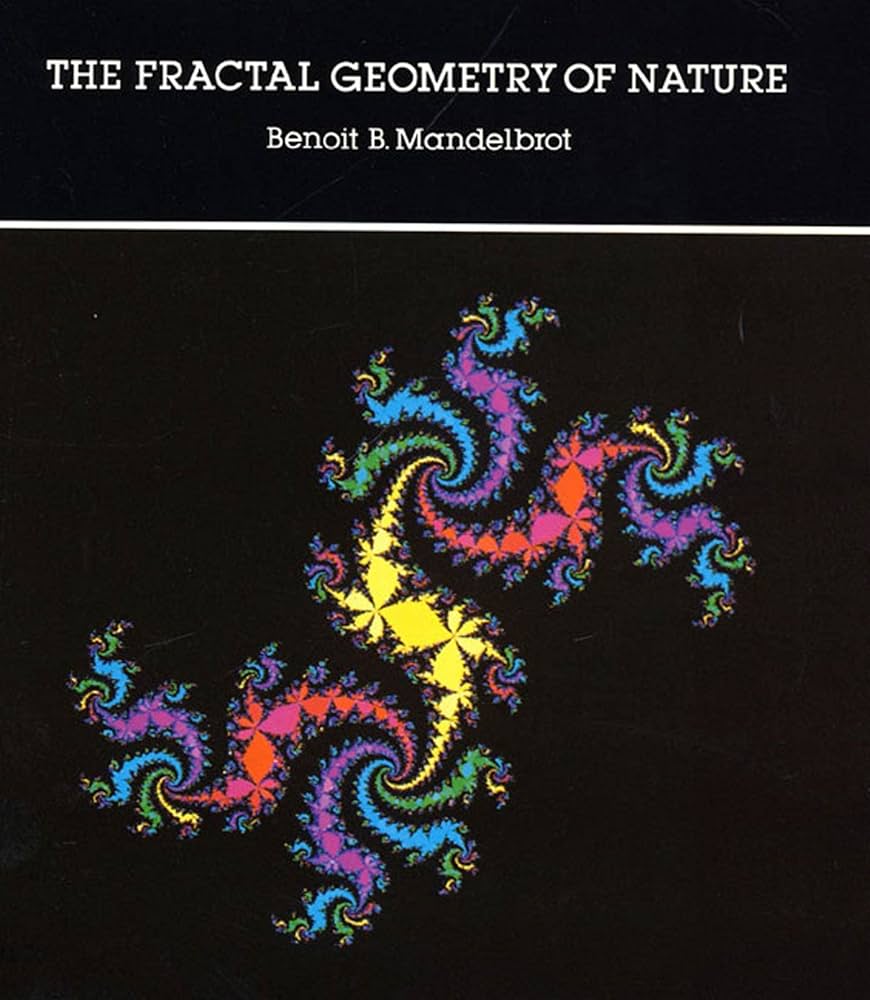
In 1982, Benoît Mandelbrot said: then let us build a new geometry.
Self-similarity — the core idea
Every part resembles the whole. This is self-similarity — the heart of fractal geometry.
Mandelbrot's proposition sounds almost childlike at first: many shapes in nature repeat themselves. Look at a mountain from far away, then from close up — similar roughness. Take a small section of a coastline, magnify it — similar curves. Break off one branch of a broccoli head — a miniature of the whole plant.
This idea of “self-similarity” was not new to mathematics. But Mandelbrot took it from a curiosity and made it an instrument for describing the language of nature itself. And he gave it a name: fractal.
Mandelbrot's most famous question
How long is the coastline of Britain?
100 km ruler
Large bays and peninsulas measured — minor inlets missed entirely.
~2,800 km
10 km ruler
Smaller inlets captured. The line grows longer as detail increases.
~3,400 km
1 km ruler
Coves, rocks, tide pools — each curve adds length. No limit in sight.
~17,820 km
The answer depends on the scale you use. The smaller your ruler, the more curves you catch, and the longer the coastline grows — without limit. The coastline is, in a meaningful sense, infinitely long.
This question is both perfectly simple and completely world-altering.
The book is not just a new branch of mathematics. It is a manifesto about how science sees — and misses — the world.
Physics assumes smooth curves. Economic models assume neat distributions. But the real world is not smooth. The real world is jagged, fragile, irregular-looking — yet in possession of a deep order that Euclid's tools were never built to measure.
Do not be misled by the difficulty of some sections. Getting lost here is not a failure — it is almost part of the experience. Because just below a dense equation, there is always an image from nature: a satellite photograph of a river basin, a bronchial tree, a magnified corner of the Mandelbrot set. And that image keeps you turning pages when nothing else would.
Fractals in the natural world
Trees & rivers
Branching patterns repeat at every scale — the small mirrors the large.
Snowflakes
Six-fold symmetry that repeats inward — structure within structure within structure.
Coastlines
Every zoom reveals new complexity. The length grows without end.
“Scientists study the world as it is; engineers create the world that never has been; yet poets imagine the world that ought to be. I believe I am all three.”
Benoît B. Mandelbrot · 2010
After reading this book, you step outside and something has shifted. You look at the branching of a tree, the edge of a cloud, the bend of a river — and you see them differently. The world's appearance hasn't changed. But the language that describes it finally has a name.
In short
Mandelbrot didn't write a textbook. He wrote a new way of seeing. Difficult in places, visionary throughout — and one of those rare books that genuinely changes what you notice when you look at the world.
Benoît B. Mandelbrot — The Fractal Geometry of Nature
W. H. Freeman, 1982 · abakcus.com