Author
Dominique Ehrhard
Publisher
Les Grandes Personnes
Year
2016
Pages
26
Format
Pop-up · 15 cm square
Language
French · English ed.
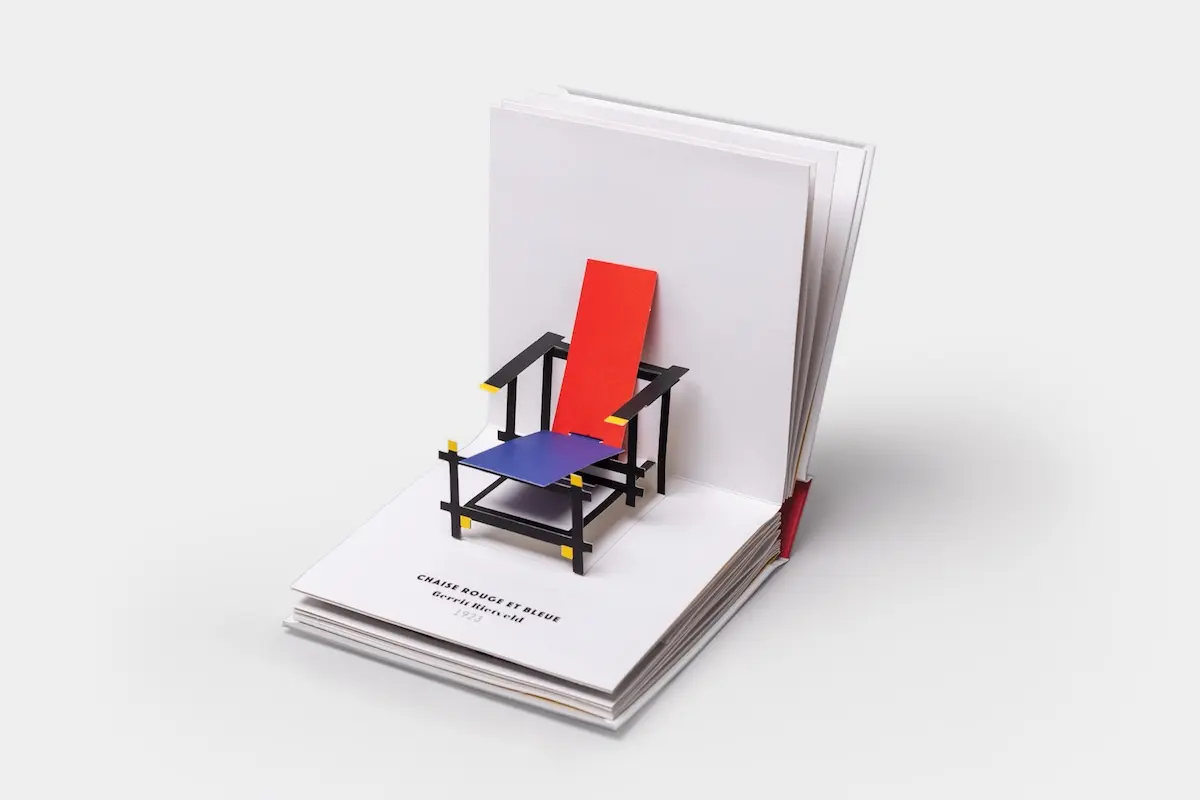
photograph of a chair tells you very little about that chair, because a chair is first of all a volume, and the empty space between its legs, the angle the seat makes with the back, the way its weight comes down to the floor only make sense once you walk around it. Dominique Ehrhard's 10 Chaises, published in 2016 by Les Grandes Personnes in Paris, solves this problem the oldest way there is, with paper. Every time you open a spread a chair rises from the middle, and when you close the page the same chair folds down between two boards into a few millimetres and disappears.
Ehrhard is a French painter and designer, and he holds the agrégation in plastic arts, the highest teaching qualification France gives in the field. Board game players know his name from games like Condottiere and Serenissima, and on the children's side he has spent years making books where you build a castle, a village or a city out of paper. Before this one he did Paris Pop-up, which puts eight famous Paris buildings into the pages the same way.
The ten chairs
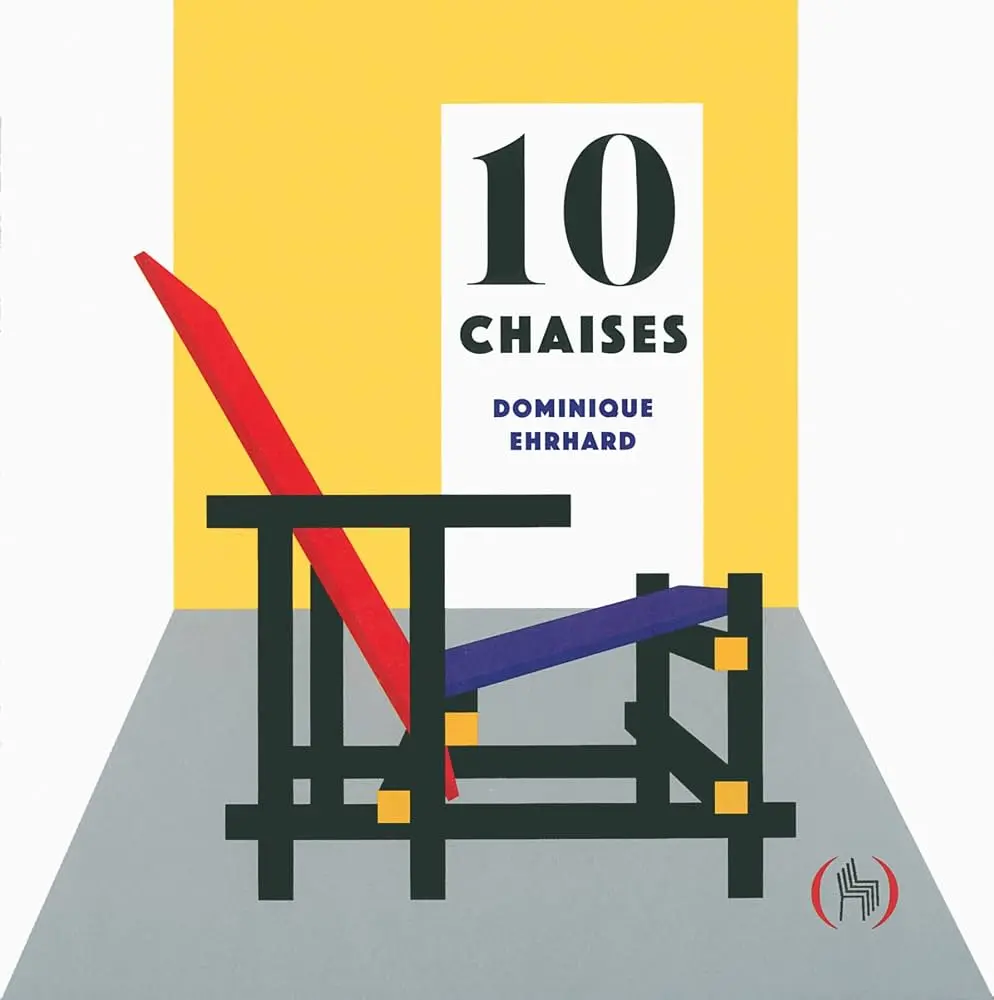
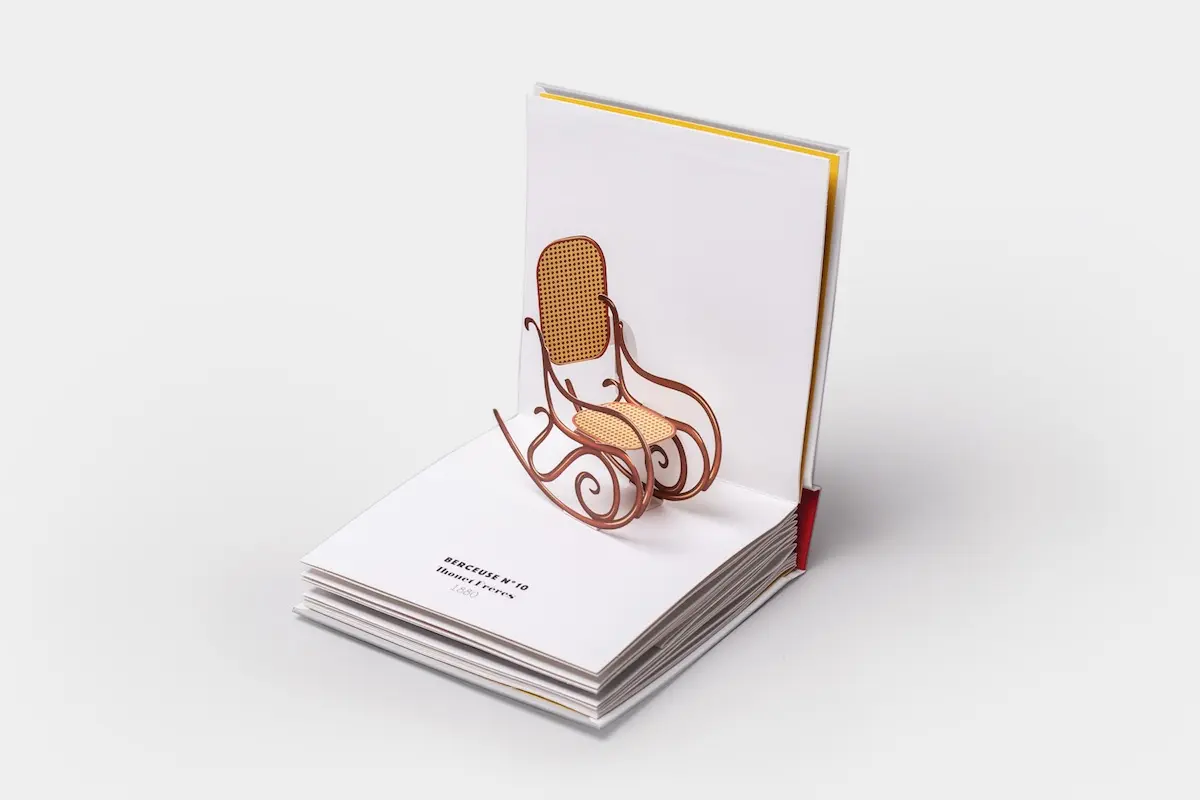
The ten chairs cover roughly a century and they run in chronological order. The book opens with Thonet's 1880 rocking chair No. 10, then comes the tall thin-backed chair Charles Rennie Mackintosh designed for Hill House in 1902, Koloman Moser's 1903 Purkersdorf armchair, and the chair Gerrit Rietveld first drew in 1917 and later painted red and blue, which is also on the cover. Then Marcel Breuer's tubular steel Wassily chair, the chrome frame the Bauhaus kept returning to and that Erich Dieckmann once drew sixty-four times on a single sheet, the LC2 by Le Corbusier, Pierre Jeanneret and Charlotte Perriand, Frank Lloyd Wright's Barrel chair, Charles and Ray Eames's RAR rocker, George Nelson and Irving Harper's 1956 Marshmallow sofa, and the book closes with Alessandro Mendini's 1978 Proust armchair.
- 011880Rocking chair No. 10Thonet
- 021902Hill House chairCharles Rennie Mackintosh
- 031903Purkersdorf armchairKoloman Moser
- 041917Red and Blue chairGerrit Rietveld
- 051925Wassily chairMarcel Breuer
- 061928LC2Le Corbusier, Pierre Jeanneret & Charlotte Perriand
- 071937Barrel chairFrank Lloyd Wright
- 081950RAR rockerCharles & Ray Eames
- 091956Marshmallow sofaGeorge Nelson & Irving Harper
- 101978Proust armchairAlessandro Mendini
Open to 180, close to zero
The part that interests me most is that every one of these chairs has to meet the same two conditions at the same time. When the page opens to 180 degrees the piece has to stand up on its own, and when the page closes to zero it has to slide into a flat envelope without any part of it hitting another. So the position of every fold and every glue point turns into a geometry problem.
He finds the line that makes a chair that chair, keeps it and throws the rest away.
Rietveld's chair is already made of flat boards and sticks, the kind of elementary form the Bauhaus teachers argued over in the ABC's of triangle, square, circle, so it goes into paper almost willingly. Thonet's steam-bent beech curves or the Marshmallow's eighteen round cushions lined up on a steel frame, each of which has to sit at its own angle, are much harder jobs.
What Ehrhard does is really a work of selection. It is the same discipline a type designer applies to a letter, where a few strokes have to carry the whole identity of the shape. In the end the Wassily chair turns into strips of paper and you still recognise it as the Wassily at first glance.
Who it is for
The book is a square format of about 15 centimetres, 26 pages, and its last five pages introduce the people who designed these chairs with short biographies. Most of them were furniture makers, carpenters, architects and designers all at once, and in those pages you see more clearly that for them a chair was a small part of a building.
The publisher gives the reading age as ten and up, and I read that as a lower limit, because the best reader of this book, I think, is an adult who has never once wondered why a chair stands the way it does. The Rhode Island School of Design library took it into its pop-up collection and filmed its pages opening one by one; the mechanism is hard to describe in words, and if you come across that short video I'd give it a minute of your time.
After the book found its readers Ehrhard made a second volume in the same format called 10 Autres Chaises. This time Josef Hoffmann's Sitzmaschine, Alexander Rodchenko's chess table and chairs, Mies van der Rohe and Lilly Reich's Barcelona chair, Hans Wegner's Wishbone, Arne Jacobsen's Ant chair and the Bouroullec brothers' 2008 Vegetal chair rise from the pages. Both books are in French, but there is very little text anyway and you don't need French to read the chairs. The first book also came out in English as 10 Chairs.
Details
- Author
- Dominique Ehrhard, painter, designer and game author
- Edition
- Les Grandes Personnes, Paris, 2016
- Extent
- 26 pages · 10 pop-ups · designer biographies
- Span
- Thonet 1880 to Mendini 1978
- Sequel
- 10 Autres Chaises
If this book speaks to you, these will too
In short
A century of chair design you can hold in one hand. Ten pop-ups, each a small geometry problem solved in paper, and a book that teaches you to look at a chair as a volume instead of a picture.
Dominique Ehrhard — 10 Chaises
Les Grandes Personnes, 2016 · English edition as 10 Chairs · ISBN 978-2-36193-442-2