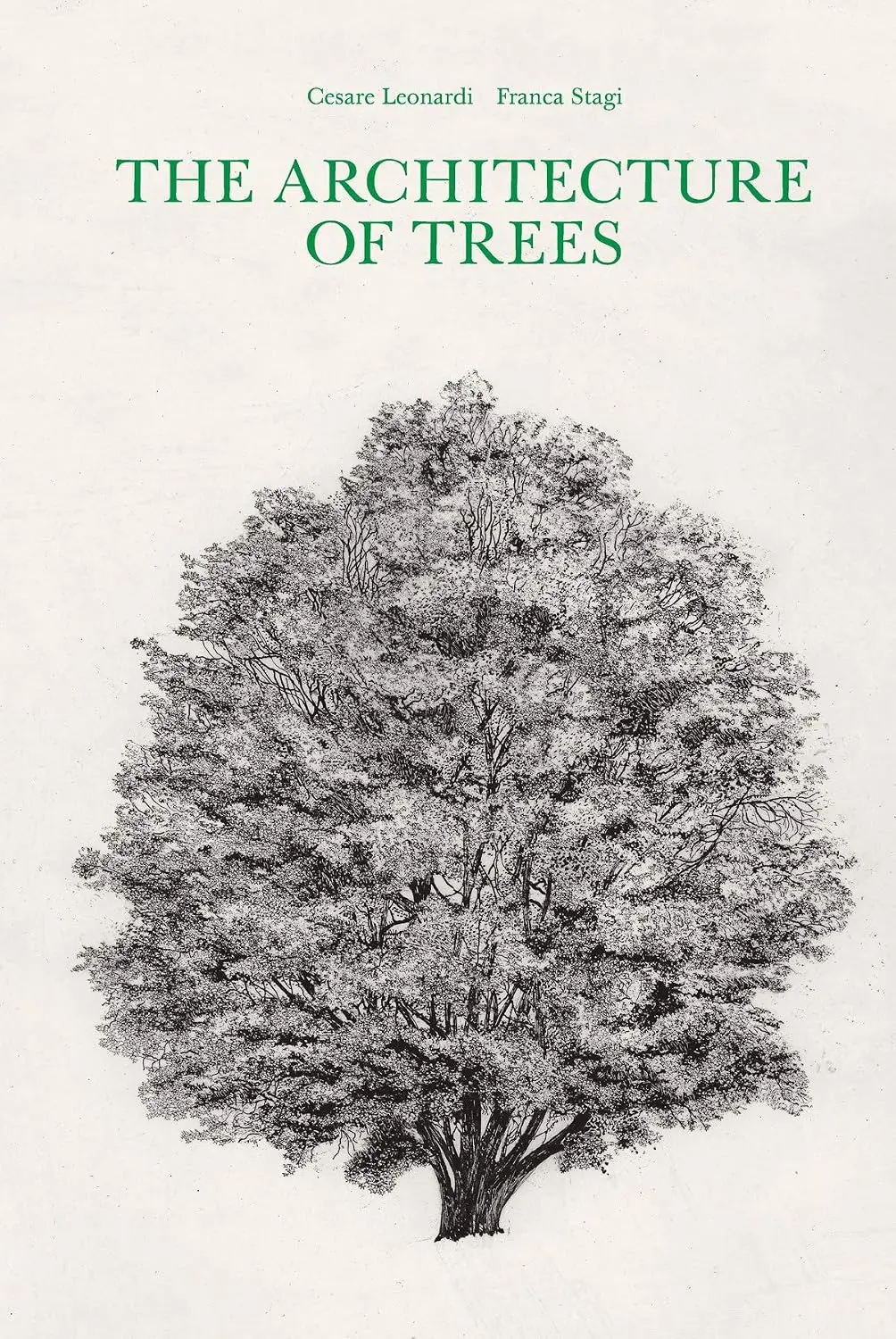
Authors
Cesare Leonardi · Franca Stagi
Publisher
Princeton Architectural Press
Year
2019 (Italian, 1982)
Pages
424
Species
212
Drawings
550+
hen Cesare Leonardi started studying architecture in Florence in 1956, his attention drifted away from the buildings and toward the trees on the hills around the city and the old, heavy trunks in its parks. Years later he said himself that he felt more drawn to those trees than to architecture, and he proposed to his professor Leonardo Savioli a graduation thesis on an urban park in his hometown of Modena. Early in the work he realized something simple that changed the direction of everything, that you cannot design a park without knowing, one by one, the trees it is made of. Leonardi only submitted that thesis in 1970, and in the years between, while he was designing fiberglass chairs and lamps in the studio he had opened in Modena with Franca Stagi in 1963, he kept photographing trees.
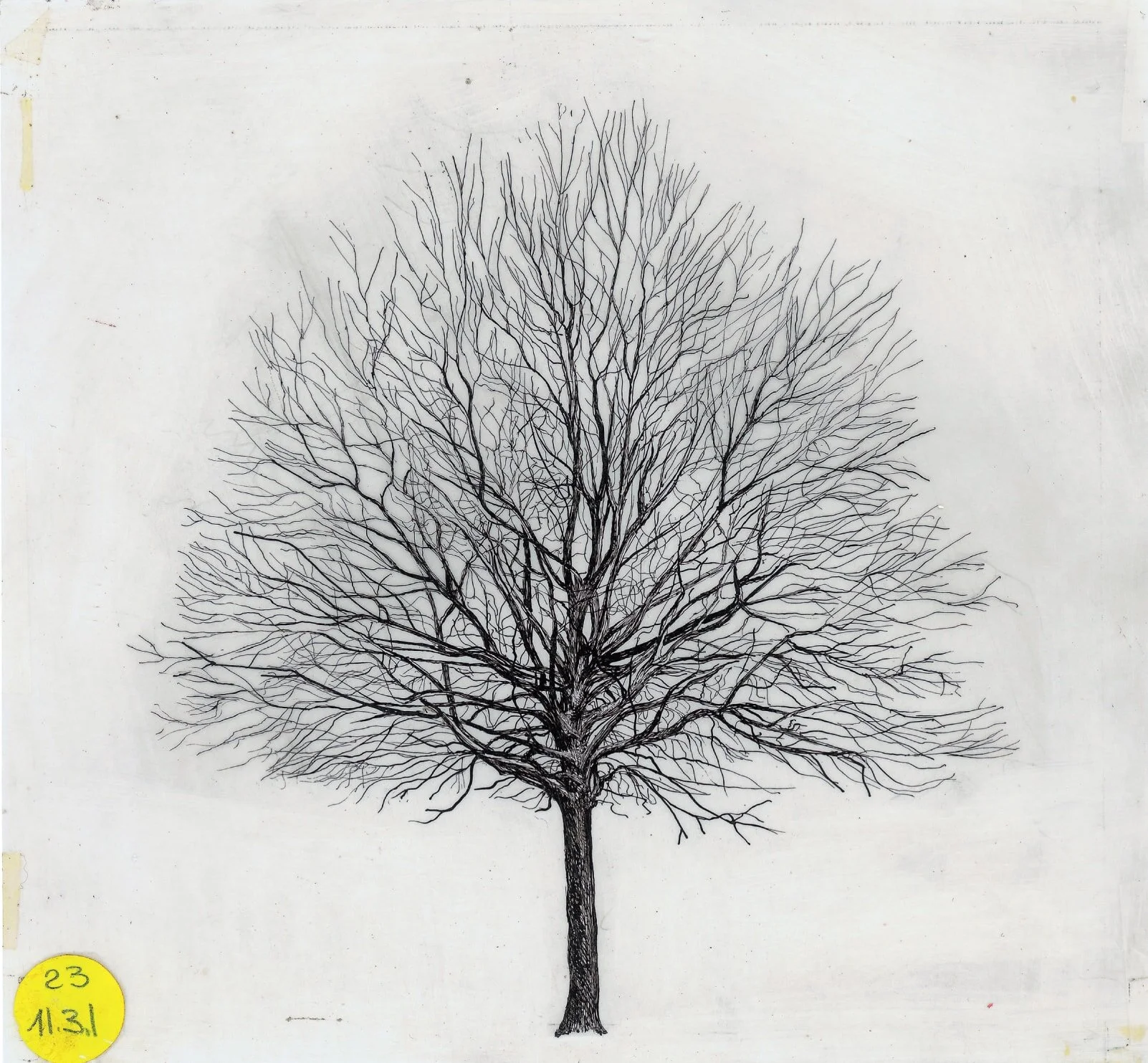
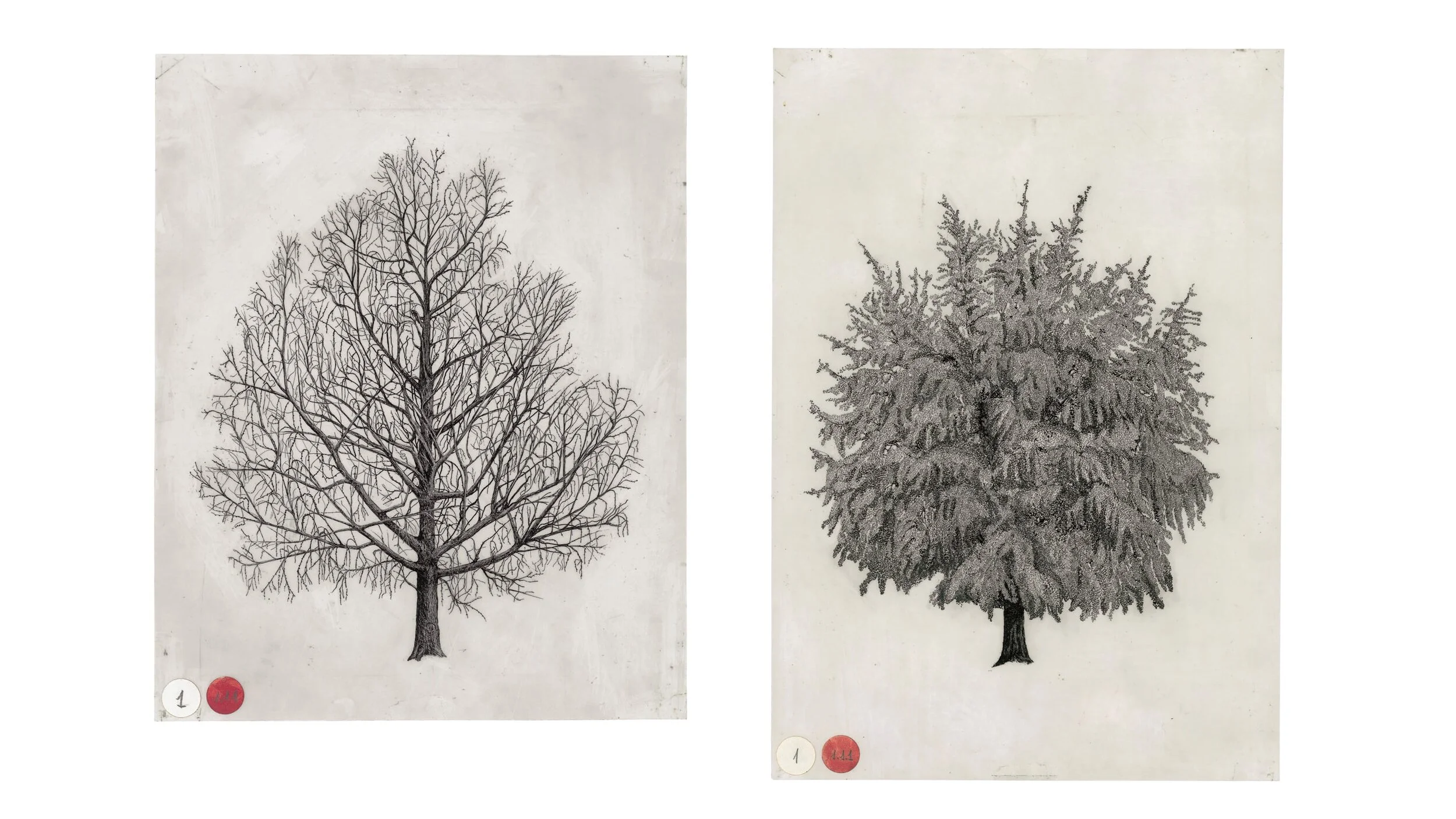
The photographs were only the start. Leonardi and Stagi redrew every tree from the photograph at a scale of 1:100, with a fine-nibbed pen and ink, and they put the same tree on paper twice, once with its summer leaves and once with the bare branches it shows in winter. The survey stretched over twenty years, the people working in the studio joined in, and in 1982 L'Architettura degli Alberi finally came out from the publisher Mazzotta. The book was really the catalogue of an exhibition that opened that same year in Reggio Emilia and then in Modena, and it brought together 374 drawings of 211 species along with the leaf and fruit details of each one. For more than thirty years it passed from hand to hand in architecture schools and landscape offices as a reference book, and it stayed in Italian the whole time.
What the English edition adds
In 2019 Princeton Architectural Press translated the book into English for the first time and made it bigger along the way. The new edition has 212 species and more than 550 drawings, it runs to 424 pages, the pages measure 10 by 15 inches, and the whole thing weighs about six and a half pounds. Behind the drawings each species gets its own sheet, where it comes from, how it handles city air and climate, the Latin root of its genus name, and small drawings of details like leaves, cones and fruit. There is also a glossary, which is where you find out why a fruit skin is called an epicarp and why a leaf that opens like a fan is called flabellate. As you can see on the book's page, this $150 volume also carries seasonal colour tables and shadow diagrams, and to me these last two are what really separate it from an ordinary botanical atlas.
The detail sheets belong to an older tradition, the one that sent painters to record a country's fruit before photography could hold a colour.
Why 1:100
Let me start with the scale, because 1:100 is, I think, the smartest decision in this book. Architects already draw floor plans, sections and elevations at this scale. When Leonardi pulls the tree into the same scale, the tree becomes a building element, something you can set next to a facade on the drawing table, trace through onto tracing paper and carry straight into a site plan. That is how I read the book's title. A 25-metre plane tree takes up 25 centimetres on the page, and the book's 38-centimetre page can fit a tree of at most 38 metres, which is taller than the great majority of trees in European cities. When the scale is one percent in length it drops to one in ten thousand in area, and a crown 20 metres across becomes a circle of 20 centimetres on the page. Since every page is at the same scale, when you put the page of a spruce next to the page of a weeping willow the difference you see is the real difference, and you can measure with a ruler whether the two trees will fit in a courtyard together.
The mathematics of a shadow
With shadows the work slides a little further into mathematics. The length of the shadow that a tree of height h casts on flat ground depends on the sun's height above the horizon, that is, on the angle α.
L = h / tan α
Modena sits at 44.65 degrees north. At noon the sun there rises 68.8 degrees in June, 45.4 degrees at the equinoxes, and only 21.9 degrees in December. So the noon shadow of a 20-metre tree is 7.8 metres in June, 19.8 metres in March and September, and 49.7 metres in December. The December shadow is more than six times longer than the June one, but in December a plane tree or a linden has no leaves, and what falls on the ground is not a dark patch but a thin net of branches that lets most of the light through. This is why the pairs of drawings in the book, with leaves and without, are not just a careful drawing habit but the two halves of the same shadow calculation. A tree that gives a short, dark shadow in summer and a long but sparse one in winter is exactly the right tree to plant in front of a bench or a classroom window, while a tree that keeps its leaves through winter, planted in the same spot, leaves a dark strip 50 metres long all through December. The shadow diagrams in the English edition spread this calculation across the hours of the day and the seasons for every species.
From the drawing table to the park
Leonardi and Stagi did not leave this knowledge in the book. Parco Amendola in Modena was built on top of this work between 1972 and 1981. When the studio broke up in 1983, Leonardi developed an acentric polygonal grid for planting trees that he called the Struttura Reticolare Acentrata, and he used it at the Bosco Albergati park in Castelfranco Emilia as a planting layout where people and trees can stand side by side without one crushing the other. Stagi gave herself to public buildings and the preservation of historic architecture, and she died in Modena in 2008. The fiberglass Dondolo rocking chair they designed together sits today in the MoMA collection, in the same century of seats that Erich Dieckmann drew sixty-four times. Leonardi was alive when the English edition came out, and he died in Modena on 4 February 2021, at 85.
Two shortcomings
I have to mention the book's two shortcomings as well. First, the trees drawn here are the city and park trees of Europe. Someone living in America will recognize the oak, the maple, the plane and the linden as genera but may not find the species growing on their own street. Second, this is not a field guide. A six-and-a-half-pound book with 15-inch pages does not go to the forest, it gets opened on a table and stays there. In return you get an inventory of 212 trees, measured with the same ruler and drawn in both summer and winter. And out of the English edition comes a bookmark as big as the book itself.
Details
- Authors
- Cesare Leonardi and Franca Stagi, architects, Modena
- Edition
- Princeton Architectural Press, 2019 · first published by Mazzotta, 1982
- Extent
- 424 pages · 212 species · more than 550 drawings
- Format
- 10 × 15 inches · about 6.5 pounds
- Scale
- 1:100, every tree with and without its leaves
If this book speaks to you, these will too
In short
An inventory of 212 trees, measured with the same ruler and drawn in both summer and winter. Not a field guide and not for American streets, but on a drawing table nothing else does what it does.
Cesare Leonardi & Franca Stagi — The Architecture of Trees
Princeton Architectural Press, 2019 · first published as L'Architettura degli Alberi, Mazzotta, 1982 · ISBN 978-1-61689-806-9