Author
Martin Hogue
Publisher
Princeton Architectural Press
Year
2023
Pages
336
Essays
8
Format
15 × 23 cm
hen Martin Hogue went camping for the first time in 2000, at a commercial campground near Badlands National Park, the attendant handed him a printed map and circled in pencil the number of one of more than a hundred tent and RV sites. Hogue had expected to find himself a corner of open land, and instead he was left holding an address. That day he noticed that a campground, too, is divided into lots and numbered just like a neighbourhood. This small oddity turned into more than a decade of research. Hogue is a licensed architect and teaches landscape architecture at Cornell University; his first book, Thirtyfour Campgrounds, came out in 2016, and Making Camp followed in 2023 from Princeton Architectural Press, the house that also brought Leonardi and Stagi's tree drawings into English.
Eight pieces of a campground
The book splits camping into eight parts and takes up each one in a separate essay. The campsite, the fire pit, the picnic table, the campground map, the tent and the sleeping bag are the first six. The last two are systems nobody thinks about but every campground stands on: bringing the water in and collecting the garbage. Hogue tells the story through patent drawings, old advertisements, sketches, tables and archive photographs. The book runs to 336 pages at 15 by 23 centimetres, in other words small enough to fit in a backpack, and at $26.95 it costs no more than a set of tent stakes.
The picnic table
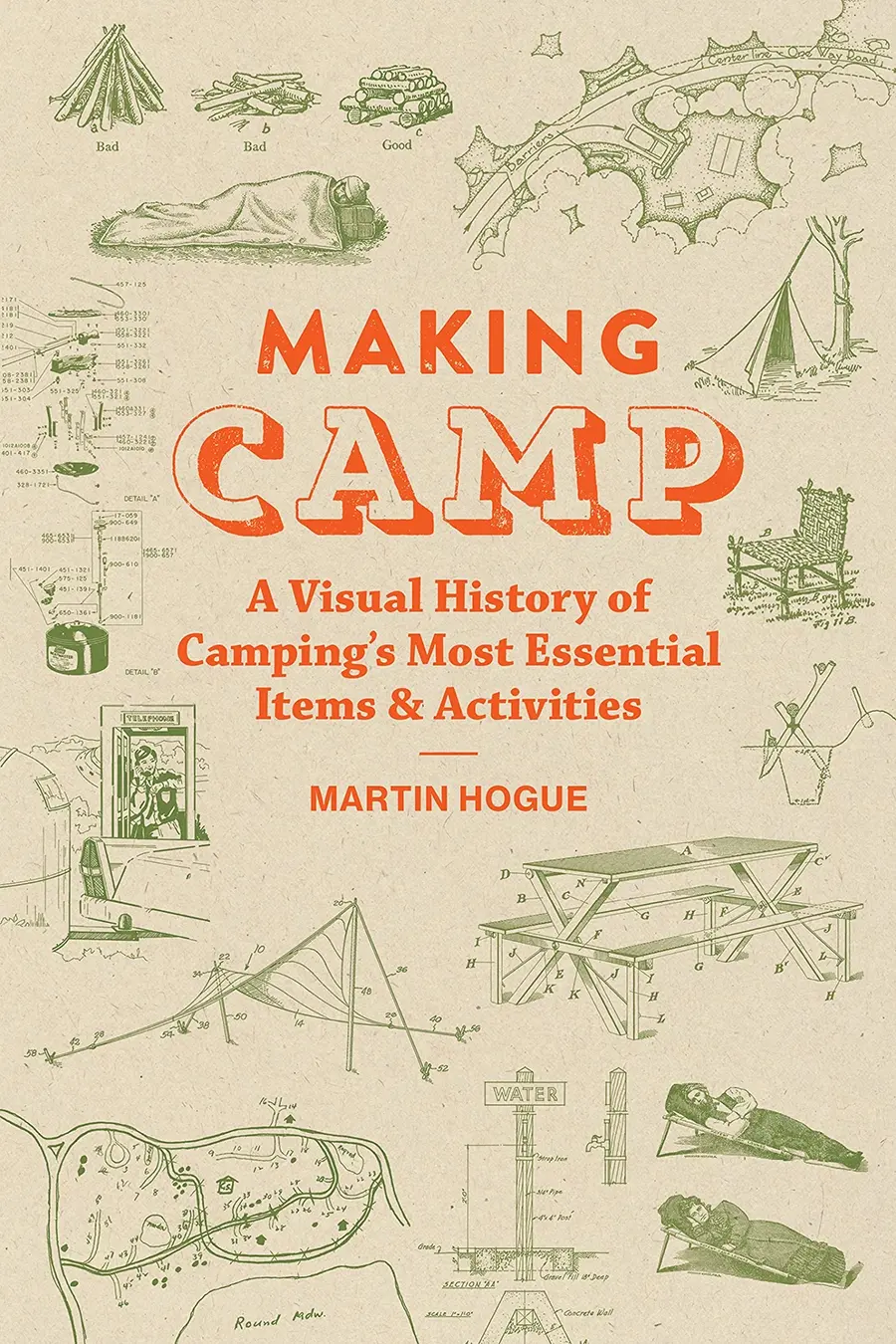
The chapter I found most interesting is the picnic table. According to Hogue, the dimensions of this table were first set in 1922 in the technical drawings of the US National Park Service, and the table we see in nearly every park today, that heavy wooden bench with its seats fixed to the frame and its legs crossed in an X, came largely out of the needs of campgrounds. In the drawing on the book's cover every part of the table is marked with a letter from A to L, and the drawing reminds you that an object you have put food on for years is really an assembly diagram. Everyone who goes camping sits at this table, but very few people stop to think that someone sat down and drew it.
Sleeping bags, tents and fire
The sleeping bag chapter is at least as charming. At the beginning of the nineteenth century German peasants spent the night inside sacks stuffed with dry leaves, and the English word for a sleeping bag only settled into the language in the middle of that century. The story of the tent goes back thousands of years, from animal hide to goat hair, from there to heavy canvas and on to today's nylon that weighs a few hundred grams. The campfire chapter tells this sequence in reverse, because building a fire and keeping it going was once the real skill of camping, and the portable gas stove made that skill largely unnecessary. Three fire layouts are drawn on the cover, two marked Bad and one marked Good, and to me the whole attitude of the book sits in that little drawing.
Two fires marked Bad, one marked Good — the whole attitude of the book sits in that little drawing.
A power outlet on the picnic table
The book also has a mildly ironic side. As Hogue describes how, over a hundred years, campgrounds turned from open meadows into dense, highly ordered settlements with infrastructure for car traffic, electricity, water and garbage, he slips in a photograph from 2008: a camper working on a laptop at a picnic table. Carrying the comforts of home into the woods is nothing new, and throughout the book Hogue asks how far we have really come between then and now. If you ask me, not very far. The table just got a power outlet.
Out of the book and onto the land
Hogue did not leave the matter in the book. At Stone Quarry Hill Art Park in Cazenovia, New York, he set up four numbered and named campsites, gave each one a picnic table, Adirondack chairs, a wheelbarrow, a trash can and a lantern, and painted all of them the same bright turquoise blue. The aim was to make campsites scattered across the land readable as a single system.
Hogue says he would like the book to be read by the light of a campfire or at a picnic table. The book is the right size for that, and as for the fire, all you have to do is build it the way the third drawing on the cover shows.
Details
- Author
- Martin Hogue, architect, landscape architecture at Cornell
- Edition
- Princeton Architectural Press, 2023
- Extent
- 336 pages · 15 × 23 cm · $26.95
- Chapters
- Campsite, fire pit, picnic table, campground map, tent, sleeping bag, water, garbage
- Sources
- Patent drawings, advertisements, sketches, tables, archive photographs
If this book speaks to you, these will too
In short
A pocket-sized design history of everything you take for granted at a campsite, from the A-to-L picnic table to the garbage truck. Read it at the table it describes, by a fire built the Good way.
Martin Hogue — Making Camp: A Visual History of Camping's Most Essential Items and Activities
Princeton Architectural Press, 2023 · 336 pages