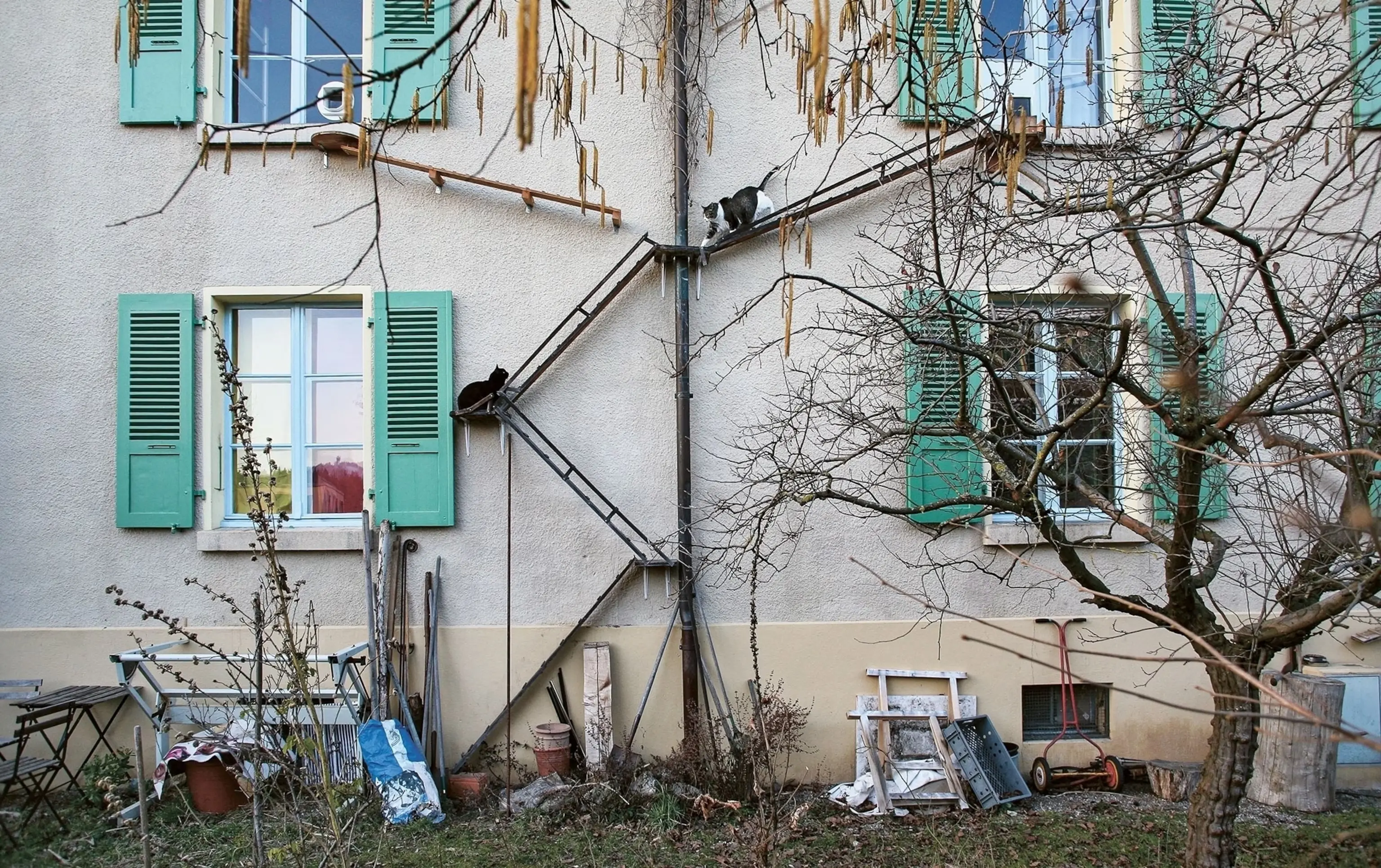
In Istanbul nobody builds a ladder for a cat, because the city is already a ladder. Eaves, shutters, air-conditioning units, a piece of rebar sticking out of a wall, crates stacked by a shop door, all of it is a step. But in a city where the windows shut tight and the facades are flat and well kept, a cat on the fourth floor can do nothing except sit at the glass and watch the street. Bern solves this in a very practical way, by nailing wood to the wall.
Brigitte Schuster is a graphic designer and writer who moved from Germany to Bern. She had seen the occasional cat ladder back home, but in Bern they turned out to be so common that she walked the city photographing hundreds of them and turned what she collected into a book published under her own imprint. It came out in German and English in 2019, and later got a second edition from Christoph Merian Verlag. The preface is by Dennis C. Turner, who studies cat behaviour. The method is the same one that turns an apartment photographed object by object into a catalogue: keep going until the sample is large enough to show a pattern.
The book
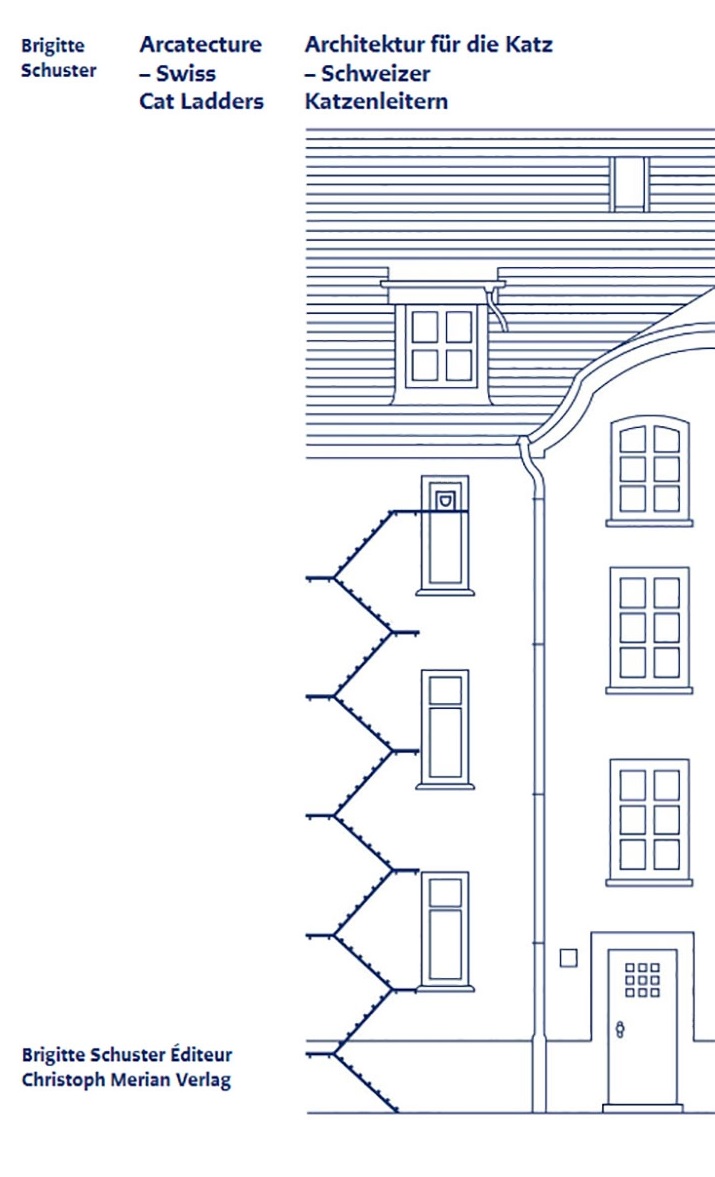
Arcatecture: Swiss Cat Ladders
Brigitte Schuster, Christoph Merian Verlag. Photographs of hundreds of Bern ladders with construction drawings beside them, and a preface by the cat-behaviour researcher Dennis C. Turner.
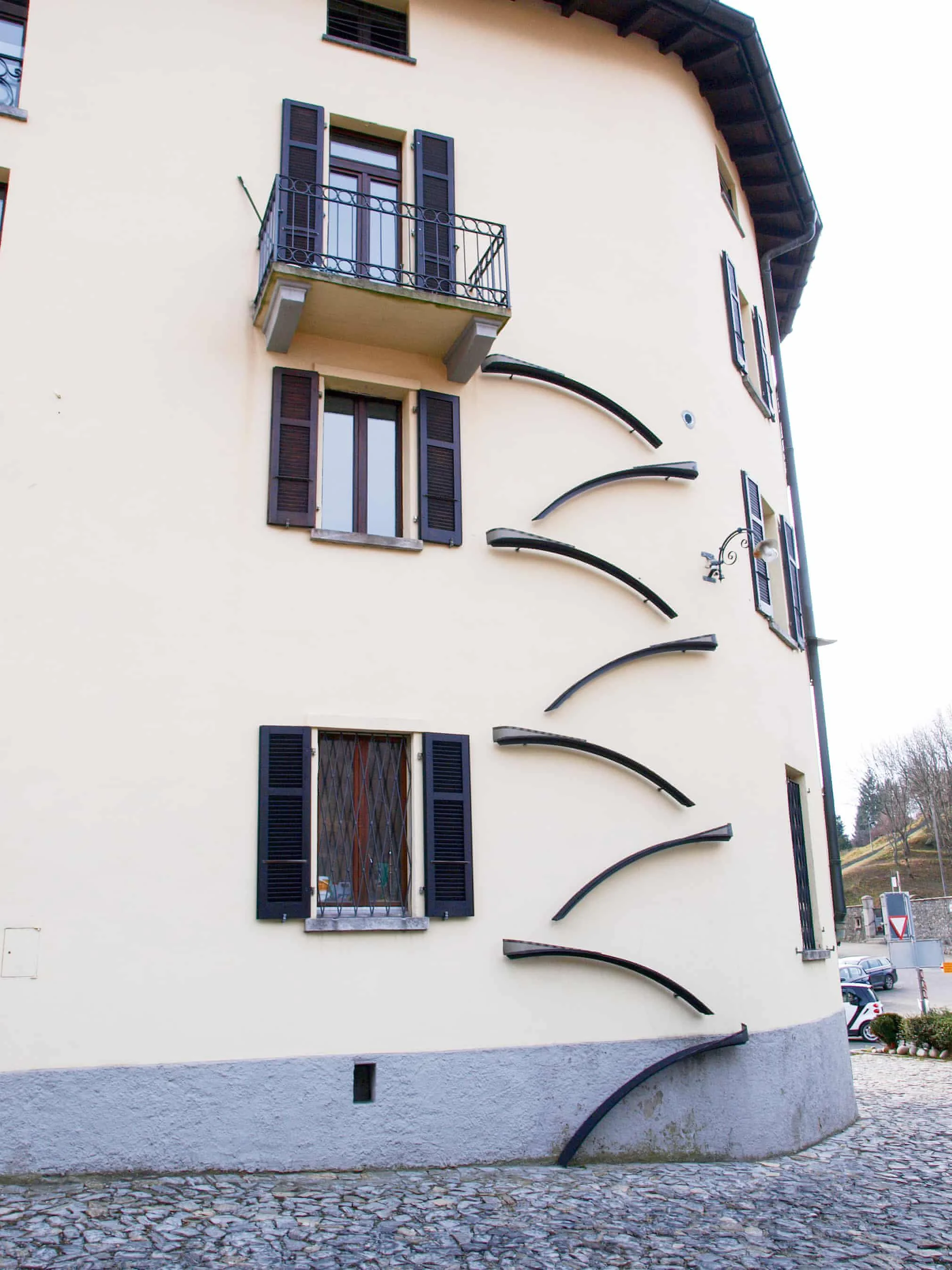
Find it on AmazonThe variety in the book is the pleasure of it. Some ladders are nothing but a plank laid between two balconies. Some are small treads nailed one by one to a drainpipe. Some start on top of the mailboxes and climb to the door lintel, using whatever the facade already offers. The showpieces are the scaffold-like structures that zigzag up four storeys. Since the collection also includes ramps, bridges and even a spiral staircase ordered off the internet, calling all of this a “ladder” is an oversimplification.
Geometry
The arithmetic of the zigzag
You make a chicken ladder by nailing crosswise battens to a straight plank, and the pitch is roughly forty-five degrees. A single one will not get a cat to the third floor, because holding that pitch while climbing nine metres means standing the foot of the ladder nine metres out from the wall, which puts it in the middle of the street. The solution is to fold the ladder.
Here is the part I like. The total length of the ladder is h / sin θ, and the width of the facade does not appear anywhere in that expression. So the number of turns is irrelevant. Narrow the facade and you get more switchbacks and shorter runs, but the amount of timber you cut and nail does not change by a hair. The zigzag saves you no wood at all, it only folds the same wood into a narrow wall. The one way to use less timber is to steepen the pitch, and that has a limit too, because there is a cat at the other end of it.
Change the height, the pitch and the width you are allowed to use on the facade. Watch how the total length refuses to react to the width.
- Total timber
- 12.73 m
- Horizontal reach
- 9.00 m
- Turns
- 3
- Length per run
- 3.18 m
Squeeze the width and the turns multiply while each run gets shorter, yet the total stays put. Raise the pitch from 45 to 60 degrees and the timber needed for nine metres drops from 12.73 m to 10.39 m.
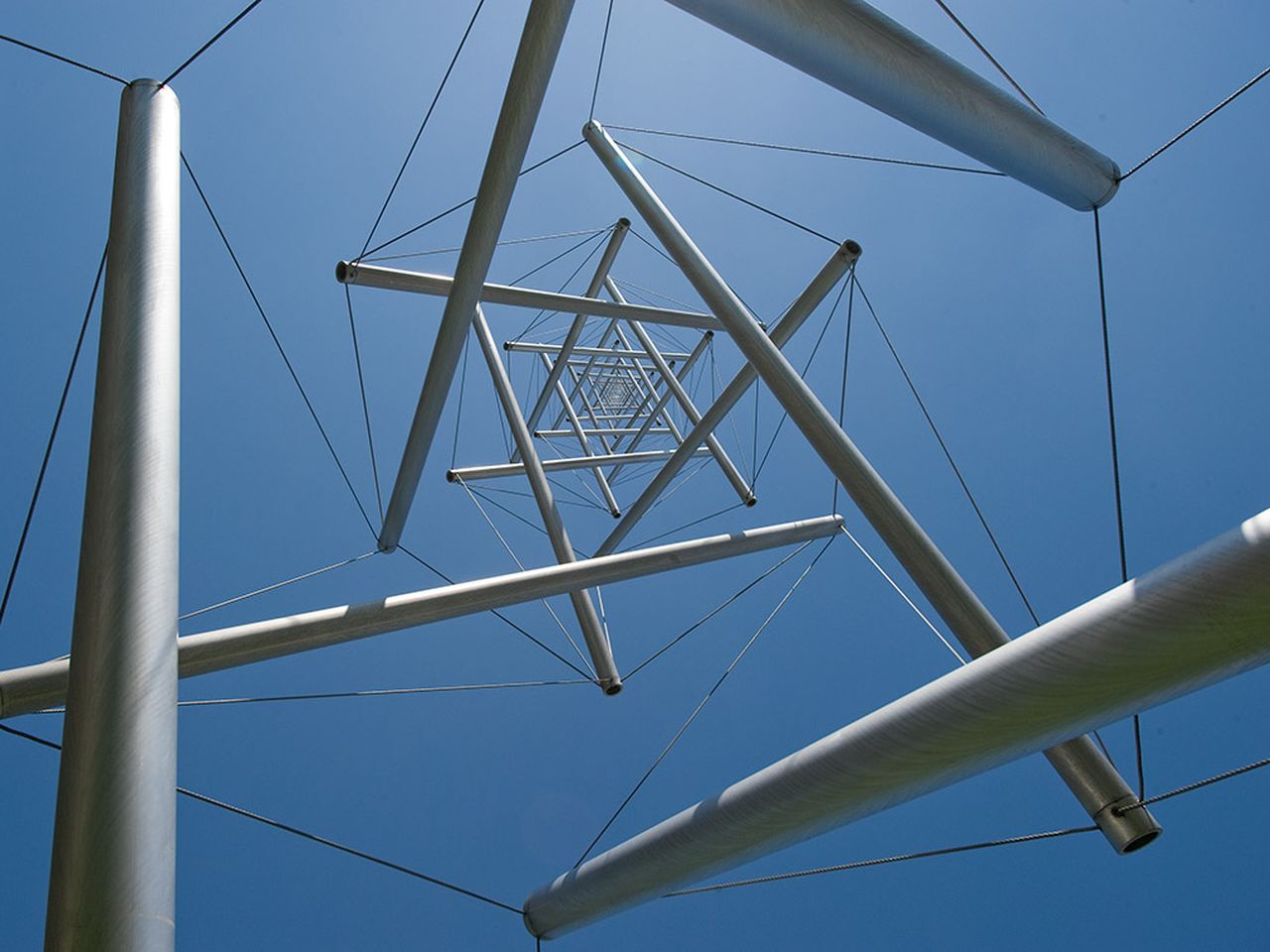
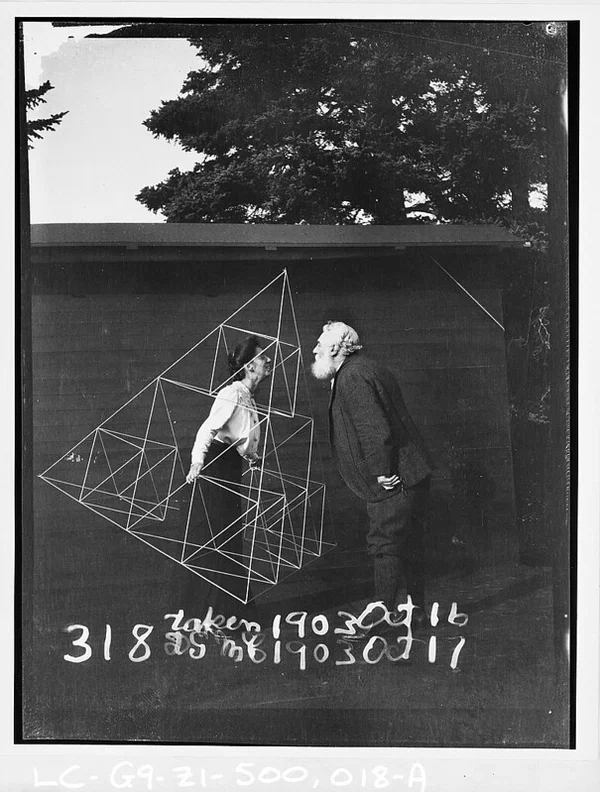
It is the same economy that governs any structure assembled from one repeated member — Bell’s kites built from identical cells or a tower held up by cables and struts that never touch. The parts list is fixed by the geometry long before anyone decides what the thing should look like.
Evidence
Does the cat actually need this
Schuster asked the same question while making the book: whether cats need these ladders or whether people build them because they find them convenient. Turner’s answer is blunt — cats do need them — and for two separate reasons. The first is physical safety, because it is not true that cats always land on their feet, and a cat that jumps from a height can end up with anything from a torn ligament to a broken leg. The second is temperament, because a cat born outdoors that spent its first weeks outdoors will develop behaviour problems when it is shut in, from clawing the furniture to marking.
There is a good statistical story behind the falling too. Over five months, a New York animal hospital recorded 132 cats brought in after falling from a height. The falls ranged from two storeys to thirty-two, the mean was five and a half, and roughly ninety per cent of the treated cats survived. The strange part is that the cats that fell from the seventh floor or higher came out with milder injuries than the ones that fell from lower down. One explanation is physical. After about five storeys the cat reaches terminal velocity, so it stops accelerating, and once the acceleration stops it unclenches and spreads itself out like a parachute, hitting the ground over a wider area — the same trick of trading speed for surface area that an owl uses to fall through air without a sound. The other explanation is colder. Nobody carries a cat that fell thirty storeys and died to the hospital, so the data was made of survivors to begin with.
Permission
Getting the neighbours to agree
Past a certain height a cat ladder stops being carpentry and becomes neighbour relations. A structure that climbs from the ground to a fourth-floor window needs at least three neighbours to agree to the plan, because the thing runs past their windows. It is not something you can do without touching anyone else’s wall, the shared face of a building is not yours to drill into, and nobody is obliged to enjoy battens being nailed across it. What makes this common in Bern is less a love of cats than a neighbourly culture used to granting that permission — the opposite of a house built around one person’s single purpose.
The numbers back the culture up. Swiss homes hold 1,853,000 cats, which makes the cat the country’s most common pet, with the dog only in third place. The canton of Bern has 108,350 registered cats. In the United States, by contrast, you will not find cat ladders, because many states restrict cats from roaming outdoors and city dwellers meet the same need by screening in a balcony, the catio.
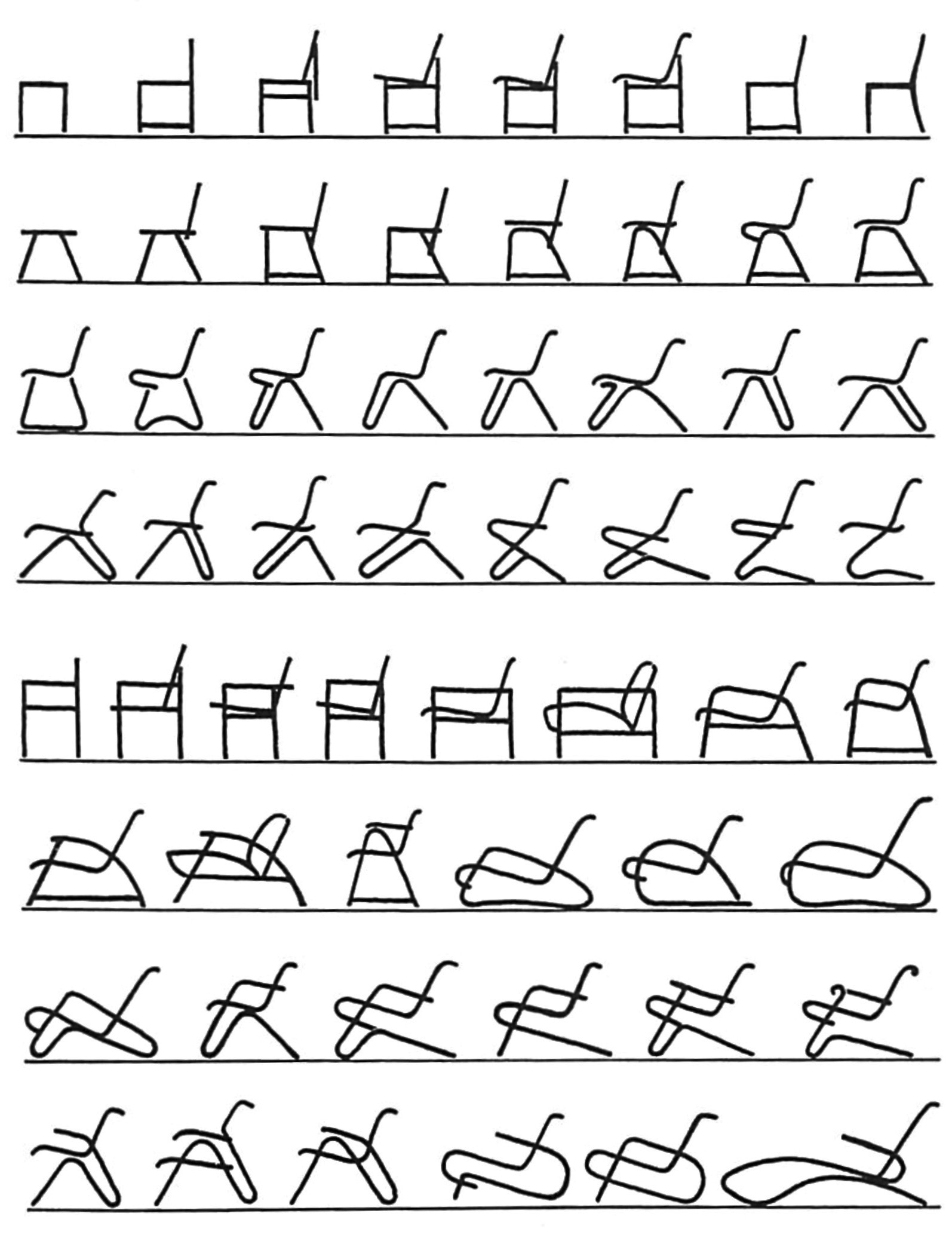
My favourite thing about the book is that Schuster puts drawings next to the photographs, showing how each model is put together and where each batten goes. That turns it from a photo album into something closer to a catalogue of specimens you can consult if you want to build your own — the same impulse that made a chair worth drawing joint by joint. At least one cat in Bern has a spiral staircase of its own, ordered online.
Sources
- Brigitte Schuster, Arcatecture: Swiss Cat Ladders, Christoph Merian Verlag — second edition of the 2019 book, preface by Dennis C. Turner.
- W. O. Whitney and C. J. Mehlhaff, “High-rise syndrome in cats,” a study of 132 falls recorded at a New York animal hospital over five months.
- Swiss pet-ownership figures for the country and the canton of Bern.
- Photographs of Bern cat ladders, and the ladder geometry worked out above.