Bell took the first American patent on the telephone at twenty-nine, and then lived another fifty years. The best part of those fifty years went to kites. On his honeymoon he had told his wife Mabel that he wanted to build flying machines, ones with telephones inside them. It sounds like a joke. He meant it.
A promise made on a honeymoon
In 1891 he settled in Baddeck, on the northern edge of Nova Scotia. Below the hill he called Beinn Bhreagh lay a lake, and over the lake there was a wind that never quite stopped. A few years later, on the banks of the Potomac, he watched his friend Langley's steam-powered model circle overhead, and in that moment he decided flight was now only a matter of time. In those years anyone who worked on aviation was not taken seriously. So Bell, to protect his standing, ran his trials up on his own hill, out of sight.
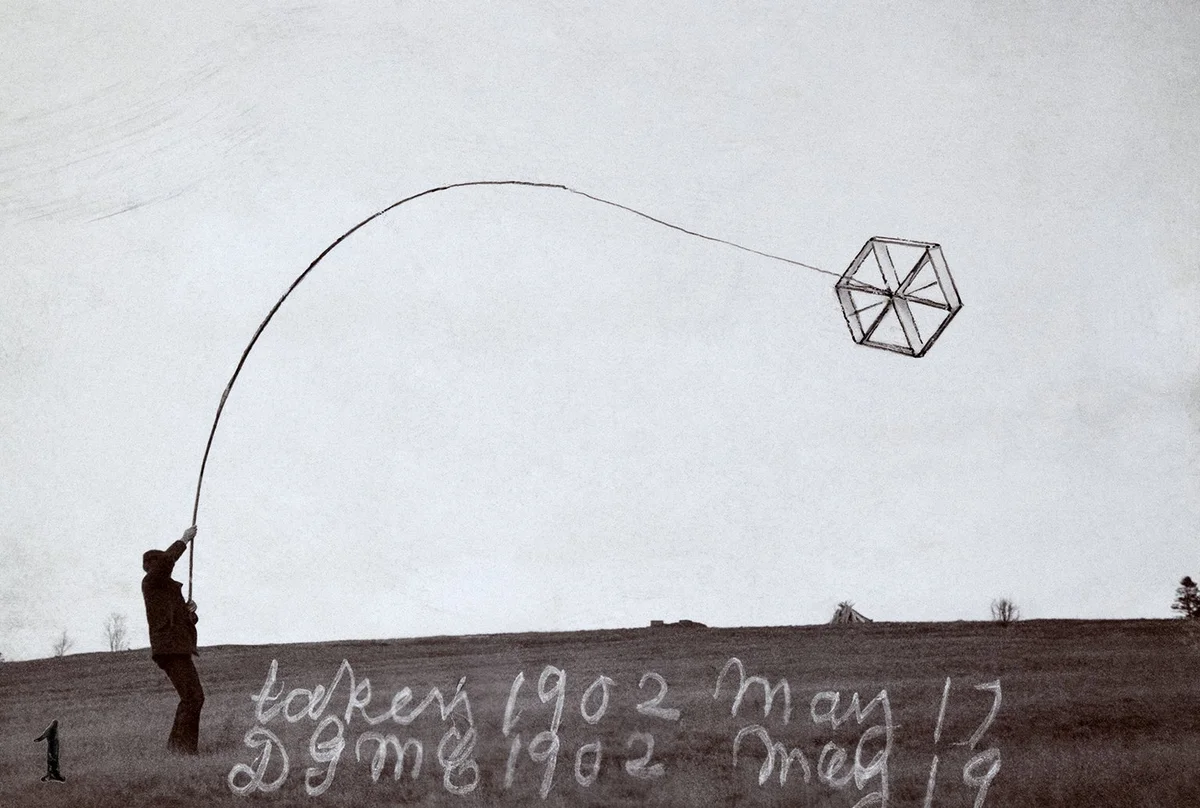
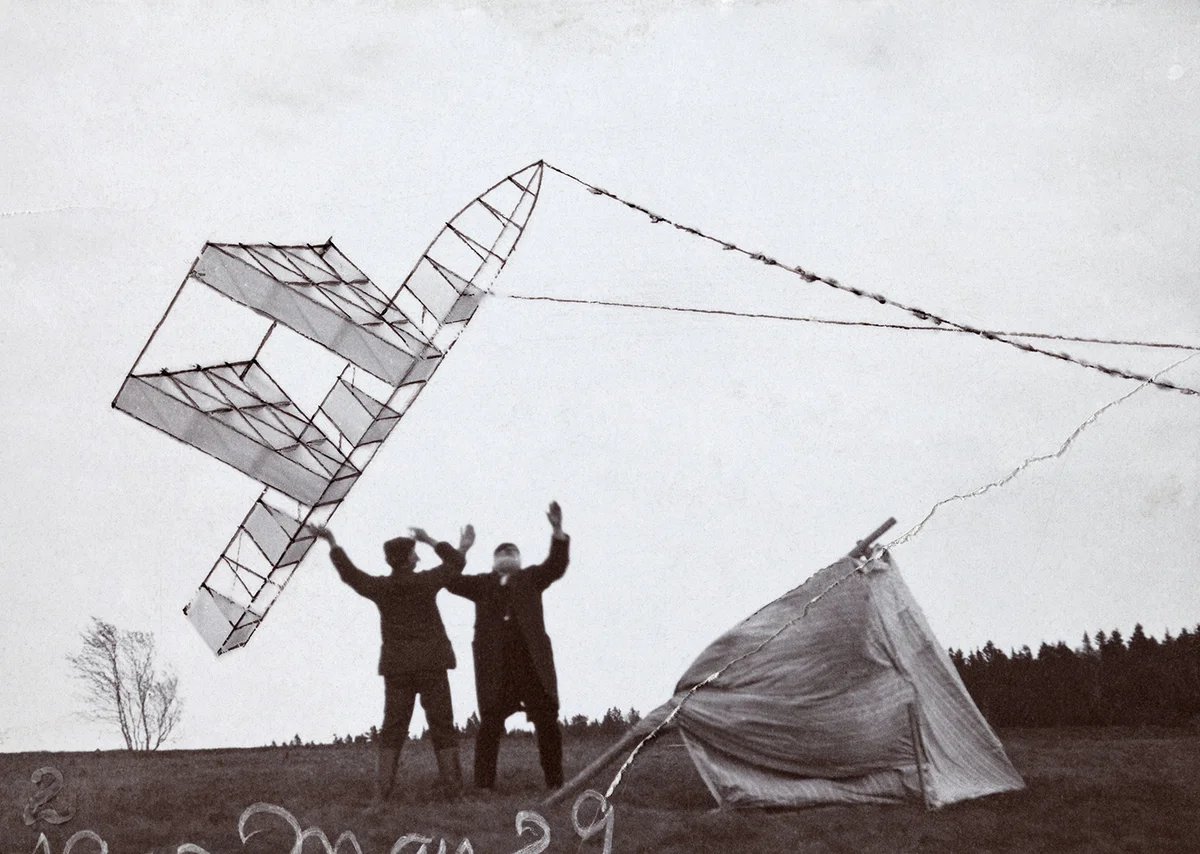
The town was slowly pulled in. Young women sat in the kite house sewing heaps of red silk, young men worked the pulleys, and the older people got used to horses galloping across the meadow. The horses were there because when the wind fell short, the most practical way to get an enormous kite off the ground was to tie it behind a horse and run it across the field.
Bell's idea fits in one line. There is no point bolting a motor onto something that cannot hold itself steady in the wind. First the kite, then the aircraft. And for that, the kite had to grow large enough to carry a man and an engine.
The bigger it got, the less it flew
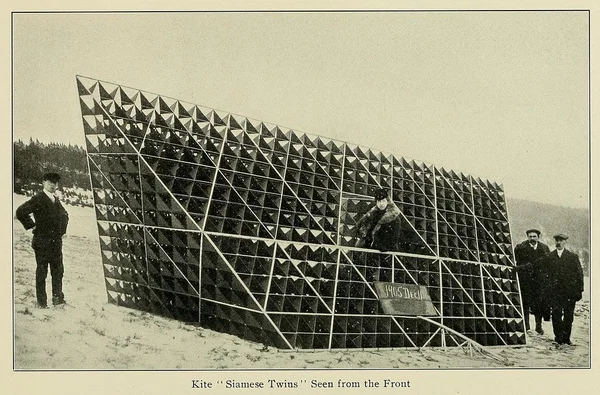
That was exactly where the trouble began. The bigger the kite, the heavier it got. Bell's small model flew in an ordinary breeze, while the giant version of the same design, with two cells each the size of a small room, would not budge; it took a hurricane to lift it. Double every dimension and the sticks get eight times heavier while the surface only gets four times larger. The design does not scale — it simply stops working somewhere above a certain size.
This was not Bell's problem alone. The astronomer Simon Newcomb had run the numbers and written that a machine capable of carrying a single man would require the discovery of some new metal or some new force.
What Bell found was not a new metal. It was a new habit.
Multiplying instead of enlarging
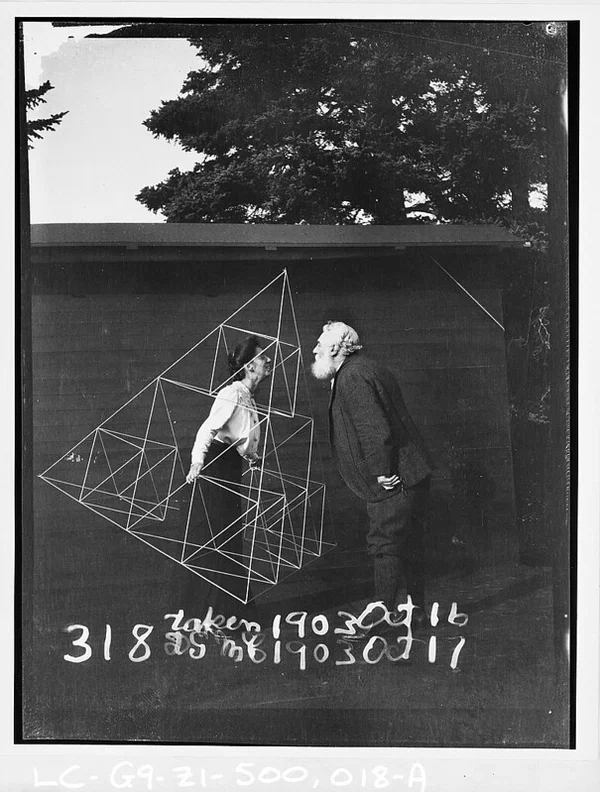
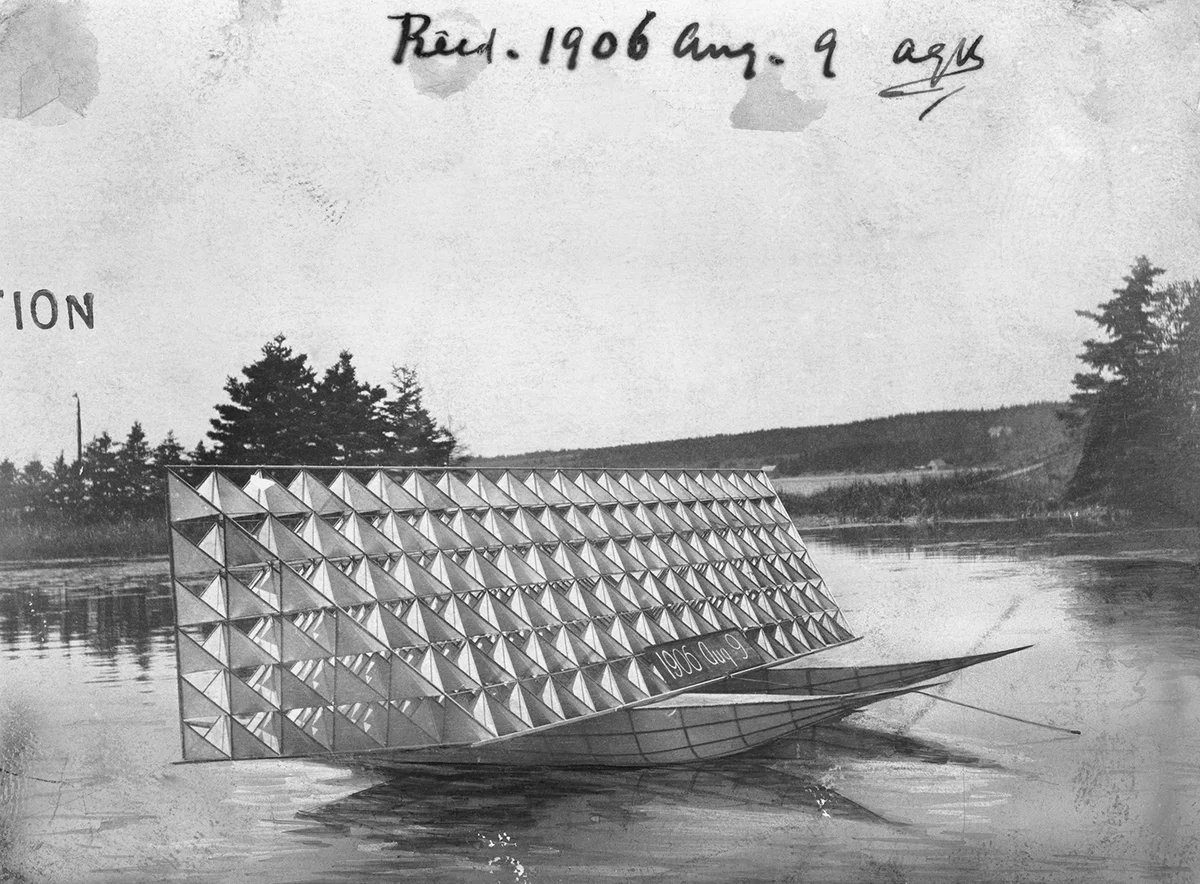
Bell stopped inflating his kite and started copying it. Tie four small kites together at their corners and you get the same shape again, only four times over. He tied four of those together. Then four more. As the structure grew it got heavier, but the wing surface grew at exactly the same rate, so the balance never tipped. The empty gaps between cells cost nothing, and they were doing the real work.
Bell explains it with a parlor puzzle. Make four whole equilateral triangles out of six matches. Everyone gets stuck, because everyone assumes without noticing that the matches have to stay on the table. Lay three down as a triangle, stand the other three up like a tent, and it is done. Bell's entire kite is the answer to that puzzle: six sticks and four triangles.
The same kite, folded four times over
4 cells4× the weight4× the wing
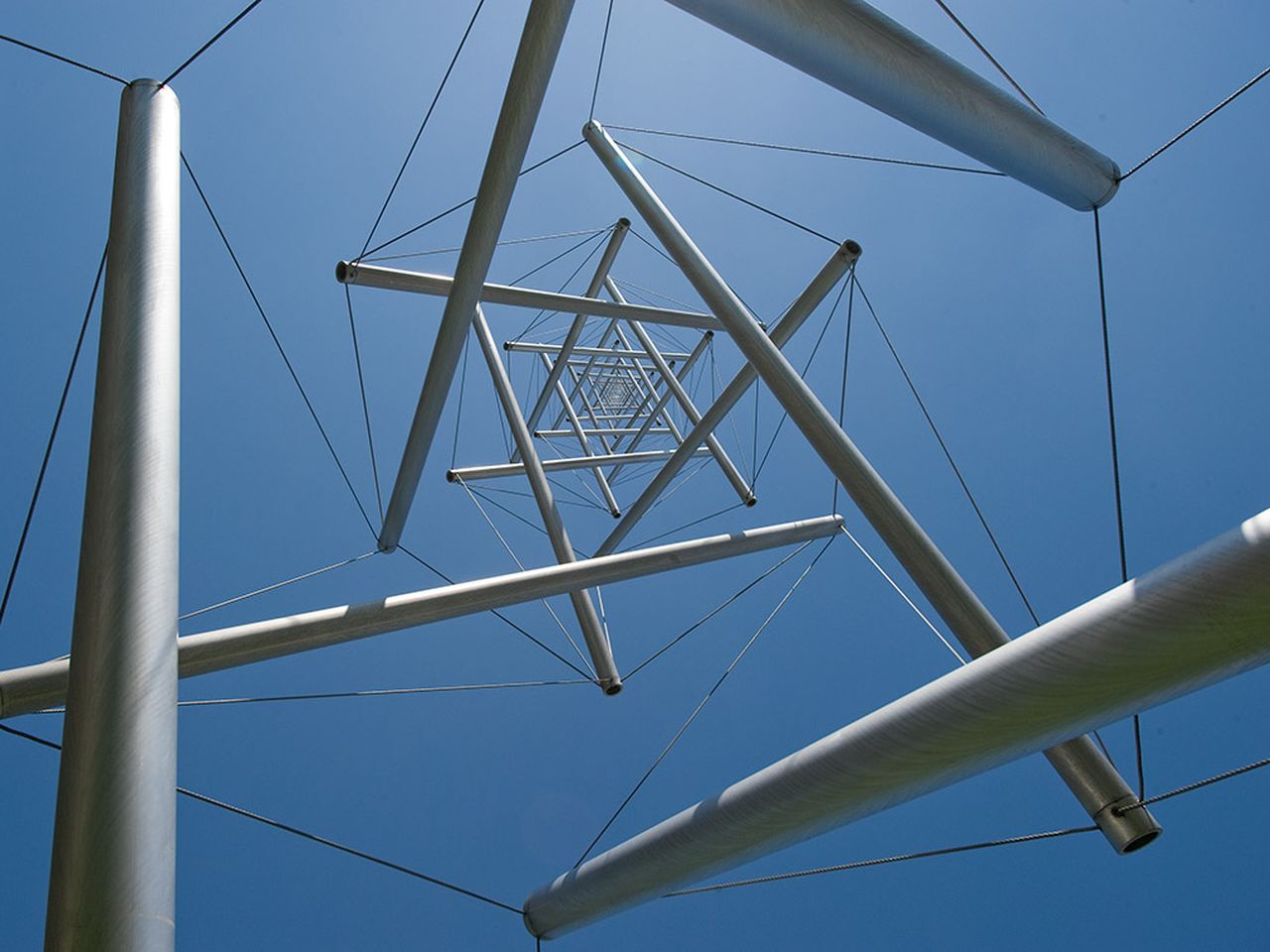
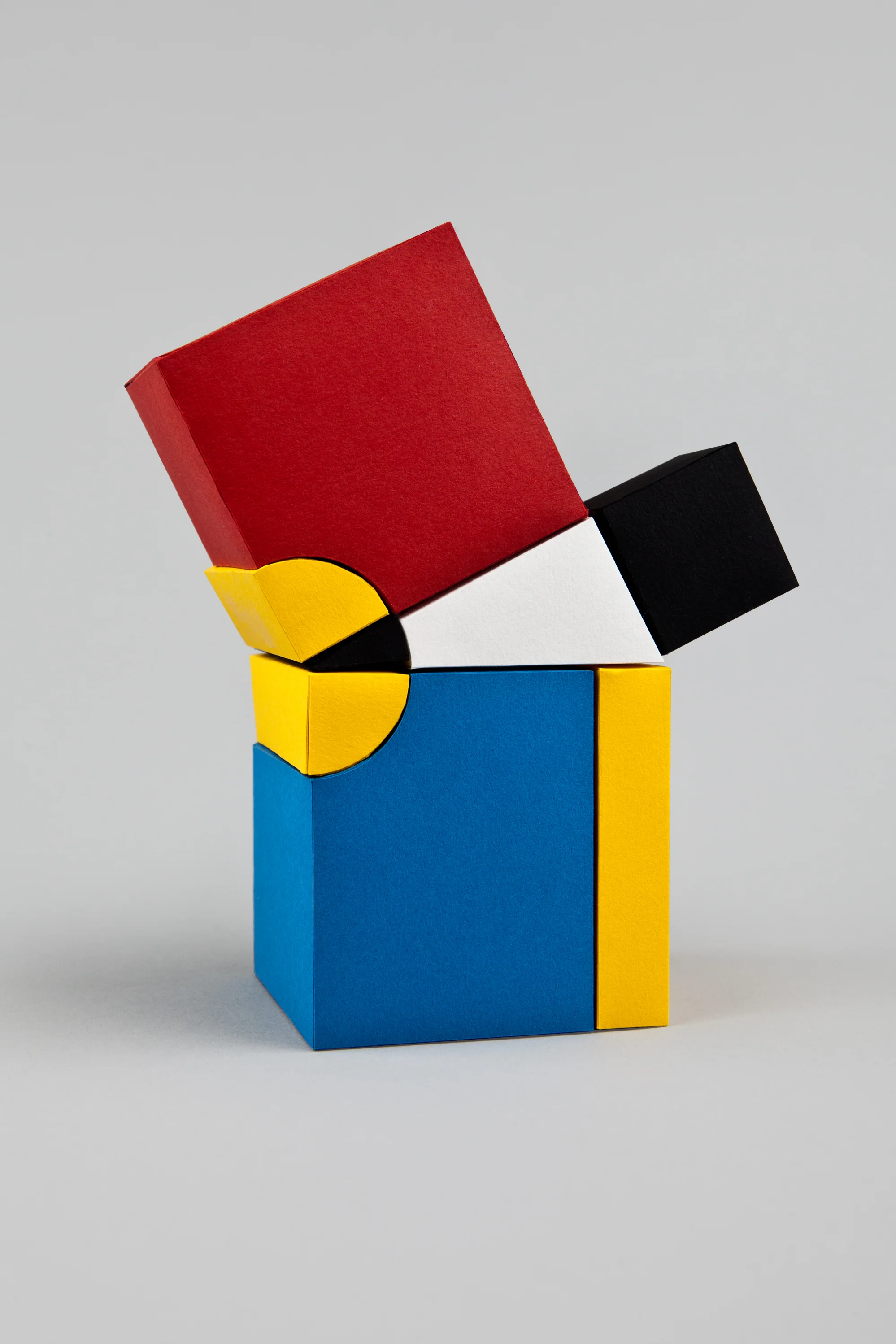
A structure that gets its strength from the arrangement of its members rather than from their mass is a familiar idea now — it is the same argument Kenneth Snelson's Needle Tower makes sixty years later, sixty feet of aluminium held up by what is not there. Bell got to it first, in silk, and never quite received credit for it.
A shape that had no name yet
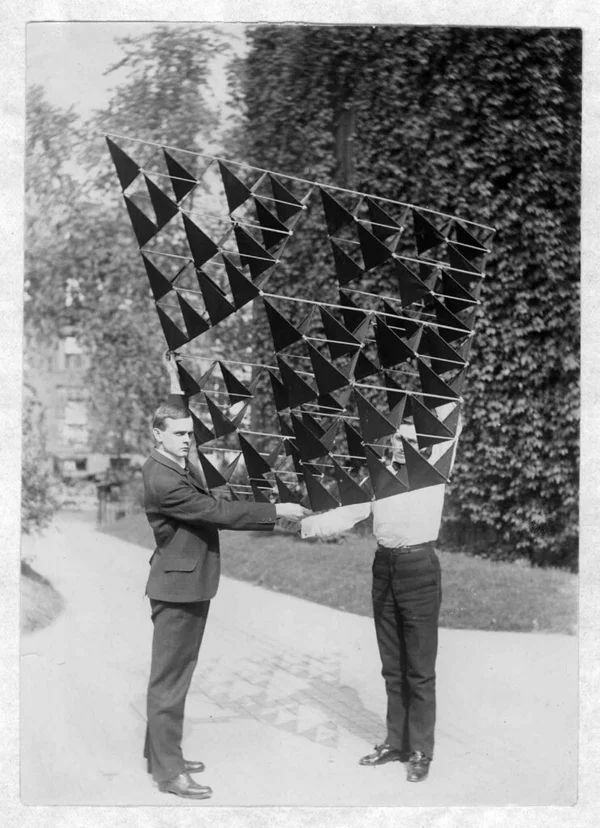
A tetrahedron built from four smaller tetrahedra, each of those built from four smaller ones again — the object is self-similar all the way down, and its surface area stays fixed while the thing it spans keeps doubling. The name mathematics gave that shape came years later. What we now call the Sierpiński tetrahedron takes its name from a Warsaw mathematician who described the triangle behind it in 1915 — a dozen years after these photographs. Bell had already wrapped the thing in silk and sent it up over a lake, before it had a name at all.
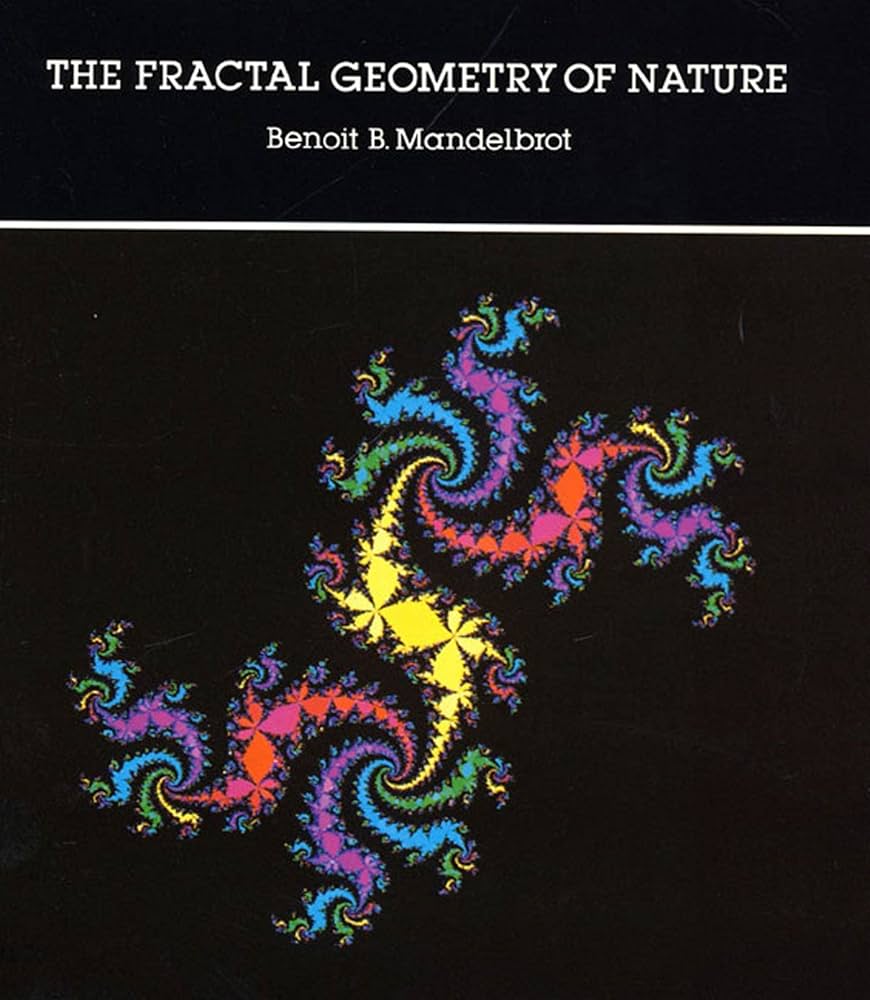
It would be another seventy years before Benoît Mandelbrot gave this family of objects a general theory in The Fractal Geometry of Nature. Bell was not doing mathematics; he was solving a weight problem. The fractal is what a weight problem looks like when you refuse to make anything bigger.
Thirteen hundred cells of red silk
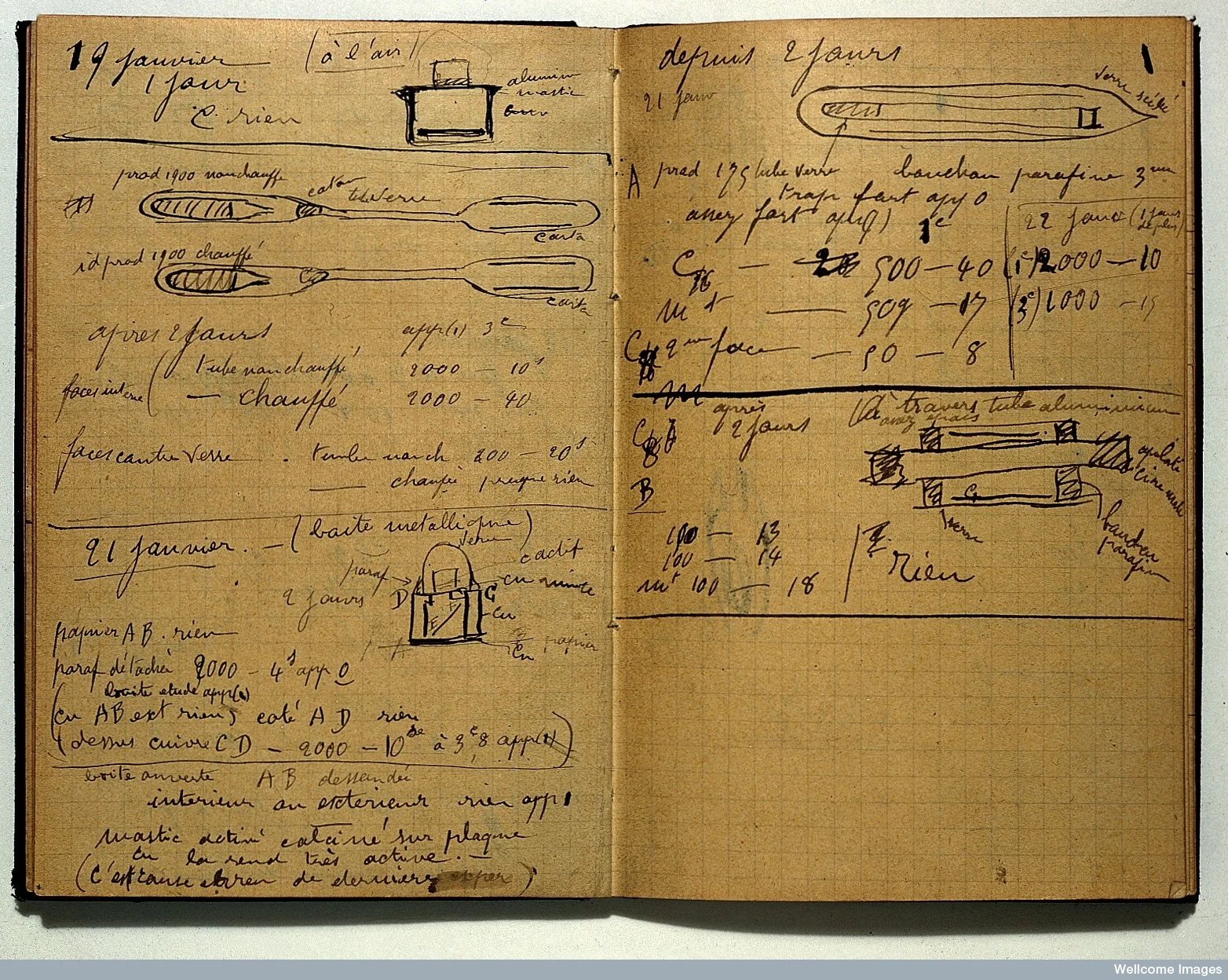
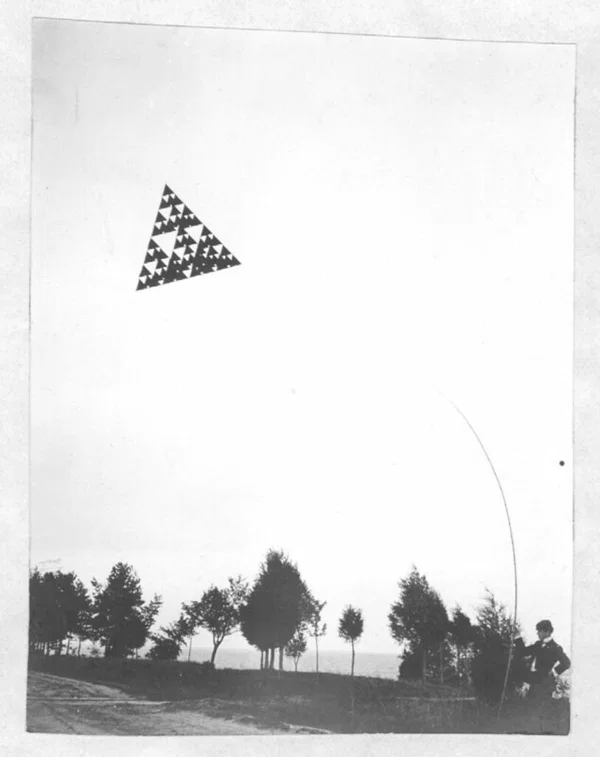
The Frost King, standing on the snow in December 1904, had 1,300 cells of red silk, each under an ounce, weighing about sixty pounds all together. It lifted four times its own weight. The following winter one of the assistants was holding the line when his feet left the ground and he rose thirty feet. In Bell's notebook this is not an accident. It is data — the same instinct that makes a working notebook worth more than the finished paper.
Three years later came the Cygnet. The forty-foot structure, with a hole left in the middle for a man, held 3,393 cells. On the morning of December 6, 1907, Lieutenant Thomas Selfridge climbed into that hole, a boat towed the kite, and Selfridge stayed a hundred and sixty-eight feet above the water for seven minutes. It went on record as the first heavier-than-air flight in Canada. Then the wind dropped. On the way down the tow line was not cut in time, so the kite nosed into the water and broke in two. Selfridge came out of the water. The next year, when a Wright Flyer crashed, he became the first person to die in an airplane accident.
The cells had no loyalty to kites
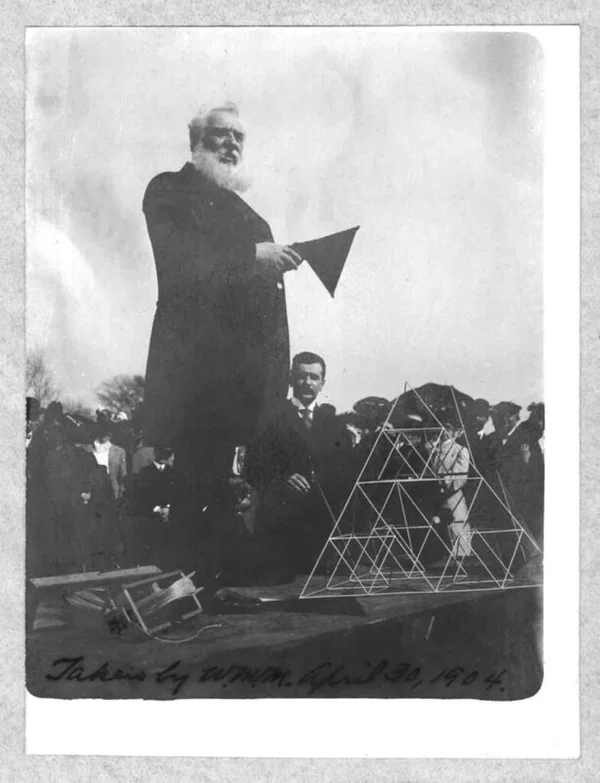
The money behind all this was Mabel Bell's. She was the one who talked her husband into forming the aviation group, and she sold a house she owned to cover the cost. My two favorite frames in the whole archive come from those years too. In one, a crowd gathered in the spring of 1904 tilts its heads up, the backs of their hats to us, and there is almost nothing in the sky to look at, only a speck. In the other, Bell has placed Helen Keller's hand on the kite string, and Helen reads the kite's motion in the air through the line.
The cells had no particular loyalty to kites. The giant ones would not fit through the storehouse doors, so they had to be assembled in the field, and when the wind would not allow it, Bell built a windbreak out of the same cells. When the season ended he took the windbreak apart and used those sticks to make shelters for sheep. He built a house, too, and a few boats. The space-frame systems you see today in airport ceilings are that cell's grandchildren.
The kites flew, but they never became an aircraft. The winners were the Wrights and their two wings, working with far fewer parts. In 1910, in Auckland, Bell stood in front of a Māori kite, thought it looked like an albatross, and went back to the museum the next day. Beinn Bhreagh, in the years that followed, was left to the sound of hydrofoils crossing the bay. When he died in 1922, his coffin was lined with the red silk of the kites.
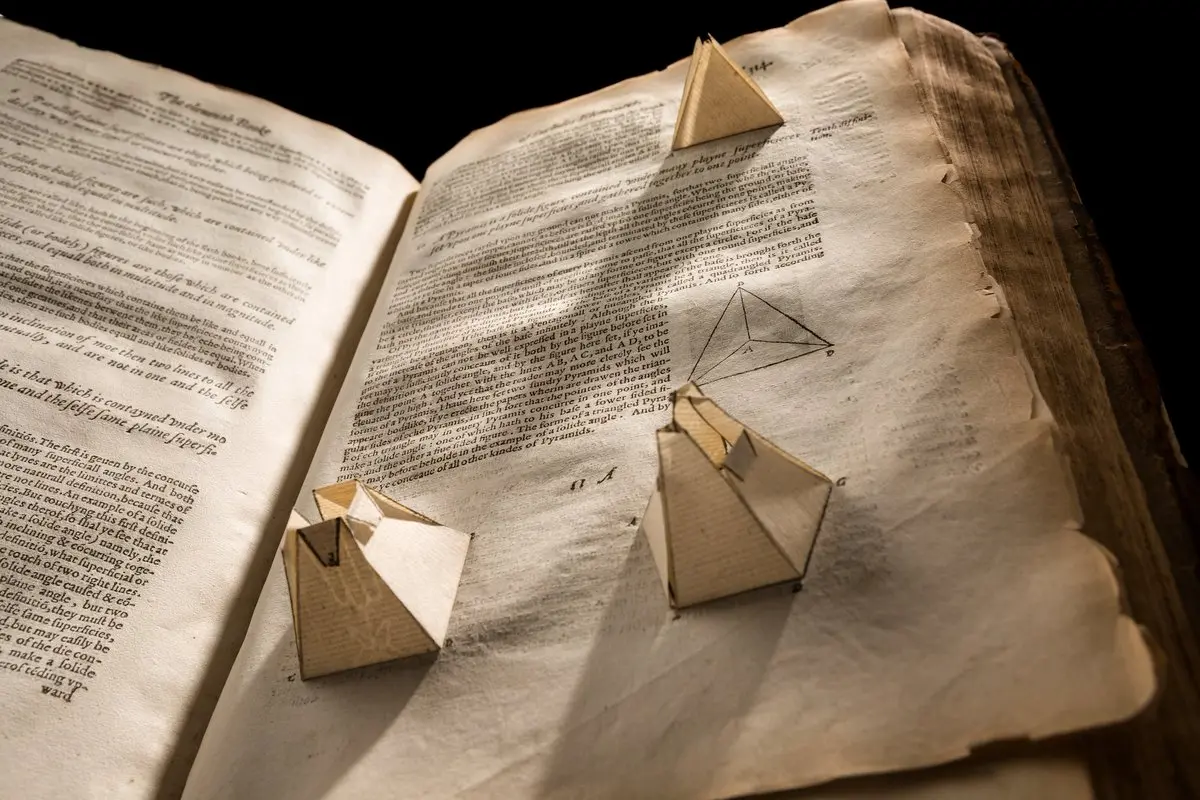
There is an old habit in this — the conviction that a shape you can hold beats a shape you can only be told about. Three hundred years before Beinn Bhreagh, Henry Billingsley glued folding paper solids into the first English Euclid so his readers could stand the propositions up off the page, and a century after Bell, Helen Friel folded Byrne's coloured proofs into paper models you can pick up. Bell's version of the same instinct was simply the largest: he built the tetrahedron at the size of a barn and sent it up into the weather.