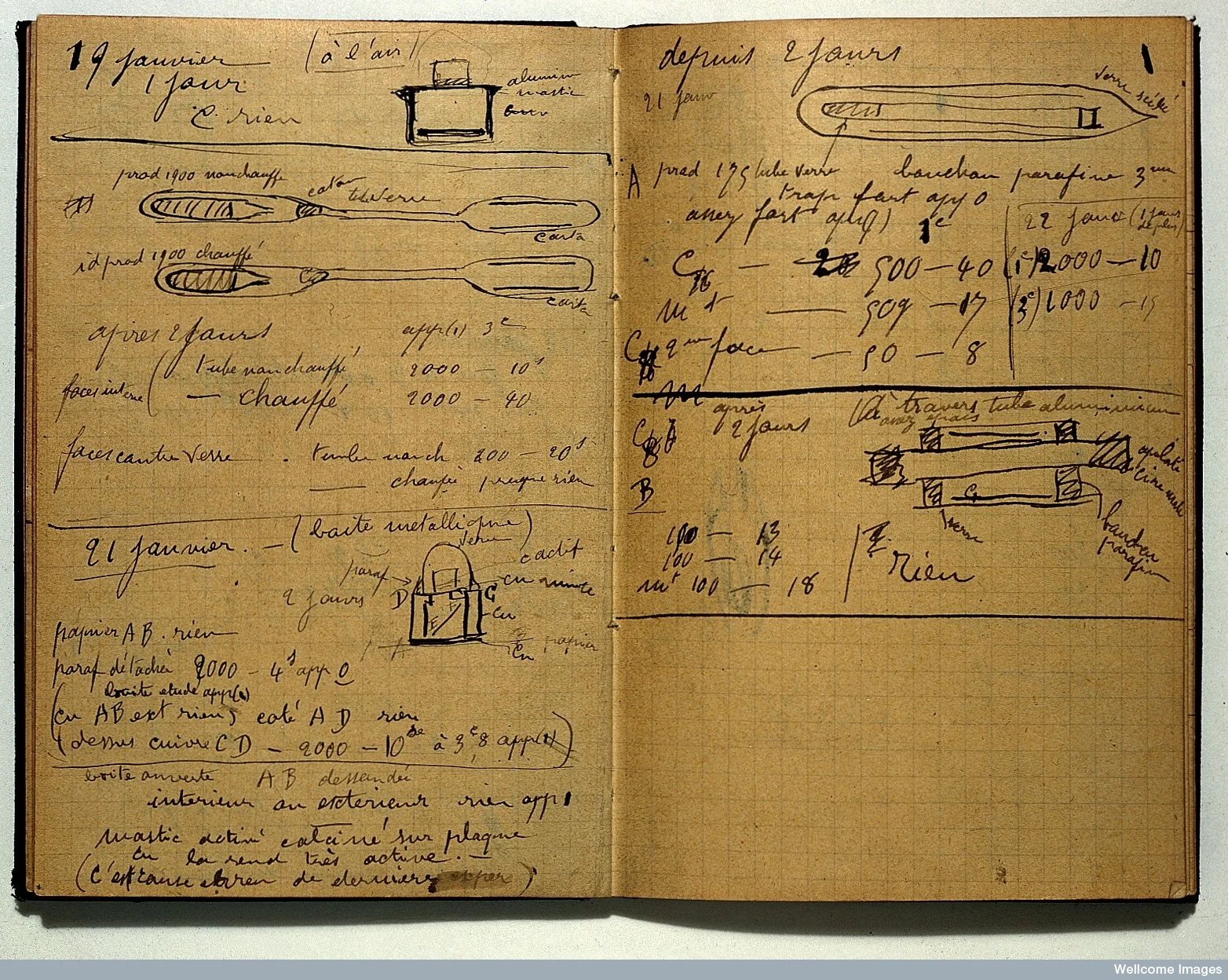
In a vault at the National Library of France in Paris, there are boxes you must sign to open. No weapons inside, no state secrets, no maps. Inside is a woman’s handwriting. Marie Curie’s laboratory notebooks, dating from the 1890s, are still radioactive a hundred and thirty years on. The library keeps them in lead-lined boxes. A researcher who wants to see them first signs a liability form, then puts on protective clothing, and only then may turn the pages.
The reason is a plain fact of chemistry. Radium-226, the isotope that settled into the notebooks, has a half-life of 1,601 years. That means it takes 1,601 years for half of the radium sitting on a page today to disappear. Another 1,601 years for half of what remains. By a rough count, these notebooks will stay dangerous until roughly the year 3500. Even Marie Curie’s shopping lists turned out to outlive most of humanity’s empires.
The decay schedule of the radium on the pages
Ra-226 · t½ = 1,601 yr · α, γ
1896 — 1898
The shed
Where the story begins was not even a laboratory. It was a shed in the courtyard of the School of Physics and Chemistry in Paris, a place where medical students had once dissected cadavers, its windows broken and its roof leaking. When the German chemist Wilhelm Ostwald visited, he described what he saw as something between a stable and a potato cellar. There was no heating. In winter the interior dropped to six degrees. Marie noted this in her notebook, because Marie noted everything. That was exactly the problem.
In 1896 Henri Becquerel had noticed that uranium salts emit rays on their own, but he did not pursue it very far. Marie Curie chose this neglected subject for her doctoral thesis. She took measurements with the electrometer her husband Pierre had built, and she was the one who caught the critical observation. The radiation depended not on the chemical compound of the uranium but only on its quantity. This meant the rays came not from the molecule but from the atom itself. In an age when the atom was held to be indivisible, that sentence was a scandal. She gave the phenomenon a name: radioactivity.
Then the strange part surfaced. The mineral uraninite, known at the time as pitchblende, gave off far more radiation than its uranium content alone could explain. So there had to be something unknown, and far more powerful, inside the ore. In July 1898 they found the first element and named it after Marie’s homeland, which was not even on the map at the time: polonium. That December they announced the second: radium.
1898 — 1902
Eight tons of rock
Announcing is one thing, proving is another. The chemistry community wanted a tangible, weighable sample. But radium’s share in the ore was below one part per million. In that shed the Curies began to process, by hand, ton after ton of pitchblende waste shipped from the Joachimsthal mines in Bohemia. Marie wrote of stirring boiling ore for hours in vats as tall as she was, with iron rods almost her own height. Over four years they melted, dissolved, precipitated, and crystallized roughly eight tons of rock.
Those years in the shed also hold the eeriest scene in the story. Radium salts glowed on their own in the dark with a blue-green light. On some evenings after dinner Marie and Pierre would walk back to the shed and watch the bottles and capsules ranged on the shelves glowing in the darkness. In her memoir Marie compared these lights to fairy lights. Anyone who reads that sentence today shudders, because those two people were in fact watching the thing that was killing them.
Some evenings they walked back to the shed to watch the bottles glowing in the dark.
Rue Lhomond, Paris · night
1901 — 1911
An element carried in a pocket
The first signs of danger arrived, but no one understood the language. Becquerel noticed that a radium tube he carried in his waistcoat pocket had burned his skin. When Pierre heard this, instead of taking fright he ran an experiment. He strapped radium to his arm, waited for hours, and recorded the resulting wound week by week. It took months to heal. From this the couple drew a medical conclusion: if radium kills living tissue, it can kill tumor cells too. The first idea of radiotherapy was born from a deliberate burn.
In his last years Pierre could not walk without a cane, and his fingers cracked constantly. Marie’s fingertips were calloused and scarred. They carried radium tubes in the pockets of their aprons and kept them in their desk drawers. It is said a radium capsule glowed at Marie’s bedside as a kind of night lamp. The contamination seeped not only into their bodies but into their belongings. Chairs, doorknobs, laboratory benches, letters, even Marie’s recipe notebook. Yes, there is a cookbook among the radioactive collection at the library. The recipe for the soup once cooked in the Curie kitchen still sets off a Geiger counter today.
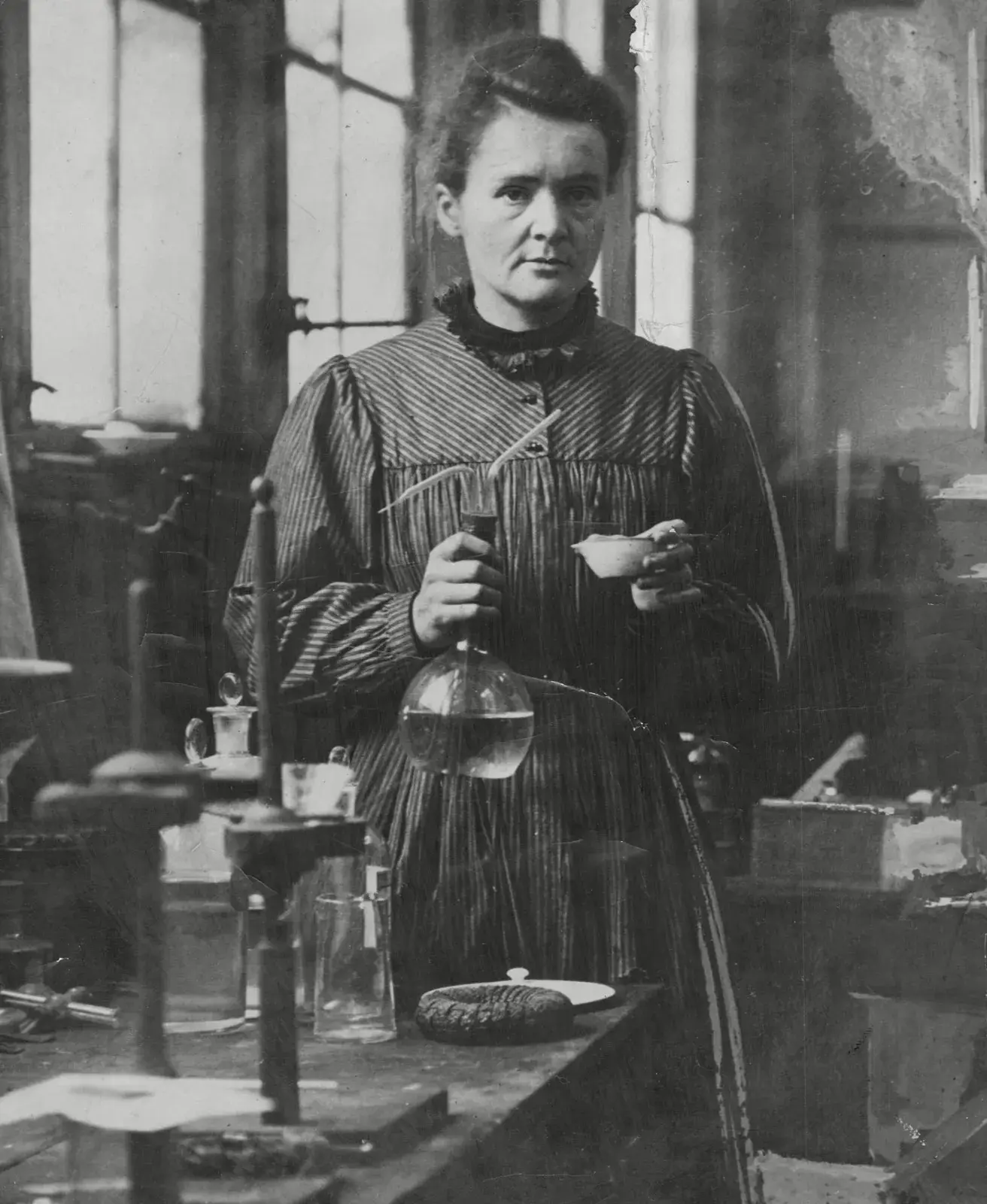
In 1903 she shared the Nobel Prize in Physics with Becquerel and Pierre. The Swedish Academy had at first planned to honor only the two men; it was Pierre’s objection that put Marie on the list. In 1906 Pierre was crushed under the wheels of a horse-drawn cart on the rue Dauphine on a rainy day, and died. Marie took over his chair at the Sorbonne, becoming the first woman professor in the university’s history. In 1911 she won her second Nobel, this time in chemistry, on her own. She is still the only person to win a Nobel in two different sciences.
The matter of the patent deserves a word here. The Curies did not patent their radium purification method. They explained it in full detail to anyone who asked. When the price of a gram of radium passed 100,000 dollars in the 1920s, making it the most expensive substance in the world, its discoverers could not afford to buy radium for their own laboratory. In 1921 American women pooled their money and gave Marie a gram of radium as a gift.
1920s — 1930s
The millionaire whose jaw fell off
While science stayed cautious, the market went mad. Radium found its way into toothpastes, chocolates, face creams, underwear. The brand Tho-Radia sold radium cosmetics. A radium water called Radithor was marketed to the wealthy as an energy elixir. The industrialist Eben Byers drank thousands of bottles of it and died in 1932 with his jaw, in the literal sense, disintegrating. The Wall Street Journal announced the case with a headline that went down in history: the radium water had worked fine until his jaw came off. Young women workers who painted glowing numerals on watch dials began dying of rotted jaws, because they pointed the brush tips with their lips. The Radium Girls lawsuits became one of the cornerstones of occupational-health law.
Marie, for her part, did something entirely different in the First World War. She mounted X-ray machines onto vans and drove them to the front. Thanks to these mobile X-ray vehicles the public called petites Curies, along with the fixed stations that were set up, roughly a million wounded soldiers were imaged over the course of the war. Marie drove the vehicles herself and worked at the front with her seventeen-year-old daughter Irène. Without lead, without shielding, without a dosimeter.
1934 — 1995
The lead coffin
Marie Curie died on 4 July 1934, of aplastic anemia, at a sanatorium in the French Alps. Her bone marrow had stopped producing blood cells. For many years the cause of death was recorded as radiation from long-term exposure. She was buried in a lead-lined coffin at Sceaux, beside Pierre.
In 1995 France decided to move the couple to the Panthéon, where the nation’s heroes lie. Marie became the first woman admitted there on her own merit. During the transfer the French radiation-protection authority took measurements and met with an unexpected result. The radium contamination in Marie’s body was lower than had been assumed. That finding gave rise to an intriguing hypothesis. What killed Marie may have been less the radium she carried in her pocket for years than the X-ray machines she operated with no protection during the war years. Even radium had failed to kill her; the machines she used to save others had.
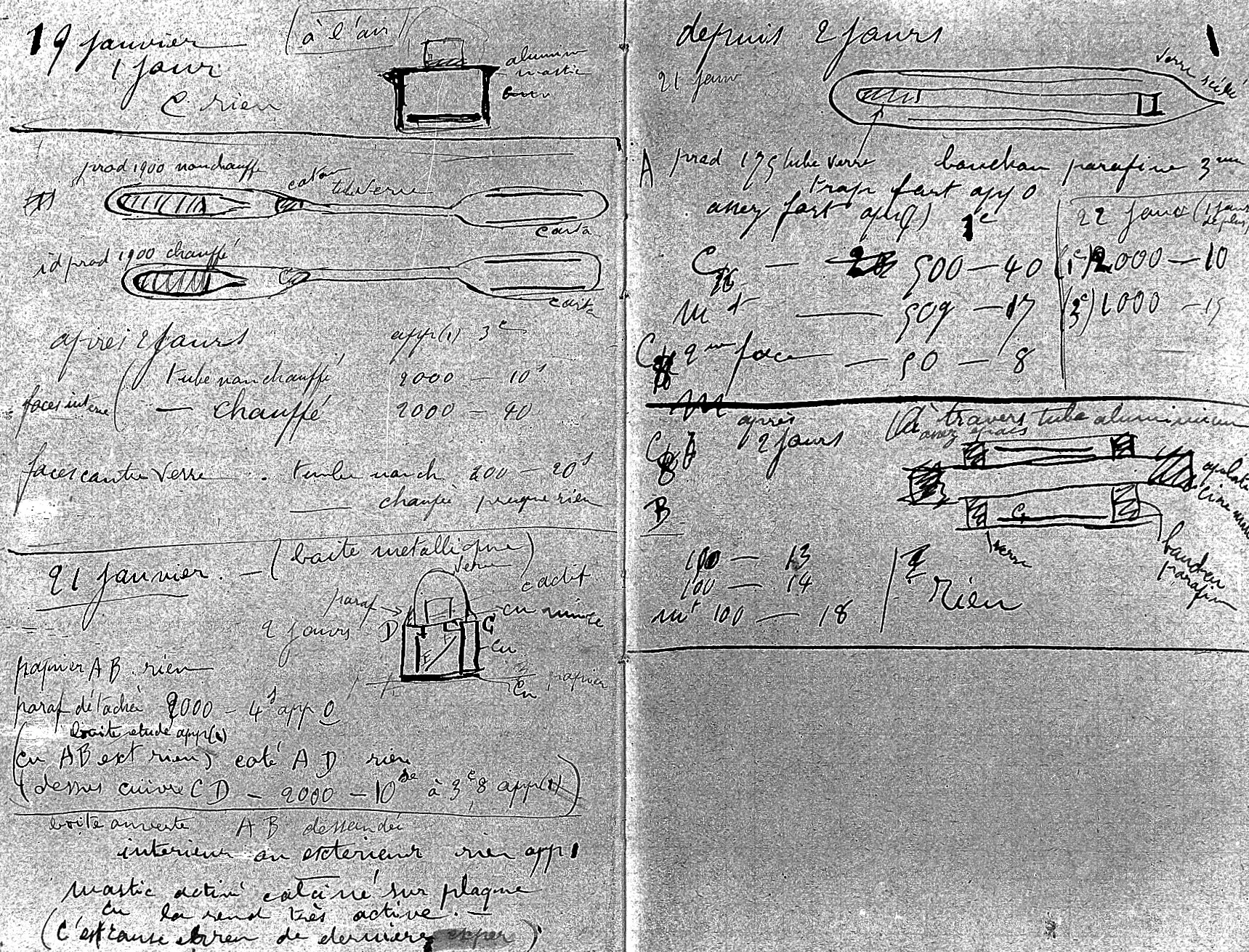
That her body came out relatively clean while the notebooks stayed contaminated is no contradiction. A body sheds some of the radium; paper sheds none. The radium dust that drifted into the air in the shed, the kitchen, the workbench settled into the pages and stayed there. Today those pages hold Marie’s measurements, calculations, drawings, and fingerprints. The fingerprints themselves are radioactive.
A scientist’s legacy is usually a metaphor. Marie Curie’s is physics.
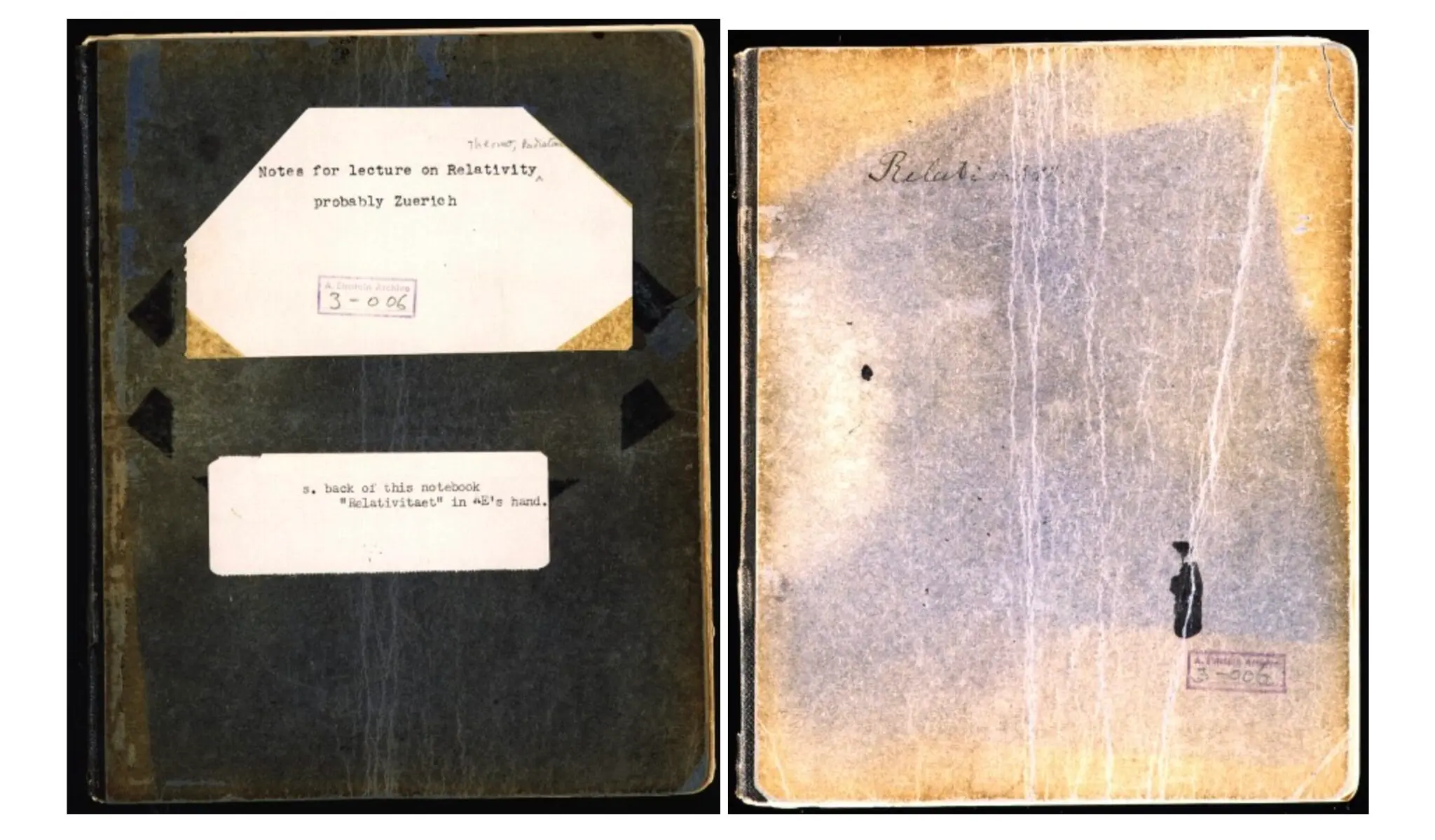
Anyone who wants to touch her notebook signs to accept the cost of it. The ink on the paper has long since faded, but the element smeared beside the ink is still decaying thousands of times a second. Compare that with Einstein’s Zurich Notebook, which you can read online, freely, without a waiver. One physicist’s notes became a monument to beautiful wrong turns. The other’s became a radiation source. Marie Curie died in 1934. Her notebooks will keep working until the year 3500.
The Fonds Curie collection also includes personal papers — letters, drafts, domestic records. Among them is something as intimate as the letter Richard Feynman sealed for forty-two years after his wife died: the private record of a life lived at the absolute edge of what was known. The difference is that Curie’s papers are still dangerous to hold.
Sources
- Bibliothèque nationale de France, Fonds Curie.
- Barbara Goldsmith, Obsessive Genius: The Inner World of Marie Curie.
- Françoise Giroud, Marie Curie: A Life.
- Susan Quinn, Marie Curie: A Life.
- Denis Brian, The Curies: A Biography of the Most Controversial Family in Science.