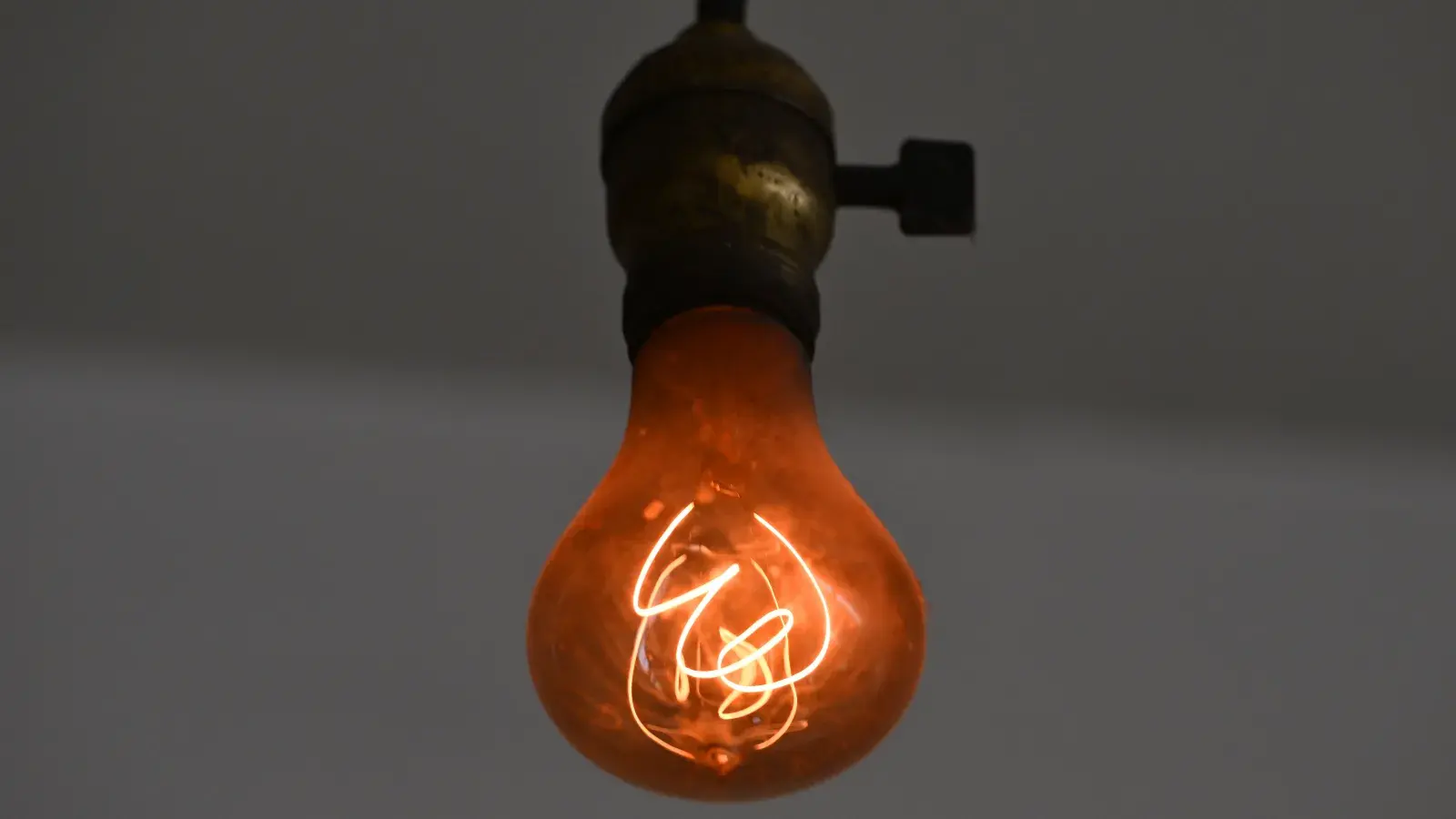
In the small town of Livermore, California, a thin cord hangs from the garage ceiling of a fire station at 4550 East Avenue. At its end dangles a hand-blown, pear-shaped bulb, its glass darkened with soot. The light is faint, no brighter than a nightlight. This bulb was switched on in June 1901 and, apart from a few brief interruptions, has never been turned off since. Guinness World Records certifies it as the longest-burning light bulb on Earth. The townspeople call it the Centennial Light.
As of today it has burned for more than one million ninety thousand hours. That is roughly twenty-two times the fifty-thousand-hour lifespan printed on the box of a modern LED. And it is not an LED, nor even a typical incandescent by today’s standards. It is an ordinary carbon-filament bulb of hand-blown glass, built with nineteenth-century technology, only about twenty years after Edison patented his practical incandescent lamp.
It Began With a Gift
The story starts with the sale of a power company. Dennis Bernal owned the Livermore Power and Water Company. In 1901 he sold the business and, according to his daughter Zylpha Bernal Beck years later, donated one of his bulbs to the town’s volunteer fire department. The volunteer firefighters of that era called themselves the Livermore Fire Boys, and the bulb was hung in the hose cart house on L Street.
Its job was humble. When the alarm rang in the middle of the night, the bulb stayed lit twenty-four hours a day so the volunteers could find the equipment in the dark. Nobody switched it off, because switching it off never occurred to anyone. That very indifference turns out to be the first secret of its long life.
Shelby and Chaillet
The bulb was made in the late 1890s by the Shelby Electric Company of Shelby, Ohio. The design belonged to Adolphe Chaillet, a French engineer who worked for the company. Chaillet was trained in physics and held a patent on his filament design, and his claim was plain. Shelby bulbs would burn brighter than their rivals and last longer. The company’s advertisements of the day pitched their product as the best lamp on Earth. It could have been mere ad copy. A hundred and twenty-five years later it turned out not to be.
- Manufacturer
- Shelby Electric Co., Ohio
- Design
- Adolphe Chaillet
- Made
- Late 1890s
- Glass
- Hand-blown
- Filament
- Carbon
- Original power
- 30–60 watts
- Brightness now
- ~4-watt level
- First lit
- June 1901
No One Noticed Until 1972
For seventy years the bulb was just the old lamp in the garage. Firefighters tapped it lightly for luck and occasionally used it as target practice for nerf balls. In 1972, Tri-Valley Herald reporter Mike Dunstan spent weeks interviewing the town’s oldest residents and produced a story headlined “Light Bulb May Be World’s Oldest.” Dunstan then reached out to Guinness, Ripley’s Believe It or Not, and General Electric. All three came to the same conclusion. This was the longest-lasting bulb on record.
From that day the bulb’s status changed. It stopped being a target and came under the town’s protection.
Four Buildings, One Bulb
- 1901Hung in the hose cart house on L Street. A nightlight for the volunteer firefighters.
- 1903Moved to a downtown garage shared by the fire and police departments.
- 1937Roosevelt’s WPA remodeled the fire house, and the bulb went dark for about a week. The longest interruption in its history.
- 1976Moved to its current home at Station No. 6. The transfer was a full ceremony. Because unscrewing the bulb from its socket was judged too risky, the cord was cut instead, the bulb was placed in a specially built box, and it was carried under full firetruck escort. Total time without power: twenty-two minutes. An electrician was waiting at the new station to wire it into a generator-backed line.
Ripley’s ruled that this forced twenty-two-minute pause did not spoil the continuous-burning record. Since then the bulb has hung from the same ceiling, connected to an uninterruptible power supply.
Why It Still Burns
There is no single definitive answer, but we have four strong, complementary explanations.
First, filament thickness. Physicist Debora Katz of the U.S. Naval Academy bought a Shelby bulb from the same era and studied it. By her measurements, the Shelby filament is roughly eight times thicker than the filament in a modern incandescent bulb. A thicker filament wears down more slowly. Simple and effective.
Second, the material. The filament is carbon, not tungsten. Katz’s work suggests the carbon filament behaves like a semiconductor. As it heats, it conducts electricity better, which smooths out the voltage swings that wear a filament down. The industry switched to tungsten in the twentieth century because tungsten tolerates oxygen better, but a carbon filament running continuously at low power clearly has its own advantage.
Third, low power. The bulb originally burned at somewhere between 30 and 60 watts, and today it gives off about as much light as a 4-watt nightlight. Lower temperature means less evaporation, which means less wear.
Fourth, and perhaps most important, it is almost never switched off. What usually kills an incandescent bulb is not burning but switching. Every time it turns on, the filament heats and expands abruptly; every time it turns off, it cools and contracts. This thermal cycling fatigues the metal, and the filament eventually snaps at its weakest point. A filament that has run for a hundred and twenty-five years almost without interruption has never suffered that fatigue.
The Phoebus Cartel
The bulb’s story is interesting on its own. Read in context, it turns into an uncomfortable question. In 1924, the major manufacturers, including General Electric, Osram, and Philips, met in Geneva and formed the Phoebus cartel. The cartel imposed a standard that deliberately capped bulb life at one thousand hours. Firms that made longer-lasting bulbs were fined. It is regarded as the first well-documented case of planned obsolescence.
In other words, when the Livermore bulb was built, the industry had not yet learned to make its products deliberately short-lived. Chaillet designed the bulb to last as long as possible, because durability was a selling point in his day. Twenty-five years later, that same industry would come to see durability as a cost. The faint light in the garage is not a record of what engineering could achieve, but a record of what it later chose not to. The playbook is not extinct, either — it just moved from filaments to firmware. Google alone has retired 299 products since 2006, an average lifespan of 5.2 years.
Time Spent in the Dark
The outage record over a hundred and twenty-five years is surprisingly short. The bulb itself has never once failed. Every minute spent in darkness traces back to either human hands or the infrastructure around it.
The 2013 incident was the bulb’s tensest night. On the evening of May 20, viewers watching the live webcam saw the light go out, and the news spread fast. The next morning an electrician determined that it was not the bulb that had failed but the uninterruptible power supply feeding it. The faulty supply was bypassed with an extension cord, and the bulb came back on nine hours and forty-five minutes later. Freed of the supply’s limits, it even glowed for a few hours near its old brightness.
The Bulb That Outlives Its Cameras
The bulb marked its hundredth birthday in 2001 with a town barbecue and live music. The celebration drew a certificate of recognition from the California Senate, a resolution from the Alameda County Board of Supervisors, and a letter from then-President George W. Bush. In 2015 it passed its one-millionth hour. It has appeared on MythBusters, been the subject of at least four books, and starred in a South African commercial about things built to last.
My favorite detail is this. The live webcam set up to watch the bulb around the clock has been replaced many times. As of 2016, the bulb had outlived three webcams. Modern devices installed to watch a hundred-and-twenty-year-old bulb failed one by one while the bulb kept burning. It would not be the first time an old technology quietly outlasted its replacements — Henry Billingsley’s 1570 paper polyhedra still hold their shape better than most things built to replace them, too.
There is even a forecast for its future. Optical engineer Martin Kykta studied the bulb’s structure in 2021 and predicted that, so long as it keeps running at 4 watts or less, it could last another century. The Livermore-Pleasanton Fire Department has committed to housing and maintaining the bulb for the rest of its life. The station is open to visitors, and when on-duty personnel are available you can see the bulb in person during set hours each day. If the door is closed, ringing the bell is enough. For those who can’t come in person, the live feed is still running.
That pale light on the garage ceiling hangs like a quiet record next to the billions of bulbs designed to fail at a thousand hours. A record of how long good work can last — the same kind of record kept, a century later and with electricity instead of incandescence, by eleven light bulbs turned into a moving sculpture of Newton’s cradle.