Eleven light bulbs. Two hidden pistons. One physics law that has not changed since 1687. Yasutoki Kariya's senior thesis installation made Newton and Edison share the same sentence — and the internet noticed.
ewton's Cradle is one of those objects that sits on executive desks for years without anyone thinking very hard about it. Five steel balls suspended from a frame, and when you pull one back and release it, the ball at the other end swings out while the three in the middle appear not to move at all. The physics is genuinely interesting — it involves the simultaneous conservation of both momentum and kinetic energy, a constraint that forces the particular solution of one ball out for one ball in — but the object has become so familiar that it no longer prompts curiosity. It prompts the vague sensation that you are in an office.
Yasutoki Kariya, a student at Musashino Art University in Tokyo, decided to replace the steel balls with incandescent light bulbs. Not as a metaphor. As a demonstration. The result is an installation called Asobi — the Japanese word for play — and it is one of the more quietly perfect things a design student has produced in recent memory.
What the Installation Does
The bulbs do not actually touch each other. This is the first thing to understand, and also the first thing that makes the installation more interesting than a simple visual joke. In Newton's Cradle, the transfer of energy happens through direct contact — ball strikes ball, compression wave travels through the chain, the ball at the far end receives the impulse and swings out. The physics depends on contact.
Kariya removes the contact entirely. Two concealed pistons, programmed in sequence, move specific bulbs while the others remain still. The light travels down the line — one bulb brightening as another dims, the illumination propagating from end to end — creating the visual impression of energy in transit without any actual energy transfer between the bulbs at all. What you see is a representation of a physical law, not the law itself. The chain of light is a simulation of the chain of momentum.
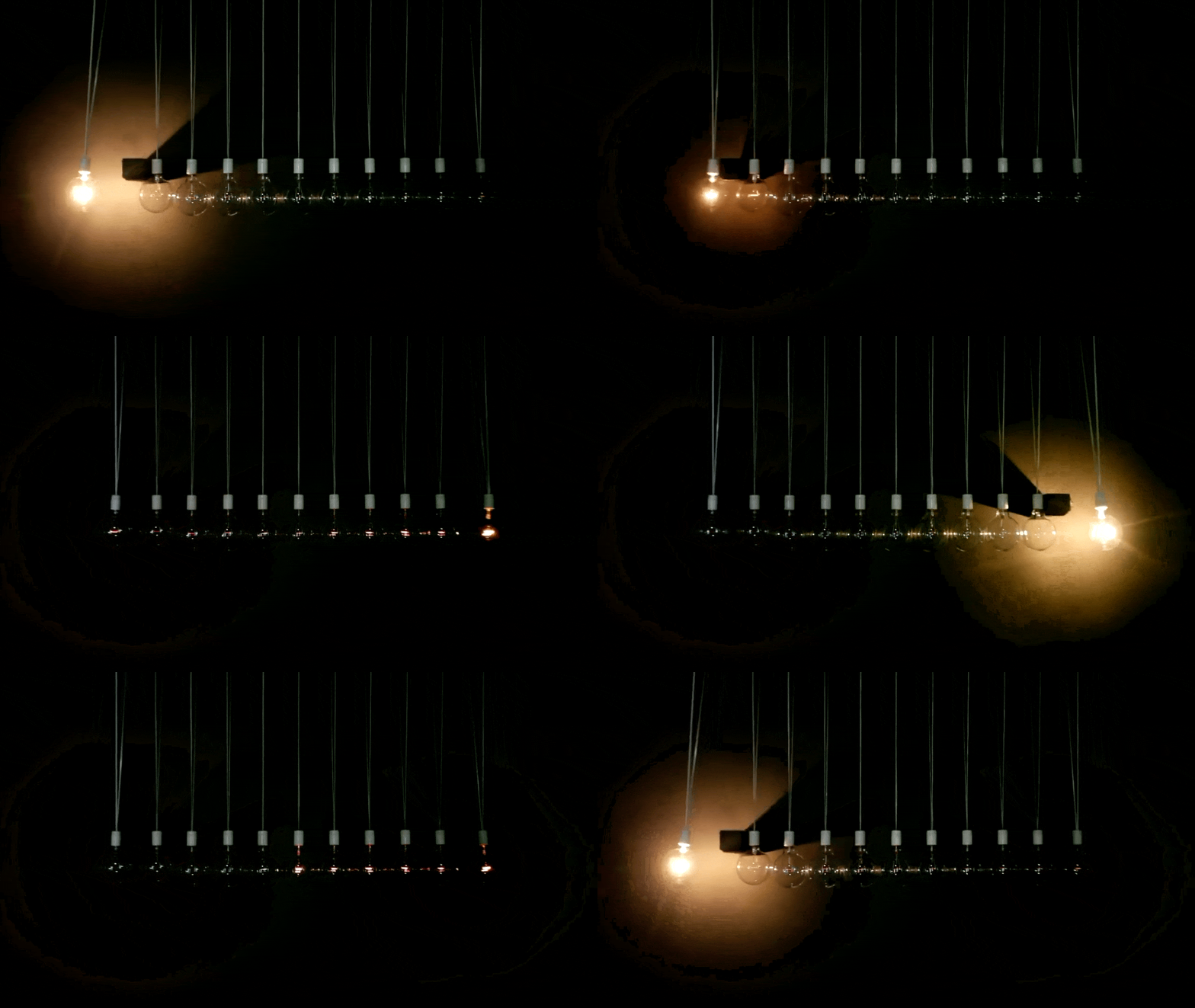
The relay was programmed to visualize the movement of energy: a light bulb collision replacing the iron ball collision used to demonstrate the law of inertia, across 11 bulbs. The sound of collision — the sharp click Newton's Cradle makes — was also reproduced.
— Kariya, artist statement, 2012
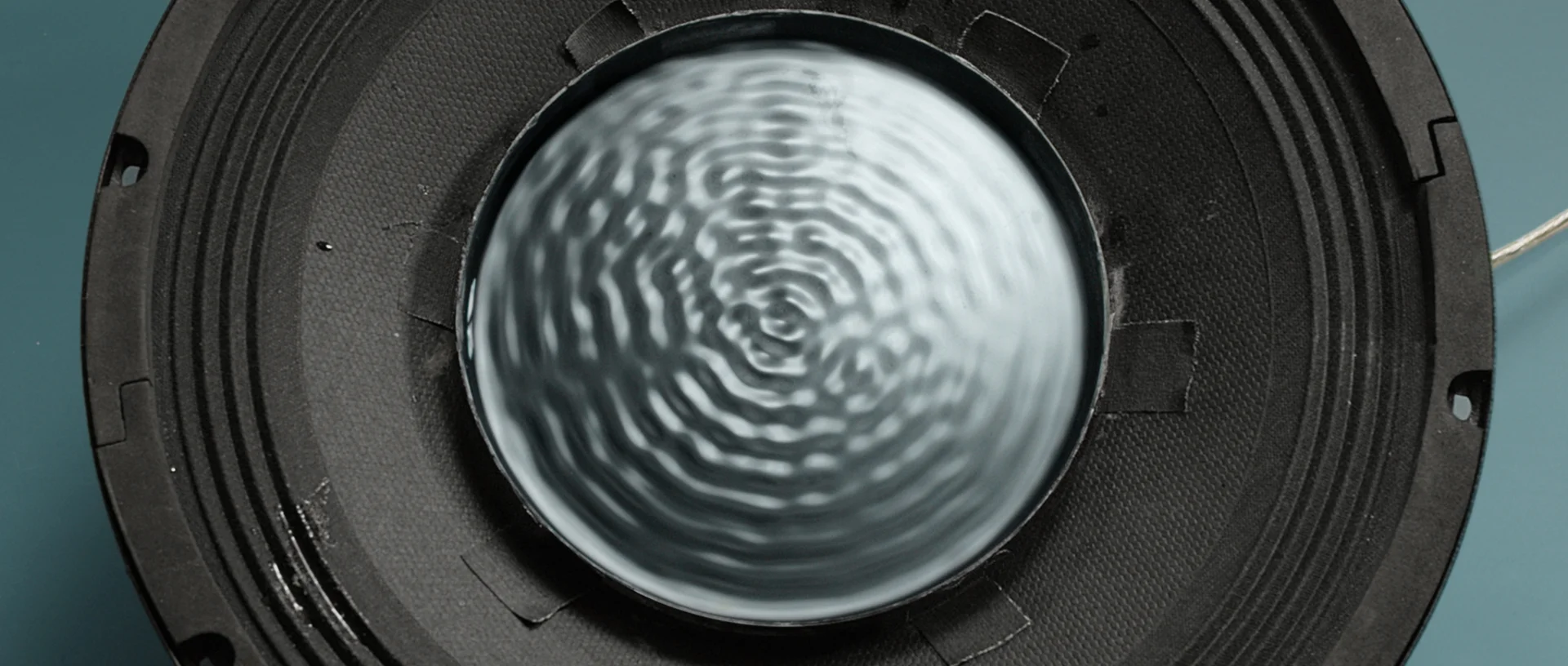
This distinction matters because it shifts the work from engineering to something closer to philosophy. The original Newton's Cradle is the physics. Asobi depicts the physics. The gap between those two things is exactly where the installation lives. It is the same trick that lets a metal plate teach you about waves: in Nigel Stanford's Cymatics, sound is made visible by sand snapping into Chladni figures — the pattern stands in for a law you could otherwise only write down.
Newton and Edison in the Same Room
Newton's third law of motion — that for every action there is an equal and opposite reaction — was published in 1687. Thomas Edison's carbon-filament incandescent bulb was patented in 1879. For 192 years these two facts occupied separate rooms in the history of science and technology. Kariya put them in the same room.
The incandescent bulb is itself a device for converting one form of energy into another: electrical energy into heat, and heat into light. The filament glows because electrons moving through a resistive material lose energy as thermal radiation, some portion of which falls in the visible spectrum. Edison's bulb is, at its core, a demonstration that energy changes form rather than disappearing — which is also, more or less, what Newton's Cradle demonstrates with steel balls and momentum.
The bulbs do not actually touch, preventing them from breaking. The glass is suspended just close enough to suggest contact, and just far enough apart to make it impossible.
— Asobi, 2012
The fragility of glass adds another register. Steel balls are designed to survive collision. Light bulbs are not. The installation stages a collision that never happens, between objects that could not survive it if it did. This is not incidental. Kariya's choice of material introduces a tension the original Newton's Cradle does not have: the perpetual suggestion of destruction that never arrives.
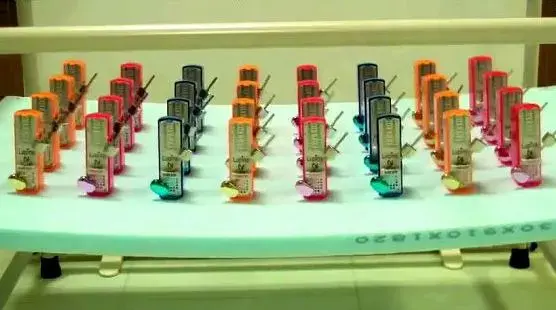
The deeper subject is synchronization — many separate parts behaving as one connected system. It is the same principle that makes 32 metronomes drift into a single shared beat, and the same one that lets thousands of fireflies flash in unison across a forest. Asobi compresses that idea into a row of glass and filament: a chain of events that looks, for a moment, exactly like cause and effect.
A Senior Thesis
Asobi was Kariya's senior thesis exhibition piece. It was nominated for the Mitsubishi Chemical Junior Designer Award in 2012, which is aimed at graduating design students in Japan and rewards original work with support and training. The nomination is notable but not the point. The point is that the work was made as a graduation requirement, under the constraints of a university exhibition, by a student who had not yet been given permission by the professional world to make things of this caliber.
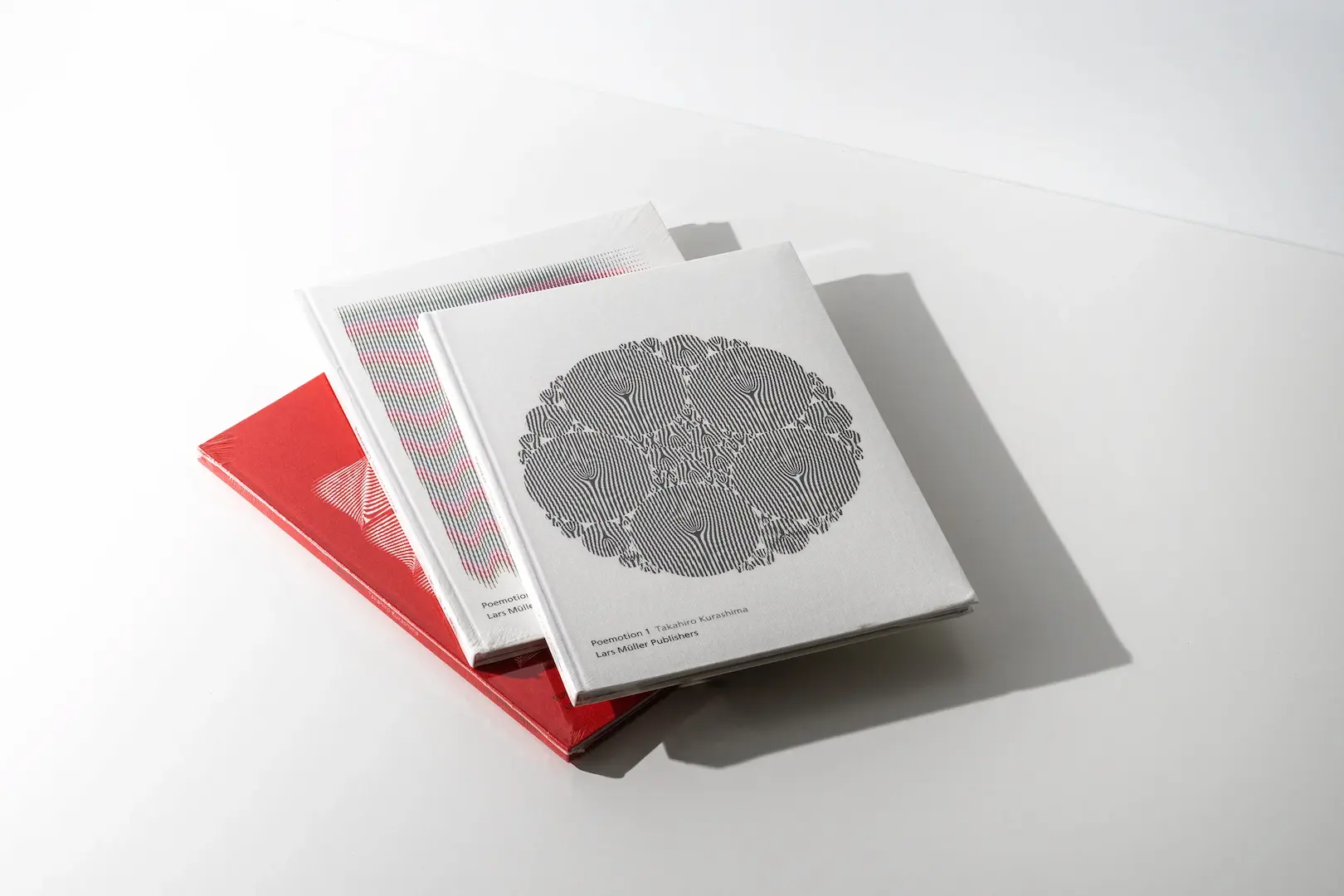
This is the thing about senior thesis exhibitions: they are one of the last moments in a designer's career when the work exists purely for itself, with no client, no brief, no market, and no one to tell you the concept is too abstract for the target demographic. Kariya used that freedom to make something that two physicists from three centuries apart would have both found worth looking at. That is not nothing. That is, in fact, quite a lot. Musashino Art University has a particular gift for this kind of quiet, hand-operated wonder — it is also where Takahiro Kurashima made Poemotion, a book that animates only when you slide a film across its pages.
Notes
- 1.Newton's Cradle is named after Isaac Newton but was not invented by him. The device was popularized in 1967 by Simon Prebble, who sold it under the name “Newton's Cradle.” The physics it demonstrates — simultaneous conservation of momentum and kinetic energy — is genuinely Newton's, but the desk toy arrived three centuries after the law.
- 2.The Mitsubishi Chemical Junior Designer Award has been running since the early 2000s and is one of the more prominent recognition programs for graduating design students in Japan. It is affiliated with Mitsubishi Chemical's materials research programs, which explains the emphasis on material innovation in nominated works.
- 3.Musashino Art University, where Kariya studied, is one of Japan's most respected art and design institutions. Founded in 1929, it has produced a significant portion of Japan's working designers across industrial design, graphic design, and fine art. The senior thesis exhibition is a public event that functions as both graduation requirement and professional debut.
Yasutoki Kariya — Asobi, 2012 · Musashino Art University · Abakcus