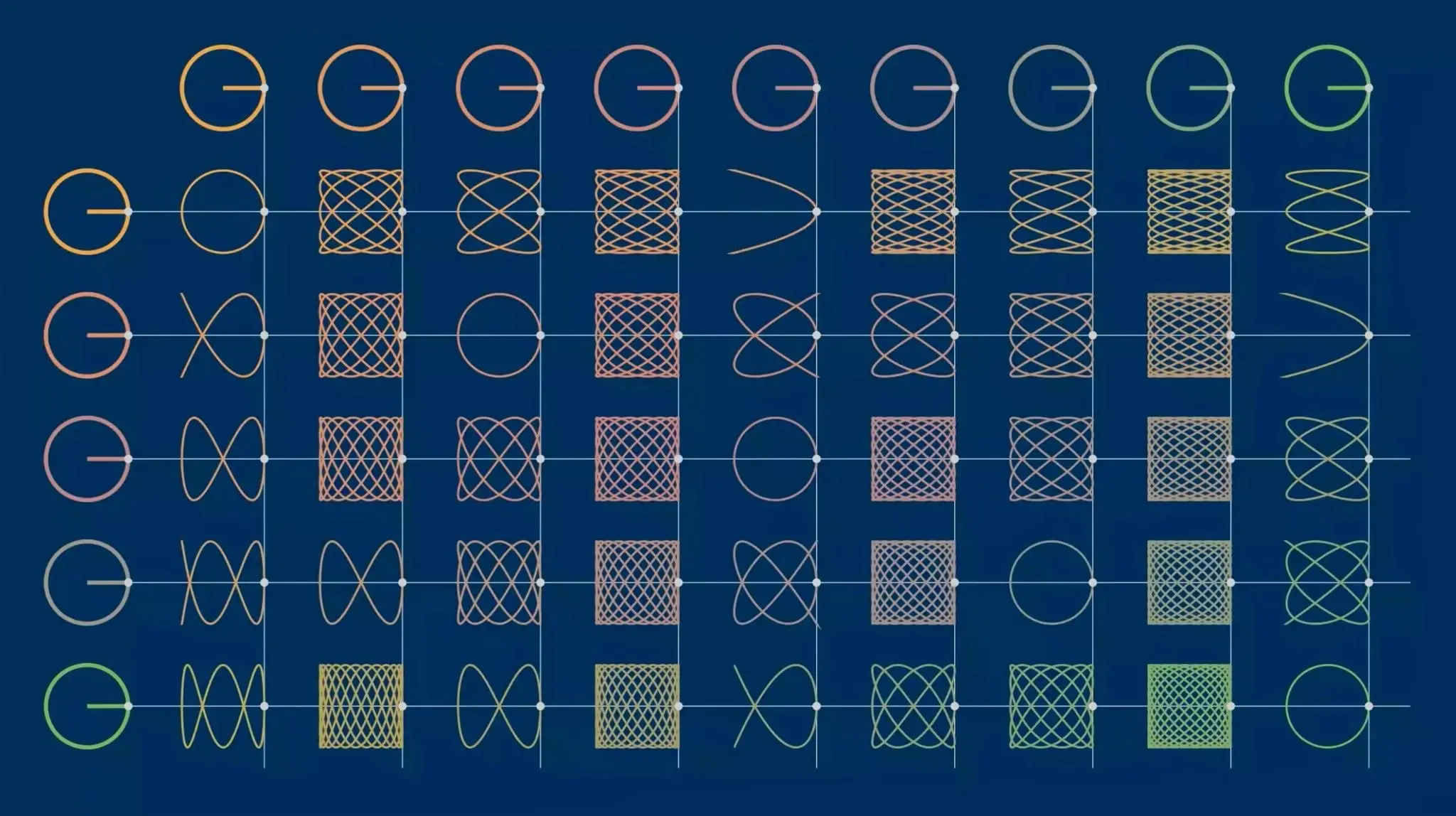
wo layers of lines. One printed on the page, one on a thin transparent film. When they overlap, the difference in their spacing and angle generates an interference pattern — a moiré effect. Circles appear to spin. Grids vibrate. Complex forms build, hold, and dissolve. Takahiro Kurashima’s Poemotion series starts exactly here: turning a physics principle into a book object.
The patterns on each page are static by themselves. The moment a reader slides the enclosed film across them, the geometry activates. No electronics, no battery, no code. The motion is produced entirely by the relationship between two printed surfaces — and by the speed and angle of the reader’s own hand.
Kurashima didn’t put the motion on the page. He put it between the page and the film.
Poemotion was published in 2011 by Lars Müller Publishers, the Swiss design house that positioned it as part of a long-running “school of seeing” tradition. Kurashima studied at Musashino Art University in Tokyo, where he has lived and worked since 1993. Since the first book, he has completed two sequels and a follow-up titled Moirémotion. The trilogy has sold close to 100,000 copies worldwide.
Poemotion · Kurashima
Stillness exists in motion. Motion lives in stillness.
Stillness is not the only thing one sees, nor is motion the only thing.
In between stillness and motion, a new vision rises. Like in between thoughts and action, one finds a new vision. From a new vision, comes a new force that generates a new world.
Poemotion is the way to see a new world.
The moiré effect is not a new invention. The name comes from 19th-century textile manufacturing, where the pattern appeared as an unwanted artifact in woven fabric. By the mid-20th century, kinetic artists — Bridget Riley, Victor Vasarely, Carlos Cruz-Diez — were using interference patterns deliberately, building large-format works that shifted as the viewer moved. Kurashima’s contribution is compression: the same optical logic, scaled down to a pocket-sized book, operated by the reader’s thumb.
01
Poemotion 1
The first volume. Circles, grids, and spirals. The fundamental vocabulary of the moiré effect.
02
Poemotion 2
More complex forms. Figure-ground relationships become the subject.
03
Poemotion 3
The final book in the trilogy. Layered visual narratives across the full sequence.
There is a specific irony in the timing. Poemotion appeared at the height of the tablet era, when interactivity meant touchscreens and apps. The book answered with a piece of plastic film and a printed page. No two readings produce the same result — the hand’s tremor, the angle of approach, the speed of the slide are all part of the output. A screen renders every frame identically. This does not.
What the video shows is the mechanism in real time. Kurashima’s hands moving the film, the patterns responding, the transition from static geometry to apparent motion. The film is from 2012, made for the book’s release. It does not explain anything. It demonstrates. If the idea of design that activates only on contact interests you, the kinetic tarts of Dinara Kasko are another study in what happens when a physical object only becomes what it is at the moment of use.
At a glance
How It Works
The moiré effect was named in the 19th century after a type of woven fabric that produced similar interference patterns.
Poemotion (2011), Takahiro Kurashima · Lars Müller Publishers · Video: vimeo.com/40808542 · abakcus.com