Oliver Jeffers began writing this book the night his son was born. He had no plan for it. He simply needed to explain the world to someone who had just arrived in it.
here is a category of object that resists classification by age. It is not a children’s book that adults can also enjoy. It is not an adult book pitched at a child’s reading level. It is something rarer: a thing made for one specific person, at one specific moment, that somehow speaks to everyone who has ever been in a similar position — which is to say, everyone who has ever found themselves responsible for another human being they did not yet know how to explain the universe to.
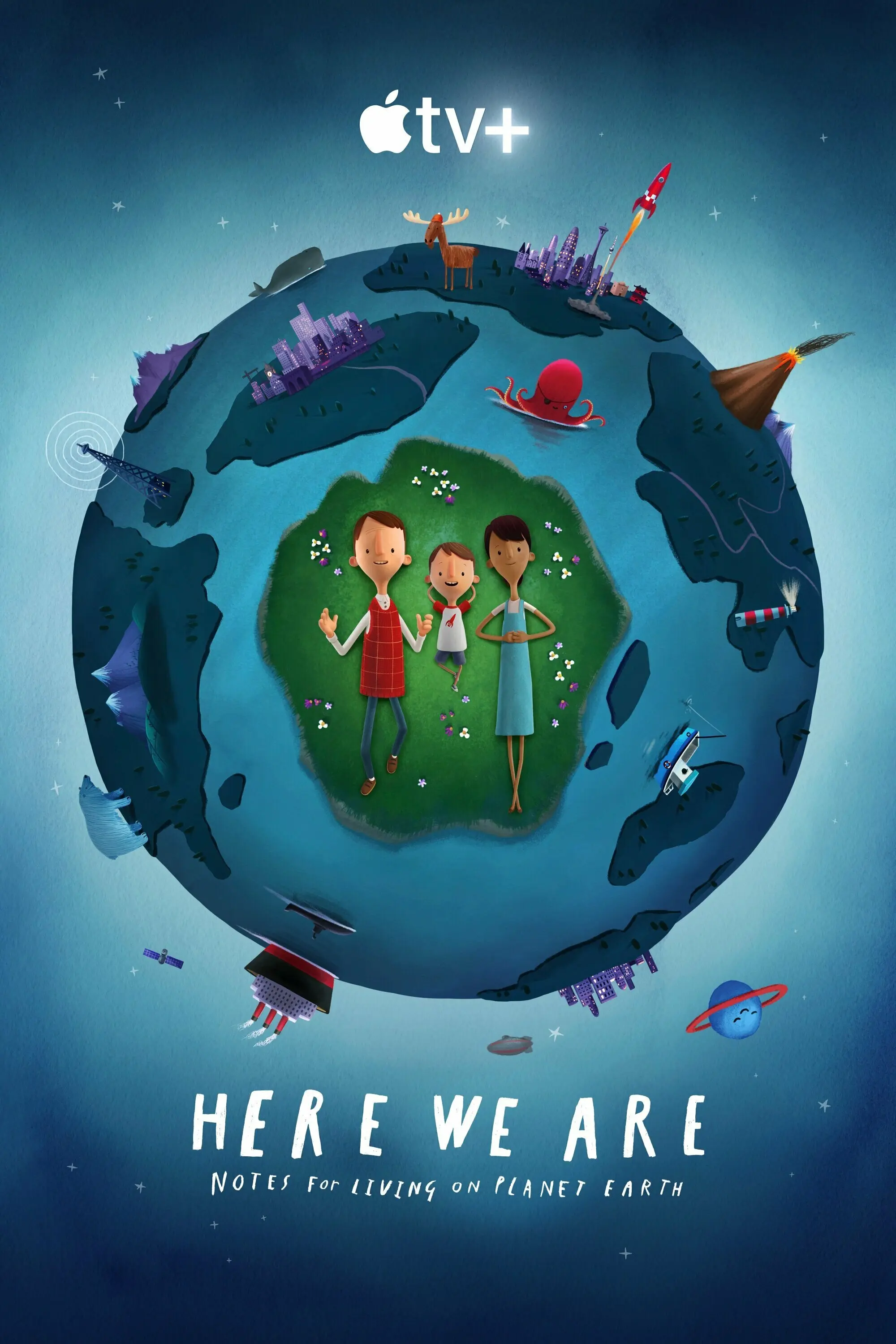
Oliver Jeffers, born in Australia and raised in Belfast, published Here We Are: Notes for Living on Planet Earth in 2017. The book began, he has said, not as a book at all — it began as a letter, written to his newborn son Harland, cataloguing everything Jeffers felt his son would need to know: the size of the universe, the varieties of human face, the location of Earth in relation to everything else, the fact that time moves at different speeds depending on what you are doing with it, and the fact that he would not be alone. The letter became a picture book. In 2020, Apple TV+ adapted it into a 36-minute animated short, narrated by Meryl Streep, with Jacob Tremblay voicing the seven-year-old protagonist Finn.
The Problem of the First Sentence
Any book that attempts to explain the world to a newborn faces an immediate technical problem: where do you begin? The universe is approximately 13.8 billion years old. Earth formed about 4.5 billion years ago. Complex life took another several billion years to appear. A first sentence that honors this timeline would run longer than the book itself.
Jeffers solves this with the kind of precision that looks effortless until you try to replicate it. The book opens: Well, hello. Two words. And then: We call it Earth. Not “this is Earth.” Not “you are on a planet called Earth.” The word “we” does immediate and irreversible work. It establishes that the narrator and the reader are in this together — that this is a tour given by someone who lives here, to someone who has just moved in.
Jeffers began work on Here We Are the night Harland was born. The idea, he said, was to give his son a tour of everything he knew — from very large things like the universe to very small things like fingernails.
Maisonette interview, 2018
The animated film preserves this tone with unusual fidelity. The screenplay, written by Luke Matheny and Philip Hunt, keeps the book’s voice intact and expands it into a single Earth Day, in which Finn accompanies his parents to the Museum of Everything — a museum that contains, among other exhibits, the entire observable universe, a section on human faces, and a wing dedicated to the passage of time. It is the kind of museum that only exists in children’s books and, increasingly, in the better science communication of our era.
What the Film Adds
The book is 48 pages. A page might carry six words and a watercolor illustration. What it achieves in that space — a working cosmology, a taxonomy of living things, a philosophy of kindness, a meditation on time — is a function of Jeffers’ understanding that picture books operate through accumulation. Each page is a small percussion. The meaning arrives from the pattern, not any single beat.
Adapting this into film required filling the silence. Matheny and Hunt introduced a narrative frame — the Earth Day visit, the museum, a plot involving a father who is slightly distracted — that gives the film somewhere to go. Meryl Streep’s narration threads the book’s original voice through these additions. The result is not the book made moving. It is the book’s spirit given room to walk around.
In making the film, the production team at Studio AKA — the same London studio that animated Jeffers’ earlier Lost and Found in 2008 — developed a visual language that matched the watercolor looseness of Jeffers’ original illustrations while meeting the demands of 36 minutes of continuous movement.
Apple TV+ production notes, 2020
Jacob Tremblay, who was thirteen at the time of recording and voicing a seven-year-old, delivers the kind of performance that requires you to forget the mechanics. Chris O’Dowd and Ruth Negga play the parents with a specific register — warmly distracted, intermittently present, trying — that will be familiar to any adult who has found themselves simultaneously responsible for a child and for the world the child is about to inherit.
The Political Subtext That Is Not Actually a Subtext
Jeffers has been direct about the context in which he wrote the book. He began it when Harland was born, in 2014. He finished it in 2017. The intervening years contained enough global news that a book counseling kindness toward strangers, attention to the fragility of the planet, and basic curiosity about people who look different from you was, by the time of publication, making an argument that felt newly urgent. Jeffers did not disguise this. The book’s final pages are explicit: be kind to it and each other.
The film was released on April 17, 2020 — five days before Earth Day, three weeks into a global pandemic that had confined most of its audience to their homes. The timing was not planned. The resonance was not accidental. A 36-minute animated film about the strangeness and fragility of being alive on this particular planet, released on a streaming service to an audience that had nowhere else to go, found its moment without looking for it.
On the Difficulty of Small Things
Jeffers has spent his career working in a format that is systematically underestimated. Picture books are short. Their sentences are simple. They are shelved in the children’s section. These facts are regularly taken as evidence that the form is minor.
What is actually required to make a picture book that works — to find the six words that, placed next to the right image, produce an emotion in a reader who has been alive for three years and a reader who has been alive for forty — is not minor at all. It requires the elimination of everything that is not essential. The writer who can do this is working in the same tradition as the mathematician who distills a long proof into a single elegant line: the complexity has not been removed. It has been hidden, without remainder, in the simplest possible statement.
Jeffers’ books have now been translated into more than fifty languages and his total sales across all titles exceed fourteen million copies. He remains, by most measures, one of the most widely read artists working in any medium today.
High Museum of Art, Oliver Jeffers retrospective, 2024
Here We Are — in both its forms, book and film — achieves what the best science communication has always aimed for and rarely managed: it makes the scale of the universe feel intimate rather than annihilating. It does not diminish the strangeness of being alive. It holds that strangeness carefully, the way you hold something that could break, and says: look. This is where you are. This is what it is. You are not alone in it.
That is a lot to ask of 48 pages and 36 minutes. Jeffers delivers both.
¹ Studio AKA is the London-based animation studio responsible for both the 2008 Lost and Found adaptation and the 2020 Here We Are film. Their visual approach deliberately preserves the hand-rendered quality of Jeffers’ watercolor originals rather than translating them into the smoother style typical of contemporary animation.
² The Museum of Everything referenced in the film is also a real institution — a London-based exhibition project founded in 2009, dedicated to outsider and self-taught artists. Jeffers’ use of the name in the book predates any formal collaboration, though the overlap in spirit is exact.
³ Jeffers co-directed the music video for U2’s “Ordinary Love” in 2013 with Mac Premo, for which he won a New York Emmy in 2010 for an earlier collaboration with Premo. He is, in other words, an artist who works in several registers simultaneously — fine art, children’s books, animation, music video — and the registers do not cancel each other out.
In short
Forty-eight pages and thirty-six minutes that make the scale of the universe feel intimate rather than annihilating. A tour of everything, given to someone who has just arrived.
Here We Are: Notes for Living on Planet Earth · Dir. Philip Hunt · Apple TV+, 2020 · IMDb · Book on Amazon · abakcus.com