aime Escalante had already taught mathematics and physics in Bolivia for twelve years when he came to the United States. His credentials were in Spanish — no one recognized them. He worked factory jobs while teaching himself English and earning a second degree. He was forty-three years old when he walked into Garfield High School in East Los Angeles in 1974. The school was on the verge of losing its accreditation. Most of his students couldn't handle fractions. A vice principal reprimanded him for arriving too early, then again for leaving too late, then once more for raising funds without administrative permission.
The film tells this man's story — but softens certain edges to do it. Watching Stand and Deliver, you can feel where the compression happens. Escalante's first calculus class was in 1978; the film collapses the whole arc into a single school year. His students' success on the AP exam was not a one-time miracle — the program grew over years, hundreds of students passed, Garfield eventually became one of the most successful AP Calculus programs in the country. None of that is in the film, because no sequel was made.
Eighteen students passed the exam. The Educational Testing Service called almost immediately: the scores were invalidated. The reason given was that the answers were too similar to one another. In other words, they had studied together.
It is worth naming what the testing board did: when eighteen Latino students from East Los Angeles passed one of the most rigorous math exams in the country with high scores, the first response was not congratulation but suspicion. The logic — the answers were too correct, therefore something was wrong — had its own long history. Marilyn vos Savant had encountered a version of it: give a right answer that surprises people, and a certain kind of institution reaches for doubt before it reaches for congratulation. The “answers were too similar” rationale could have been applied to any class that had studied together. Escalante agreed to let his students re-sit the exam — for their sake and for the program's future. They took it again. They passed again. This time no one said anything.
Edward James Olmos gained forty pounds for the role, had his hair thinned, and spent eighteen months shadowing Escalante. Some of the film's most quoted lines — “You burros have math in your blood” — were taken directly from Escalante's actual classroom. Olmos received an Academy Award nomination for Best Actor; had Dustin Hoffman not been in Rain Man that same year, he would very likely have won. The film was made for $800,000 and grossed $14 million. It began as a PBS project, picked up by Warner Bros. after a festival screening.
What the film doesn't say — but historians do — is that Escalante's program eventually became a victim of its own success. As it grew, as outside attention increased, tensions with colleagues and school administration grew alongside it. Escalante left Garfield in 1991. Not a quiet retirement — he was worn down. The calculus program shrank rapidly after he left. No film covered this part, because this part isn't motivational. It's structural.
The AP Calculus exam is a peculiar object. In the United States, students who pass it can place out of calculus in college — the exam functions as a door into higher education. Escalante understood that door well, because when he arrived in America it had been closed to him. He told his students plainly: math is the great equalizer. Unlike other subjects, your accent, your name, and the name of your neighborhood don't affect whether your answer is correct. Two plus two is four in East Los Angeles too. Feynman made the same argument from a different direction: the subject itself is indifferent to the person holding the pencil.
“Math is the great equalizer.” Escalante didn't prove it with a slogan. He proved it with calculus.
The film is still worth watching — but it deserves to be watched without the “inspirational teacher movie” label attached. The real story is this: students who worked hard were assumed to be cheating; the program was ground down as it grew; the man behind it had unrecognized credentials and started over at forty-three. These are not poster-quote materials. They are structural problems — and Escalante didn't solve them by tearing the structure down. He went through it. With calculus.
Escalante died in 2010. In his final years he faced serious financial difficulty; money had to be raised to cover his cancer treatment. Cast members from the film and former students organized a fundraising campaign. A commemorative stamp was issued in his likeness. A memorial service was held on the front steps of Garfield High School.
¹ Escalante described the film as “ninety percent truth, ten percent drama.” The most significant omission, he said, was time: the success shown in the film took considerably longer to achieve than a single school year.
² The film is used as classroom material in many American high schools. According to Olmos, some students watch it more than once before graduating. That fact is simultaneously a testament to the film and a mild indictment of the curriculum.
In short
The most important math film ever made — not because it's accurate, but because it's honest about what the subject can actually do for a person who has been told it isn't for them.
Also on Abakcus
For the other film on this site that puts education at the center and refuses the easy reading, Rushmore. And for the argument Escalante was making with a blackboard — that the subject itself doesn't care who you are — Richard Feynman made the same case in print: what Feynman thought math education was getting wrong.
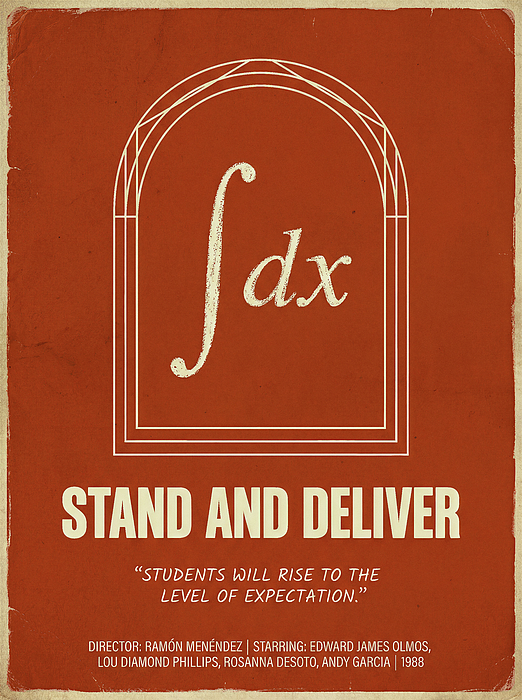
Stand and Deliver · Dir. Ramón Menéndez · USA, 1988 · abakcus.com