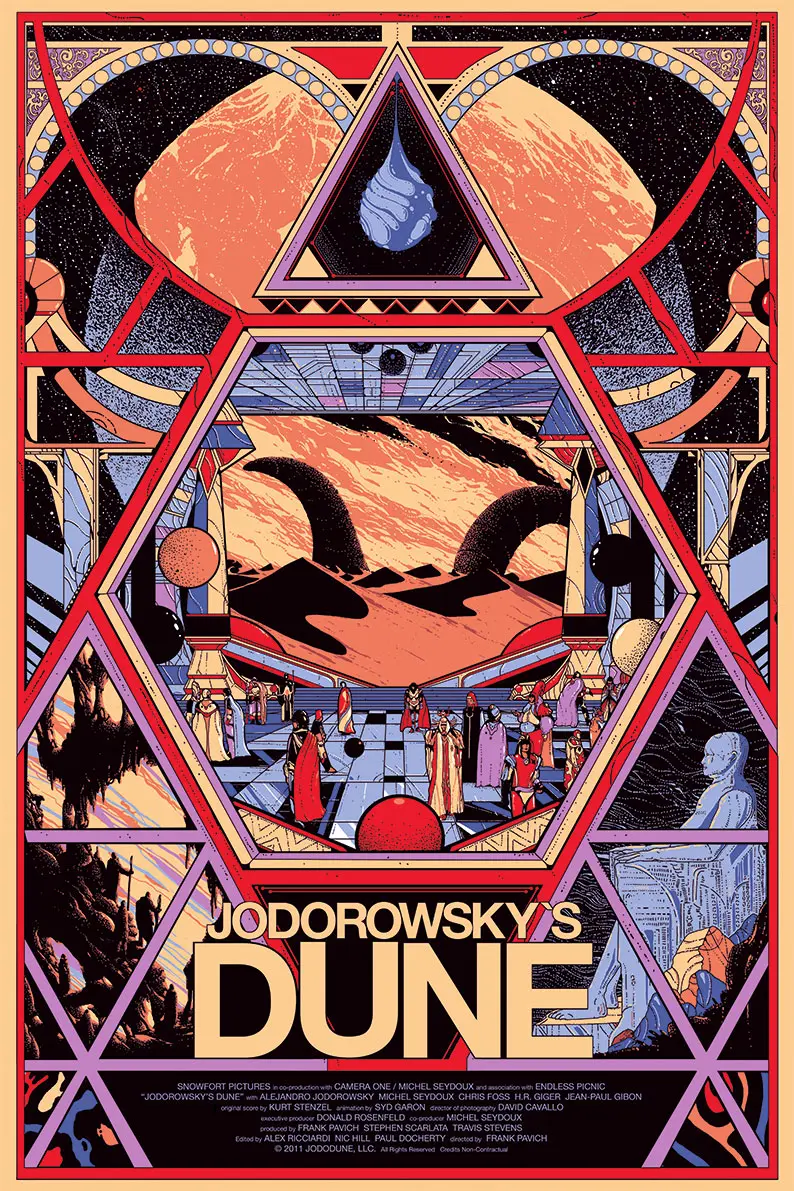
n 1974, Alejandro Jodorowsky set out to adapt Frank Herbert's Dune for the screen. The Chilean-French director behind El Topo and The Holy Mountain believed a film was not a technical project. It was a ritual — one that would transform its audience the way a powerful drug transforms the mind, without any drug involved.
He set himself a single rule: work only with the greatest artists alive. Then he went and found them, one by one. He sent no scripts through agents, made no phone calls to studios. He knocked on doors.
He visited Salvador Dalí at his Paris hotel and convinced him to join — for $100,000 per day of shooting. He took Orson Welles to his favorite restaurant and talked him into playing Baron Harkonnen over dinner. He found Pink Floyd in their studio and walked out with their commitment to the score. He traveled to H.R. Giger's workshop, where the Swiss artist had spent years accumulating dark, biomechanical imagery with nowhere to put it. And he recruited Jean Giraud — known to the world as Moebius — who would draw every frame of a film that had not yet been written.
“I wanted warriors. Spiritual warriors. People who had changed their minds.”
Alejandro Jodorowsky
When his son Brontis was nine years old, Jodorowsky began preparing him for the role of Paul Atreides. Every day, for five years, the boy trained in martial arts and yoga. This was before a single frame had been filmed. Before anyone had agreed to finance the project. Five years of preparation for a film that had no guarantee of ever existing.
What do you call that, if not obsession? The same quality that makes Good Will Hunting feel urgent — genius pursued past every reasonable stopping point — runs through this story at a scale Hollywood had never seen.
The assembled team
Jean Giraud (Moebius)
Visual design, storyboards
H.R. Giger
Harkonnen world design
Pink Floyd
Score
Salvador Dalí
The Emperor
Orson Welles
Baron Harkonnen
Chris Foss
Spacecraft design
The book and its end
Over two years of pre-production, Moebius drew every scene, every character, every detail. The result was a storyboard book of more than 3,000 pages. Jodorowsky had a handful of copies printed and carried them to Hollywood, looking for a studio willing to finance the film.
Hollywood said no. The budget was too large, the project too strange, the director too unpredictable. Jodorowsky's Dune was never shot.
Today, only two copies of that book are known to survive. One belongs to Jodorowsky himself. The drawings share something with Henry Billingsley's pop-up Euclid and Alejandro Guijarro's photographed blackboards: knowledge made visible before it has anywhere to go.
The anatomy of an invisible influence
Frank Pavich's 2013 documentary tells the story of how the project came together and fell apart. But the more interesting question is this: how does an unfilmed movie become one of the most influential works in science fiction?
The answer lies in those storyboard books. The Hollywood studios that passed on the project didn't return them. They sat on shelves. The visual team behind Star Wars saw them. The crew developing Alien saw them — and H.R. Giger, who had spent two years designing Harkonnen's world, channeled everything into that film. Moebius's drawings became the visual grammar of an entire generation of French science fiction. Chris Foss's spacecraft shapes turned up everywhere.
A film that was never made managed to infiltrate the DNA of dozens of films that were. If you want another portrait of how a single image can outlive its maker's original plan, Taming the Garden does something similar on a different scale — a tree on a barge, crossing water it never chose.
An unfilmed movie found its way into the bones of science fiction cinema anyway.
Pavich's documentary makes this visible. Animated storyboards, archival photographs, and long interviews with Jodorowsky — now in his eighties, still electric with enthusiasm — add up to something rare: a portrait of failure that feels like triumph. It belongs on any shelf of films worth watching carefully, alongside our list of beautiful math and science documentaries and the tighter craft of Los Cronocrímenes.
At one point in the film, Jodorowsky looks into the camera and says he never felt any regret. The project happened. Just not on a screen. That line has the same quiet force as Feynman's ode to a flower: understanding does not subtract from wonder. It multiplies it.
↗ Watch the documentaryJodorowsky's Dune — Frank Pavich (2013)Jodorowsky's Dune (2013), dir. Frank Pavich · Sony Pictures Classics · Trailer: YouTube · abakcus.com