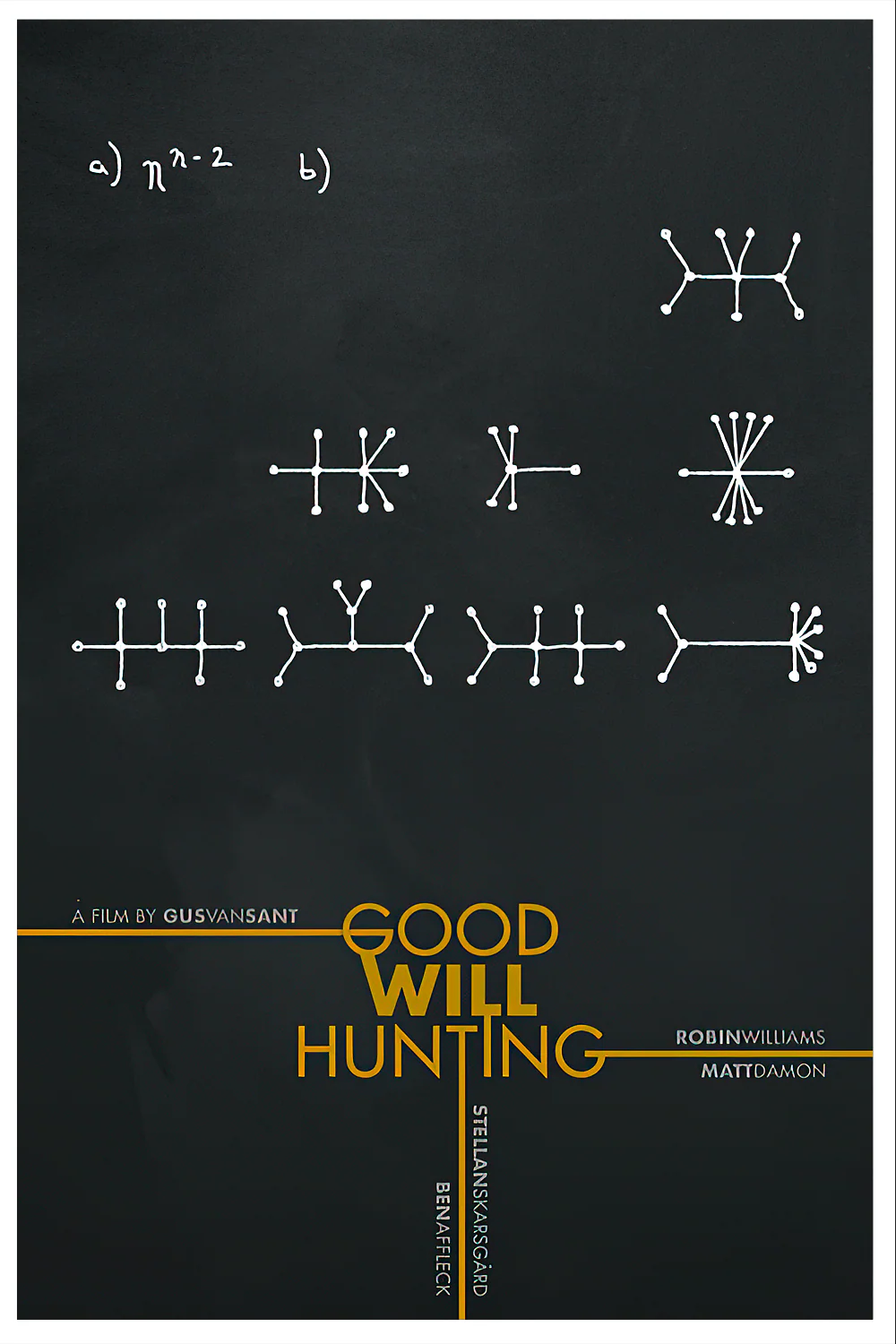
he problem is written on a blackboard in the hallway at MIT. Professor Gerald Lambeau posts it there — something from algebraic graph theory — as a challenge to his graduate students. He expects it to take them a semester. It takes an anonymous janitor about five minutes. Will Hunting mops the floors at one of the most selective universities in the world and solves research-level mathematics in secret, on his lunch break, in chalk, on a wall.
The setup of Good Will Hunting is, on its face, a fantasy — the hidden genius revealed by a single audacious act. But the film isn't really interested in the mathematics. MIT's entrance exams have always been predicated on the idea that mathematical ability can be identified and cultivated. The film asks a harder question: what do you do when that ability is present but the person carrying it has no interest in being cultivated?
Will Hunting grew up in South Boston, moved through foster homes, and has a criminal record. Lambeau finds him, arranges to keep him out of prison on condition that he work on mathematics and see a therapist. The therapist — Sean Maguire, played by Robin Williams — is also from Southie. He is the only person in the film who doesn't want anything from Will. He's not trying to redirect talent. He's trying to reach a person.
The mathematics is never the point. It's the proof of something the film wants to say about what we do with people who fall outside the systems we've built to accommodate them.
The screenplay, written by Damon and Affleck when they were in their mid-twenties, won the Academy Award for Best Original Screenplay. It's worth noting what's in it: not a single scene where Will actually struggles with a math problem. He never has to work. The problems are trivial to him, the way breathing is trivial. The struggle is everything else — connection, trust, leaving, the version of safety that looks like staying in South Boston forever. The film understands that mathematical talent solves precisely none of those problems.
Robin Williams won the Academy Award for Best Supporting Actor for his portrayal of Sean Maguire. It's a quiet performance — most of it is listening. The famous scene on the bench in the Public Garden, where Maguire tells Will "it's not your fault," and repeats it, and watches something collapse — is not about mathematics at all. It's about what happens when someone is confronted with unconditional acknowledgment for the first time. The film earns that scene because it has spent ninety minutes establishing why Will would resist it.
Maguire's method is not technique. He doesn't use a system. The Feynman Technique is built around the idea that you can teach yourself anything by explaining it simply. Maguire works from a different direction entirely: the thing Will needs to learn cannot be written down, cannot be explained, and definitely cannot be self-taught. It requires another person. That's the film's actual argument.
Gus Van Sant directs the film with very little visible style, which is the right decision. The screenplay is so dense with character that any directorial imposition would have smothered it. The camera watches. The light is flat and real — South Boston in winter looks like South Boston in winter. The hallways at MIT look like hallways. The film doesn't romanticize the academy or the neighborhood. Both are just places Will moves through.
The blackboard problem Lambeau posts is not fictional. It's drawn from a real branch of combinatorics — specifically from the theory of graph homeomorphisms and adjacency matrices. The film underplays this detail deliberately. What matters is not what the problem is, but that Will solves it without being asked, without an audience, and without signing his name. The anonymity is the tell: Will wants the problem solved more than he wants credit for solving it.
This is the same quality that makes the film worth watching twice. Feynman's argument about math education — that the pleasure of the subject is intrinsic and not dependent on recognition — is something Will already knows. His problem with mathematics is not that it's difficult. His problem is that doing it publicly hands him over to institutions he doesn't trust: universities, government programs, research careers. The choice not to perform is its own kind of statement.
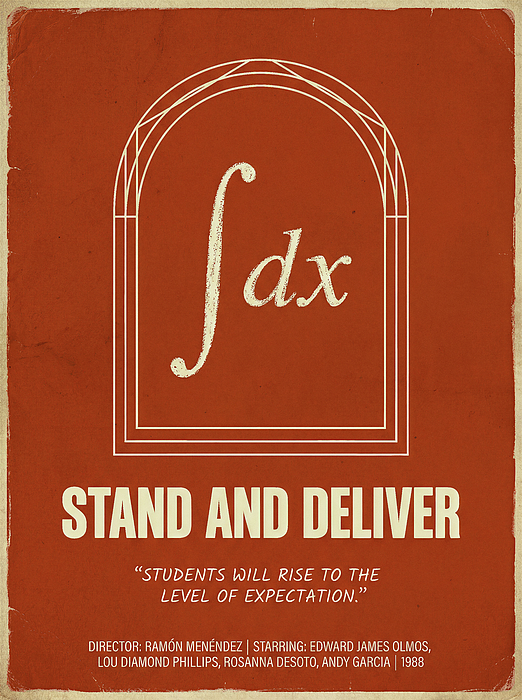
Compare this to the students in Stand and Deliver: Escalante's class wanted in, and the institution's first response was suspicion. Will is already in — Lambeau is handing him the door — and his first response is disinterest. Both films are about the gap between what the institution offers and what the person actually needs. They just approach from opposite sides of the gate.
“You wasted all those years trying to be angry at me. I think you've been angry at yourself.” — Sean Maguire
The film ends without resolving the mathematical question. Lambeau doesn't get his prodigy. The government agency doesn't get its analyst. Will drives to California to find a girl. It's the correct ending — not triumphant, not tragic, just human. The last thing we see is an empty apartment and a note that says I had to go see about a girl. Two thousand miles of highway. No chalkboard at the other end.
¹ Damon and Affleck originally wrote the script as a spec thriller — Will was recruited by the NSA, and the tone was considerably darker. The version that reached Gus Van Sant had been rewritten several times. Rob Reiner and Castle Rock pushed for a version focused entirely on the psychological relationship, which ultimately won out.
² The film was made for approximately $10 million and grossed $225 million worldwide. It launched both Damon and Affleck as major film actors and produced one of the most quoted speeches in American cinema history — the "it's not your fault" scene, which Williams improvised in part.
In short
A film about mathematics that is entirely uninterested in mathematics. It uses genius as a premise and then spends two hours asking what on earth you're supposed to do with one — and who gets to decide.
Also on Abakcus
For the film that puts math on trial from the other direction — students who work hard and are assumed to be cheating — see Stand and Deliver. And if you want to read what self-teaching actually looks like as a practice, Calculus Made Easy — Silvanus Thompson's 1910 book, free online and in print on Amazon — is the closest thing to what Will Hunting is presumably doing alone in his apartment at night.