The premise takes about five seconds to understand and considerably longer to absorb. Two men, filmed from directly above, sweep debris across a bare floor. One pile moves every minute. The other moves every hour. Together they trace the hands of a clock. The video runs for exactly twelve hours — one full revolution of an analog clock face — and the piece functions as a working timepiece. If you know when it started, you can read the time from the position of the sweepers. That is all it does. That, it turns out, is enough.
Sweeper's Clock was first shown in April 2009 at the Salone del Mobile in Milan, as part of Dutch designer Maarten Baas's Real Time series. It arrived alongside two other pieces: Analog Digital Clock, in which a person behind a translucent screen paints a digital display by hand, erasing and redrawing each digit as the minutes change; and Grandfather Clock, in which a man hidden inside an antique clock case manually paints the hands. The three works were presented together, each making the same point from a different angle.1
What You Are Actually Watching
The mechanics are worth understanding precisely. The two men were filmed sweeping rubbish in an otherwise vacant space, one pile advancing every minute and the other every hour. The filming took twelve hours — a full working day. Portions of the depiction were completed using CGI after the sweepers' motions were filmed separately and repeated to fill out the complete twelve-hour cycle.2
The overhead camera angle is not incidental. From that perspective, the floor becomes an abstract plane — a clock face stripped of numbers and markings. The sweepers become the hands, their brooms the mechanism. The debris they push is not waste in the usual sense: it is the material from which time is being made visible. Each drawn or swept minute is unique and reflects the character of its performer. Every minute becomes more valuable and meaningful when the marking of time involves the precious time of different individuals. The same visual trick — turning motion into readable structure — is what makes Tomohiro Okazaki's matchstick study so compelling.
720
minutes. The length of the video, exactly. Each one distinct — the sweepers' movements vary slightly with fatigue, attention, posture. No two minutes in the piece are identical. A mechanical clock repeats the same motion 720 times in twelve hours. These sweepers do not.
The Real Time Series
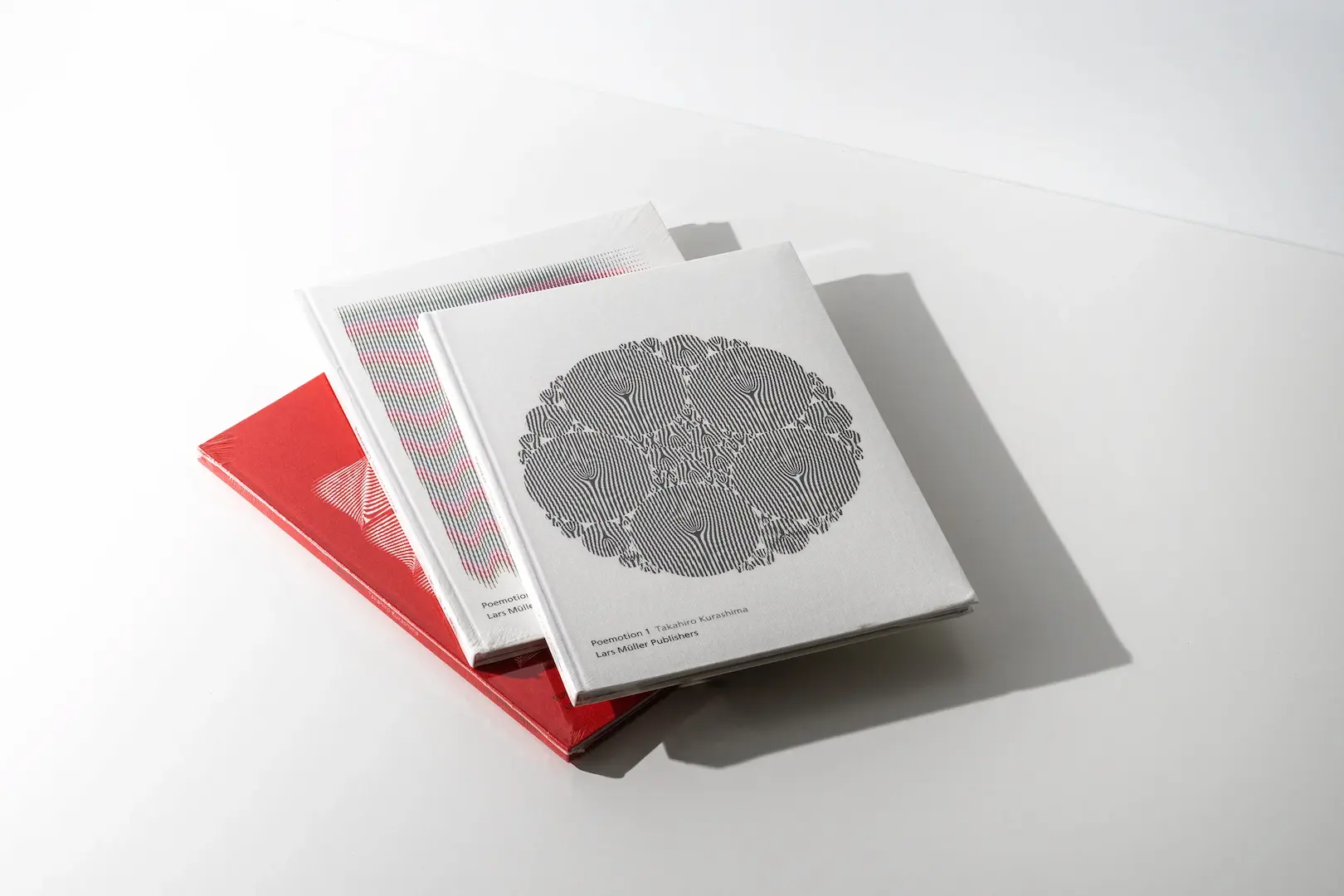
Sweeper's Clock belongs to a series that Baas has been developing since 2009 and continues to expand. Each piece in the series works on the same principle: human performance replaces mechanical function, and the result is a clock that actually tells time while asking what telling time means. In a different medium, the same logic of hidden movement made visible appears in Poemotion and in Kung Fu Motion Visualization.
Sweeper's Clock
2009
Two men sweep debris into clock hands. Filmed overhead, 12 hours. MoMA collection.
Analog Digital Clock
2009
A person behind a translucent screen hand-paints a digital display, erasing and redrawing each minute.
Grandfather Clock
2009
A man concealed inside an antique clock case paints the hands by hand. Also known as Self Portrait Clock.
Schiphol Clock
2016
A 3-meter installation at Amsterdam Airport. A man in blue overalls repaints the minute hand every 60 seconds.
The Schiphol Clock — a permanent installation in Lounge 2 at Amsterdam's Schiphol Airport, seen by millions of travelers each year — brought the series its widest audience. The man's blue overalls, yellow rag and red bucket pay a subtle homage to Piet Mondrian and Gerrit Rietveld. That detail — a working airport clock secretly encoding a reference to De Stijl — is characteristic of how Baas layers meaning. The surface is functional. Everything underneath it is a question. If you like this kind of form/function tension, it connects naturally to Dieckmann's metal tube chair and The Geometry of Type.
Maarten Baas: Between Art and Design
Baas was born in West Germany in 1978 and trained at the Design Academy Eindhoven, one of the most conceptually oriented design schools in Europe. He became widely known in 2002 when his graduation project — charred and resin-coated furniture from existing design classics, called Smoke — sold immediately at a gallery in Milan and announced a designer who was less interested in solving problems than in posing them.3
Baas operates in the space between art and design. The Real Time series sits squarely in that space. It is design because it produces functional objects — the pieces keep accurate time. It is art because the function is the least interesting thing about them. What they produce, beyond the readout, is attention to what keeping time costs.
The works take a step away from mechanization and automation, and from the identical, mass-produced household object.
— Malva Museum, on the Real Time series
What the Clock Is Actually Saying
Every clock is an argument about what time is. The mechanical clock argues that time is regular, divisible, and indifferent to the observer — each second identical to the last. The digital clock makes the same argument more bluntly: time is a number. It increments. That is all. For another piece where rhythm and physical law overpower intuition, see Cymatics: Sound Has a Shape.
Baas's clocks make a different argument. In Sweeper's Clock, time is produced by human effort. It costs something. Two men spend a working day marking each minute of half a day, and their labor is not hidden inside a mechanism — it is the mechanism. The fatigue in posture at the tenth hour is visible in the less precise arc. The clock is accurate, but it carries evidence of the work that made it accurate.
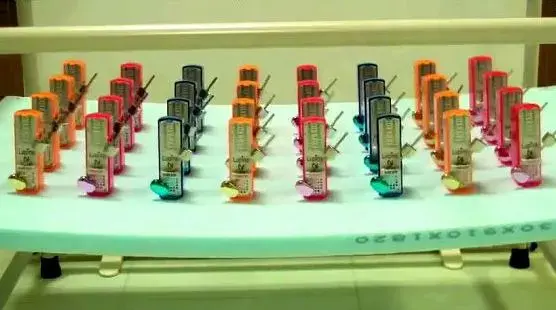
There is a second argument embedded in the overhead framing. Clocks are usually read from in front. The aerial view puts the viewer above the work, looking down at the sweepers as if they were the mechanism of a movement you had opened. The clock is transparent. You can see exactly how it works. For systems where order emerges from repeated micro-adjustments, compare with 32 Metronomes and the Strange Sympathy. For slow, deliberate temporal attention, see A Drawing That Erases Itself.
Where the Work Lives
Sweeper's Clock entered the MoMA collection in 2011, donated by Baas himself — catalogued as a video, duration 720 minutes, gift of the designer.4It is also held by the Art Institute of Chicago and has been installed in public spaces including Erasmus Medical Center in Rotterdam and the facade of the Malski building in Lahti, Finland.
- →Museum of Modern Art (MoMA) — New York. Gift of the designer, 2011. Catalogue no. 764.2011.
- →Art Institute of Chicago — Chicago. Permanent collection.
- →Malva Museum / Malski building — Lahti, Finland. Public installation, facade of Päijänteenkatu 9.
- →Erasmus MC — Rotterdam. Installed in the main waiting area, ground floor.
- →Schiphol Airport — Amsterdam. Lounge 2. Permanent installation of the related Schiphol Clock, 2016.
The public installations are worth pausing on. A hospital waiting room is one of the places where time weighs most heavily — where the distance between one minute and the next can feel enormous. Placing a clock that visibly costs human effort in that room does not make waiting easier. It makes the minute more present. That same shift in perception appears in Ode to a Flower, where attention itself becomes the subject.
I was completely mesmerized. I was standing in the middle of the waiting area on the ground floor of a hospital, staring at a clock.
— Visitor, Erasmus MC, Rotterdam
Sources
- 1. Maarten Baas, Real Time — Public Works. Official artist website. First presentation at Salone del Mobile, April 2009.
- 2. Wikipedia, Real Time (art series). CGI completion of repeated motions across the 12-hour cycle.
- 3. Wikipedia, Maarten Baas. Design Academy Eindhoven background and the Smoke series.
- 4. MoMA, Maarten Baas. Sweeper's Clock. 2009. Video, 720:00 min. Gift of the designer.
- 5. Malva Museum, Lahti. Real Time Sweepers Clock. Public art installation, Päijänteenkatu.
- 6. The Kid Should See This, Schiphol Clock: Painting and erasing a clock in real-time.
- 7. Related piece on time-reading language systems: Literature Clock.
- 8. Related piece on educational math framing: Feynman and Math Education.