he video ends and the garden is gone. Not archived, not photographed for a portfolio, not preserved behind glass — gone, raked smooth, returned to a blank field of white sand ready for the next pattern. Whatever Yuki Kawae spent hours drawing with a small rake across a coffee-table-sized box in his Bay Area apartment is already gone by the time you finish watching it. This is not an oversight. It is the whole argument.
Kawae is a designer by training, and his Zen garden practice began in 2019 as a personal answer to a professional problem. He was, as he described it later, overwhelmed by tasks and expectations — the grinding arithmetic of daily life in which everything is either urgent or overdue. He turned to gardening first, the larger outdoor kind: pruning, watering, repotting. And then he noticed something. While his hands were in the soil, the calculations stopped. Not paused, not muted — stopped. He had found the off switch, and it was made of dirt.
Each video requires hours of work before a single frame is filmed: conceptual planning, rake design and production, pattern practice, revisions. What you watch in 23 minutes represents a process that may have taken an entire day.
Without outdoor space for a garden, he built a sand garden instead — a shallow wooden box, a set of small rakes of his own design, a bag of fine white sand. The scale is domestic, almost absurdly so: this is an object that fits on a coffee table, in an apartment, in a city full of coffee tables. But the practice that emerged from it is not domestic at all. Kawae composes patterns with the attention of someone working at full size — circles that ring small stones, lines that cross and generate new shapes at their intersections, fractals that build outward from a single groove in the sand. Each movement is committed. There is no undo.
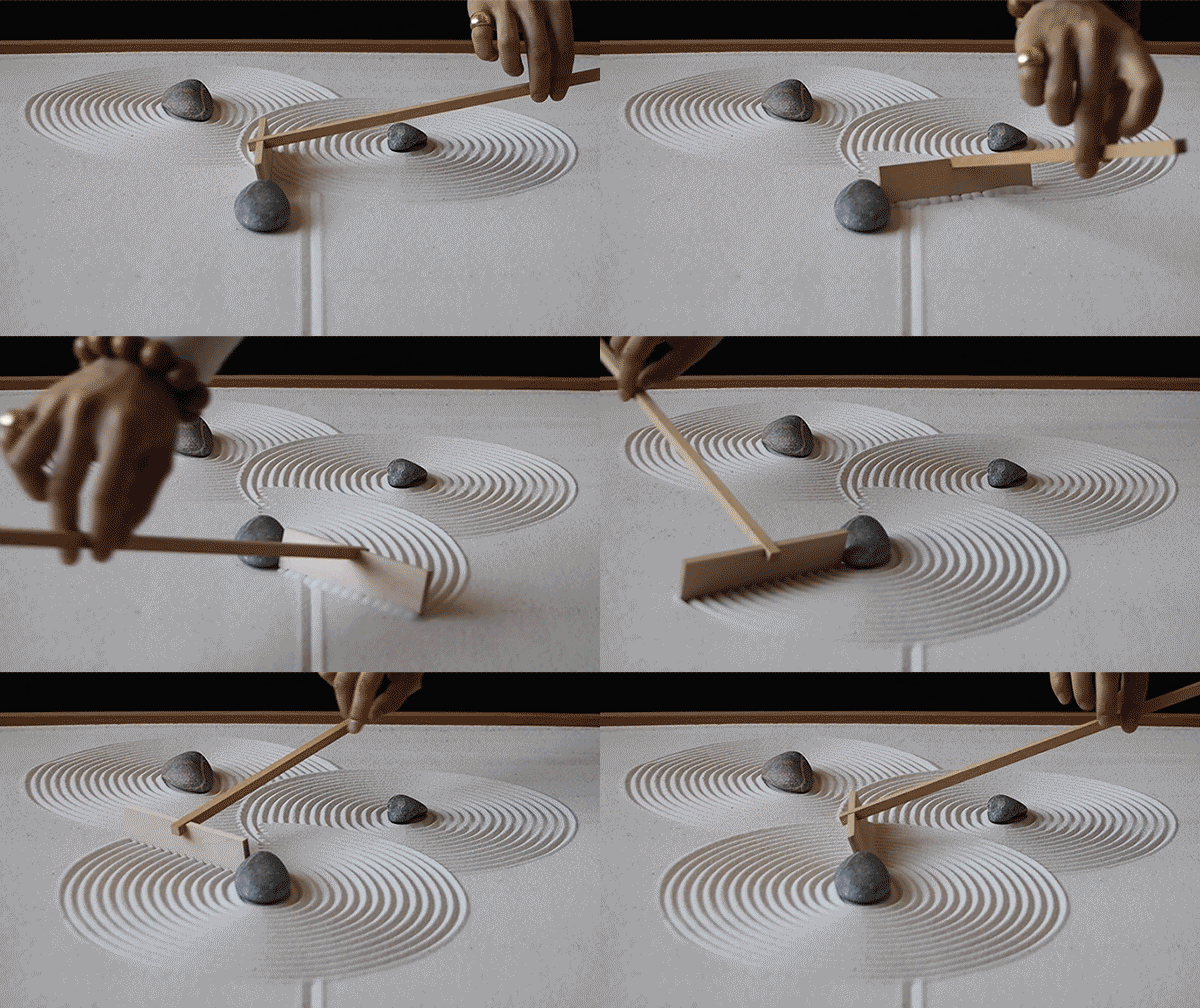
Each rake pass is a committed decision — no undo in sand
“All the zen garden patterns are not permanent, and they get erased to start a new one. It is temporary like many things in life.”
Yuki Kawae
The 23-minute video above is not a tutorial. There is no narration, no on-screen text, no explanation of technique. You watch a rake move through sand. That is the entire content. The effect — which is real, and reproducible, and confirmed by the 3-hour-and-40-minute version that exists for people who want more of it — is something close to the experience Kawae describes: the calculations slow down. You stop tallying. The rake moves, the pattern grows, and the part of your brain that was tabulating unfinished tasks finds it has nothing left to tabulate. The same quality appears in stop-motion work that demands total presence — the medium forces the mind into the moment.
On the 3-Hour Version
There is a version of this video that runs for three hours and forty minutes. It exists because people asked for it — because 23 minutes was not always enough. This is worth sitting with for a moment: there is an audience, apparently large enough to justify the production, for which watching a rake move through sand for nearly four hours is a reasonable use of an afternoon.
This says something about the video. It also says something about the afternoons.
Extended version · 3 hours 40 min
Kawae has spoken about what the practice taught him: that most of what feels permanent is not, and that most of what feels urgent shares that quality with the pattern in the sand — compelling while it exists, irrelevant once it's smoothed away. This is not a new observation. Buddhist thought has been making it for two and a half thousand years. What Kawae adds is a proof of concept at coffee-table scale: a sand garden that fits in an apartment, a rake you can hold in one hand, and a practice that requires nothing except the willingness to draw something you will immediately erase. It sits in the same tradition as art made with the assumption of its own disappearance.
The patterns themselves are not incidental. Kawae approaches them as a designer: there is planning before the rake touches the sand, there are revisions when a line goes wrong, there is a visual logic to how one shape generates the next. The work is precise without being rigid. The sand accepts the rake and gives back something the rake alone could not have predicted — a texture, a shadow, a small irregularity around a stone that becomes the most interesting part of the composition. Kawae says he often ends up with a completely different pattern than the one he intended. He seems to consider this a feature. Which is another way of saying that the process overrides the plan — and that sometimes this is the only honest way to work.