here is a version of music that never reaches your ears. It lives in the sand on a metal plate, in the standing waves of vodka in a petri dish, in the momentarily frozen spiral of water from a garden hose. New Zealand musician Nigel Stanford spent months finding this version of music — not composing to it, but composing from it.
The result is Cymatics, a music video that reverses the usual relationship between sound and image. The images did not illustrate the music. The music was written to fit the images — or rather, to fit the physics that generated them. Most music videos are afterthoughts; Stanford's process was the opposite: identify the experiment, understand its physics, figure out which frequency produces the most interesting shape, then write a note for that frequency.
Musician: Nigel Stanford
Director: Shahir Daud
Album: Solar Echoes
Year: 2014
“The music was written last.”
Nigel Stanford
The Five Experiments
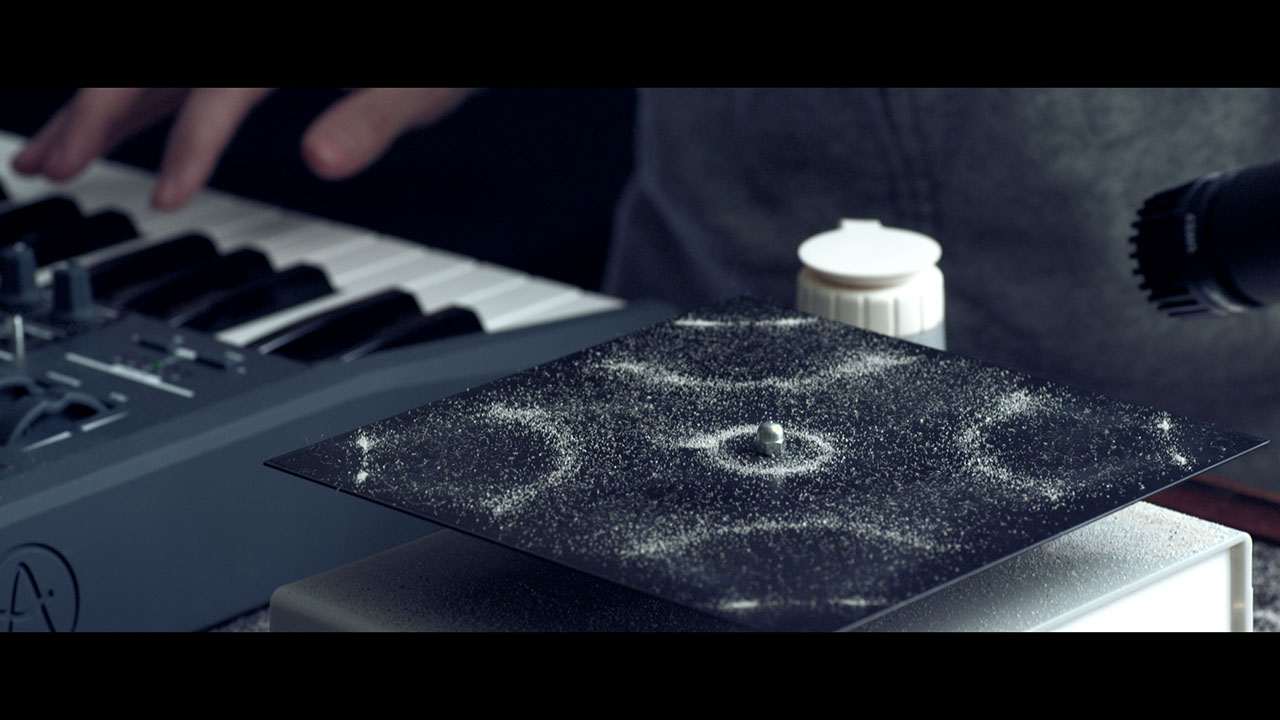
Sand scattered on a thin metal plate attached to a speaker migrates to the nodal lines — the places where the plate is not vibrating. The shapes are called Chladni figures, after Ernst Chladni who mapped them with a violin bow in 1787.
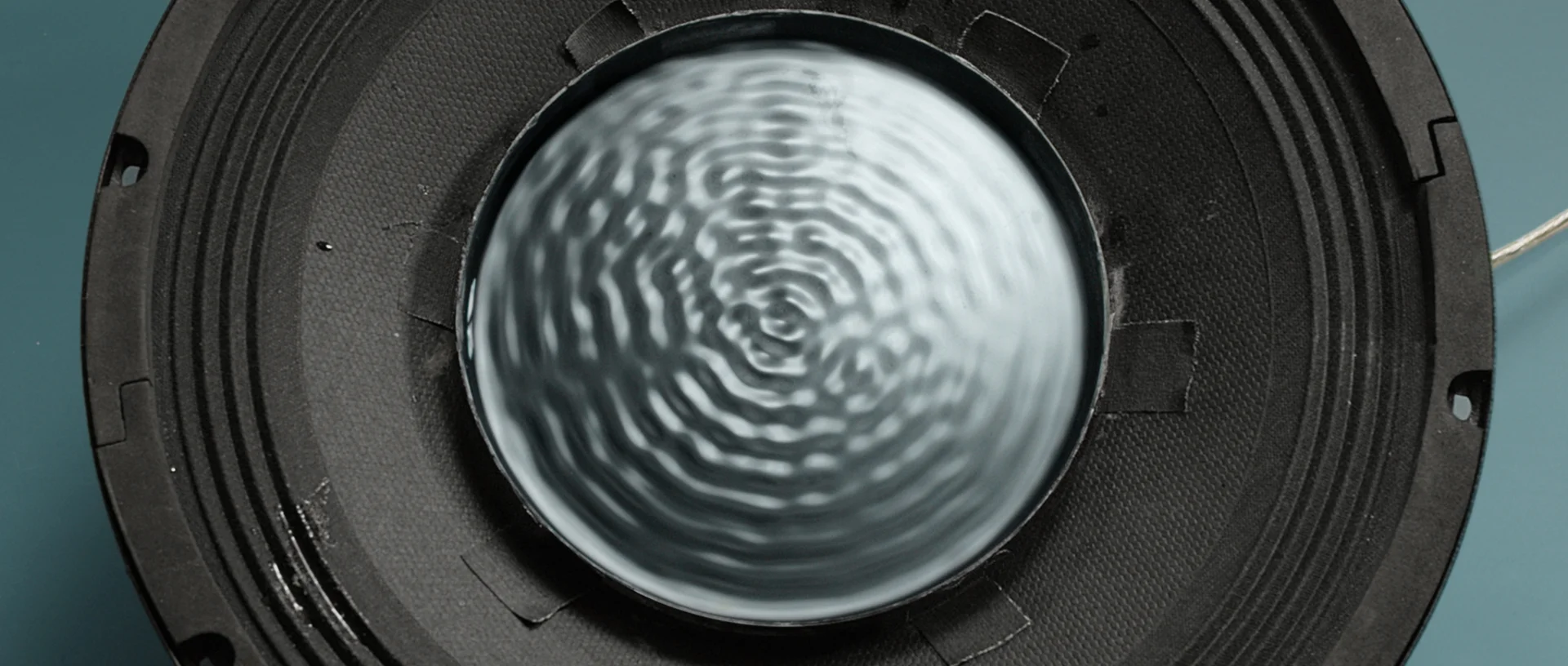
A petri dish filled with vodka is taped to a speaker. Low frequencies push the liquid into standing waves — interference patterns where peaks and troughs lock in place. Vodka rather than water: lower surface tension makes the patterns more pronounced.
A speaker drives water through a hose at a frequency matched to the camera's frame rate of 25 fps. The water appears to freeze — a spiral suspended in mid-fall. Nothing is slowed down. The stroboscopic illusion is doing all the work.
Magnetic ferrofluid poured into a tray, with three electromagnets underneath. Different keyboard notes switch one, two, or all three magnets on. The fluid spikes upward along field lines, forming spiny black crowns.
A metal tube filled with flammable gas, perforated along its length. Audio frequencies create pressure standing waves inside the tube; where pressure is high, flames burn low; where pressure is low, flames burn high — a visible cross-section of a sound wave, written in fire.
The word “cymatics” was coined by Hans Jenny, a Swiss physician who spent the 1960s photographing and filming the effects of vibration on liquids, powders, and pastes. The patterns he found were not decorative accidents — they are deterministic: a given frequency applied to a given medium in a given geometry will produce the same pattern every time. The shapes are solutions to the wave equation, made visible.
Toward the end of the video, Stanford puts on a chain mail suit and keeps working while a Tesla coil fires bolts of electricity at him. The suit is a Faraday cage — a conductive enclosure that routes current around, not through, the body inside. It is the same principle that protects aircraft from lightning. In the context of the video it reads as spectacle. In the context of the physics, it is just another demonstration: electromagnetic fields, like sound waves, can be shaped by the right material geometry.
What makes the video worth watching is not the spectacle — though the ferrofluid and the Tesla coil are genuinely striking — but the underlying claim that sound and geometry are not separate categories. A frequency is a number. A number, applied to physics, produces a shape. The shape can be beautiful. None of this requires mysticism; the wave equation is enough. The same instinct — that abstraction and beauty point at each other — drove Oliver Byrne to print Euclid in color in 1847.
In short
A music video where the physics wrote the music. Five experiments, five solutions to the wave equation — all made visible in sand, vodka, water, fire, and iron.
Nigel Stanford — Cymatics · Solar Echoes, 2014 · dir. Shahir Daud · abakcus.com